Search This Blog

Showing posts with label China. Show all posts

Friday, 5 August 2022

LEON CAZADOR - HIS LIFE

 On the occasion of the publication by Rough Edges Press of three novels featuring Leon Cazador, Private Eye – Rogue Prey, No Prisoners, and Organ Symphony, you will find below a brief biography of the character and a time-line for guidance 

LEON CAZADOR, P.I.

Brief biography

The world needs brave souls like Leon Cazador who is not afraid to bring the ungodly to justice and so help, in his own words, to hold back the encroaching night of unreason.

Leon was born on 16 February 1963 in Spain. He has an English mother (Julia), Spanish father (Paco), a married sister, Pilar, and an older brother, Juan, who is an officer in the Guardia Civil. Leon Cazador sometimes operates in disguise under several aliases, among them Carlos Ortiz Santos.

When he was twenty-one, rather than wait for conscription, he decided to jump and joined the Army, graduating as an Artillery Lieutenant. (Spain’s conscription didn’t cease until 2001). 

About a year later, he joined the Spanish Foreign Legion’s Special Operations Company (Bandera de operaciones especiales de la legión) and was trained in the United States at Fort Bragg, where he built up his considerable knowledge about clandestine activities and weapons. Some months afterwards, he was recruited into the CESID (Centro Superior de Informacion de la Defensa), which later became the CNI (Centro Nacional de Inteligencia). Unlike most Western democracies, Spain runs a single intelligence organization to combat both domestic and foreign threats. 

Part of his intelligence gathering entailed his transfer to the Spanish Embassy in Washington, D.C. There, he met several useful contacts in the intelligence community. 

At the close of the Soviet occupation of Afghanistan he embarked on a number of secret missions to that blighted land with CIA operatives. By the time the Soviet withdrawal was a reality, Leon was transferred to the Spanish Embassy in Tokyo, where he liaised with both intelligence and police organizations.  

Secret work followed in China, the Gulf and Yugoslavia. 

In 1987, Leon was attached to a secret section of MI6 to assist British operatives in Colombia. 

Although he has been decorated four times in theaters of conflict, reports imply that his bravery justifies at least three more medals. 

A year after witnessing the atrocity of the Twin Towers while stationed with the United Nations, he returned to civilian life and set up a private investigation firm. 

During periods of leave and while stationed in Spain, he had established a useful network of contacts in law enforcement, notably Captain Silvano Lopez of the Guardia Civil. 

One of his early cases resulted in him becoming financially set for life, so now he conducts his crusade against villains of all shades, and in the process attempts to save the unwary from the clutches of con-men, rogues and crooks.


Leon Cazador’s life timeline

(His age is shown in brackets)


1984 - Graduated as Artillery Lieutenant in Spain’s Army (21)

1985 – Joined Spanish Foreign Legion, Special Ops Co. (22)

1986 – Joined CESID (Later to become CNI, 2001) (23)

1987 – Spanish Embassy, Washington DC (24)

1987 – Secretly deployed in Afghanistan (Soviet withdrawal May/88-Feb/89) (24)

1988 – Spanish Embassy, Tokyo, Japan (liaising with intelligence and police re Yakuza) (25)

1989 – Secretly deployed in China, providing intelligence on the protests (Tiananmen Square) (26)

1990 – Gulf War special operations. Medal. (27)

1991 – Yugoslavia – special operation then aiding the UN peacekeeping forces. Medal.  (28)

1992-1993 – special ops during Bosnian War (NATO peacekeeping began 1995); wounded/escaped. (29-30) Medal.

1994 – Hospitalized. (31)

1995 – Spanish Embassy, London (32)

1997 – Attached to MI6 adjunct International Enterprises and deployed to Colombia to investigate the formation (in April) of the United Self-Defense Forces of Colombia. (33)

1998-1999 – secret operations in Kosovo, in preparation for NATO bombing campaign. Medal. (34-35)

2000 – United Nations secondment (36)

2001 – Witnesses 9/11 atrocity (37)

2002 – Leaves service. Returns to Spain and begins career as a private investigator. (38)

2003 – Relic Hunter case – now financially set for life to conduct his crusade against the ungodly (39)

2014 – Involved in Cat’s Crusade: Catalyst with Cat and Rick in Barcelona (51)

2015 – Attended wedding of Monica and Detective Francis Attard in Malta (52)

2017 – Working with FBI, Sister Cristina in Charleston, SC (December): see also Organ Symphony (54)

2018 – Involved in endangered species case: see Rogue Prey (June) (55)

2019 – Rogue Prey (July); recruits Carlota Diaz as PA; see also No Prisoners (September) (56)

2022 – The Organ Symphony case (August) (59)


Monday, 20 December 2021

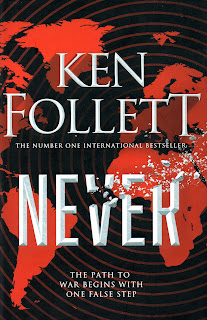
NEVER - Book review


Ken Follett’s 800-plus page novel Never (2021) is a warning: small differences of ideology and policy can evolve, step by unwitting step, into devastating global conflict.

The US President is Pauline Green, a wife and mother; she is a moderate unlike her political opponent, Senator James Moore, who is a hawk threatening to challenge Pauline for the Republican nomination.

Tamara Levit is a CIA agent attached to the Chad embassy; she’s working with Tab Sadoul, an attaché at the EU mission there.

Kiah is a widowed mother of Naji, a baby boy, and lives beside Lake Chad.

Abdul Haddad is an undercover CIA officer tracking a consignment of cocaine, which is presently hidden in a bus.

Chang Kai is Vice-Minister for International Intelligence in Beijing. Kai has useful contacts in North Korea and in the United States.

The CCP President is Chen, a moderate, a far cry from the present incumbent.

In several cases their lives will become interlinked; we get to know and feel concern for them as individuals.

Tamara is Abdul’s contact; she passes on information he obtains which is then used to close down insurgents’ camps through lethal force. Kiah joins a group of migrants on the smugglers’ bus, along with Abdul, and a friendship develops. Chad and neighbouring Sudan are at loggerheads. During an incursion an American corporal Ackerman.is killed. The weapons used by the insurgents were North Korean. Protests are made, to no avail. An assassination attempt is made on the president of Chad and reprisals result. And so it begins – tit-for-tat diplomacy, escalating gradually…

As usual with Follett, the book is a fast read. He and his consultants have amassed a great deal of insider information regarding the workings of both the US and Chinese political machines. There’s also action, bravery, political chicanery and betrayal.

The sections involving Abdul and Kiah, while interesting and suspense-filled, are secondary to the main thrust of the novel. They do provide a human dimension to the modern plague of people smuggling, however.

As evinced by the outbreak of the Wuhan virus, the Chinese government is reluctant to lose face, and this attitude could well have grave consequences for the world…

Editorial comment:

Thank heaven for an author who doesn’t write ‘she thought to herself’; instead we get, ‘she said to herself’ (p64). (Honestly, who else can you ‘think to’?)

While there’s no real confusion because the individuals are on different continents, one wonders why Follett chose Kiah and Kai for two character names. Generally, writers are advised not to use similar-sounding names (though even Tolkien slipped in Saruman and Sauron!)

Fatima asked Jadda: ‘How will we know what to do?’ (p164) This should be Kiah asking Jadda. Fatima knows this already, being in the system.

Wednesday, 11 November 2015

Writing – when to give up

I would imagine that from time to time every author hits metaphorical brick walls, perhaps when sales have not been as promising as hoped.

The ideas might still come along, but the take-up by new readers isn’t happening.

In the old days, this lack of or reduction of an audience meant that a good number of mid-list authors were ‘let go’. Some tried under different pen names, others soldiered on, slogging away at new variations, new styles even, and some might have succeed despite the earlier obstacles.

Now, with the advent of e-readers, and the minimal costs involved, old works can be resuscitated, while the one-time mid-list authors can write to their heart’s content, getting their books out there, even if their readership can be counted in the tens rather than the hundreds or thousands.

There’s an interesting blog from crime author Martin Edwards on this very subject, relating to crime writer Chris West who decided not to write any more crime fiction. I recommend it:


Maybe the favourable reviews of the newly released e-books will encourage him to return to a genre which seems to fit him rather well.

Saturday, 1 August 2015

Three Avenging Cats

I’m pleased to announce that Crooked Cat have accepted the next two books in the ‘Avenging Cat’ crime series, Catacomb and Cataclysm.

Now might be a good time to meet Cat – Catherine Vibrissae in the first book in the series (paperback or e-book):

CATALYST

Catalyst, a person that precipitates events.

That’s Catherine Vibrissae. Orphan. Chemist. Model. Avenging Cat.

She seeks revenge against Loup Malefice, the man responsible for the takeover of her father’s company. An accomplished climber, Cat is not averse to breaking and entering to confound her enemies. During her investigations, she crosses the path of Rick Barnes, a company lawyer, who seems to have his own agenda.

Ranging from south of England to the north-east, Wales and Barcelona, Cat’s quest for vengeance is implacable. But with the NCA hot on her tail, can she escape the clutches of sinister Zabala and whip-wielding Profesora Quesada?
 
Catacomb and Cataclysm will be published  in paperback and e-book format later this year:

CATACOMB

The Avenging Cat series #2

Catacomb, a subterranean cemetery: a place where ancient corpses are found – or new ones are dumped…

After their recent success in Barcelona, both Cat and Rick continue their vendetta against Loup Malefice and his global company, Cerberus, penetrating the lair of Petra Grimalkin in Nice.

But death stalks the pair, as do the dogs of law from the NCA, Basset and Pointer.

Cat’s trail of vengeance next leads to the Cerberus health food processing plant in the Maghreb…  She puts her skills to good use in Morocco where she again confronts the psychotic killer, Zabala.  From the exotic streets of Tangier to the inhospitable High Atlas Mountains, danger lurks and a deadly ambush awaits…
 
CATACLYSM

The Avenging Cat series #3
 
Some months after their adventure in Morocco, Catherine Vibrissae receives devastating news from Rick, news that will change her life.

Still determined to go to Shanghai to face down her arch enemy Malefice and end her vendetta once and for all, she thwarts an ambush by Cerberus head of security, Mr Soong.
 
But, to complicate matters, oligarch and people-smuggler Belofsky is in Shanghai with his own agenda.
 
While Cat plays cat-and-mouse with Soong, she uncovers a conspiracy that could lead to open conflict between China and Japan.

***

From Amazon COM here

From Amazon UK here

From Kobo here

From Smashwords here

Monday, 8 June 2015

Writing - 'The pen conveys...'

During my research for Cataclysm (set mostly in China [but also Tenerife, Madrid and Rome]), I discovered a few interesting quotations – none of which I’ve used in the book.

But they may be interesting to readers and writers – or not...

Certainly, the old fellow Anonymous has the most attributed to him; he must have been very busy.


***

Procrastination is the thief of time – Anonymous

 The cure of ignorance is study, as meat is that of hunger – Anonymous

The difficulty is not in reading books, but in applying the truths to life, and the greatest difficulty is in remembering them – Chang Chao

 
In making a candle we seek for light; in reading a book we seek for reason: light to illuminate a dark chamber, reason to enlighten a man’s heart – Anonymous


The pen conveys one’s meaning a thousand miles – Anonymous

It is more profitable to reread some old books than to read new ones, just as it is better to repair and add to an old temple than to build an entirely new one – Chang Chao

The benefit of reading varies directly with one’s experience in life. It is like looking at the moon. A young reader may be compared to one seeing the moon through a single crack, a middle-aged reader seems to see it from an enclosed courtyard, and an old man seems to see it from an open terrace, with a complete view of the entire field. – Chang Chao

And… a general quotation:

He who has never tasted the bitterness of life has never known the sweetness of it all – Anonymous


Friday, 23 January 2015

FFB - Nanjing 1937


Nanjing 1937 by Ye Zhaoyan was published in 1996; this edition 2003; translated from Chinese by Michael Berry.

Ding Wenyu, almost forty, is married and a womaniser; he’s a college professor proficient in English, French, German, Spanish, Italian and Romanian; his ‘legendary’ language abilities come in useful from time to time. When in his late teens he was banished to France as a result of a misguided pursuit of a young woman. In Paris he crossed paths with Ernest Hemingway, Vladimir Nabokov and Jorge Luis Borges, among others. Indeed, the book is deliberately scattered with name-dropping, notably the hierarchy of China at the time (there’s a helpful glossary of historical figures). Wenyu does not appear to be a likeable fellow, though he is amusing and his conceit in disavowing the mores of his times evokes sympathy.

Whether a fault of the translator, the editor (if any) or the author, the text is peppered with far too many clichés: ‘hold a candle’, ‘between a rock and a hard place’, ‘a piece of cake’, ‘the short end of the stick’ to list a few. As the book contains irony as well as humour, perhaps this is intentional. Besides humour, there are a few scenes of farce, too.

Wenyu’s life is changed when he beholds the younger sister of the girl he’d pursued twenty years earlier: At her wedding to a popular fighter pilot, Yuyuan captures Wenyu’s heart. He is smitten with ‘a kind of adoration of the utmost purity’. Unlike his encounters with married women and prostitutes, he does not lust after her. [Yuyuan is also an exotic garden in the Old City of Shanghai.]

‘In this world there are many mistakes committed due to a lack of love, but love has the power to purify. It can make someone forget themselves and all their inhibitions. Before he met Yuyuan, Ding was a pathetic orphan, lost in a desert without an oasis in sight… Orphans to love are stranded at an eternal impasse; to pursue a woman without love will never quell the loneliness in one’s heart. Love is humankind’s starting point and its final resting place.’

So, he becomes obsessed with Yuyuan. He writes love letters (not lewd or salacious, just full of praise) to her every day. Perhaps nowadays he would be arrested for stalking. ‘True love is based on giving and not taking. Only a love based on giving is true love.’ In the final event, he follows that dictum, giving of himself.

In parallel – deliberately – the author juxtaposes Wenyu’s pursuit of his love against the threat of Japanese invasion – both seeming leisurely in pace, though that same pace quickens towards the end. There are some interesting snippets about the military situation, for example: ‘According to intelligence reports at the time, the Japanese military’s primary future target was not China but Russia. Moreover, if the Japanese navy wanted to conquer the Pacific, a direct conflict with America would be inevitable….’

This is, just, a love story; the blurb calls it ‘epic’ but it isn’t. Its emotional punch is weakened by the omniscient point of view, so as a result the ending was disappointing.

Some critics have mentioned ‘explicit’ scenes and ‘raunchy sex scenes’; these are minor, and most of the sex (there isn’t much) is handled without graphic detail. There is one curious item regarding women without pubic hair being called ‘white tigers’; the legend has it that white tigers can harm men, so apparently many superstitious Chinese men will not bed a ‘white tiger’. Another minor though dubious incident involves an acquaintance of Wenyu indulging in necrophilia.

The book is enlightening about the culture and attitudes of the time in China. What comes across most forcefully is the universality of the human condition, irrespective of culture. In 1937 Nanjing there was a cult of personality; the rich and notable craved to be seen at events; divorce was considered a scandal but accepted; and young girls attempted to marry older rich men.

Hanging over the leisurely and sometimes farcical courting by Wenyu is the oppressive knowledge that Japanese forces would prevail and Nanjing would fall. The Chinese saying is perfectly apt: ‘If good fortune awaits there is no reason to hide – if disaster awaits there will be no place to hide.’

Saturday, 29 November 2014

Saturday Story - 'Hell for Leather'


Tiananmen Square - Wilipedia commons
 

HELL FOR LEATHER


Nik Morton


China, 1977


Keith Tyson shivered although he was wearing full survival gear. At least the cave in this godforsaken cliff offered him shelter from the icy winds coming off the Yellow Sea. But it wasn’t the cold; he was suffering from the after-effects of the drugs they’d pumped into him barely ten hours ago. 

It had been a simple enough mission. Flown out of South Korea, they’d dipped over the wave crests and under the radar, avoiding any aircraft sorties from the bases at Yantai, Tianjin and Qingdao. Parachute drop at the rendezvous point outside Zuzhou. As planned, he’d been met by a group of seven activists. Their English was rudimentary, so he spoke in Mandarin. They helped him with his disguise, though they couldn’t do much about his height, abnormal for most Chinese men. To compensate, he adopted a subservient stoop.

His mission was simple enough. The death of Zhou Enlai and Mao Tse-tung the previous year, followed by the end of the Cultural Revolution and demonstrations, suggested that perhaps the country was ripe for a people’s revolution that might even lead to democracy. It was Tyson’s job to organise the popular uprising against the government, before anyone could be nominated as top leader of the nation.

But someone in the activist group - an idealist, a hater of the West, or perhaps someone who wanted position, power, money or all three - had betrayed them. At his second arranged meeting in a basement in Shanghai, the Chinese military organised a raid and his small group was arrested. The suicide pill would have worked but he and his contacts were quickly gassed and the false tooth removed before he regained consciousness.
 
They would have been justified in secretly executing him without a trial. Certainly, they had no intention of parading him in front of the world press. There was already talk of the proposed new leader, Deng Xiaoping approaching the West, and in particular the United States, in a push for economic reform. This promise of Western finance was too precious to jeopardise over one spy. 

The Central External Liaison Department got its way and Tyson was handed over to this espionage system. They wanted to brainwash him, to learn about his contacts and his secret organisation. For many years, ‘Interprises’ had managed to stay separate to MI6, since its creator swore that MI6 leaked like a sieve.
 
Tyson had studied the methods employed during the Korean and Vietnam Wars. In the first few hours, he realised that they were very good at inflicting pain and demolishing self-belief and faith. Yet he discovered depths of will and strength he never knew he possessed.

To begin with, they set about him with the so-called softening-up process. Physical trauma combined with drugs tended to bear the best results in the quickest time, or so the manuals stated. Fortunately, he’d read those manuals and he was able to employ mind-games of his own which enabled him, up to a point, to combat the drugs and retain a sense of self. It was like fighting the influence of alcohol, only ten times more difficult.
 
They discovered nothing, but Tyson knew that he had to escape within the first twenty-four hours, before his body clock and senses were thoroughly disoriented, before he was so tired and hungry and hurt that his meagre defences would crumble.

Five times in the first day, his hands were tied behind his back with a leather strap and then they ducked his head in a bath of icy cold water until his lungs were fit to burst. He gasped for air and floundered, his hearing muzzy. Normally, they untied him and threw him into his stinking dank cell; but this last time they forgot. 

It seemed to take Tyson an age to work loose that leather strap.

When his plate of maggot-riddled rice was brought, he sat unmoving, hardly looking at the guard in his fatigues. But he was poised, every aching muscle in readiness to spring.

The guard made his mistake and turned to the cell door, keys in his hand.

Tyson sprang, looping the leather strap round the man’s neck, cutting off any cry of distress. 

When he was done, he checked the cell door and the corridor. All clear.

He exchanged his stained and torn clothing for the guard’s. The trousers were tight and too short and the tunic threatened to pop its buttons, but it would have to do.  He locked the dead guard inside and strode hurriedly down the passage and passed the interrogation room but didn’t give it a second glance. If he ever got out of here, he guessed that he’d suffer many sleepless nights reliving his time in that room. He climbed up a flight of stone steps.
 
Luck is everything, Tyson knew. Some people are blessed with plenty of it. His held. He located the Commandant’s offices on the third floor. There was only the one guard and he didn’t suspect anything until it was too late. Now Tyson was armed with a revolver and cartridges. He slipped into the office and soon found the safe behind a painting of Mao. It was an old model and, after a few moments, he opened the safe door. Inside he found an assortment of documents, an automatic pistol and some money. He identified what he wanted, however, a list of names of those suspects who planned demonstrations against the State. Destroying them would not accomplish anything, he knew, since there were bound to be copies. He thrust them inside his jacket. The analysts at Fenner House would be interested. If any survived the inevitable clampdown, then they might be worth contacting in the future.
 
Along another passage he located a changing room filled with clothing - an assortment of gear, including that appropriate for survival at sea. He picked out the biggest sizes and donned as much as he could wear.
 
Clinging to shadows, he descended to the cells, surprised the guards and released twenty-two prisoners. The breakout was a distraction to the establishment’s sentries and gave him precious time to make his way over the wall and along a little-used coastal track. Behind, the siren blared and gunfire echoed, the sounds snatched away by the growing wind-howl. He hoped some dissidents would get away.
 
About two hours later, he found his cache of equipment, hidden in the cliffs where he’d left it. Tyson switched on the beacon and shoved it inside his rucksack. Weak from the beatings and the drugs, his stomach rumbling, he trudged along the goat track cut into the cliffs.
 
He found the cave and sat hunched against the rock wall, shuddering while he forced chocolate into his mouth. He couldn’t taste it. He was seeing double now too. His fingers were numb. Frostbite, gangrene – no, it was the after-effects of the drugs.
 
‘Charabanc approaching bus-stop.’ The radio set up in front of him crackled and the phrase was repeated. Thank God. They’d been constantly monitoring since he penetrated China. His beacon meant he needed extraction fast.
 
Easing his aching body upright, he sought purchase from the cave wall and stood. Shuffling to the entrance, he saw two dots – no, that was his double vision. The conning tower of a conventional diesel submarine, just surfacing: the charabanc. Risky, ploughing through the Yellow Sea.
 
He slithered down the ragged rocks in front of the cave mouth. Gulls called raucously as they fled their cliff-side nests. He triggered the orange flare. A bigger risk.
 
A red flare shot into the night sky, its source about a mile south. The Chinese were still hunting him. Now it was a race against time.
 
Bracing himself, he stumbled into the surf that beat against the rocks. Spume frothed everywhere. At last, he spotted the rigid raider and two dark shapes in it, the wake glinting in the faint moonlight as help headed towards him.
 
The buoyant craft veered next to him, Tyson grabbed a rope handhold and for the first time since his escape he really thought he might make it. He scrambled up and over the side of the bobbing craft. ‘Let’s go!’ shouted a sailor. Then they headed back to the black monolith, the conning tower.
 
Not a moment too soon. Rifle fire sounded, echoing. Ineffectual.
 
Tyson didn’t remember getting inside or the boat submerging. He regained consciousness in a bunk bed. The smell of stale air and oil filled his nostrils. A medic leaned over Tyson, checking his eyeballs. ‘I’ll give you a shot to combat the drugs, sir.’
 
Two faces loomed out of the shadows but with a bit of concentration Tyson recognised it was only one man. Swann.  ‘Did you get anything, Keith?’
 
‘Here.’ He fished the sheets out of his jacket and handed over the names, a list of brave souls who might one day create an historic upheaval.
 
It was twelve years later before the demonstrations erupted in earnest, the pictures televised and beamed around the world. The Tiananmen Square massacre, resulting in hundreds of deaths at the hands of the military, signified a tragic episode in China’s history. In 1992 Deng restarted economic reforms.

***

This story has been gleaned from certain manuscripts provided by several secret agents who served in International Enterprises, an adjunct to the British Intelligence Service, in the 1970s. Swann and others are featured in the full-length adventures of psychic spy Tana Standish, beginning with the e-book The Prague Papers (Crooked Cat Publishing).
 
Please purchase from
Amazon UK here
Amazon COM here
 
'Hell for leather' Previously published in The New Coastal Press, 2010.
Copyright Nik Morton, 2014.

Note: This story was originally written in response to the writers' circle theme 'leather'...

Monday, 4 August 2014

Books – Crystal balls at the ready!


By 2018, a new consumer report predicts that e-books will be Britain’s favourite reading format. They’ll overtake the sale of paperbacks and hardbacks, according to PwC.

So, in the next four years the consumer e-book market is predicted to triple from £380m to more than £1bn.

Astonishingly, half the population of the UK is expected to own a tablet device of some kind by 2018. In that same period, sales of printed books are estimated to fall by a third, to £912m.

Yet it’s still positive for print book writers and buyers. Before 2013, the UK book market was in decline, but now it is predicted to be worth £1.9bn in 2018, which is a healthy balance sheet by all accounts...

Perhaps we should be looking to the east as China is predicted to become the world’s second largest book market in 2017, overtaking Japan and Germany, with the US the world’s number one book market with predicted revenue of $37bn.

[My apologies for the repetition of the word ‘predicted’ – who’d have foreseen that?]


Information gleaned from Writers’ News, August 2014 – www.writers-online.co.uk

Thursday, 30 January 2014

Year of the Horse

No, this isn’t about equestrianism or westerns, though it could be… Tonight, all round the world, Chinese will be wearing red and celebrating New Year. Currently, it’s the year of the snake. At midnight tonight, we’ll enter the year of the horse.


‘Seeing is easy, learning is hard’ – old Chinese proverb.

I might abhor the Chinese predilection for medicines that require powdered rhino horn and the slaughter of endangered species, but there is still much to admire in their ancient culture, their resilience in the face of a traumatic history, and their ability to innovate.

The Middle Kingdom, Zhongguo or Tschin or Da Qin – the People’s Republic of China is the third-largest nation in the world in land area and has the largest population. It has the longest continuously recorded history and has given the world some of the most significant scientific and technological inventions.

‘Everything in the past died yesterday; everything in the future was born today.’ – wisdom of Kung Fu master.
 
According to the world view of ancient China, the Middle Kingdom lay precisely below the centre of the firmament. The further you were from here, the lower in the cosmic hierarchy. The unfortunate people and cultures living on the dark peripheries of the earth were considered barbarians. Until more enlightened times, the westerners thought much the same about the far east.

‘In painting the tiger, you may delineate his skin but not his bones; in your acquaintance with a man, you may know his face but not his heart.’ - wisdom of Kung Fu master.

It was supposedly Napoleon who warned, ‘Let her sleep, for when she wakes, she will shake the world’, alluding to China. As we know, in recent years there’s been no doubt that China is wide awake, an already formidable power for the new millennium, intent on perhaps dominating world commerce. This is a remarkable transformation for such an ancient country that has historically focused inward.

‘Read a few more books and talk a little less.’ – Chang Chao.

Perhaps the dark days under Mao are now merely shadows in the past. It’s too early to say.

I’ll conclude with a jewel of a truism from the Inscription on the temple of Everlasting Harmony: ‘A gem is not polished without rubbing nor a man perfected without trials.’ I think this can be applied to real individuals, male and female, as well as characters in our fiction.

Happy New Year!
 
 
Write a western in 30 Days by Nik Morton (John Hunt Publishing)

 
Bullets for a Ballot by Nik Morton (BTAP Publishing)
 
Old Guns by Ross Morton (Robert Hale)


Thursday, 9 January 2014

China tackles illegal ivory trade


Torn from the pages of the New York Times - an article entitled ‘China Destroys 6 tons of ivory’ by Bettina Wassiner. [This is a shortened version].
Over the past five years or so, poaching of elephants has swelled to record numbers, and China’s been accused as the main culprit with its huge appetite for ivory.

On Monday (6 Jan), however, the Chinese authorities received widespread plaudits when, in a first for the country, they destroyed more than six tons of confiscated ivory ornaments and tusks in Dongguan, a city in the southern province of Guangdong, which is a major hub for the ivory trade.

The widely publicized event was attended by state officials, foreign diplomats and wildlife campaigners.

Cristián Samper, president and chief executive of the Wildlife Conservation Society: congratulated the Chinese government “for showing the world that elephant poaching and illegal ivory consumption is unacceptable. We are hopeful that this gesture shows that we can win the war against poaching and that elephants will once again flourish.”

Patrick Bergin, chief executive of the African Wildlife Foundation: “a courageous and critical first step by China to elevate the important issue of wildlife trafficking and elephant poaching among its citizens and around the world.”

Last November, the United States destroyed six tons of ivory. The Philippines, Kenya and Gabon have also destroyed stocks of ivory in their countries.

Rising affluence and more open trade links between China and the rest of the world have fuelled demand for scarce natural resources – anything from ivory to tortoises, shark fins and rosewood – over the past few years, wreaking havoc in many ecosystems and pushing many species to the brink.

The trade is lucrative. Raw ivory can fetch more than $1,000 a pound.

Perhaps the event in Dongguan will help hammer home the message: there’s no profit in slaughtering elephants.

But there’s still a long way to go. Those six-plus tons destroyed represent only a small part of China’s total ivory stockpile, estimated at about 45 tons. Hong Kong’s stash of confiscated ivory has swelled sharply, thanks to several large intercepts in recent years. If China were to destroy the remainder of its ivory stocks and lead the world by committing not to buying ivory in the future, the impact on the survival of African elephants would be immense.

And of course this doesn’t stem the tide of illegal trading in tiger bones and rhino horns for medicinal purposes…

Amazon co.uk Kindle may be purchased here

Blood of the Dragon Trees - a brief excerpt:
Thirty men constantly whittling and inscribing created a surprisingly loud noise inside the high-roofed warehouse. Dolores and Cipriano strode down the aisles of Chinese and Korean men. On her right was the production line for rendering ivory into hanko – small inscribed cylindrical seals.
            ‘Don’t you just love the intricate work of these guys?’ Cipriano said.
            ‘Yes, darling, they’re works of art. They’re given a good salary and we make millions. It’s called the art of making money. Everybody wins.’
            On their left was another production line, where elaborate figurines were being carved out of the ivory tusks of elephants.
            ‘I’ve got a shipment of walrus tusks coming in next month,’ Cipriano said. ‘They’ll fetch more than this, because they’re so rare.’
             At mention of ‘rare’, her brow darkened. ‘We must be careful, Cippi, dear. We’re becoming too successful.’
paperback may be purchased postfree worldwide here
 
Spanish Eye - a brief excerpt:
I shook off such heavy introspective thoughts and studied the photograph.
It showed a large boa constrictor, beautifully marked with cream, brown, tan and gray camouflage ovals and diamonds.
“That’s more like it!” I said enthusiastically. I’d played enough poker games to know that my face betrayed none of my true emotions.
Such exquisite skin belonged on the reptile, not on somebody’s feet or handbag. Still, I was being marginally unkind to Señor Perez whose business was finding expensive homes for exotic pets and not slaughtering endangered species for eye-catching fashion accessories.