Search This Blog

Showing posts with label Ken Follett. Show all posts

Sunday, 29 June 2025

A PLACE CALLED FREEDOM - Book review


Ken Follett’s novel A Place Called Freedom was published in 1995 and is a fascinating dive into history. 

The prologue or whatever (it’s untitled) is a conceit that we could do without; it mentions an iron neck-collar worn by slaves: ‘This man is the property of Sir George Jamisson of Fife, AD 1767’.

The book is broken into three parts: Scotland, London, Virginia.

Mack McAsh is a young miner in Fife; a slave to the mine owner, Sir George. ‘Life was hard for miners, but it was harder for their wives’ (p116). Mack speaks up about the injustice he and his fellows endure and is brutally punished: ‘... you have to understand that they don’t feel pain as we do’ (p132).

Lizzie Hallim used to play with Mack when they were bairns, but now they are worlds apart. She is attractive, indeed. ‘I can get a husband whenever I like. The problem is finding one I can put up with for more than half an hour’ (p14). Her mother needs Lizzie to make a match that will save their property and land since her father has died leaving much debt. The obvious answer is Jay Jamisson, son of Sir George...

This is a time of unrest in the colonies, Boston boycotting all British import, and even giving up tea!  This problem may also affect the lucrative business of transporting and selling seven-year slaves – criminals sent from England to the New World: ‘130 or 140 convicts packed into the hold shoulder-to-shoulder like fish in a basket’ (p44).

Anxious to have his freedom, Mack escapes the mines and finds himself in London, where he falls foul of the law – thanks to the intervention of the Jamissons. He faces the Westminster magistrate, Sir John Fielding. ‘Fielding was blind, but that did not hinder him in his work’ (p249).

Follett has done his research – as he always does. There’s a passage concerning ‘the Blind Beak’ Fielding in The Fatal Shore: A History of the Transportation of Convicts to Australia 1787-1868) (published in 1986) by Robert Hughes. Fielding, half-brother of Henry, was ‘able to identify3,000 different malefactors by their voices alone’ (ibid p26). Due to the American War of Independence, no more convicts were sent to the Americas, so the prison hulks of Britain were overflowing; the government therefore had to resort to transporting felons to Australia instead of to Virginia.

However, this story occurs before the First Fleet to the antipodes, before 1776 in fact. Jay and George Jamisson are classic villains. The fate of Lizzie and Mack are inevitably entwined.

The 567 pages fly by to a satisfactory ending.

Editorial comment:

‘I think to myself’ (p3) – ‘I think’ is adequate!

‘he thought to himself’ (p214). Enough said...

Monday, 6 November 2023

JACKDAWS - book review


The prolific Ken Follett’s Jackdaws was published in 2001. His output is varied and broad in theme and place and time. Here, he returns to the Second World War and spies – some twenty-three years after his WWII debut novel Eye of the Needle.

The story covers the nine days before D-Day, June 6, 1944. Twenty-eight-year-old Felicity 'Flick' Clairet, an SOE agent is leading a Resistance assault on a French chateau in the village of Sainte-Cecile, the German communications hub for the area. But it goes wrong and she and her French husband barely manage to escape. Some of their team are killed and others are captured.

The German interrogator is Colonel Dieter Franck who, while not enjoying inflicting pain on his victims, is good at it. The Germans are aware that an invasion is about to occur soon and that will entail the rising up of many Resistance cells. He is certain that if he can break the will of his captives, he can learn details about the various groups.

Flick returns to England and is given permission to try again to crack the chateau communications hub. She recruits the Jackdaws, a ‘dirty half-dozen’ – all-female team to infiltrate in place of the regular cleaners. Not all of them will survive...

This is a typical Follett page-turner with characters you soon come to know and care about. Even Franck evokes a measure of sympathy. The interrogators, the invaders, considered the SOE agents as terrorists. Both sides were ruthless. In these sensitive times perhaps some readers will find certain aspects of the violence depicted as distressing; yet this kind of thing – and worse – happened. I’ve read a number of nonfiction and fiction books about the SOE and Follett’s research seems very accurate – and never slows the pace.

If you want an involving fast read, this suspenseful thriller will fit the bill.

Editorial comment:

Blame the editor. On p312 a coded message mentions Friday 1 June. Yet on p315 we’re told that Friday is 2 June. Oops. [Hopefully it has been amended since my 2002 edition].


Thursday, 3 November 2022

EYE OF THE NEEDLE - Book review


Ken Follett’s debut novel Eye of the Needle (1978) is a fast-paced thriller which deservedly got him noticed – and was made into a film of the same name starring Donald Sutherland, Kate Nelligan and Christopher Cazenove.

Henry Faber (Sutherland) was a Nazi sleeper agent working for Canaris. His nickname is ‘The Needle’ as he uses a stiletto knife to kill. He is almost caught sending radio messages but manages to murder his landlady before she can give him away. He goes on the run, resorting to one of several aliases. 

At about the same time Lucy gets married to RAF pilot David Rose, who is due to join his squadron for his first flight in a Spitfire. Driving away on their honeymoon, they’re involved in a car crash.

Some three or so years later, Lucy is with David and their young son on Storm Island, virtually cut off  from the world and the war. Which is how David likes it, since he lost his legs in the crash and has become embittered. He no longer seems to love Lucy and she has become a drudge; if it wasn’t for David’s disability and her son, she might have left him. There is a sheep farmer at the other end of the island, with a radio transmitter.

At this time Faber has been ordered to investigate Patton’s troops who are supposedly poised to invade Calais. He penetrates the fake airfield and camp in Norfolk, complete with inflatable tanks and plywood aircraft. It’s an elaborate ruse to misdirect the Nazis, when the real landings will be in Normandy. He takes photos and then moves north to keep his rendezvous with a submarine in the North Sea.   

Hunting Faber is a spycatcher called Godliman, a recently recruited history professor, and his colleague Special Branch Inspector Fred Bloggs. Considering the communication limitations during wartime, they still manage to track Faber to the north.

While a sleeper, Faber met Godliman when they were both admiring a cathedral’s architecture. So Follett even then was interested in the subject – and of course that interest blossomed into his outstanding magnum opus The Pillars of the Earth (1989).

Faber steals a boat in an attempt to meet the U-boat. Unfortunately, a storm hits and he is washed ashore on Storm Island. Lucy takes him in and he provides her with a believable cover-story. Once he learns about it, Faber intends to use the radio transmitter to summon the U-boat. 

Follett convincingly portrays the frustration and despair of Lucy. David’s attitude virtually throws together Faber and Lucy – and a guilt-ridden passionate interlude follows. The claustrophobic atmosphere of the farmhouse combined with, the close proximity of a fit good-looking stranger, an attractive woman and an embittered cripple result in violence and death.

A tense page-turner that has not lost any of its appeal since publication.

If you’ve never read any Follett, this is a good place to start.


PS - It's rare to find a typo in Follett's books. Here's one, though: '... picked up her wristwatch from the door.' (p249) Should be 'door', of course. :)

Monday, 20 December 2021

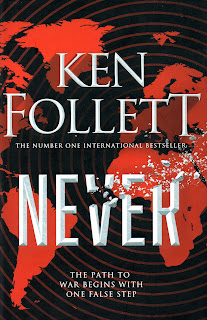
NEVER - Book review


Ken Follett’s 800-plus page novel Never (2021) is a warning: small differences of ideology and policy can evolve, step by unwitting step, into devastating global conflict.

The US President is Pauline Green, a wife and mother; she is a moderate unlike her political opponent, Senator James Moore, who is a hawk threatening to challenge Pauline for the Republican nomination.

Tamara Levit is a CIA agent attached to the Chad embassy; she’s working with Tab Sadoul, an attaché at the EU mission there.

Kiah is a widowed mother of Naji, a baby boy, and lives beside Lake Chad.

Abdul Haddad is an undercover CIA officer tracking a consignment of cocaine, which is presently hidden in a bus.

Chang Kai is Vice-Minister for International Intelligence in Beijing. Kai has useful contacts in North Korea and in the United States.

The CCP President is Chen, a moderate, a far cry from the present incumbent.

In several cases their lives will become interlinked; we get to know and feel concern for them as individuals.

Tamara is Abdul’s contact; she passes on information he obtains which is then used to close down insurgents’ camps through lethal force. Kiah joins a group of migrants on the smugglers’ bus, along with Abdul, and a friendship develops. Chad and neighbouring Sudan are at loggerheads. During an incursion an American corporal Ackerman.is killed. The weapons used by the insurgents were North Korean. Protests are made, to no avail. An assassination attempt is made on the president of Chad and reprisals result. And so it begins – tit-for-tat diplomacy, escalating gradually…

As usual with Follett, the book is a fast read. He and his consultants have amassed a great deal of insider information regarding the workings of both the US and Chinese political machines. There’s also action, bravery, political chicanery and betrayal.

The sections involving Abdul and Kiah, while interesting and suspense-filled, are secondary to the main thrust of the novel. They do provide a human dimension to the modern plague of people smuggling, however.

As evinced by the outbreak of the Wuhan virus, the Chinese government is reluctant to lose face, and this attitude could well have grave consequences for the world…

Editorial comment:

Thank heaven for an author who doesn’t write ‘she thought to herself’; instead we get, ‘she said to herself’ (p64). (Honestly, who else can you ‘think to’?)

While there’s no real confusion because the individuals are on different continents, one wonders why Follett chose Kiah and Kai for two character names. Generally, writers are advised not to use similar-sounding names (though even Tolkien slipped in Saruman and Sauron!)

Fatima asked Jadda: ‘How will we know what to do?’ (p164) This should be Kiah asking Jadda. Fatima knows this already, being in the system.

Wednesday, 6 January 2021

A Dangerous Fortune - Book review


 Ken Follett’s family saga, published in 1993, is yet another of his fast-paced satisfying historical novels; the 596 pages simply sped by.

Set in the period 1866 to 1892, the saga revolves around the Pilasters, a banking family. Young Hugh harks from the ‘unfortunate’ side of the family; his father committed suicide on being ruined in a financial collapse not of his making. Yet Hugh is bright and quick to learn, unlike Edward, his cousin, who is incompetent, cowardly and unimaginative. Also affected by the financial disaster is Maisie: her father loses his job, so she and her brother run away to save their parents from worrying about them.

The story begins at private boys’ school when an illicit absence of a small group turns into a drowning. Among those involved are Hugh, Edward and Micky Miranda. To cover up the tragic death and ostensibly protect Edward, Micky lies to Edward’s mother, the powerful attractive Augusta. Over the years Micky inveigles himself into the Pilaster family and once leaving college he is taken into the banking fraternity. Meanwhile, Hugh works his way up from a lowly position in the London bank.

Hugh meets and becomes enraptured by the wilful Maisie, who has grown into an enchanting woman desired by many men in London society. His brief liaison is discovered by Augusta and rather than he be exposed and bring scandal upon the family, she arranges for Hugh to be transferred to the American branch of the bank.

However, as the years pass, Hugh makes a success of his transfer and finally returns to London to acclaim from his seniors. Unfortunately, Micky has meanwhile been plotting to indulge his brigand of a father by arranging dubious loans to his country, Cordova in South America. Exposure of this scheme would ruin the bank and the Miranda family’s chances of a coup against the incumbent dictator. The stakes are raised.

All the characters are well drawn, and either evoke sympathy or anger as they contend with events out of their control. The period is shown in its finery, its sordidness, and the hypocrisy of the times. Some of the sex scenes might distress those of a ‘sensitive disposition’ but I believe they’re true to the period. Above all it’s a story of international finance, the establishment’s complicity in shady dealings, the betrayal of friends, the manipulation of weak men and women, multiple murder, and, above all, love and honour.

There are enough twists and turns in the plot to keep you reading to find out what happens next. I’ve yet to read a bad book by Ken Follett, and this is no exception.

Tuesday, 4 August 2015

Among good company!

The Book Depository entry for Catalyst shows ‘Other people who viewed this bought:’

and the selection of paperbacks purchased makes interesting reading in every sense!

Blood of the Dragon Trees – Nik Morton

Sudden Vengeance – Nik Morton

To Kill a Mockingbird – Harper Lee

The Martian – Andy Weir

The Girl on the Train – Paula Hawkins

Sharp Objects – Gillian Flynn

Vicious – V E Schwab

Edge of Eternity – Ken Follett

Ready Player One – Ernest Cline

Remember, books ordered from the Book Depository are POST FREE WORLDWIDE!


When I clicked on Blood of the Dragon Trees, I learned that viewers of that book had bought some of the above thrillers, plus Spanish Eye, I Let You Go, Speaking in Bones and Gone Girl… Interesting!


Monday, 15 December 2014

Blog guest - B.A. Morton - horror, crime and historical author

Continuing my infrequent blog guests of my namesake writers, today I’m pleased to welcome Babs Morton.  Babs lives in UK’s Northumberland National Park, an inspirational place indeed. She writes a crime series (Mrs Jones, Molly Brown), a historical series (Wildewood Chronicles), and standalone horror, Bedlam.

NM - Welcome, Babs. Glad you could drop by. I’ve just finished your thriller Mrs Jones and enjoyed it. I found the characters very engaging. The pace you set forced me to keep turning the pages.

I believe that a sense of place is important in fiction. To date, you have two detective books featuring Connolly, both set in New York; the characterisation, and the setting seem believable. Yet you’re British and live in the north-east of England. How did you achieve that semblance of reality?

B - Gosh, a vivid imagination, I guess. I’ve never been to the US, but I do watch a lot of movies ;)

NM - Are you drawn equally to crime, horror and historical novels, or do you have a preference?

B - I enjoy all genres. It really depends on where my head is when I’m in the mood for writing. I suppose if I was forced to choose, I’d say crime, psychological crime. I do love a twisted plot and a twisted character doesn’t go amiss either.

NM - As you’ve got two ongoing series at present, you’re obviously drawn to find out what happens next to your characters. Who is your favourite character from one of your books and why?

B - That’s difficult. I love them all for different reasons. Tommy Connell from Mrs Jones is a loveable rogue. He’s always going to do what’s right, but he’ll generally go about it the wrong way. If you met him, you’d likely want to knock some sense into him, but you’d like him and you’d trust him. He does have darker moments and things he’s not proud of, but by and large he’s a good guy. Probably my favourite character to create was Joe McNeil from Bedlam (which is also destined for a 3-book series). Joe has big issues, emotional and psychological, and the task was to get right in there with this totally messed up guy and create a situation where readers would root for a drunken, drug addled copper, and where they would care about what happened to him. Tommy Connell made me smile, Joe McNeil made me cry. Aw, bless them both.

NM - Where do you find inspiration?

B - Almost everywhere. An image, a snatch of conversation, anything really. I listen to music a lot when I’m writing. Mrs Jones popped into my head after listening to the song of the same name. Wildewood is more personal as the story is loosely based on the history of the valley where I live. My home was built on the foundations of a medieval chapel, and I have a great interest in medieval history. The theme music to that series would be Sting’s A Winter’s Tale.
 
Bedlam grew from a short story competition entry. I wrote it the night before my daughter left for Australia. I was very emotional and I think it flavoured the writing in a unique way. Soundtrack – Stereophonics, Graffiti on a train, the whole album is Bedlam to a tee.

NM - How long have you been writing? 

B - Probably since childhood in some shape or form, but seriously since 2010.

NM - What influenced you to start?

B - When we ‘escaped to the country’ I had more time. The family bought me a laptop and that was it. I posted some work on the Harper Collins site Authonomy and was introduced to some fellow writers who have become very good friends. Through them, I was persuaded to enter Mrs Jones in the Yeovil Literary Prize, and was flabbergasted to come second in the novel category. That led to publication.

NM - How do your family/friends feel about your writing?
B - They’re very supportive. Friends in the village particularly like the Wildewood series. Some of them maybe wonder where all the dark stuff, like Bedlam comes from, but they’re very polite and don’t cross the street when they see me coming.

NM - What are you working on now?

B - Currently I’m having fun with some Wildewood novellas. They’re prequels to the main series and detail the hero Miles’ adventures in The Holy Land, prior to returning to Northumberland. I then have the second book in the main series to finish. Once that’s done I’ll be donning my psychological crime hat for a while.

NM - What is your biggest distraction when it comes to writing?

B - Thinking about the plot rather than just getting it written.
 
NM - A tall order, I know, but what is your favourite book? And why?

B - I have so many books that I love, but if I had to pick one I guess it would be Pillars of the Earth by Ken Follett. I told you I’m a medieval history nerd and that is such a wonderful story. By contrast my favourite writer is crime writer John Connolly, I love his Charlie Parker character and the subtle blend of supernatural in his psychological crime series.

NM - I’d agree with you regarding Follett’s work; his follow-up World Without End is superb too; in fact there’s a life-sized statue of him in Vittoria, Spain, outside the cathedral that inspired the latter book. Yes, when it first came out, I was hooked on Connolly’s first book, Every Dead Thing. Is it possible for a writer to be an objective reader?
 

B - I find I’m a critical reader and also an impatient reader. Time is very important to me, so I tend to make up my mind about a book within the first few pages. It’s hard to switch off that little editing light in my head and put away my virtual red pen. But when I pick up something truly wonderful it doesn’t matter whether I’m a writer or simply a reader, I recognise it immediately.

NM - That goes for me too, Babs. If I’ve sucked into the writer’s invented world, then the occasional glitch is barely noticed. How much research goes into each book?

B - It depends on the book. I spend a tremendous amount of time researching my historical series and ultimately might only use a notion here and there to add authenticity. I do get carried away, because it’s interesting, and I have to remember why I’m there, digging about in medieval weaponry or thirteenth century curse words. With the crime fiction, I research technical details, i.e. scene of crime information, weapons and procedures, but I don’t get bogged down in it.

NM - If you could live anywhere in the world where would it be and why?

B - Where I am now. My little cottage in Northumberland is just perfect for me.

NM - How useful or important are social media for you as a writer?

B - It connects me to the wider world, fellow writers and readers. This is particularly important as I live in a rural location. It’s good to network, to share experience and work. I wouldn’t say I was particularly adept at it though. Technology is not one of my strengths.

NM - Congratulations on getting a contract with the publisher Caffeine Nights, who will be releasing Twisted. Can you tell us more about that book?

B - Thanks. I’m really pleased to be working with Caffeine. They’re also re-releasing Bedlam in 2015, which I’m excited about. You probably guessed by now - I have a soft spot for Bedlam. Twisted is a dark and tangled crime thriller set in Newcastle. We have a dangerous, escaped bank robber, a kooky hostage who turns out to be a bit of a psycho, good cops, bad cops, gangsters, a one eyed dog, and a good measure of black humour thrown in. It was fun to set some scenes in and around my old stomping ground of Jesmond Dene and Paddy Freemans.

NM - Fascinating mix, Babs, and I’m familiar with Jesmond Dene. I used to work in Newcastle, in the 1960s! Okay, where do you hope to be in 5 years?

B - I would love to be writing full time. I currently work part time in the village GP surgery. I do love my job, but I’d rather be writing.

NM - Now please tell us about one of your books.

B - I’d like to tell you a little about my new series of novellas that introduce the story of Miles of Wildewood prior to his return to Northumberland. Tasters for the main Wildewood Chronicles series, they begin in The Holy Land in 1272 A.D. and follow Miles and his cohorts through various adventures. There are four planned. Bad Blood and Assassin’s Curse are available now, I’m currently working on A Fallen Man and Winter’s Child will follow shortly.


Bad Blood – Blurb
Miles of Wildewood discovers the boy Edmund at the mercy of his sworn enemy, Guy de Marchant. The feud between the two men has dark roots in an incident shrouded in secrecy and protected by a Templar oath. The boy’s plight provides the catalyst for an escalation of hostilities. As a trial by combat is hastily arranged to settle the dispute, Miles’ benefactor Hugh de Reynard seeks a favour from the future king and the Templars prepare for the inevitable backlash.

Miles must save the boy, but at what cost?


Assassin’s Curse – Blurb
Royal birthday celebrations fill Acre’s crowded streets. The enchanter Maleficius and his bizarre cavalcade distract those sworn to protect the prince and the rivalry between Templar and Hospitaller knights reaches boiling point. Amidst the jesters, jugglers and fantastical beasts a lone assassin threatens the heir to the throne. It falls to Miles of Wildewood and Jesmina, the sultry daughter of Saladin the snake trader, to save the day and the life of the future king. But can Jesmina be trusted?


Thank you, Babs. I certainly like those covers for Bad Blood and Assassin’s Curse. Here's hoping they pull in more fans!

B.A. Morton - Bio
Born in the North East of England, B.A. Morton writes across a number of genres including crime, romance, horror and historical fiction. After a twenty year civil service career, she and her family escaped the rat race and relocated to the remote beauty of the Northumberland National Park. She now lives in a cottage built on the remains of a medieval chapel.

A member of the Crime Writer’s Association, she is a self confessed crime fiction addict. In 2011, her debut novel Mrs Jones a crime thriller set in New York, took second place in the international literary competition, The Yeovil Prize, and launched her writing career.


Nik, thank you so much for inviting me along to talk about my favourite subject...books! Best wishes and good luck in all you do. Babs x

Friday, 20 June 2014

FFB - World Without End

It could be argued with ease that this isn’t a ‘forgotten book’ – even so, as it was published in 2007, it’s now quite old.


This 1237-page tome from Ken Follett continues the story of Kingsbridge, the town and cathedral we first encountered in The Pillars of the Earth, but some 200 years later. Monumental in size, in scope and execution, World Without End is an enthralling read that deserves all the superlatives it has gleaned. I’m only sorry it took me so long to get around to read it – it’s been sitting on my library shelf for five years. Initially, I was daunted by its size. But once I’d read Pillars, I knew World Without End might be a thick book, but it would be a fast read, and it was, as Follett’s story pulls you in and the pages seem to turn of their own volition.

World Without End spans the period 1327 to 1361, following the lives of four main characters, Gwenda, Caris, and the two brothers Merthin and Ralph. The saga begins with these four as children, witnessing a fight and a murder in the forest – an event that has far-reaching consequences.

After 60 pages or so, we leap forward ten years and their separate lives begin to go in different directions. Both of Follett’s main female characters are strong, gutsy – Caris is a splendid creation, heroic, brave, driven, saintly yet flawed. The two brothers are complete opposites, Merthin a pacifist and a builder, while Ralph a violent and a destructive seeker of power. Intertwined with these four are many other characters, rich and poor, simple and complex, cunning and humorous.

The plotting is faultless, evidence of a master storyteller at his peak.

Throughout, it’s a believable depiction of the lives and times in this period, with the feudal system crushing ambition, the plague devastating swathes of the population, and politics of church and aristocracy vying for power and glory.

By the end, I felt I’d lived with these characters and was sorry to leave (most) of them - no mean achievement for a writer after so many pages!  
 
***
 
Both books have been filmed as TV series and are on DVD. Pillars is better, perhaps because it’s longer, but they’re both worth watching.


Thursday, 6 March 2014

Writing tips - Size isn’t everything

“How many words are right for my novel?” That’s a familiar question raised by beginners. There will be as many answers as there are words, I imagine. My take on it follows.


We’re talking novels here – not novellas, novelettes, or long short stories.

A novel tells a story and you should use as many words as it takes to tell the story well. That’s the basic, rather glib answer, but it’s also valid, too. To tell the story properly, you need characterisation, a sense of place, imagery that immerses the reader into the fictional world, conflict, a beginning, a middle and an end. Usually, some change has to occur, whether in the protagonist’s life or worldview or in other characters’ lives.

Most publishers’ websites provide a useful guide to the word-count they’re looking for, and really you should attempt to comply with their requirements if you’re aiming for those publishers. Don’t try to be the exception.

Chuck Sambuchino talks at length about writers trying to ‘be the exception’. Truth is, there are a good number of authors who are the exception to ‘the rule’. But there are thousands of unpublished authors who thought their lengthy tomes were the exception too, and they’re still unpublished… The article is here.

Chuck provides a guide to the desired length of commercial and literary adult novels – say, 80,000 to 110,000 word might pass muster, anything longer might not. Certain genre fiction might differ – westerns, crime and sci-fi/fantasy, for example. Young adult seems to fit into the 55,000-70,000 bracket. Note the word 'might'...

At the outset, unless you’re aiming at a specified word-count required by a publisher, I feel that you shouldn’t unduly concern yourself with the number of words. Write the story, get the pacing and all the other aspects right, finish the novel, then self-edit, self-edit and self-edit to make each word and each scene count. When the writing does exactly what you want it to do and creates images in the mind’s eye, grabs your emotions, and doesn’t take forever to end, you’re probably ready to review the word-count. If it falls short of a publisher’s minimum requirement, examine each scene – have you wrung every ounce of emotion and drama from it? If the book is still too long by their requirements, put it aside for a while and come back to it with fresh eyes (meanwhile, work on your next book); if those fresh eyes still can’t see any non-essential scenes and repetitive dialogue, then search for another publisher that might fit better – or send it off anyway. Truth is, a book is never finished, it’s abandoned. The knack is not to abandon it too soon; be honest with yourself and be sure that you have honed it as well as  you are able.
The gate-keepers – agents and publishers – don’t know what they’re looking for with regard to content. They want to be lost in a story – whether that’s an engaging character or two, a believable created world or an absorbing theme that won’t let go. Truly, the word-count shouldn’t matter if you can supply what they want. Yet experience tells them that invariably, a long book usually means it hasn’t been edited adequately.

My wife Jennifer’s (as yet unpublished) romantic suspense novel The Wells Are Dry is 150,000-words long, even after much heart-searching editing and cutting down; yet its narrative flow doesn’t feel like it’s a long book. The same can be said of books by George R.R. Martin and Ken Follett, for example; they write hefty tomes, yet they’ve mastered narrative flow, keeping the story moving for the myriad characters, so it doesn’t seem like those 1,000-plus pages are long.
If you honestly feel you can’t cut another scene or word and you reckon the reader will lose herself in the work, then you’re in with a chance of acceptance, no matter what the word-count. Having said that, if you stick to the publisher’s requirements, you improve your chance of acceptance.
***
Some examples

49,000 words
 
 
52,000 words                  80,000 words
 
81,000 words