Search This Blog

Showing posts with label MI6. Show all posts

Tuesday, 4 February 2025

KOLYMSKY HEIGHTS - Book review


Lionel Davidson’s Kolymsky Heights was published in 1994 and garnered great praise as a thriller of over 450 pages. It was his last novel. It’s a spy story with a difference.

A mysterious message is sent out from a secret Russian research station situated in Siberia. Whoever works there cannot leave, ever. A French Canadian Indian, Jean-Baptiste Porteur – renamed Johnny Porter – has had contact with the source of the message. He is recruited by MI6 and CIA to investigate and sneak into the secret complex to find out what is happening there.

Despite its page-count, I found it a fast read.

Davidson provides layer upon layer of detail to make the Indian’s quest believable, and it works very well. Along the way we get to know Porter who manages on his wits to get what he wants. He is good at making friends and enlisting unthinking help. He is good at disguising himself as a man of several nationalities, and employs his vast linguistic knowledge.

Whether it’s the journey from Japan by sea or penetrating the permafrost wasteland of Siberia, you feel the place, feel the cold, smell the engine oil. There are several maps which prove useful.

There is an element of science fiction in the guise of the McGuffin Porter seeks.

It is also a love story.

The final pages are tense, fast-paced and immersive.

I thoroughly enjoyed the journey.

Davidson died in 2009, aged 87.

Saturday, 11 February 2023

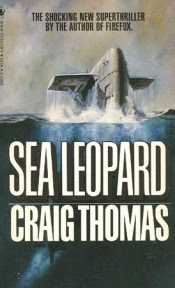
SEA LEOPARD - Book review


Craig Thomas is on top form with his seventh novel, the thriller
Sea Leopard published in 1981.

This adventure again features Kenneth Aubrey, Deputy Director of British Intelligence, and Patrick Hyde, one of his field agents.

The book begins with a map of the North Sea, UK, Scandinavia and Russia and the Barents Sea. This is followed by documents from Plessey, the weapons manufacturer, the SIS, Ministry of Defence and the US Navy Defence Department, all relating to the installation of a new anti-sonar system for submarines, ‘Leopard’.

The nuclear submarine HMS Proteus has the system installed and is running trials at sea when a distress call is detected.

At about this time a search was underway for Leopard’s inventor, Quinn, who has gone missing. Hyde is attempting to track down Quinn. Soviet agents are attempting to abduct Quinn’s daughter, Tricia, in the hope that she will lead them to Quinn’s whereabouts.

The distress call is a trap and the captain of Proteus, Commander Lloyd falls for it.

The tension mounts as a number of Soviet surface ships and submarines play cat-and-mouse with the Proteus – for their sonar is incapable of detecting the British submarine, thanks to ‘Leopard’.

Ingenious methods are deployed by Russian Valery Ardenyev, office in charge of the Soviet Underwater Special Ops Unit to incapacitate the submarine and take the crew captive and then learn everything about the Leopard system.

A rescue mission is then mounted by Aubrey, using USN special agent Ethan Clark.

The suspense mounts, switching from Hyde’s search in England, Ardenyev’s bold assault in inclement weather, Aubrey’s altercations with Ministers and the Navy’s hierarchy, Commander Lloyd’s concern for the safety of his vessel and crew, and Clark’s near-impossible mission on the edge of the Arctic Circle.

 A gripping thriller that time has not spoiled in the slightest. 

Friday, 5 August 2022

LEON CAZADOR - HIS LIFE

 On the occasion of the publication by Rough Edges Press of three novels featuring Leon Cazador, Private Eye – Rogue Prey, No Prisoners, and Organ Symphony, you will find below a brief biography of the character and a time-line for guidance 

LEON CAZADOR, P.I.

Brief biography

The world needs brave souls like Leon Cazador who is not afraid to bring the ungodly to justice and so help, in his own words, to hold back the encroaching night of unreason.

Leon was born on 16 February 1963 in Spain. He has an English mother (Julia), Spanish father (Paco), a married sister, Pilar, and an older brother, Juan, who is an officer in the Guardia Civil. Leon Cazador sometimes operates in disguise under several aliases, among them Carlos Ortiz Santos.

When he was twenty-one, rather than wait for conscription, he decided to jump and joined the Army, graduating as an Artillery Lieutenant. (Spain’s conscription didn’t cease until 2001). 

About a year later, he joined the Spanish Foreign Legion’s Special Operations Company (Bandera de operaciones especiales de la legión) and was trained in the United States at Fort Bragg, where he built up his considerable knowledge about clandestine activities and weapons. Some months afterwards, he was recruited into the CESID (Centro Superior de Informacion de la Defensa), which later became the CNI (Centro Nacional de Inteligencia). Unlike most Western democracies, Spain runs a single intelligence organization to combat both domestic and foreign threats. 

Part of his intelligence gathering entailed his transfer to the Spanish Embassy in Washington, D.C. There, he met several useful contacts in the intelligence community. 

At the close of the Soviet occupation of Afghanistan he embarked on a number of secret missions to that blighted land with CIA operatives. By the time the Soviet withdrawal was a reality, Leon was transferred to the Spanish Embassy in Tokyo, where he liaised with both intelligence and police organizations.  

Secret work followed in China, the Gulf and Yugoslavia. 

In 1987, Leon was attached to a secret section of MI6 to assist British operatives in Colombia. 

Although he has been decorated four times in theaters of conflict, reports imply that his bravery justifies at least three more medals. 

A year after witnessing the atrocity of the Twin Towers while stationed with the United Nations, he returned to civilian life and set up a private investigation firm. 

During periods of leave and while stationed in Spain, he had established a useful network of contacts in law enforcement, notably Captain Silvano Lopez of the Guardia Civil. 

One of his early cases resulted in him becoming financially set for life, so now he conducts his crusade against villains of all shades, and in the process attempts to save the unwary from the clutches of con-men, rogues and crooks.


Leon Cazador’s life timeline

(His age is shown in brackets)


1984 - Graduated as Artillery Lieutenant in Spain’s Army (21)

1985 – Joined Spanish Foreign Legion, Special Ops Co. (22)

1986 – Joined CESID (Later to become CNI, 2001) (23)

1987 – Spanish Embassy, Washington DC (24)

1987 – Secretly deployed in Afghanistan (Soviet withdrawal May/88-Feb/89) (24)

1988 – Spanish Embassy, Tokyo, Japan (liaising with intelligence and police re Yakuza) (25)

1989 – Secretly deployed in China, providing intelligence on the protests (Tiananmen Square) (26)

1990 – Gulf War special operations. Medal. (27)

1991 – Yugoslavia – special operation then aiding the UN peacekeeping forces. Medal.  (28)

1992-1993 – special ops during Bosnian War (NATO peacekeeping began 1995); wounded/escaped. (29-30) Medal.

1994 – Hospitalized. (31)

1995 – Spanish Embassy, London (32)

1997 – Attached to MI6 adjunct International Enterprises and deployed to Colombia to investigate the formation (in April) of the United Self-Defense Forces of Colombia. (33)

1998-1999 – secret operations in Kosovo, in preparation for NATO bombing campaign. Medal. (34-35)

2000 – United Nations secondment (36)

2001 – Witnesses 9/11 atrocity (37)

2002 – Leaves service. Returns to Spain and begins career as a private investigator. (38)

2003 – Relic Hunter case – now financially set for life to conduct his crusade against the ungodly (39)

2014 – Involved in Cat’s Crusade: Catalyst with Cat and Rick in Barcelona (51)

2015 – Attended wedding of Monica and Detective Francis Attard in Malta (52)

2017 – Working with FBI, Sister Cristina in Charleston, SC (December): see also Organ Symphony (54)

2018 – Involved in endangered species case: see Rogue Prey (June) (55)

2019 – Rogue Prey (July); recruits Carlota Diaz as PA; see also No Prisoners (September) (56)

2022 – The Organ Symphony case (August) (59)


Monday, 13 June 2022

NO TIME TO SPY: 1 – COME SPY WITH ME - Book review


This, the first book in the trilogy No Time to Spy by Max Allan Collins & Matthew V Clemens (published by Rough Edges Press, 2021) is highly enjoyable. The authors are after my own heart with their playing with words – both book titles and chapter headings. Some chapter headings: Harbour Frights, Dominican Dominoes, The Brother-in-Lawford, and Sand Storm, for example)

The action of all three books spans from 1959 to late 1963. The central conceit is splendid: John Sand is a recently retired MI6 agent, now married to Stacey. His real-life exploits have been written as fiction by a friend and former colleague not a million miles removed from Ian Fleming. ‘Though retirement had been forced upon him by his colleague’s novels – and because Sand’s body carried more lead in it than a crate of number two pencils – he relished his new freedom.’ (p13)

Unfortunately, the past tends to raise its ugly head in the guise of an old enemy, Raven, who attempts to kill not only Sand but his wife! It is possible the attempt is connected to a secret mission the US President wants Sand to undertake – go and protect Castro from a planned assassination!

Apart from the local colour, the authors also inject the Rat Pack into the story – capturing the voice and mannerisms of Sinatra et al (yes, including Peter Lawford). The period is well-realised, as are the references: ‘Wearing a smile on a face on loan from Troy Donahue, the blond boy said…’ (p105)

There are several amusing scenes, plenty of wit and suspense, a dash or two of sex, glamorous settings, and the kind of fast-paced action we’ve come to expect in the life of a famous spy. ‘Sand let go of the assassin, a corpse now, and let him sink like the stone he’d had for a heart.’ (No spoiler page number here).

I look forward to savouring the other two books: Live Fast, Spy Hard and To Live and Spy in Berlin.

Monday, 8 May 2017

Book review - The Spycatcher


The Spycatcher (2011) is a debut espionage novel by Matthew Dunn, who just happens to have been trained by British SIS, as well as working with units of the SAS, SBS, and MI5, GCHQ and CIA operatives. The credentials are backed up by prose that reeks of insider knowledge.


The book was originally published with the title Spartan in hardback and then retitled for the paperback. The hero, Will Cochrane, is known by the code name Spartan. The British Spartan Programme allows only one man to go through the process, and he will be answerable only to the Prime Minister and his controller, Alistair: Spartan is trained to be a lethal weapon.

It begins with high tension, in New York’s Central Park, where an assignation turns into an assassination. Cochrane is badly wounded but survives (he would, wouldn’t he?) Part of the mystery that is his life unfolds as he is introduced to a secretive American who just happens to know Cochrane’s controller. The debacle in Central Park involved several agents from Iran. Alistair has learned that the Iranians are planning a massive atrocity in either the UK or the USA. Cochrane’s task is to identify the mastermind, capture him and get him to reveal the intended target. Nothing to it, really. Except, as Alistair says, ‘There is nothing regular about this mission.’ Cochrane is sent to meet a MI6 contact in Sarajevo, who knows somebody who might have a lead on the so-called mastermind.

No sooner does he get there than it all goes wrong.

But Cochrane has one lead – Lana, a woman living in Paris, who might have known the ‘mastermind’ during the Bosnian conflict. She was a journalist at the time, and came away scarred both physically and mentally. Reluctantly, he enlists her aid in locating her ex-lover, a man she now hates.

He is aided by a team of four specialists recruited specially for this mission. They’re tough and soon prove their loyalty to Cochrane. The trail will lead from the freezing streets of Sarajevo to the snow-clad mountain region of New York State and the city itself for the violent denouement.

Throughout, we follow the spy’s tradecraft, trailing suspects, killing shadowy agents. These passages are well written, sucking you into the suspenseful story, all the time casting doubt on the ability of innocents to survive. The insider knowledge is evident but never obtrusive. We believe in the apparent invincibility of Spartan. But he makes mistakes; inevitably. Dunn has created a hero readers will willingly follow in subsequent books. Cochrane is flawed, troubled by his past, aching to give it all up and lead a ‘normal’ life, and yet he is a driven soul, wanting to right wrongs, needing to punish those who do evil things. He is not averse to being judge, jury and executioner.

The narrative compels the reader to keep turning the pages. That is what every thriller should do; many don’t manage it.

Dunn has now produced seven books in the Spycatcher series. Be aware that he has also published two novellas and check the review comments of these.

Editorial comment.

Despite the page-turning ability of the writer, there are certain aspects that should have been addressed by his editors.  Almost on every page, somebody’s eyes ‘narrowed’; it became tedious. As for Cochrane’s training, stoic in adversity, it seemed out of character for him to kick the ground (or something else), or stamp his feet ‘in frustration’ so often.

The twist was not a surprise and, in a similar vein to Dan Brown, the explanations seemed contrived. Yet, and yet, the sheer verve of the narrative and the strength of the character Spartan carry you through these minor misgivings. That’s not great literature, but it is good story-telling.

As for the book title change, that seems significant and worthy of note by budding authors. Spartan was fine, since this was the main character’s codename. However, it smacked of a historical novel, not a contemporary espionage thriller. So, I can understand the change. It became The Spycatcher with the strapline ‘It takes a spy to catch a spy’.  However, subsequently it soon became simply Spycatcher and then the next books were referred to as Spycatcher novels. And if you examine some of the titles, some have been subtitled ‘A Will Cochrane novel’.  Received wisdom is to create a brand. And yet there’s a lack of consistency here; if Harper Collins (and its imprints) can’t manage that, what chance have lesser mortals, I wonder…. 

Thursday, 25 September 2014

Writing - The Prague Papers - Foreword

Prague - Wikipedia commons

THE PRAGUE PAPERS

 
(Tana Standish, psychic spy, in Czechoslovakia – 1975)
The first in a series

 
Nik Morton

 
To be published by Crooked Cat – currently in the publisher’s edit phase,
so it will be subject to change


FOREWORD: Manuscript


Portsmouth, Hampshire, UK


The agent who called himself Mr. Swann entered the Queen’s Hotel bar at 2PM, just as he had promised. In my business, I’d met a few spies and all of them were nondescript. After all, to be a good agent, you need to blend in, be unmemorable. Swann just didn’t fit that category, so I wondered if I was wasting my time on this mysterious appointment.

            He was tall, dark and sanguine. In his early fifties, maybe a little older. His black hair sported a white streak on the left; a livid jagged thin scar continued from there at the hairline all the way down that side of his face to his chin. The bottle-green worsted suit was bespoke, the shoes patent leather. He wore gloves and carried a large brown leather briefcase. Removing a dark gray trilby, he nodded at me. Spots of summer rain had peppered dark blobs on his shoulders and hat.

As I stood to greet him, he gestured for me to remain seated and strode over. He limped ever so slightly, as if one leg was shorter than the other; I’m only a reporter, not a detective, and I certainly wasn’t going to measure his inside leg.

            He’d implied he was still in the field but I was beginning to suspect that he’d been put out to grass. A bit harsh, I thought. Because of his physical appearance maybe nowadays he was a desk man at ‘Legoland’, the agents’ popular name for the headquarters building at Vauxhall Cross on the Thames.

Let’s be honest, he wasn’t going to melt into any background. Besides, these days he was the wrong ethnic type for infiltration. The Twin Towers atrocity changed several priorities and a few careers come to that. Why do we in the media insist on the shorthand ‘9/11’? Sounds more like a deodorant brand to me. What’s wrong with giving that terrible act of violence against the victims of over thirty different nations its proper name? Anyway, the world was not the same since then and now the clandestine services were mainly gunning for fanatical terrorists, not greedy traitors or misguided ideologists, though those sort probably still existed in the woodwork, waiting their chance to emerge.

            Sitting opposite me, Swann smiled as the middle-aged blonde barmaid placed a whisky and dry ginger in front of him. Clearly, he was known in this place. Not promising, I thought, though obviously being prominent could also imply that you couldn’t possibly be a spy because spies are shadow creatures. Double blind, or whatever they call it.

Maybe that’s how the character James Bond got away with it for so many years, traipsing round the world using his own name more than the odd pseudonym. Now Quiller, he was much more realistic. Never did get to know his real name. And of course Quiller’s author, Adam Hall, was a cover-name for the late lamented Elleston Trevor. Still, those spies were fiction; Mr Swann was fact and studying me.

            Swann’s eyes were a cold blue; one of them, I suddenly realised, was glass. You’d have to be quick to detect the movement but, in an instant, his single orb seemed to scan the entire room and its occupants. As it happened, I’d chosen a booth where we couldn’t be overheard.

Despite the very visible scar, it was obvious that he had undergone some plastic surgery: the aging skin round eyes and cheek contrasted starkly with the pristine sheen of his square jaw.

            He lifted the briefcase onto his lap and clicked open the metal clasp. He fished out a bundle of paper. ‘Perhaps this manuscript would prove of interest, Mr. Morton?’

            I liked the man at once. No skirting around the reason for our meeting, no small talk about the lousy British weather. Straight to the point.

            He handed over about a ream of Courier font typewritten paper, secured by a thick elastic band. The corners were turned and the sheets had lost their whiteness. A bit like me, I suppose. It also reminded me of my rejected manuscripts – except there were no coffee-mug stains.

            ‘Have you heard of the Dobranice Incident?’

            ‘No,’ I said.

            ‘It was a while ago, I must admit.’ He’d never make a politician, I thought; they never admitted anything.

            ‘So when was this incident?’

            ‘1975.’

            ‘Good God, the Dark Ages!’ If my shaky memory was to be believed, I was an idealistic nineteen-year-old, reporting the Melody Maker pop-scene at the time. I shook my head. ‘I wasn’t into world events then.’ I’m fifty-eight now and world-weary. Early retirement would be nice, but it wasn’t going to happen since the politicians had wrecked my personal pension. At least I genuinely liked writing – and getting paid for it. Though, on reflection, no matter how much I wrote, it didn’t get any easier.

            ‘The incident was trivialised,’ Swann said. ‘Made barely page three in the broadsheets at the time. A postscript, really.’

            ‘And this postscript – these papers concern that ‘incident’?’

            ‘Dobranice. Yes.’ He handed over a single sheet, a typed list.

            I glanced at it. Some place-names I recognized as trouble spots from recent history, others I hadn’t heard of and the rest might well be places from a Pirates and Travellers game:

Dobranice

Tehran

Kabul

Caldera

Izmir

Hong Kong

Elba

Naples

Peking

Bulawayo

Mogadishu

Cairo.

       ‘When you said agent, you didn’t mean travel agent, by any chance?’ I asked.

His mouth made a grimace but his good eye shone, betraying amusement. ‘Keith warned me about your – for want of a better description – sense of humour. No, that’s a list of places – where certain assignments were carried out.’

‘So this manuscript is about Dobranice, the top of the list?’

‘Yes. Top place on the list. Top story.’ He grinned lopsidedly. ‘Top secret.’

I took a good gulp of my cool San Miguel, just to remind me of sunnier climes. This hotel was one of the few places to stock imported Spanish beer. Most of the stuff was bottled in Britain and didn’t taste the same. I glanced at a window. Needless to say, it was raining again. A sultry summer, so the weathermen promised. Weathermen and politicians – don’t believe a word they say.

I nodded at the bundle of typescript, itching to get my hands on it, but I held back. ‘Why give this to me?’

            ‘Times have changed.’ He sipped his whisky. ‘The Old Order has gone now. Even if the thirty-year-rule allows them to release anything about the incident, I doubt if you’d ever see the full story.’

            ‘Well, thirty years have gone, haven’t they? I don’t recall anything being released about this Dobranice place, though.’

            ‘And I doubt if you will, ever. Anyway, whether it’s Prague, Dobranice or other assignments in Iran, Afghanistan, Argentina… Not everything is covered by the thirty year rule; some take longer to be released. The point is that they’re all about Tana. And we feel her story should be told now.’ The look in his eye seemed wistful, as if there was a history between him and this Tana person.

            ‘Tana?’

            ‘Tana Standish.’ He nodded at the pile of paper. ‘Read the manuscript – she’s in there.’ He looked sad, almost bereaved, the way he spoke about the mysterious Tana.

            Blood throbbed in my temple. Every instinct I’d developed in the news-hunting game told me this might be worth a look. ‘You said "we". Who wrote this?’

            ‘Me. And a few others. Keith and Mike. Others. A group effort. Let’s just say that we downed a few drinks and got together a number of times after the Berlin Wall came crumbling down. I know, that’s a long time ago as well.’ His mouth curved. ‘Anyway, it made a pleasant change from dry assignment reports.’

            ‘But –?’ I offered. There always has to be a but.

            He smiled again, thinly. ‘Well, it might be best to rewrite it as fiction, Mr. Morton. Just to avoid the stupidity of another Spycatcher circus.’

            ‘Or Stella Rimington’s Open Secret?’

            ‘Not so open, was it? In fact, not much action in her prose, I’m afraid. Now, Dobranice – it has more than enough action.’ His features turned rueful. ‘More than enough.’

            ‘Anyway,’ I said, ‘those books were about the Security Service, MI5. This isn’t, is it?’

            ‘Indeed, you’re quite right. It’s a rather secret part of the Firm, actually.’

            ‘I’m not going to put any agents at risk by writing about this, am I?’

            ‘No, these adventures won’t figure in the revelations of Wikileaks, Assange or Snowden.”

            ‘I’m pleased to hear it.’

            ‘It might have fresh relevance, now that Mr Putin is keen to start a fresh Cold War.’

            ‘True. What do you want in return?’

            He studied the remains of his drink and because I wasn’t psychic I couldn’t fathom what he was thinking, but it was more than his words: ‘Just the story. The story is the thing.’

            Another question had been nagging throughout our clandestine meeting. ‘Why bring this to me? As much as I try spreading the word on Twitter and Facebook, I’m not exactly well-known, you know.’

            ‘Jack Higgins turned us down.’

            I glared and he grinned. ‘Just joking,’ he said. ‘You’ve been around the block, if you like, you’ve lived through these times, even if you didn’t know what was going on in secret circles. Not many do, if we’re honest. We’ve still got one of the most secret societies on earth, right here in good old Britain. Whatever happened to ‘Great’?’

            ‘Sold for a peerage, perhaps?’

            He shook his head and smiled. ‘I don’t do politics. Not a good idea in our profession. But as I was saying, actually, Keith liked your articles for the Portsmouth and District Post.’

            I didn’t for a minute believe a word of it. And yet... I fingered the manuscript in anticipation. It seemed too good to be true. I was being handed all this secret stuff on a plate.

‘All right, then,’ I said, ‘I’ll give it a go.’

‘Just do her justice,’ he said.

* * * *

Later, how I wished I’d met Tana Standish. People like me – and those accursed politicians – sit cozily at home with our petty complaints while men and women like her fight the good fight against evil. The Cold War may have gone away for a while, but we still need people like Tana Standish, Alan Swann and Keith Tyson. And they get no thanks. Mainly, their stories go unheard and unread. At the most, their achievements probably get a footnote in a newspaper.

            After several months shut away from the world of today I have finished this book, which I have called The Prague Papers – the first chronicle of Tana Standish’s missions which presages several calamitous adventures with significant revelations from recent history. It is dedicated to all the secret agents who fight behind the scenes and behind the news.
 
***
 
Note: This is just a teaser. All of the Tana Standish books begin in a similar manner, with the secret documents being handed over... The novel is in the third person, however.