Search This Blog

Showing posts with label apocalyptic. Show all posts

Monday, 20 December 2021

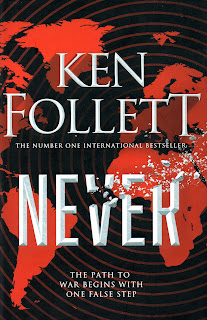
NEVER - Book review


Ken Follett’s 800-plus page novel Never (2021) is a warning: small differences of ideology and policy can evolve, step by unwitting step, into devastating global conflict.

The US President is Pauline Green, a wife and mother; she is a moderate unlike her political opponent, Senator James Moore, who is a hawk threatening to challenge Pauline for the Republican nomination.

Tamara Levit is a CIA agent attached to the Chad embassy; she’s working with Tab Sadoul, an attaché at the EU mission there.

Kiah is a widowed mother of Naji, a baby boy, and lives beside Lake Chad.

Abdul Haddad is an undercover CIA officer tracking a consignment of cocaine, which is presently hidden in a bus.

Chang Kai is Vice-Minister for International Intelligence in Beijing. Kai has useful contacts in North Korea and in the United States.

The CCP President is Chen, a moderate, a far cry from the present incumbent.

In several cases their lives will become interlinked; we get to know and feel concern for them as individuals.

Tamara is Abdul’s contact; she passes on information he obtains which is then used to close down insurgents’ camps through lethal force. Kiah joins a group of migrants on the smugglers’ bus, along with Abdul, and a friendship develops. Chad and neighbouring Sudan are at loggerheads. During an incursion an American corporal Ackerman.is killed. The weapons used by the insurgents were North Korean. Protests are made, to no avail. An assassination attempt is made on the president of Chad and reprisals result. And so it begins – tit-for-tat diplomacy, escalating gradually…

As usual with Follett, the book is a fast read. He and his consultants have amassed a great deal of insider information regarding the workings of both the US and Chinese political machines. There’s also action, bravery, political chicanery and betrayal.

The sections involving Abdul and Kiah, while interesting and suspense-filled, are secondary to the main thrust of the novel. They do provide a human dimension to the modern plague of people smuggling, however.

As evinced by the outbreak of the Wuhan virus, the Chinese government is reluctant to lose face, and this attitude could well have grave consequences for the world…

Editorial comment:

Thank heaven for an author who doesn’t write ‘she thought to herself’; instead we get, ‘she said to herself’ (p64). (Honestly, who else can you ‘think to’?)

While there’s no real confusion because the individuals are on different continents, one wonders why Follett chose Kiah and Kai for two character names. Generally, writers are advised not to use similar-sounding names (though even Tolkien slipped in Saruman and Sauron!)

Fatima asked Jadda: ‘How will we know what to do?’ (p164) This should be Kiah asking Jadda. Fatima knows this already, being in the system.

Tuesday, 13 October 2020

LAST LIGHT - Book review

 LAST LIGHT

Alex Scarrow


A disaster novel published in 2007. It begins with a mystery in a New York hotel in 1999 and then moves to ‘the present’ where within the space of a week modern life as we know it crumbles. 

Andy Sutherland is a civilian engineer in Iraq when the oil wells in the Middle East are destroyed. Virtually simultaneously, others round the world are hit. Back in London, Andy’s wife Jenny is in Manchester for a job interview while their daughter Leona is at university and their young son Jacob is at boarding school. Andy swiftly realises that the concerted attacks on the oil supply are the beginning of a massive global disaster He warns his family to get together and stockpile food and water before people realise what is about to hit them.

Scarrow manages to keep the pages turning, also introducing an added threat: his email to Leona was intercepted and links back to that time in the NY hotel… Leona had recognised someone then which now makes her a high risk for some very powerful people.

The chapters are short – all ninety of them – and inject pace and anticipation as law and order dissolves and society disintegrates. Pitched against rebel forces, Andy and his small contingent have to fight their way out of Iraq. He desperately needs to get to his family, while his family are left to contend with looters and rioters. There are many tense moments for all involved.

There’s a lot of swearing, probably appropriate, considering the individuals and the dilemma they face: a global oil shortage. There’s also a conspiracy involved, similar to that posited in the film Batman Begins (2005). Since the book was written, the UK’s reliance on imported oil has diminished slightly; wind turbine power is proving a good alternative and at least the US has since become self-sufficient with its massive shale oil business…

There is a sequel, After Light (2011).

Wednesday, 14 May 2014

A Departure - Book review

This book, A Departure,  has gathered quite a momentum of praise and exposure. Admittedly, some of this is due to the youth of the author. Tom Ward was about twenty-three when he wrote it. Received wisdom would have us believe that the age of the author is not relevant, it’s the story that counts – either it works or it doesn’t, it either involves the reader or it doesn’t. I’d go along with that. Still, once I’d read the book and then checked out the Amazon reviews, I was struck by the range in comments. A Departure has acquired an enviable number of reviews. Yet some of the reviews are not real reviews, simply stating something along the lines of ‘A great book, I couldn’t put it down, look forward to Tom Ward’s next one.’ Other less complimentary reviews highlighted his age and perceived inexperience, while several commented on typos. [The publisher has since attended to the typos].

Tom Ward took a risk, embarking on a debut novel in the dystopian genre. There’s a long history of this type of work, going back even before John Wyndham and Brian Aldiss, the authors who introduced me to the sub-genre . The conceit is depicting how ordinary individuals cope with their new and darkened circumstances, and to a large extent I believe Tom Ward achieves that, despite some stylistic flaws.
 
Michael Taylor is approaching the end of his teens when ‘the event’ occurs. We don’t get told what happened, though it’s hinted that it might have had something to do with global warming. Plenty of disaster novels don’t give the reasons – simply thrusting their characters into the new changed world. Whatever the cause, it seems that the vast majority of people have succumbed – simply died in their tracks. Eerily empty streets, beloved of disaster movies, are depicted realistically. Michael’s encounter with a man who intends to steal the family car is the first of several scenes where extreme violence raises its head – and it’s uncomfortable in its depiction, and in Michael’s psyche.

Michael returned home briefly after his family’s failed attempt to leave the country met with the deaths of his parents and sister. Now, he sets off in a stolen car, heading first to his grandparents’ house. Already, he’s quite hardened to the sight of dead bodies. His eventual leave-taking of his proud grandfather is moving without being mawkish. ‘Something sank in Michael’s chest as his bottom lip began to quiver. Suddenly, he was a young boy again, crying at his grandparents’ house after falling over, but this time a plaster and some Germolene would not make things better.’

He then goes south, in a hazy attempt at finding succour. On his way, he encounters a mixture of strange, interesting, violent people, all understandably affected by the apocalyptic event. He is not alone for long, soon joining up with Judith, then David and Zanna, encountering a religious group, a pseudo-government-run tent camp, a supermarket refuge for youths, and an isolated farmer and wife.

There is a danger with this kind of novel that it will be bleak throughout: ‘The corpses were scattered over the fields like seeds in spring.’

Yet we know from first-hand accounts that even survivors of the Holocaust had cause to rely on humour to get them through their horrendous ordeal. Humour is part of the human condition. And so Tom Ward gives us humour, too, for example:
 
‘Michael walked on, guitar song assaulting his ears from all directions. It seemed as though guitar players had been exempt from the apocalypse.’

There are many glimpses of good metaphor and description, too: ‘… June sun quickly turned the air thick and warm, the tent walls sagging inwards like a surrendered lung that could breathe no more of the heavy air.’ And I liked this description – ‘Judith cut in, her voice hard as a week-old scone.’
 
Unexplained disasters throw up survivors and in some way they prove the theory of the survival of the fittest; not necessarily fit in a physical sense, or exhibiting a higher capacity of intelligence; it may be something as simple as the fitness of certain genetic pointers carried by those who live on.

And the book’s title can be viewed on several levels. The story is a departure for Michael, moving from boyhood to manhood, since it’s definitely a coming-of-age tale. It is also a departure for the survivors from everything they knew, everything familiar. And ultimately it’s a departure by some survivors from the UK.
 
I particularly liked the neat ‘golden’ reference at the beginning and its echo at the end of the book.
 
A worthy debut novel. Tom Ward should be encouraged to keep writing. I would hope that he doesn't take the negative comments too much to heart and make his literary departure. For he has much to offer readers as he evolves. (I've been writing for over forty years and I'm still evolving!)

[A shorter version of the above review will be posted in Amazon and Goodreads.]
