Search This Blog

Showing posts with label CIA. Show all posts

Wednesday, 28 May 2025

THE HUNT FOR RED OCTOBER - Book review


Tom Clancy’s debut thriller The Hunt for Red October was published in 1984 and surprisingly I’ve just got round to reading it 41 years later! It’s obvious why it became a best-seller – the amassed technical and logistic and intelligence detail reeks of authenticity.

This review will be short, since it’s likely that most readers here have seen the film starring Sean Connery (1990). The story covers eighteen days from December 3.

Soviet Captain Ramius is taking the new ballistic missile submarine Red October to sea for an tactical and equipment validation exercise. By page 6 it is clear that Ramius intends to kill the political officer Putin. From that moment the suspense builds and does not let up.

Both the US monitoring ships and the Soviets in the exercise area lose all trace of Red October.

CIA Analyst Jack Ryan gleans information which leads him to the incredible conclusion that the Red October is sailing towards North America to defect.

So begins a chase, involving the real USS Dallas, HMS Invincible, other US vessels and a number of Soviet craft. Open conflict is a real threat – by accident or by design. Geopolitics are involved; obviously, if it is known that the Red October is being held by the Americans, the USSR will demand its return by international law, since neither was at war.

The various personalities on October and Dallas are drawn very well. The politics are sketched out by the President, the head of CIA and others believably. All in all, the 477 pages flew by.

Thursday, 23 June 2022

NIGHT SCHOOL - Book review


Lee Child’s 2016 book is a flashback novel, taking us and Reacher to 1996. Intelligence has overheard that a deal is going down, and it involves an American and the price is a hundred million dollars.

Reacher is sent to so-called night school with two others: an FBI agent and a CIA analyst. Their homework – decide who the American is and what is worth that amount of money. And who is buying?

Reacher opts to recruit Sergeant Frances Neagley and skips school, heading for Berlin where he reckons the action is. He’s not wrong. Is he ever?

Accounting can  be boring, by all accounts. And bad accounting can be the harbinger of a cataclysm. To say more would involve spoilers.

Meanders more than usual; not one of his best.

Monday, 20 December 2021

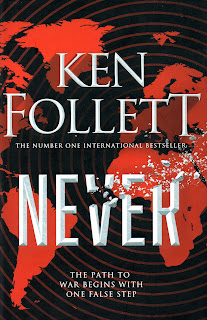
NEVER - Book review


Ken Follett’s 800-plus page novel Never (2021) is a warning: small differences of ideology and policy can evolve, step by unwitting step, into devastating global conflict.

The US President is Pauline Green, a wife and mother; she is a moderate unlike her political opponent, Senator James Moore, who is a hawk threatening to challenge Pauline for the Republican nomination.

Tamara Levit is a CIA agent attached to the Chad embassy; she’s working with Tab Sadoul, an attaché at the EU mission there.

Kiah is a widowed mother of Naji, a baby boy, and lives beside Lake Chad.

Abdul Haddad is an undercover CIA officer tracking a consignment of cocaine, which is presently hidden in a bus.

Chang Kai is Vice-Minister for International Intelligence in Beijing. Kai has useful contacts in North Korea and in the United States.

The CCP President is Chen, a moderate, a far cry from the present incumbent.

In several cases their lives will become interlinked; we get to know and feel concern for them as individuals.

Tamara is Abdul’s contact; she passes on information he obtains which is then used to close down insurgents’ camps through lethal force. Kiah joins a group of migrants on the smugglers’ bus, along with Abdul, and a friendship develops. Chad and neighbouring Sudan are at loggerheads. During an incursion an American corporal Ackerman.is killed. The weapons used by the insurgents were North Korean. Protests are made, to no avail. An assassination attempt is made on the president of Chad and reprisals result. And so it begins – tit-for-tat diplomacy, escalating gradually…

As usual with Follett, the book is a fast read. He and his consultants have amassed a great deal of insider information regarding the workings of both the US and Chinese political machines. There’s also action, bravery, political chicanery and betrayal.

The sections involving Abdul and Kiah, while interesting and suspense-filled, are secondary to the main thrust of the novel. They do provide a human dimension to the modern plague of people smuggling, however.

As evinced by the outbreak of the Wuhan virus, the Chinese government is reluctant to lose face, and this attitude could well have grave consequences for the world…

Editorial comment:

Thank heaven for an author who doesn’t write ‘she thought to herself’; instead we get, ‘she said to herself’ (p64). (Honestly, who else can you ‘think to’?)

While there’s no real confusion because the individuals are on different continents, one wonders why Follett chose Kiah and Kai for two character names. Generally, writers are advised not to use similar-sounding names (though even Tolkien slipped in Saruman and Sauron!)

Fatima asked Jadda: ‘How will we know what to do?’ (p164) This should be Kiah asking Jadda. Fatima knows this already, being in the system.

Wednesday, 19 November 2014

Writing – research – espionage, defectors

The defecting spy is a staple for many espionage novels and films.  Obviously, at the height of the Cold War, it seemed quite commonplace, and judging by the newspaper reports it appeared that the Soviets were better than the NATO countries at suborning dupes in the West.

But the Soviets didn’t get all their own way, by any means. Briefly, here are two defectors of note.

Penkovsky

GRU Colonel Oleg Penkovsky first approached the Americans in 1960, but they dallied too long, so he approached the British the following year.

The Penkovsky Papers are reputed to have been written by the CIA, and some disinformation has been bandied about that Penkovsky wasn’t actually shot as a traitor or committed suicide in his cell (1963); the message was that he actually lived in retirement, having fooled the West into believing that the Cuban missiles were important to Kruschev, rather than in effect protecting Castro from US invasion – part of the deal struck at the height of the 1962 crisis. Yet the perceived repercussions in Moscow and within the echelons of the GRU and the KGB suggest that Penkovsky’s information, passed on at risk of his life did indeed damage the Soviet spy machine.
 
 
[Also of interest, see http://www.paperlessarchives.com/penkovsky.html]

Lyalin

In September 1971, the mass expulsion of 105 Russian diplomats and trade officials by Britain caused a storm. While MI6 and the CIA were aware of most of the individuals’ true purpose, the defection of Oleg Adolfovitch Lyalin revealed that their espionage activities were much worse than thought. Lyalin was an officer in the KGB’s Department V, responsible for sabotage and assassination. PM Heath and Foreign Secretary Douglas Home warned Moscow that if any reprisals against Western envoys followed the expulsions, even more Soviets would be sent back to the USSR.

Lyalin had arrived in London in 1969 and enjoyed the life there as a Soviet trade delegate. He was conducting an affair with his secretary, though he was a married man with a family in Russia. He was stopped for a drink driving offence and was persuaded that any subsequent disgrace would ruin him, so he agreed to cooperate with the authorities. He revealed that teams of saboteurs had been prepared to exact maximum damage on British radar stations, communications centres and other important complexes 24 hours before any surprise attack by the Soviet Union. Lyalin’s specific target was to blow up the Fylingdales early warning system in Yorkshire; he had plans and maps to link up with Russian commandos on the coast. Other plans entailed blocking the Clyde estuary, thus trapping the nuclear submarine fleet at Holy Loch, the London Underground system to be flooded, and indeed to employ British traitors to attack air bases using weapons from arms caches. This was some of the background to the expulsion of those 105 Soviets, and shows how serious and sinister the Cold War had become.

Britain lodged a formal protest to Soviet Foreign Minister Andrei Gromyko and advised friendly countries about the details of the expulsions. By doing this, they effectively pulled the teeth from the mouths of the Soviet planners. Foreknowledge is power, after all.
 
 
The Prague Papers will be released as an e-book on 26 November by Crooked Cat Publishing. It's set in 1975, and yes, defectors are involved in the story... The first of the chronicles about Tana Standish, psychic spy (in action 1965-1988). 
 

Friday, 25 April 2014

FFB - Wild Fire

My Friday's forgotten book is Wild Fire by Nelson Demille is the fourth Detective John Corey thriller, following on from Night Fall (2004). I’ve read and enjoyed all Demille’s John Corey thrillers up to his 5th (see breakdown below; I've got his 7th on order now). They’re great because Corey’s wisecracking persona is so believable. Yes, he’s a bit coarse, big-headed and pig-headed, but he also laughs at himself and the human condition. He has immense courage and is a friend for life. When he got married to FBI agent Kate Mayfield, they became a match made in heaven. This pair just bounce off each other and are clearly in love, despite Corey’s many faults. Sometimes, Kate is a stabilising influence on John; but not nearly so much since 9/11.

‘Wild Fire’ appears to be a secret codename for a government response to a terrorist nuclear attack. That’s devastating enough. Yet somebody outside government knows about it…

When Corey’s pal is sent on a routine task to investigate the Custer Hill Club – a secret society of powerful men, the guy ends up dead: an unfortunate shooting accident. But Corey takes the death personally. As he should, since he was the first choice for the job. Why did his pal die? Taking along his wife, Corey starts his own investigation. As it’s in the first person, we’re pretty sure Corey will survive, but we can’t help but be fearful for his wife, brave as she is. The ending is very tense indeed.

Along the way there are many laugh-aloud moments, which I’ve come to expect of a Corey book; however, there are plenty of chilling scenes, with the odd dose of pathos and compassion thrown in. If you haven’t read a John Corey book, the best place to start is with Plum Island, where he first meets Kate. But any of them are worth the price – and become addictive reading if you can get past the ripe language.

The John Corey thrillers in sequence:

  1. Plum Island (1997)
  2. The Lion's Game (2000)
  3. Night Fall (2004)
  4. Wild Fire (2006)
  5. The Lion (2010), direct sequel to The Lion's Game
  6. The Book Case (2011) – Kindle Single, 54pp short story
  7. The Panther (2012)


Wednesday, 23 October 2013

Blog guest – Charles Ameringer – ‘more than a grain of truth’

Today, my blog guest is Charles Ameringer. Charles is professor emeritus of Latin American history at Penn State University and a former captain in the USAF Reserve. Before beginning his teaching career, he served as an intelligence analyst in the U.S. Department of Defense.
 
His book The Old Spook is a spy/detective novel about a burned out CIA operative Tom Miller that morphs Richard Burton (Alec Leamus) into Humphrey Bogart (Sam Spade)—and back again! A tale of espionage and sleuthing that engages the reader in the culture and tradecraft of the CIA and the dilemma of government secrecy in a democratic society.  The novel begins with a flashback of the old spook’s career that reveals the stress of shady dealings with sinister characters and transports the reader to such places as Mexico, Guatemala, Costa Rica, Bolivia and Chile. Miller has hair-raising encounters with the Russian agent who recruited Lee Harvey Oswald and meetings with Miami Mafia figures. He’s involved in several plots to assassinate Fidel Castro.

In the wake of the Watergate scandals and Jimmy Carter’s purging of the clandestine services, Miller takes forced retirement.

Not ready to call it quits, however, he goes home to Milwaukee where he opens a detective agency and takes on a missing-person case that unwittingly puts him on the trail of a Mafia hit-man. This case gains the attention of Detroit crime bosses and the CIA itself and then there’s an attempt on his life…

The novel covers the 1950s to the 1990s and plenty of names are dropped – Dulles and Helms of the CIA, the Kennedys, Guevara, the missing union boss Jimmy Hoffa, the Mafia chieftains Sam Giancana and Johnny Roselli, Oliver North et al. In the style of Upton Sinclair and Herman Wouk, the fictional Tom Miller interacts with actual events and personalities to provide an entertaining and intriguing read.

All author royalties will be donated to the Wounded Warrior Project.

Review

The fictional Tom Miller interacts with actual events and personalities through recent history played out on the global stage. Often, it reads as though Miller was there, liaising with shady wheelers and dealers in South and Central America.

If you have any recollection of some of these events, you’ll soon begin to wonder if this fictional account contains much more than a grain of truth. Fans of John Le Carré, Len Deighton and Charles McCarry will enjoy this revelatory novel. - Pastimes Costa Blanca magazine, May 2012.
 
Charles Ameringer
 
Q & A

This is your debut fiction book. When you were writing your non-fiction works, did you ever hanker after writing fiction at the time?

No, not really.  I was thoroughly committed to the methodology of the History discipline, that is, seeking empirical evidence and striving to relate events as accurately as possible.  At the same time, I always tried to write well, in order to be stylistic and literary.  After I retired, I had the urge to combine that creative instinct with imagination.  Inspired by Upton Sinclair’s Lanny Budd series and Woody Allen’s “Zelig,” I did so by placing a fictional character at the scene of historical events as they were happening.  Drawing on my experiences as a professor travelling abroad to interview persons of interest and conduct archival research, I created a CIA operative to go where I had gone and meet with whom I had met, only at another time and under different circumstances.     

Charles, I suspect that the character of Tom Miller has been bouncing around in your head for a number of years. Can you tell me when you first decided to write about Tom?

It’s true that he had probably been there for some time, and popped into my consciousness after I finished my last scholarly work in 2009.  Although an octogenarian and retired, I still had the urge to write, but I wanted to free myself of methodological restraints and have some fun (although there is absolutely no distortion of factual material in The Old Spook).  Tom Miller is essentially my alter ego.  As noted, he retraces my steps, but only to provide authenticity to the places he goes and people he meets.  Many novels are autobiographical in nature.  For example, Ernest Hemingway was an ambulance driver in Italy during the First World War, providing the template for Frederic Henry in A Farewell To Arms.  As a result, such novels are unique; there is none other like each and there never can be.     

Your book reminds me of Richard Pape’s Arm me Audacity, because when I finished that I really wondered if the narrative was true. Obviously, you feature real people and the big events you relate were true – but are you able to enlighten us as to how much of the double-dealing and political chicanery actually occurred?

As you say, the big picture is a factual account, being based on the extensive research I completed for my non-fiction study, U.S. Foreign Intelligence: The Secret Side of American History, which David Kahn (The Codebreakers) describes as “one of the first and one of the best surveys of American foreign intelligence.”  Tom Miller’s presence at these events is the product of my imagination, but his specific actions in no way alter the truth of what was occurring around him.  As Dean Andrade, the host of the “Milwaukee Authors” website, writes in his review of The Old Spook: “I really enjoyed the blend of real history with fiction, with a story that weaves together famous names and events—the Bay of Pigs, Che Guevara, the Kennedy assassination, Jimmy Hoffa, Oliver North, Aldrich Ames, and much more—all told with sharp historical accuracy and keen insight.”  However, there is a story within the story; the novel is divided into three parts and Part Two, “Where’s Aldo?” is pure fiction.  None of what occurs there is true, which may explain why it’s the most exciting portion of the book, given that Tom’s character enjoys a free rein.  Still, it wouldn’t make sense without the context of the truthful double-dealing detailed in the other parts.  Nor, is this to suggest that the other parts of the novel are lacking in thrills and suspense; as the popular author Debra Hartmann states in her review, “A great read, entertaining and powerful, a story that leaves you constantly on the edge.”          

You definitely gave The Old Spook a sense of place. Do you think this is important in fiction, and why?

Combining the places where I lived and worked with my travels as a professor engaged in research, I sought to give Tom and the reader a “real feel” of the venues in the novel   Perhaps it’s the teacher in me, but I think a work ought to be informative; if you’re going to take the reader to the campus of the National University of Mexico, for a drink in La Floridita in Havana, a stay in a pensión in San José, Costa Rica, or a trek to the copper mine in Chuquicamata, Chile, you are obliged to make it as realistic as possible.  To have been there helps, although some place descriptions may be unavoidably second-hand.. 

I believe your wife is a strong support in your writing. How do your family/friends feel about your switch to fiction?

Initially, my wife and sons were sceptical when I put on my novelist’s hat, but subsequently were quite sincere in saying that they really liked the novel and wondered “if we have a grandma Moses phenomenon here.”   However, my sons were a bit taken aback by my use of obscenities in the text, but I explained that it wouldn’t do to clean up the language of the fictional Mafia hit man Jack Aldo, a central figure in the story.  .      

You’ve just celebrated your 87th birthday and I know that time marches on. Do you have plans for another fiction book, or do you feel you’ve said all you needed to say in The Old Spook?

I don’t intend ever to stop writing and I have a number of ideas in mind.  Right now, I’m toying with a story about a freshly-minted assistant professor coping with a Berkley-inspired campus movement during the 1960s. 

A tall order, I know, but what is your favourite book? And why?

It is a tall order, but I think it’s Graham Greene’s Our Man in Havana.  In my opinion, there’s no place as fascinating as Old Havana (pre-Fidel, that is), which Greene portrays beautifully, and it’s a whimsical and tragic tale of an unwitting screw-up that somehow fate permits to end well.    

Where can readers find you?

You can find me on Facebook, Goodreads, and Amazon.com
and The Old Spook on the following links:
Amazon.com = http://goo.gl/J8S403
Amazon.co.uk = http://goo.gl/IO3tKt
 
Thank you, Charles.

Books by Charles Ameringer:

The Democratic Left in Exile: The Antidictatorial Struggle in the Caribbean, 1945-1959  

Don Pepe: A Political Biography of José Figueres of Costa Rica 

Democracy in Costa Rica 

U.S. Foreign Intelligence: The Secret Side of American History

The Caribbean Legion: Patriots, Politicians, Soldiers of Fortune, 1946-1950

The Cuban Democratic Experience: The Auténtico Years, 1944-1952 

The Socialist Impulse: Latin America in the Twentieth Century