Search This Blog

Friday, 17 June 2022

WORTH DYING FOR - Book review

Lee Child’s 2010 novel is high-suspense, one of his best in my opinion.

It started in a small town in Nebraska. A domestic disagreement. Seth Duncan punched his wife. She deserved it, according to him. Reacher happened to be with the local doctor when the call came through. He went with the doc – and discovered Mrs Duncan was a regular punch-bag.

Reacher detests bullies. So he walks to the steakhouse and punches Seth Duncan in the nose. Breaks it.

This is not good because the Duncan clan is mighty powerful in these parts. And the brothers use the sports jocks as their protectors and enforcers. They set these enforcers on Reacher – and soon come to regret it. Almost more broken bones than you’d find in a charnel house.

Apparently, the Duncans are involved in some criminal business, but nobody talks about it. Another thing nobody talks about is the missing eight-year-old girl who vanished decades ago. The girl’s mother is the elderly lady, Dorothy Coe who befriends Reacher; she’d always hoped her girl would return one day.

There’s something wrong in this town and Reacher can’t let it go. And as Dorothy Coe declares, ‘Some things are worth dying for.’ (p379) Maybe this is one of them.

A fitting explosive denouement.


Monday, 13 June 2022

NO TIME TO SPY: 1 – COME SPY WITH ME - Book review


This, the first book in the trilogy No Time to Spy by Max Allan Collins & Matthew V Clemens (published by Rough Edges Press, 2021) is highly enjoyable. The authors are after my own heart with their playing with words – both book titles and chapter headings. Some chapter headings: Harbour Frights, Dominican Dominoes, The Brother-in-Lawford, and Sand Storm, for example)

The action of all three books spans from 1959 to late 1963. The central conceit is splendid: John Sand is a recently retired MI6 agent, now married to Stacey. His real-life exploits have been written as fiction by a friend and former colleague not a million miles removed from Ian Fleming. ‘Though retirement had been forced upon him by his colleague’s novels – and because Sand’s body carried more lead in it than a crate of number two pencils – he relished his new freedom.’ (p13)

Unfortunately, the past tends to raise its ugly head in the guise of an old enemy, Raven, who attempts to kill not only Sand but his wife! It is possible the attempt is connected to a secret mission the US President wants Sand to undertake – go and protect Castro from a planned assassination!

Apart from the local colour, the authors also inject the Rat Pack into the story – capturing the voice and mannerisms of Sinatra et al (yes, including Peter Lawford). The period is well-realised, as are the references: ‘Wearing a smile on a face on loan from Troy Donahue, the blond boy said…’ (p105)

There are several amusing scenes, plenty of wit and suspense, a dash or two of sex, glamorous settings, and the kind of fast-paced action we’ve come to expect in the life of a famous spy. ‘Sand let go of the assassin, a corpse now, and let him sink like the stone he’d had for a heart.’ (No spoiler page number here).

I look forward to savouring the other two books: Live Fast, Spy Hard and To Live and Spy in Berlin.

Sunday, 12 June 2022

THE LAST ONE LEFT - book review


It’s a long time since I read a John D. MacDonald novel. This one was first published in 1967; my edition is the 2014 Random House copy, recently purchased. Amusingly, MacDonald dedicated the novel ‘to Travis McGee who lent invaluable support and encouragement’.

It begins and also ends with the boating couple Howard and June Prowt off the Gold Coast off Florida. Anyone who has read MacDonald will be familiar with his knowledge of sailing craft, which shows in his description of both the vessel and the state of the sea. They thought they saw a boat adrift but were unable to go alongside and then it was gone.

Staniker has survived an explosion at sea; he’d been hired to captain the boat for the Kayd family. He’s the last one left, the rest of the passengers have perished. He is being nursed back to health.

Sam Boylston, a Texas lawyer, is mourning the death of his sister Leila – she was one of the passengers on the Kayd vessel.  Leila’s husband Jonathan was convinced she was alive and planned a hair-brained search for her in the vast ocean.

Chrissie Harkinson is pleased to bed the young boat boy Oliver for she has a use for him. She also knows Staniker so naturally she visits him, just to see how he’s doing…

And so begins a convoluted but easy to follow plot that is pure MacDonald. His descriptions of characters, minor and major, and the locales are spot on, as ever. Oh, yes, indeed, there’s certainly something not right. There’s the question of a considerable amount of cash involved which might be missing… There’s also a beautiful Cuban maid with an interesting back-story, and she is involved with Raoul Kelly, an investigative reporter.

The characters are set up, the plot is unfolding and it all falls into place. And as you’d expect with one of John D.’s mystery thrillers there are murders and betrayals.

Loved it. Good to reacquaint myself with you, John D. You might have died in 1986, aged seventy, but you still excite your readers three decades later.

Friday, 10 June 2022

SYMPATHY FOR THE DEVIL - Book review


The University: Book One by Terrence McCauley is like it says on the cover, a fast-paced thriller. Highly original too.

Way back in the early 1970s there was a sci-fi detective series called Probe starring Hugh O’Brian as agent Hugh Lockwood. The series concerns the so-called World Securities Corporation, a high-tech international private investigation company that employs field operatives—the elite of whom are aided by implanted audio receivers and who carry Scanners, tiny video camera/telemetry units which can be attached to tie clips or other jewellery. The most common method is to wear the Scanner on a ring, enabling it to be discreetly aimed. Two other agents Tony Franciosa and Doug McClure. They’re in constant contact with the probe technical staff. At the time I thought this was great stuff.

Now move to the present and we have an agency that is ten or even a hundred times better than depicted in Probe. The University is a non-government intelligence network. OMNI – the Optimized Mechanical and Network Integration protocol – was now far-reaching, thanks to advances in artificial intelligence and satellite assets.

Heading The University is the Dean.

One of the Office Heads is James Hicks; he’s ex-special services and knows how to handle himself. He has worked for the Dean for almost two years but had never met him.

Hicks has access to the OMNI satellite feeds, able to spy on and listen to suspects and enemies alike. And of course OMNI can perform instant translation of languages overheard. Omniscient, indeed.

Hicks also has access to all kinds of useful people, one of whom is Roger, who is a master at interrogation. Quite a chilling creation, is our Roger.

For this latest mission Hicks is thrown by the fact that an asset has seemingly been turned against the University. Many of the assets he recruited were unsavoury men and women, but they all had something in common: they could be useful when called upon for certain tasks required by The University. In fact, as Hicks observed, ‘They’d all done things that had opened themselves to University pressure and blackmail. Any dirt he had on them was their own fault. He’d sooner have sympathy for the devil himself than for any of his potential recruits’ (p8)

There is plenty of non-stop action throughout so that the 323 pages sped by. This could become an addictive series.

Although this is a contained story, it leaves the reader wanting more – and happily there is more. Book Two is A Murder of Crows. Two other books follow... so far.

Wednesday, 4 May 2022

Dead Burying the Dead Under a Quaking Aspen - book review


Screenwriting guides advocate “leave plenty of white space on the page”; effectively, “less is more”; or “give the reader/viewer space to visualize”. David Cranmer accomplishes that with this slim yet thoughtful and often poignant book of 29 poems. Indeed, his words “create fuel for the soul” – “The Need”. Herein you will find a “carefully crafted house of words” – “Daughter”.

The range of subject matter is considerable. From Haiti to Texas; from New York to the intergalactic void of space.

“The Inconsiderate” puts you into a grim gory scene laid out by the dreaded Tonton Macoute, for example.

Cranmer has the neat knack of sometimes deliberately forcing a space – a pause – in a line, mainly to make it more telling. Of course poetry is best appreciated when read – the listener gets the cadences, soaks up the emotion through the tone.

“reaching out to take my hand

asking to be   familiar again.” – “Cri de Coeur

Many of the poems feature death in all its guises. He quotes Martin Amis pointing out that “poetry alone… can face death on anything like equal terms.”

As Cranmer says in “Blue”:

“capturing the poetry of a slow death.”

There’s the unresolved murder of Hugh Chaffin, a man who loved gardening and was bound, gagged and bludgeoned to death; there’s the internationally abhorred murder and dismemberment of Jamal Khashoggi, journalist and a resident of Virginia.

So, yes, there’s anger here, too.

And there’s the poignant “On the Border” where the narrator is visiting his Mom in a hospice and is reminiscing about those times when they’d watched westerns on TV together. “Except in these rooms, Alzheimer’s is the ruthless gunslinger.” He swats a mosquito and feels like a “much-needed paladin” – a fine reference to Have Gun Will Travel.

Perhaps pride of place must go to “Under the Quaking Aspen” where a few moments spent with his daughter Ava prove almost ineffably tender. His wife Denise is not forgotten: for their daughter is “cut from a priceless diamond”.

A fine production that will bear re-reading.

Friday, 11 February 2022

Illustrators Quarterly Magazine - #1


The ongoing series of quarterly perfect-bound full colour magazines began with this issue in 2012.

Anyone interested in illustrating art will cherish these magazines.

This issue features a lengthy article about Denis McLoughlin – 44 pages lavishly illustrated with his often gritty book covers. McLoughlin mainly concentrated on hard-boiled crime but also westerns, including the Buffalo Bill annuals I recall from my childhood. Indeed, McLoughlin, who hailed from Bolton, Lancashire, was so knowledgeable about the Old West that he produced The Encyclopedia of the Old West (original title Wild and Woolly) in 1975: a veritable mine of information!

There follows 22 pages of an interview with artist Ian Kennedy. Again, every page features samples of his comic illustrations and paintings, notably from the Commando comics that have been around since 1961. An outstanding artist, sadly missed (he died 5 February this year).

Next is a feature on the ‘Alluring Art of Angel Badia Camps’, one of a host of Spaniards who began plying their trade in Britain to good effect in the 1960s. We get fifteen pages of samples of his work from the covers of romantic fiction and women’s magazines; distinctive, atmospheric and colourful.

Two regular features are: The Gallery and The Studio. For the Gallery there are six pages of ‘the Fin de Siècle Erotica of Cheri Herouard’. He illustrated the covers of La Vie Parisienne, but also posters, postcards and menus. The Studio features Mick Brownfield’s iconic Christmas cover of the Radio Times in 2009 with Santa and a Dalek. The end pages consist of art-book reviews and contact details for art supplies, illustrators, museums and other related subjects.  

Copies of most back issues are still available, many at reduced prices.

It’s published by The Book Palace and can be obtained through their website www.illustratorsmag.com. Back issues can also be obtained from www.booksaboutart.co.uk.

The Book Palace also issues, from time to time, special issues on certain illustrators, and most of these are destined to become collectors’ pieces.

Tuesday, 8 February 2022

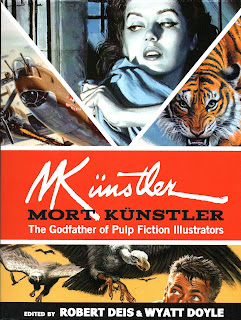
Mort Kunstler - The Godfather of Pulp Fiction Illustrators

Mort Künstler – The Godfather of Pulp Fiction Illustrators

Edited by Robert Deis & Wyatt Doyle


My daughter bought this for me for Christmas.

There are 110 pages; the first ten comprise illustrated text – reminiscences by Mort about how he got into the illustrating business. For many years he’d turn out three covers and two interior illos for men’s adventure magazines. He also worked for other publishers at the same time, ‘twelve-hour days, fifteen-hour days, sometimes seven days a week.’

The remaining pages are full colour full page paintings full of action from magazines between 1952 and 1972. He also produced lots of film posters for adventure films such as The Poseidon Adventure and The Hindenburg, as well as advertising promotions and then broke into historical paintings for The National Geographic.

He relates that the word 'künstler' means ‘artist’ in German.


If you appreciate art, this book is an excellent addition to your collection.