Search This Blog

Showing posts with label #artist. Show all posts

Tuesday, 8 February 2022

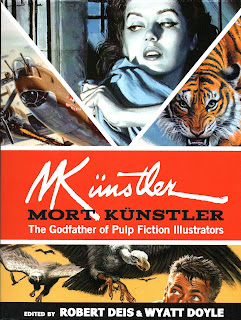
Mort Kunstler - The Godfather of Pulp Fiction Illustrators

Mort Künstler – The Godfather of Pulp Fiction Illustrators

Edited by Robert Deis & Wyatt Doyle


My daughter bought this for me for Christmas.

There are 110 pages; the first ten comprise illustrated text – reminiscences by Mort about how he got into the illustrating business. For many years he’d turn out three covers and two interior illos for men’s adventure magazines. He also worked for other publishers at the same time, ‘twelve-hour days, fifteen-hour days, sometimes seven days a week.’

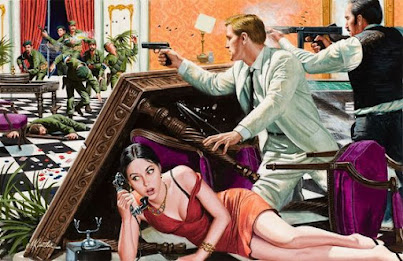
The remaining pages are full colour full page paintings full of action from magazines between 1952 and 1972. He also produced lots of film posters for adventure films such as The Poseidon Adventure and The Hindenburg, as well as advertising promotions and then broke into historical paintings for The National Geographic.

He relates that the word 'künstler' means ‘artist’ in German.


If you appreciate art, this book is an excellent addition to your collection.

Friday, 25 January 2019

Book review - Incident on Ath (Dumarest 18)


E.C. Tubb’s eighteenth book in the Earl Dumarest galaxy-spanning saga is Incident on Ath.

But first, some background:
The Dumarest novels are set in a far future galactic culture that spread to many worlds. Earl Dumarest was born on Earth, but had stowed away on a spaceship when he was a young boy and was caught. Although a stowaway discovered on a spaceship was typically ejected to space, the captain took pity on the boy and allowed him to work his passage and travel on the ship. By the time of the first volume, The Winds of Gath, Dumarest has travelled so long and so far that he does not know how to return to his home planet. Perplexingly, no-one has ever heard of it, other than as a myth or a legend. It’s clear to him that someone or something has deliberately concealed Earth’s location. The Cyclan, an organization of humans (cybers who are surgically altered to be emotionless, and on occasion they can link with the brains of previously living Cyclans, in the manner of a hive mind process, seem determined to stop him from locating Earth. The cybers can call on the ability to calculate the outcome of an event and accurately predict results.

An additional incentive for the Cyclan to capture Dumarest is that he possesses a potent scientific discovery, stolen from them and passed to him by a dying thief, which would inordinately amplify their already considerable power and enable them to dominate the human species. Also appearing in the books is the humanitarian Church of Universal Brotherhood, whose monks roam many worlds, notably every world where there is war.
***

Incident on Ath (1978) is a self-contained adventure; it begins on the planet Ath, with a gifted artist, Cornelius, and his sensual sponsor Ursula; he craves perfection in his art and she is prone to taking a drug that offers her temporary oblivion.

On the planet Juba Dumarest rescues a woman, Sardia, from attack. She is a retired ballet dancer, now dealing in artwork and artefacts. She is grateful and takes him back to her apartment. ‘Asleep she was more beautiful than awake, small tensions eased, muscles relaxed, the hand of time lifted from brow and cheek and the corners of the eyes. The mane of her loosened hair lay like a serpent over the pillow… In her throat, beneath the rich olive of her skin, a small pulse beat like a tiny drum.’ (p35) Here, in the apartment, among her collection he spots an intriguing painting – a scene depicting a familiar sight. ‘The moon he had seen when a child on earth’ (p26). Dumarest learns that the painting comes from Ath.

Also on Juba is a Cyber Hine; at puberty he was operated on: an adjustment to the cortex which took from him the ability to feel emotion… Yet Dumarest cleverly evades the cyber with Sardia’s help.

He and Sardia arrive on Ath to find there are no taverns, no hotels. To obtain accommodation you have to be a guest. Guests are bid for by the populace. They have little choice but to go along with the local custom. Dumarest becomes the guest of the woman Ursula – who reveals that she knows of earth! Sardia is the guest of Cornelius… 

Cornelius tells Sardia about the creative impulse, applicable to writers as much as artists: ‘You get an idea, a concept, and you work on it until, within your mind, it is there in its final accomplishment. A work complete in every detail. Then comes the need to communicate and so the necessity of taking that image from the mind and setting it down on canvas…’ (p86) ‘A determination to pursue the demon which plagued him; the creative madness which cursed all true artists. A thing they carried as a burden and a dread, hating it, fearing it, owned by it and totally possessed by it.’ (p88).

As a dancer, Sardia empathises. ‘No dance could be given a personal interpretation without confronting the same devils which tormented every creative artist. The compromise. The limitation of the medium involved. The hopes and aspirations and, always, the sickening knowledge of failure.’ (p86)

Dumarest saw the parallels between Cornelius and himself. ‘Yet the quest was a search and both men sought, in their own way, to find the same thing. The truth… A painting finished – a world found.’ (p89)

As always, Tubb was inventive – ‘The cube itself provided the music…’ (p103) – this written long before the devices we now have in the twenty-first century.  

There are two cultures on Ath – ‘the Choud make the decisions and the Ohrm obey. Anything else is unthinkable.’ (p141) Only there are factions who are intent on overthrowing the Choud, though those in power seem incapable of conceiving any kind of rebellion… Arrogant, uncaring, incapable of listening, the Choud are in for a surprise – as will be the reader when the devastating truth is revealed.

A fast-paced moral tale about the over-reliance on computer systems with plenty of insights into the human condition.

Note:
A pity the blurb writer didn’t read the text more closely. The back cover states ‘His rail led to Ath – and to the ominous forces of the Cylan’ when it should be Cyclan! Oh, well…

Editorial comment
In the text we have: ‘… the forearm pressed against her windpipe as the snort of the laser he held pressed against her temple.’ (p174) Of course this should be ‘snout’ not ‘snort’ and there are ways to avoid repeating ‘pressed against’…

Monday, 10 October 2016

Book review - Becky


E.V. Thompson was a very popular storyteller with over forty historical novels to his name. Becky was published in 1988.

Impecunious artist Fergus Vincent arrives in Lewin’s Mead, a slum area in Bristol in the early 1850s. He’s seeking a friend and mentor, Henry who lives there. Henry told him ‘A good artist is accepted wherever he chooses to work, but he must observe the rules there – their code. Break that code and he might as well pack up and leave.’

Fergus virtually trips over an urchin as he’s seeking his friend. Becky, the unkempt girl of about fourteen summers offers to take him to the attic room, informing him that Henry died from alcoholism, owing rent. On their way, Fergus is involved in an affray with the blackguard bully Joe Skewes and barely escapes, thanks to the intervention of Becky. The Skewes family will haunt his life for a long time afterwards…

With Becky’s aid, Fergus finds his friend’s abode, which is filled with drawings and paintings that will serve to pay for the outstanding rent. On an impulse, Fergus decides to rent the room himself.

Thompson immerses you in the story immediately, with plenty of colourful description and characterisation and humour. His landlady, Ida Stokes is a hard case but with a good heart. Becky soon realises that Fergus has considerable artistic talent when he quickly sketches her admiring some birds outside the attic window. This first sketch will become a much-prized painting much later. Becky is bold, irreverent and says what she feels. ‘You’ve drawn the me that’s inside. Not the me that other people see…. I’m not sure I like it.’

Having been invalided out of the navy, Fergus hasn’t a lot of money. That’s why he elected to live in this attic room, as it was cheap. He grasped the idea that he would sketch the people of the slums, those on the dockside and in the taverns, and perhaps he could earn enough to live off his efforts.

Gradually, he becomes accepted by the local populace, the police, and particularly Becky. There’s nothing untoward between him and the girl, but he does become very fond of her and sketches her a great deal. At one point, he comes into contact with Fanny Tennant, the daughter of an alderman and a teacher of poor children. Fanny becomes his champion, wanting him to succeed in his art. Unfortunately jealousy is aroused in Becky’s breast and problems arise. 

Throughout, Thompson presents the unpalatable but real situation for the slum dwellers. There are good souls who want to help, like Fanny. But it seems that the majority of the Bristol upper class would rather turn a blind eye. This is brought to a head when Fergus gets involved with the plight of a number of Irish immigrants who become prey to cholera. Women and children die, and they’re shunted out of the area, without much medical aid. Fergus recorded their harrowing ordeal with his sketches and managed to prick many a conscience.

The relationship between Fergus and Becky is fraught with obstacles, and their friends suffer too. There do not seem to be any easy answers; how do you pull yourself out of the slum environment and make something of your life? For able-bodied men, they could join the army or navy, but for the women, there was little hope. Thompson captures the despair and the injustice of the time. 

Here’s Fergus’s viewpoint as he approaches a pawn shop with one of his paintings: ‘There were many varied items offered for sale, each one mute evidence of human failure, carrying price-tags that put a pathetic value on heartbreak and poverty. Wedding rings were here aplenty, with brooches and bangles. Few were of any great value, but most had meant far more than money to their late owners…’

The ending is not a happy one. Yet there is a sequel, Lewin’s Mead (1996) which returns to the travails of gutsy Becky in the slum. I have yet to read that, but the romantic in me hopes for a happy ending, even if real life at that time probably had very few of those.

E.V. Thompson can always be relied upon to tell a good tale, whether that's embedded in social deprivation or conflict. He died in 2012, aged 81.

Thursday, 21 May 2015

Glen Orbik - R.I.P.

Readers of Hard Case Crime will be familiar with the artist Glen Orbik. His output was outstanding, much of it harking back to the old pulp and noir covers of yesteryear. He died on 11 May, aged 52, too young to go. 

You can appreciate his work at his website here


My thanks to Paul Bishop for drawing my attention to this ‘In Memoriam’ article which features twenty covers by Orbik plus links to his artwork:


Here are some of his book covers I’ve scanned from my library: