Search This Blog

Showing posts with label speculative fiction. Show all posts

Monday, 7 February 2022

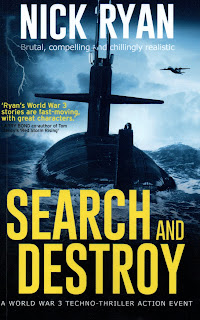
SEARCH AND DESTROY - Book review


Nick Ryan’s sixth book in his World War III techno-thriller series is gripping stuff. Where the earlier books relate to combat in Europe, this one concerns submarine warfare in the Pacific against China.

Commander Chris Coe is an old-school submariner and is abrasive with regard to his XO, Richard Wickham, so we have two types of conflict – personal and military.

The nuclear boat Oklahoma City is tasked with searching for a Chinese convoy and destroying it. The technical details seem authentic: the tension is raised as the vessels employ counter-measures, guile and gutsy experience.

Interestingly, Ryan’s website gives a blow-by-blow account of WWIII – without recourse to nuclear weapons! He must have been prescient, anticipating the January 2022 announcement from the five powers that they would not resort to nuclear weapons in any conflict!

The website is www.worldwar3timeline.com – and it makes fascinating reading. Gradually, he appears to be writing thrillers of similar length based on this timeline.

Let’s hope it all stays as fiction.

Editorial comment

Nothing that follows spoiled my enjoyment and appreciation of the book. However:

I bought the paperback so my comments relate to that; some of the comments won’t apply to the e-book version.

The cover is excellent. However, there’s no text on the spine. This mitigates buying/collecting any others in the series as they'll all be 'anonymous' on my bookshelves!

As this was published on Amazon, I must assume Mr Ryan is using Kindle Direct. Any book published in this system can have spine text if the page-count is in excess of 130. This book has 185 pages; so no excuse.

There are no page numbers! (I agree, this doesn’t matter for an e-book). The new KDP process requires creating an e-book first. But the text that is loaded can contain headers and footers, including page numbers; the second process is converting to a paperback where these features will show in the paperback. [Check out my book Mission: Khyber, a psychic spy novel in paperback and e-book, which shows how it can be done.]

Chapter headings are cramped and amateurish.

Typos listed below aren’t traceable by page number – see above!

‘dressed in hiv-viz colored vests’ should be ‘hi-viz’.

It may be different in the US Navy, but certainly in the Royal Navy, when referring to the 24-hour clock, only the number is used: 2300 – not ‘2300 hours’. The British army and air force use the suffix ‘hours’ however.

‘loosen the reigns’ – should be ‘reins’ [occurs more than once, I think]

‘computer-like monitor’ – surely it should simply be ‘monitor’?

‘carried a compliment of largely outdated torpedoes’ – should be ‘complement’ [this occurs twice]

‘sober expressions on his officer’s faces’ – this should be ‘expressions on his officers’ faces’ – there’s more than one officer so the apostrophe follows the ‘es’.

‘men poured over the imagery’ – should be ‘pored’.

‘Code strode into the wardroom’ – should be ‘Coe’.

‘tone was edge with frantic desperation’ – should be ‘edged’.

‘taut and nerve-wracking minutes’ – should be ‘nerve-racking’ (as if the nerves are on a rack; wrack is seaweed)


Friday, 7 January 2022

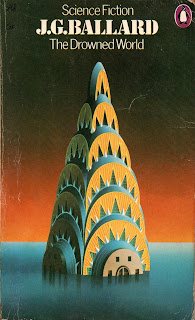
THE DROWNED WORLD - Book review


Although J.G. Ballard had many short stories published, it was his second novel, The Drowned World, published in 1962 that established him as a writer of note, infusing his work with the emotional significance of ravaged landscapes and destroyed technology.

Dr Kerans was among a group of scientists studying the effects of the Earth’s transformation. Some six decades earlier severe solar storms stripped away much of the ionosphere and left the planet prey to increased solar radiation, which resulted in the polar ice melting and the oceans rising. Now, he and the team – comprising Dr Bodkin, Lieutenant Harman, Colonel Riggs, Beatrice Dahl and several troopers – dwelled on a waterborne testing station in a sunken London which more and more resembled the Triassic age. ‘Like an immense putrescent sore, the jungle lay exposed below the open hatchway of the helicopter.  Giant groves of gymnosperms stretched in dense clumps along the roof-tops of the submerged buildings…’ (p53). There were islands of silt, where exotic plant-life thrived and alligators roamed as their primordial ancestors had aeons ago. ‘A thick cloacal stench exuded from the silt flat, a corona of a million insects pulsing and humming hungrily above it…’ (p61) Enclaves of the surviving population existed in the northern pole area.

Confusing disorientating dreams invaded the group’s consciousness, while waking and sleeping. Kerans believes humankind is regressing mentally to a prehistoric age, doubtless affected by the heat of the sun, minds entering ‘time jungles’ of uterine dreams, submerging into their amniotic past, experiencing archaic memories: ‘However selective the conscious mind may be, most biological memories are unpleasant ones, echoes of danger and terror. Nothing endures for so long as fear.’ (p43)

What set Ballard apart from a lot of his contemporary sci-fi writers was his mastery of the metaphor and his ability to describe in effective detail the cataclysmic worlds he envisaged. Such as: ‘like the heady vapours of some spectral grail.’ (p46). Or: ‘Overhead the sky  was vivid and marbled, the black bowl of the lagoon, by contrast, infinitely deep and motionless, like an immense well of amber.’ (p47) And: ‘Now and then, in the glass curtain-walling of the surrounding buildings, they see countless reflection s of the sun move across the surface in huge sheets of fire, like the blazing faceted eyes of gigantic insects.’ (p40)

Not a great deal happens, perhaps echoed here: ‘… a white monitor lizard sat and regarded him with its stony eyes, waiting for something to happen.’ The heat, the humidity, the pressure on the brain, all combined to wear them all down: when it came time for Riggs to move the team north, there was considerable reluctance to go: the ennui of lotus eaters corrupted their reality. However, escape, conflict and encounters with renegade groups liven things up.

Like many of his tales, this book depicts the gradual disintegration, both physically and mentally, of a man. Significantly, Ballard uses the phrase ‘Day of Judgement’ twice.

Interestingly, when Ballard writes ‘Staring out over the immense loneliness of this dead terminal beach, he soon fell into an exhausted sleep’ (p168), he is using the title of a short story published in New Worlds in 1964: ‘Terminal Beach’, which later became the title of a collection of his stories.

Editorial comments:

Two main protagonists are Kerans and Riggs – both names ending with an ‘es’. There’s nothing wrong with this, but some writers tend to avoid adopting such names, primarily because of the possessive apostrophe – Kerans’s or Kerans’, for example – which can appear clumsy.

‘… a warning shell from his flare pistol.’ (p31) ‘Warning’ seems incongruous since flares invariably were used to signal distress, not a warning.

Good to see he uses the phrase ‘he murmured to himself’ (p34) instead of the ludicrous but ever popular phrase among many published writers, ‘he thought to himself’.

 ‘He was talking to Beatrice and I when it happened…’ – should be ‘Beatrice and me’.

‘His bare feet sank into the soft carpeting…’ (p149), This would be disastrous for his bare feet, as the place had been seriously vandalised with broken glass everywhere!

Wednesday, 14 October 2020

THE SECOND SON - Book review

THE SECOND SON

Charles Sailor


Published in 1979, it has taken me forty years to get round to reading this challenging and excellent novel on my bookshelf.

Friendly, helpful charitable construction worker Joseph Turner is working on a 24-storey skyscraper when he saves the life of a friend, but in so doing falls to certain death. Miraculously, he survives the fall and thereafter he has to come to terms with his new-found powers, including his ability to heal. Within a short while he has an immense following. Joe realises that he cannot single-handedly help everyone. He asks people to find their own inner strength and to help themselves. A mixed message, at best.

The Pope seems to accept the possibility that Joe might be a – or the – Messiah, but others in Rome are not so sure. Powers in Rome and in Washington DC see Joe as a threat and a hired killer is despatched to deal with Joe.

A riveting story (no pun intended) that poses the question: What would we do if a new Messiah did walk among us? There are several poignant moments and heartfelt grief. Joe made a difference. Maybe that is all any of us can ask.

It was optioned as a movie but it was never made.

Tuesday, 13 October 2020

LAST LIGHT - Book review

 LAST LIGHT

Alex Scarrow


A disaster novel published in 2007. It begins with a mystery in a New York hotel in 1999 and then moves to ‘the present’ where within the space of a week modern life as we know it crumbles. 

Andy Sutherland is a civilian engineer in Iraq when the oil wells in the Middle East are destroyed. Virtually simultaneously, others round the world are hit. Back in London, Andy’s wife Jenny is in Manchester for a job interview while their daughter Leona is at university and their young son Jacob is at boarding school. Andy swiftly realises that the concerted attacks on the oil supply are the beginning of a massive global disaster He warns his family to get together and stockpile food and water before people realise what is about to hit them.

Scarrow manages to keep the pages turning, also introducing an added threat: his email to Leona was intercepted and links back to that time in the NY hotel… Leona had recognised someone then which now makes her a high risk for some very powerful people.

The chapters are short – all ninety of them – and inject pace and anticipation as law and order dissolves and society disintegrates. Pitched against rebel forces, Andy and his small contingent have to fight their way out of Iraq. He desperately needs to get to his family, while his family are left to contend with looters and rioters. There are many tense moments for all involved.

There’s a lot of swearing, probably appropriate, considering the individuals and the dilemma they face: a global oil shortage. There’s also a conspiracy involved, similar to that posited in the film Batman Begins (2005). Since the book was written, the UK’s reliance on imported oil has diminished slightly; wind turbine power is proving a good alternative and at least the US has since become self-sufficient with its massive shale oil business…

There is a sequel, After Light (2011).

Thursday, 12 November 2015

FFB - All the Sounds of Fear

The 1973 Panther paperback was the first British publication of this collection by Harlan Ellison. It comprises eight short stories previously published in magazines from 1956 to 1967. Considering that he was twenty-two when the first of these stories was published, it’s not surprising that he garnered much praise – and awards. On the back cover he is described as ‘one of the most explosive talents in science fiction today’, ‘a non-stop controversialist’ and ‘the bête noire of science fiction.’

Harlan Ellison wears his heart on his sleeve; that’s no bad thing: he has a good heart, even at eighty-one. He admits to possessing an abrasive personality, but that has no bearing here; it is his work that matters.
 
In his introduction to this book (1970), Ellison is not hopeful about our planet and human evolution: ‘we have created for ourselves a madhouse of irrationality and despair.’ Surprisingly, perhaps, we’ve survived, after a fashion, some forty-five years since; as for ‘irrationality and despair’, he could have prophetically been thinking about the ravings and cravings found in social media.

Not alone among authors, he believes that writers can make a difference: ‘The creative intellect struggles against this sorry reality… It would seem only the mind of the madman is free… And even so the artist persists… in hopes that cautions may be flung on the wind and somehow still be heard.’ He states that this collection of stories, written over a decade or so, is dominated by the theme of alienation. However, he is a romantic at heart, and still believes ‘we find hope within ourselves.’

Perhaps one of the most anthologised of his stories is the first here, ‘I Have No Mouth, and I Must Scream’ (1967), which won a Hugo Award. It’s the future and the supercomputer AM feels trapped because though he had sentience, he couldn’t do anything except simply be. In a rage, he had destroyed humankind, save for five who he would torment for all eternity. ‘He was Earth and we were the fruit of that Earth and though he had eaten us, he would never digest us.’ They couldn’t attempt suicide, either; they were to all intents immortal, and damned.

‘The Discarded’ (1959) is from the viewpoint of Bedzyk, one of many incarcerated in a space vessel, ‘a raft adrift in the sea of night’. Everyone on-board was a mutant of some description – not X-Men with superhuman powers, simply possessors of additional limbs, eyes, heads, and therefore outcast. All as a result of a terrible contagion on Earth. Once normality had resumed, those who looked different were outcast, set adrift in space, unwelcome on no inhabited station or planet.

‘Deeper than the Darkness’ (1957) concerns Alf Gunnderson who is released from prison for a special task. He was imprisoned because he accidentally started a forest fire with his mind. Now, however, the authorities wanted to put his ‘gift’ to use, to end a war. Alf was in a quandary: ‘What of the people who hated war, and the people who served because they had been told to serve, and the people who wanted to be left alone? What of the men who went into the fields, while their fellow troops dutifully sharpened their war knives, and cried?
            ‘Was this war one of salvation or liberation or duty as they parroted the phrases of patriotism? Or was this still another of the unending wars for domination, larger holdings, richer worlds. Was this another vast joke of the Universe, where men were sent to their deaths so one type of government, no better than another, could rule?’ A novella about conscience and power.

‘Blind Lightning’ (1956) finds us with old spaceman Kettridge stranded on an inhospitable planet with an enormous ravenous beast that happens to speak telepathically in his language... Quite a moving little parable, about redemption and ‘first contact’.

‘All the Sounds of Fear’ (1962) is an interesting story, first featured in The Saint Detective Magazine. Richard Becker is an extraordinary actor – he seems to not only live the stage part, but to become the character he portrays in every way, no matter what the source, historical or contemporary. Until that dark day when he emulated a character to a murderous degree and was sectioned to be studied by doctors. While in the sanatorium Becker transgresses, becoming each part again, from the most recent to the earliest. A stunning end awaits.
 
‘The Silver Corridor’ (1956) is about egomania, where two  powerful men vie to be proved ‘right’ and the other ‘wrong’ regarding the latest theory. They are thrust into a special corridor that stretches reality to the limits, where they contest in many varied duels to better each other. Of all these stories, this is the weakest, though it has plenty of colour, time-shifts, action and excitement.

‘“Repent, Harlequin!” Said the Ticktockman’ (1965) won Ellison several awards and is believed to be one of the most reprinted short stories in the English language. It is a tongue-in-cheek critique of a dystopian system and in particular of lives being ruled by the clock. In the dystopia depicted, everybody had a schedule to keep; lateness was punishable, ultimately by being switched off – everybody was fitted with a cardioplate that the Timekeeper could make inactive. Unfortunately for the system, Everett C Marm wasn’t punctual and revelled in disturbing the smooth running of the day, causing schedule mayhem while disguised as a harlequin. The mysterious Harlequin became ‘an emotionally disturbed segment of the populace’.

Ellison’s distinctive style is evidenced here, for example: ‘And so it goes. And so it goes. And so it goes. And so it goes goes goes goes goes tick tock tick tock tick tock and one day we no longer let time serve us, we serve time and we are slaves of the schedule, worshippers of the sun’s passing, bound into a life predicated on restrictions because the system will not function if we don’t keep the schedule tight… Until it becomes more than a minor inconvenience to be late. It becomes a sin. Then a crime. Then a crime punishable by (death).’ In essence, if a person was ten minutes late, then those minutes were deducted from that person’s life-span.
 
The book ends with ‘Bright Eyes’ which is anything but bright, for it is the end of the world. The last survivor – who came before Man – witnesses the utter waste of resources and life. An apocalyptic tale, with bruising and impressive imagery, and no hope.

And of course Ellison ends this collection with ‘no hope’ in the belief stated in his Introduction that his ‘cautions may be flung on the wind and somehow still be heard.’