Search This Blog

Showing posts with label #Soviet. Show all posts

Saturday, 11 February 2023

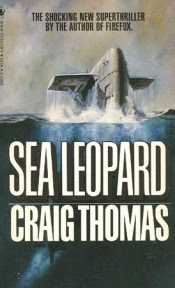
SEA LEOPARD - Book review


Craig Thomas is on top form with his seventh novel, the thriller
Sea Leopard published in 1981.

This adventure again features Kenneth Aubrey, Deputy Director of British Intelligence, and Patrick Hyde, one of his field agents.

The book begins with a map of the North Sea, UK, Scandinavia and Russia and the Barents Sea. This is followed by documents from Plessey, the weapons manufacturer, the SIS, Ministry of Defence and the US Navy Defence Department, all relating to the installation of a new anti-sonar system for submarines, ‘Leopard’.

The nuclear submarine HMS Proteus has the system installed and is running trials at sea when a distress call is detected.

At about this time a search was underway for Leopard’s inventor, Quinn, who has gone missing. Hyde is attempting to track down Quinn. Soviet agents are attempting to abduct Quinn’s daughter, Tricia, in the hope that she will lead them to Quinn’s whereabouts.

The distress call is a trap and the captain of Proteus, Commander Lloyd falls for it.

The tension mounts as a number of Soviet surface ships and submarines play cat-and-mouse with the Proteus – for their sonar is incapable of detecting the British submarine, thanks to ‘Leopard’.

Ingenious methods are deployed by Russian Valery Ardenyev, office in charge of the Soviet Underwater Special Ops Unit to incapacitate the submarine and take the crew captive and then learn everything about the Leopard system.

A rescue mission is then mounted by Aubrey, using USN special agent Ethan Clark.

The suspense mounts, switching from Hyde’s search in England, Ardenyev’s bold assault in inclement weather, Aubrey’s altercations with Ministers and the Navy’s hierarchy, Commander Lloyd’s concern for the safety of his vessel and crew, and Clark’s near-impossible mission on the edge of the Arctic Circle.

 A gripping thriller that time has not spoiled in the slightest. 

Saturday, 11 November 2017

'Impressive collection'

On Goodreads you'll find a review of my first short story collection, Gifts from a Dead Race (2017). Each of the 18 sci-fi/horror/fantasy tales prompts commentary. The last of the stories in this collection is 'A Gigantic Leap' (originally published in 2009).


A Gigantic Leap
Nik Morton ends on the best story in the collection. Yes, it’s alien bacteria premise might seem a little derivative, but the Soviet setting makes a refreshing change – particularly as it’s not railing against the system, just two people getting on with their lives. It’s an incredibly tense piece, but one that leans more to hope than tragedy. And hope is always a good way to end a big, impressive collection like this.


...
and on this Remembrance Day it is as well to foster hope for the future that, sadly, so many would never see.

Thursday, 28 July 2016

Book review plus - LIFE IN RUSSIA


Michael Binyon’s view of Russia, published in 1983 is useful for my research purposes, as I certainly wasn’t able to go there at the time (since I was serving in the RN). Binyon was a correspondent for The Times 1978-1982.

Naturally, since the wall came down in November 1989 and the USSR dissolved in December 1991, much has changed. Yet the people are probably not that different now.

The book is written with genuine warmth for the Russian people. He uses the term ‘Russian’ to simplify the fact that the USSR is a vast mixture of countries, cultures and ethnic groups. Some of the statements are prescient, though at the time of writing Binyon never conceived the breakup would occur. ‘The Soviet Union is a world of its own. But it is a world its rulers ever fear will fly apart into disparate fragments unless they keep a very tight grip.’ (p4)  Here and elsewhere, with hindsight you could easily substitute the European Union to observe strong parallels!

The recent doping scandal relating to the Olympics springs to mind when I read this entry:
 ‘Russians respect power and authority, and most have a bully’s instinct to walk all over anyone who is servile and obsequious. The best way of doing business is to make your position and determination clear from the start, negotiate toughly but politely and ensure that face is not lost…’ (p4)

And this has bearing, perhaps: ‘To a Russian, saving face is of great importance, and this Eastern characteristic colours not only individual actions but policies and attitudes in dealing with other countries. Indeed, many national policies can only be understood by reference to the Russian character.’ (p136)

For many years I was puzzled by the British trade unions’ affectionate dalliance with the USSR. Naturally, the Soviet authorities were keen to foster disruption in the West, and even suborned certain trade union members to do their bidding. Yet the picture, beyond the ‘official’ image presented to visiting union comrades was far removed from the freedoms enjoyed in the West:

‘Not one of the estimated 130 million Soviet trade unionists has ever gone on strike.’ (p27) One has not to wonder why. In 1977 a number of sacked workers got together to form an ‘independent’ union. The KGB exiled the leaders from Moscow, questioned, harassed, arrested and sent several to psychiatric hospitals. Three years later, the rise of Poland’s Solidarity movement caused Brezhnev to launch an attack on union officials for laziness and indifference to their members’ needs, turning the union leaders against their unions, using the unions to police their members in effect, for the communist cause. This was typical Russian double-think.

The union can be a deadening influence, stifling innovation, free thinking. ‘The task of the officially organised unions of artists, writers and musicians is not to promote their members’ interests, but to ensure their members stay in line.’ (p113) ‘All land in the Soviet Union is nationalised’; people can own homes, but not the land.

The propaganda had it that the country benefited from full employment. Yet there were thousands of workshy (many with false documents who have abandoned families and responsibilities). ‘Factories are only too glad when poor and disruptive workers quietly disappear. Rather than report their absence,  they allow their names to remain on the factory register, thus conveniently enabling the factory to draw state money for salaries, which are diverted straight into the management’s pockets to be used for the inevitable bribes and pay-offs.’ (p33)

I wonder how many 1980s Marxist-Leninist students would have been keen to study in the USSR. ‘University or college graduates are sent to remote villages for the obligatory two year first posting which every Soviet student faces at the end of his studies. For many, it is like banishment.’ (p196)

I was also interested to read: ‘The Academy of Medical Sciences has long been carrying out full-scale research into para-psychology, telepathy and bio-rhythms, a favourite topic of popular scientific journalism.’ (p53) See my earlier blog posts on Soviet psychic research.

Drunkenness was a big problem and accounted for absenteeism and accidental deaths, and marital and family breakdown.  ‘In the Ukraine, several mines run daily checks for inebriation among the miners as they report for work. Traffic police have also urged tougher penalties for drunken driving, which is already severely punished, and in recent years a number of people causing fatal accidents while drunk have been shot.’ (p63) Severe punishment indeed – but did it reduce the incidence of drunk driving? The book doesn’t say – and doubtless statistics were not available.

The Russians are avid readers, though found it difficult to get their hands on books (other than official tracts, presidential speeches and the like. I can’t imagine poets filling Wembley Stadium, yet Poet Andrei Voznesensky gave a reading to 80,000 people in a football stadium. ‘His latest collection was published in an edition of 200,000 and sold out immediately.’ (p109) Sales to dream about, indeed!

Voznesensky would retreat to the Georgian village of Peredelkino, south of Moscow. This is the official writers’ colony. Pasternak lived here for many years and is buried in its cemetery. Binyon spotted a man in a grey raincoat standing near the monument (to Sergei Yesenin, poet, Isadora Duncan’s lover); the man took off his hat and recited some of Yesenin’s poems. Others present clapped. This echoed in my mind – scenes from Fahrenheit 451.

Greek myths and Herodotus were best-sellers; new editions of Tolstoy sold out immediately. ‘Even during the anniversaries of Tolstoy’s birth, or Dostoyevsky’s, their works could not be found. Pushkin, Gogol hard to find…The most heavily forested country in the world has to limit its newspapers to four or six pages because of the paper shortage… painful lack of toilet paper, a commodity that has achieved an almost mystic value to those who tire of the discomfort and irony of using Pravda..’ (p170)

Surprisingly, perhaps, the Soviet press was campaigning, hard-hitting and effective, not afraid to hound racketeers and the guilty – according to the party line. Appeals in the paper Pravda could work: a resident of a village where the only shop was closed complained; a party delegation investigated and within hours a shop was opened there…

Soviet historians estimate 20 million Russians perished in The Great Patriotic War (WWII). In the Ukraine alone 20,000 villages were destroyed. ‘Even now at least half a dozen elderly people are shot each year for war crimes or collaboration with the Nazis.’ (p125)

Party members and grandmothers alike state: ‘Let there be no more war’ and the toast at every official dinner is always ‘to peace’. I’d be inclined to believe that this is still the same now; the people don’t want war, but they don’t want to be walked over either…

Binyon wrote about the little Byelorussian village of Khatyn where The Black Death SS herded 74 adults and 75 children into a barn, doused it with petrol and set it alight. One man was away at the time; Joseph Kaminski returned to find his young still alive among the charred bodies. He picked him up and the boy died in his father’s arms… a bronze statue of Kaminski carrying his dying son and staring in blank horror straight ahead stands at the entrance to Khatyn (where nobody now lives).  This is not to be confused with Katyn, where Polish officers were massacred by Stalin! (p126)

Most Russians accepted the official version of the war: it was a Russian victory over fascism, and the Soviet intervention in Manchuria forced the Japanese to surrender; there was no mention of the atomic bombs… Little or nothing was ‘said or written about the extensive American war aid, or the British convoys to Murmansk. No official memorial has been erected in that Arctic city to the allied sailors who lost their lives.’ (p127) [Since this was written, Russia pressed for the Arctic convoy veterans to be honoured with a Russian medal, but government intransigence didn’t permit it – until 2013, a year after they were belatedly presented with the British Arctic Star.]

Binyon refers to a book Through Russia on a Mustang (1891) by Thomas Stevens and offers a brief excerpt, which offers traditions, beliefs, and adventures of a witty character. It was out of print when quoted. Happily, there are several reprints available now; here’s one

There’s a brief mention of Mikhail Gorbachev, ‘the young agricultural expert in the politburo, has distanced himself from the food programme, and is presumed to have pushed for something more radical.’ (p199)

The following two passages strongly suggest the malaise that is the European Union (replace ‘communist party’ and Soviet Union with ‘EU’, perhaps: ‘The communist party is a single, monolithic organisation, and local government has only limited powers. But the Soviet Union is the world’s largest and most diverse multi-national state, and without a very firm structure and tight control at the centre, it would probably split apart into dozens of separate competing units. Regional and ethnic nationalism is strong and is growing, and despite the much-trumpeted official picture of a big, happy, harmonious family, there are tensions and quarrels beneath the surface, which are suppressed only with difficulty.’ (p206)

‘From travels in nine different republics, my impressions were strongly reinforced that the diversity and variety is such that no amount of centralisation can mould a single type of ‘Soviet man’, even if that were the aim – which increasingly is recognised as unrealistic.’ (p206) Homogenising people doesn’t work – they have their culture, belief systems, traditions and history.

Another example comes from Latvia: Russians, Ukrainians and Belorussians flooded into Riga because of the higher standard of living, and brought Russification in their wake. When the non-Latvian population reached 800,000 out of a total of only 2,500,000 in all Latvia, further immigration was stopped.’ (211) Freedom of movement within the USSR (by party pressure) created an immigrant crisis.

And we’ve seen how Russia deals with the fundamentalist Islamic issue. The State’s atheism does not sit comfortably with Islam.  Science and Religion said the home mosques supported social customs that were incompatible with modern social life, including blood feuds, the abduction of brides, the marriage of underage girls and polygamy…’ (p245)

This is a fascinating and thought-provoking book, a glance back in time, when the Cold War was thawing then heating up, as East and West attempted to accommodate the other, neither side wanting more global conflict. The Soviet Union could not sustain its vast empire and it took the realist Gorbachev to understand that. What followed was another completely different ball game – but throughout the period, from the time of this book to the present, the Russian people have found the changes in their lives bewildering and unsettling. Certainly, the independent states seem keen not to go back.


Sunday, 29 May 2016

Book review - In Honour Bound


Gerald Seymour writes about contemporary issues and this one is no exception, being published in 1984 at the height of the Soviet occupation of Afghanistan.This version is 'tenth impression with a new cover, 1990'.

SAS Captain Barney Crispin is meant to train Afghans to deploy Redeye rockets against a Soviet killer Mi-24 helicopter, with the intention of bringing back to the UK secret parts of the crippled craft.  Sadly, their mission goes catastrophically wrong and the guerrillas are killed. Driven by guilt and bloody-mindedness, Barney determines to disobey orders and infiltrate Afghanistan and do the job himself – with the aid of Gul Bahdur, a teenage Afghan boy as guide, and a couple of donkeys. This foray into danger is well told, so we can feel the privations suffered by Barney – and the Afghans he meets.

In parallel with his mission is the dilemma of the Soviet commander in charge of the Mi-24s, Major Pyotr Medev, who is tasked with clearing out the Afghan villages without losing any craft. So far, he’s managed this (and thousands of refugees in Iran and Pakistan attest to it): until one of his aircraft is shot out of the sky…

Another protagonist is Italian nurse Mia Fiori who spends her leave helping the guerrillas in the Panjshir Valley. Unfortunately, this time around she is baulked before she can get there…

Lastly, there’s disenchanted ex-sergeant Schumack, a soldier of fortune who is intent on fighting for the Afghan cause until he dies.

Their paths will cross and they will be in great danger. Pressure pushes Barney to use his Redeye missiles to down a helicopter and retrieve the vital parts before the snows block off half the country. He only has eight missiles. He is begrudgingly accepted by the Afghan fighters, though he has to walk a knife-edge between total rejection and death at their hands.  It’s a battle of wills and wits, leading to a tense showdown.

Research and detail piled on detail lend credence to the story. We feel we were there, in the Soviet airbase at Begram, the dangerous streets of Kabul, the treacherous mountains and passes of Afghanistan.

Seymour never disappoints, though I sometimes feel he unfairly condemns his heroes and heroines in the final stages. I won’t say what happens to the hero of this one; it’s worth reading to find out!


Tuesday, 3 May 2016

A woman with a mission


Tana Standish, a child-survivor of the Warsaw Ghetto, was adopted by a British naval lieutenant and in 1965 joined the British Secret Intelligence Service. She is a psychic with a photographic memory. Each adventure begins with the passing of a collection of papers and manuscripts to the author (Nik Morton) by one of her secret service associates. He then writes down her experiences.

The Tana Standish psychic spy series
The first is The Prague Papers (Czechoslovakia, 1975), followed by The Tehran Text (Iran, 1978), [both of which were previously published (2008 & 2009 respectively), though the latter received minimal exposure as the collapse of the publisher occurred almost at the same time as its release. Both available as Crooked Cat e-books.

At least two more adventures are planned: The Khyber Chronicle – (Afghanistan, 1979/80), a work-in-progress, and The Caldera Cryptogram (Argentina, Falklands, 1982).  

Snippets from 12 reviews of The Prague Papers follow, with sections excised to avoid too much repetition.

Reviews of The Prague Papers

By means of a first person Foreword and Afterword, author Nik Morton employs a nifty ruse to create the impression that his fast-paced spy novel is his rewritten version of a factual story passed to him in the bar of a hotel in Portsmouth, Hampshire, by British ex-agent Alan Swann. The ploy certainly gets matters off to a good start and sets the scene for this novel and a major spy mission into the Soviet controlled Czechoslovakia of 1975.
Enter Tana Standish, a wiry, attractive, all-action female version of James Bond. Once a five-year-old orphaned Polish Jewess adopted by a Royal Navy Lieutenant and his wife, she is not only very fit and lightning fast with her feet and hands—not to mention guns and the other tools of her trade—but she has psychic powers which enable her to see into the minds of her enemies (and friends), virtually regardless of where they are. This has to be the most useful tool a spy could have in her armoury and Tana puts hers to very good use.
… she is invited by her former lover and comrade, Laco Valchik, to return to Czechoslovakia to ‘repair and rebuild’ a spy cell they created in 1968. She’s also about to face some old enemies... Unbeknown to Tana, somewhere in Kazakhstan there are other ‘Psychics’ at work. Indeed, there is a secret psychic listening station there and one of the psychic operatives is inconveniently picking up some of the thoughts and emotions passing through Tana’s mind hundreds of miles away...
Reading this excellent novel is a bit like an extreme sport. The pages fly by at a pace… becoming engrossed in this relentless flow of exciting action and carefully researched information which lasts right up to the climactic denouement—in itself, both satisfying and rewarding—because Morton’s writing is very smooth and totally believable. All-in-all, The Prague Papers gave me that feeling of ‘being there myself’, rubbing shoulders with his characters, and for quite a while after finishing it, I found myself thinking about them and all they had been through. William Daysh, author of Over by Christmas

As well as creating memorable characters (Tana Standish will stay with me for a long time), Morton captures the essence of Prague and the Czech soul, educates us into the world of Eastern Bloc politics, and tells an intricate tale of espionage. As if this weren’t enough, he explores the fields of psychics and telepathy, adding intriguing depth to his story.
Far more than a ‘spy thriller’, this book will astound both lovers of that genre and those looking for a truly satisfying read. – Maureen Moss, editor and travel writer

I found myself in a world of double-dealing and intrigue at a level which made James Bond and Modesty Blaise look like rank amateurs... This Cold War espionage tale was fast moving and had more than one sting in it… This tale is a lively, well written espionage adventure with plenty of twists. – The New Coastal Press

… that’s the plot in a nutshell, but the skilful Mr. Morton does some entrancing work within that results in a gripping read that will enthral the reader to the last page. Interestingly, Morton sells it as a true story passed to him by an agent and published as fiction, a literary ploy often used by master thriller writer Jack Higgins. Let’s just say that it works better than Higgins. – Costa Blanca News, Danny Collins, author of The Bloodiest Battles

Welcome back to the Cold War…. Snatches of John le Carré, Len Deighton and Adam Hall are in effect sewn into the secret weave that runs like a latent thread through the pages of Nik Morton's spy adventure set in Eastern Europe… Morton's heroine, Tana is made of stern stuff and possesses a savant like ability to move out of her consciousness and into an ethereal plane... – Michael Parker, author of The Devil’s Trinity

… an exciting and well-constructed espionage thriller. I do not usually like these sort of books (I prefer horror stories) but I thought that this was an intelligent and nicely-paced story. Morton pays great attention to detail and he has created a memorable heroine with Tana Standish… The year is 1975 and Tana is sent on a special mission to Czechoslovakia … and this sets off an intriguing chain of events and some nail-biting set-pieces as Tana encounters Russian soldiers, ruthless assassins and sadistic torturers… There is plenty of (literally) thought-provoking material thrown in along the way making this an extremely entertaining read. Even if you do not normally like spy thrillers, The Prague Papers is well worth checking out. - Amazon UK, 2010

…Tana Standish… is a brilliant character, being a spy with amazing ability and deadly expertise to easily rival any top spy from previous literary works… the book is spell-binding with great depth and wonderful characters which is on par with any top spy novel, (or any thriller novel for that matter). Nik Morton (has) the ability to make you believe that you are in the story yourself, which is a rare thing. I can honestly say only a handful of novelists have that kind of skill…. – Amazon UK, 2011

… Tana Standish, a female ‘Bond’ is a wonderful, stylish character who carries the story through a roller coaster of chases, shootouts, and devious undercover operations. Highly trained and fearless, she also possesses a psychic ability that gives her an advantage but also places her in the crosshairs of enemies who track her from a secret base in Kazakhstan. The locations are detailed, as are the workings of the intelligence agencies, evidence surely of an in-depth knowledge and extensive research. The pace is full speed ahead and often the subject matter is brutal but I couldn’t look away and I certainly didn’t want to stop reading. If you enjoy Bond or Bourne then you will enjoy this, it just begs to be a movie.
            Well plotted and executed this is a story that held me enthralled and intrigued from the first page to the last...and then I read the epilogue, and I realised just how eye-opening this novel is... – Amazon UK, January 2015

… You are immediately immersed into the action. Ingenious switches of time and place present the back-story without disturbing the flow, and an exciting thriller with psychic undertones takes off. I could not put it down. – Amazon UK, March 2015

Thoroughly enjoyed this. The very opening chapter is a promise of intrigue and suspense. I wasn't disappointed. Good fast pace. Characters that are so vividly and craft-fully developed that I very much felt a part of their lives. I am now in the second of the series for another rollercoaster ride. – Amazon UK, August 2015

… Tana Standish has one more thing going for her: psychic talents. There’s nothing outlandish in the psi-spy’s capabilities – they’re neatly underplayed, a talent which isn’t understood or entirely controllable but which frequently tips the odds in her favour.
            This mild shift into the land of ‘maybe’ is carefully contrasted with the grim, grey reality of life in Czechoslovakia in the Seventies, brought to heel seven years earlier by Soviet tanks, its citizens stifled by the relentless brutal mechanisms of an efficient totalitarian regime. An underground resistance cell has been compromised. Tana is assigned to put the network back together and use her special talents to ascertain if communications have been compromised, or worse.
            The result is a running chase through the back streets and sewers of Prague, where the protagonists barely taste their black bread and spicy sausage between violent and amorous encounters. This isn’t a slow-burn spy story a la Alan Furst where the tension builds over quiet encounters and long railway rides. Instead it’s more of a headlong hurtle through rapid liaisons and botched ops; there’s every opportunity for Tana to show off not just her psi skills but also her street savvy and close-quarters combat.
            For me, the best scenes are the one-on-one confrontations, claustrophobic closed room battles of expert second-guessing. There’s a superb fight sequence which takes place in a pitch-dark living room, where weaponless Tana must defend herself against an armed opponent using her memory, wits, senses and what falls to hand. It’s beautifully choreographed and delivered.
            The finale (is) preceded by a simply chilling chapter, the best in the book, where Tana must marshal all of her mental strength to resist the worst that her opponents employ against her. I also thoroughly enjoyed the scenes in the Soviet psychic investigations unit. Likewise, the author’s attention to detail in his descriptions of Prague, and Tana’s cracking back-story, were superb… In the main, The Prague Papers made for a rollicking read, an intriguing mix of action-adventure, actual events and augmented espionage. There are further Tana Standish novels in the pipeline, which takes place at other pivotal points in political history. I very much enjoyed the overlap in this one between ‘real’ and ‘fiction’... – Amazon UK, October 2015

This was a brilliant read from the exciting beginning right through to the end, the pace constant and the story of the young Tana Standish engrossing…. The story has many dark moments but the writing is sharp and crisp making the more gory bits not too awful for the reader who isn’t into serious pain and bloodshed. The locations are very well described – something I’ve noted with other novels that I’ve read by Nik Morton. His research seems faultless to me as an occasional reader of politically based spy thrillers. Tana is a woman with a mission; in part her drive having been moulded by her background which we glean just sufficiently to make it all believable... – Amazon UK, November 2015

My sincere thanks to all of the above reviewers!

Amazon UK here


Amazon Com here 

The Blurb:
Czechoslovakia, 1975. Tana is a spy - and she’s psychic. Orphaned in the Warsaw ghetto during the Second World War, she was adopted by a naval officer and his wife. Now she works for the British Secret Intelligence Service. Czechoslovakia’s people are still kicking against the Soviet invasion. Tana is called in to restore morale and repair the underground network. But there’s a traitor at work.

And she learns about a secret Soviet complex in the Sumava Mountains. Unknown to her there’s a top secret establishment in Kazakhstan, where Yakunin, one of their gifted psychics, has detected her presence in Czechoslovakia.

When Tana infiltrates the Sumava complex, she’s captured! A desperate mission is mounted to either get her out or to silence her - before she breaks under interrogation.

Friday, 29 April 2016

Writing – research - displaced persons-1


Refugees from conflict have been in the news quite a while. Sadly, it is nothing new, though the scale and the destination of the refugees have altered over time.

While reading To the Frontier by Geoffrey Moorhouse (1984) I came across a number of passages relating to the thousands of Afghan refugees who fled across the border to Pakistan, long before 9/11 and its global repercussions.

Some were not fleeing actual conflict, but they were fleeing for their lives. Because they didn’t conform to an ideology. In this case, the ideology was Marxism, as espoused by the Soviet invaders and their acolytes.
I’m paraphrasing here, mostly:

This concerns a professor who happened to be a dean of literature and social sciences at the university in Kabul when the communist coup took place in April 1978. As time passed, the atmosphere became charged, with aggressive Marxists making life intolerable and work untenable.

When the Russians arrived at the end of 1979, it got worse. The professor became part of an intellectual underground… ‘holding on to certain verities whose validity had been tempered with time; truths which had remained proven after many different kinds of revolution in many lands.’ (p191)

One by one, members of his fellowship had been arrested. The news filtered back to the survivors that, one after the other, their old colleagues had been tortured, had died. The same fate would almost certainly have befallen him if one of his friends talked. His friend had been arrested on the information supplied by one of his own students. As it happened, his friend was tortured to make him implicate others but he stayed silent and died without betraying anyone.

Still, the net was closing in and one night soon after his friend’s death, in February 1980, the professor was visited by some mujahedeen who helped him escape.

The professor only took his reading glasses; everything else he left behind, including his wife and son, who were spirited out of the country three months later.

History can teach lessons, if people bother to heed history. Career, family, and even life – destroyed because you didn’t conform to an ideology. Now, whether that’s fascism, communism, Marxism, or even political correctness, it’s immoral.

Next example of displaced persons will be gleaned from Beyond the Oxus by Monica Whitlock.