Search This Blog

Showing posts with label J.G. Ballard. Show all posts

Friday, 7 January 2022

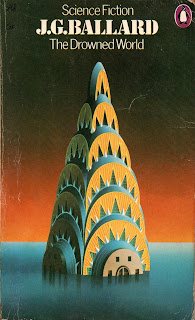
THE DROWNED WORLD - Book review


Although J.G. Ballard had many short stories published, it was his second novel, The Drowned World, published in 1962 that established him as a writer of note, infusing his work with the emotional significance of ravaged landscapes and destroyed technology.

Dr Kerans was among a group of scientists studying the effects of the Earth’s transformation. Some six decades earlier severe solar storms stripped away much of the ionosphere and left the planet prey to increased solar radiation, which resulted in the polar ice melting and the oceans rising. Now, he and the team – comprising Dr Bodkin, Lieutenant Harman, Colonel Riggs, Beatrice Dahl and several troopers – dwelled on a waterborne testing station in a sunken London which more and more resembled the Triassic age. ‘Like an immense putrescent sore, the jungle lay exposed below the open hatchway of the helicopter.  Giant groves of gymnosperms stretched in dense clumps along the roof-tops of the submerged buildings…’ (p53). There were islands of silt, where exotic plant-life thrived and alligators roamed as their primordial ancestors had aeons ago. ‘A thick cloacal stench exuded from the silt flat, a corona of a million insects pulsing and humming hungrily above it…’ (p61) Enclaves of the surviving population existed in the northern pole area.

Confusing disorientating dreams invaded the group’s consciousness, while waking and sleeping. Kerans believes humankind is regressing mentally to a prehistoric age, doubtless affected by the heat of the sun, minds entering ‘time jungles’ of uterine dreams, submerging into their amniotic past, experiencing archaic memories: ‘However selective the conscious mind may be, most biological memories are unpleasant ones, echoes of danger and terror. Nothing endures for so long as fear.’ (p43)

What set Ballard apart from a lot of his contemporary sci-fi writers was his mastery of the metaphor and his ability to describe in effective detail the cataclysmic worlds he envisaged. Such as: ‘like the heady vapours of some spectral grail.’ (p46). Or: ‘Overhead the sky  was vivid and marbled, the black bowl of the lagoon, by contrast, infinitely deep and motionless, like an immense well of amber.’ (p47) And: ‘Now and then, in the glass curtain-walling of the surrounding buildings, they see countless reflection s of the sun move across the surface in huge sheets of fire, like the blazing faceted eyes of gigantic insects.’ (p40)

Not a great deal happens, perhaps echoed here: ‘… a white monitor lizard sat and regarded him with its stony eyes, waiting for something to happen.’ The heat, the humidity, the pressure on the brain, all combined to wear them all down: when it came time for Riggs to move the team north, there was considerable reluctance to go: the ennui of lotus eaters corrupted their reality. However, escape, conflict and encounters with renegade groups liven things up.

Like many of his tales, this book depicts the gradual disintegration, both physically and mentally, of a man. Significantly, Ballard uses the phrase ‘Day of Judgement’ twice.

Interestingly, when Ballard writes ‘Staring out over the immense loneliness of this dead terminal beach, he soon fell into an exhausted sleep’ (p168), he is using the title of a short story published in New Worlds in 1964: ‘Terminal Beach’, which later became the title of a collection of his stories.

Editorial comments:

Two main protagonists are Kerans and Riggs – both names ending with an ‘es’. There’s nothing wrong with this, but some writers tend to avoid adopting such names, primarily because of the possessive apostrophe – Kerans’s or Kerans’, for example – which can appear clumsy.

‘… a warning shell from his flare pistol.’ (p31) ‘Warning’ seems incongruous since flares invariably were used to signal distress, not a warning.

Good to see he uses the phrase ‘he murmured to himself’ (p34) instead of the ludicrous but ever popular phrase among many published writers, ‘he thought to himself’.

 ‘He was talking to Beatrice and I when it happened…’ – should be ‘Beatrice and me’.

‘His bare feet sank into the soft carpeting…’ (p149), This would be disastrous for his bare feet, as the place had been seriously vandalised with broken glass everywhere!

Thursday, 2 February 2017

Book review - The Day Of Creation


For many years I’ve admired the science fiction works of J.G. Ballard, but I’d never got around to reading his non-sf novel The Day Of Creation (1987). I have now corrected that oversight.

The story is narrated by Dr Mallory, who is working for the WHO in an unnamed central African republic, near the River Kotto, yet on the edge of the encroaching Sahara. Inevitably, political and native unrest has overtaken him and the villagers in the guise of General Harare and his guerrillas. Mallory is about to be executed when the arrival of Captain Kagwa and his government troops rout the terrorists.

Shortly afterwards, as a landing strip is being bulldozed by Kagwa’s men, a huge tree is uprooted and water gushes out from the new hole. It doesn’t stop, but steadily floods the area, moving over the land. The blessing of this fresh water’s arrival affects Mallory strangely; he christens the new river with his name. Together with a twelve-year-old girl guerrilla he calls Noon, he escapes from Kagwa and commandeers a boat to head up the new river to find its source. Before long, he is also accompanied by a myopic filmmaker and his assistant.

We’re soon in the territory of an unreliable narrator. Perhaps the first clue is naming the ‘river’ after himself.  ‘The River Mallory. I felt a curious pride. Yet knowing that it  bore my name made me all the more determined to destroy it.’ (p71)  He attempted to defeat the river at the place of its ‘mouth’ but failed, so realised he must find its source in the mountains. Yet, ambivalently, ‘I was eager to see how it would grow and change.’ (p99)

Over time, the river becomes polluted with the rubbish from civilization – fridges, bottles, condoms, and the usual detritus found in a Ballard disaster novel: ‘the aerosol can and the hair-dryer, lying in the sand like objects displayed in a museum of consumer archaeology’ (p220). Is the River Mallory a metaphor for something? Maybe: man creates, then spoils, sullies and ultimately destroys?

Ballard writes ‘literary’ novels – presumably books with profound psychological depth, a message and telling metaphors. Here, there are metaphors on virtually every page. A few are strained, such as ‘I stared at the sleek swollen surface of the river, like the fleshy body of a sleeping woman’ (p112), but the majority tend to work.

Here are a few of his many metaphors:

‘Fires burned fiercely across the surface of the lake, the convection currents sending up plumes of jewelled dust that ignited like the incandescent tails of immense white peacocks.’ (p20)

‘Angry voices crossed the airstrip, an altercation that moved like a skidding stylus from French to German to Sudanese.’ (p50)

‘… cadavers in the dissection room, laid out on the glass tables like the forgotten patrons of a Turkish bath who had waited too long for physicians…’ (p70)

‘The trees leaned over the water, their roots exposed like chandeliers…’ (p92)

‘The huge trees advanced towarfds the water like an army of knights…’ (p92)

‘Hours had slipped by in seconds, falling like dust through the open grilles of my mind.’ (p106)

‘Two metal aircraft hangars stood in the grass, their curved, pockmarked roofs like the hulls of collapsed Zeppelins.’ (p224)

It’s interesting that in one point Mallory refers to Noon as a teenager, yet she isn’t; she’s twelve, pre-pubescent. She is often naked, diving for fish to feed them on their journey up-river, and Mallory seems to lust after her, though whether anything happens in fact is debatable as he becomes disoriented by disease and malnutrition. Bordering on unsavoury territory, here, perhaps.

There are moments of humour, when Noon attempts to learn English by listening to cassette tapes, though these are all Marxist indoctrination lessons for Captain Kagwa! ‘Exploitation!’ becomes her word of warning of danger.

Ballard’s lush description of the jungle and the ‘dream river’, aided by rich metaphor create good visuals, though the characters seem less substantial than the environment, perhaps because they’re translated through the fragile sanity of the narrator. Imagery supplants plot; Ballard’s imagination is seen to be formidable through his revealing prose.

Thursday, 13 November 2014

Loose change in the treasury of fiction

In his introduction to the volume collecting all his short stories, J.G. Ballard states, ‘Short stories are the loose change in the treasury of fiction, easily ignored beside the wealth of novels available, an over-valued currency that often turns out to be counterfeit. At its best, in Borges, Ray Bradbury and Edgar Allen Poe, the short story is coined from precious metal, a glint of gold that will glow for ever in the deep purse of your imagination.’

To continue yesterday’s theme about next week’s UK National Short Story Week, I thought I’d scan my book shelves for the collections by sci-fi and horror authors (a separate set of shelves).

Here I find Brian Aldiss, J.G. Ballard, Anthony Boucher, Ray Bradbury, John W. Campbell, Angela Carter, Harlan Ellison, Jack Finney, Richard Matheson, Cordwainer Smith, Philip K. Dick, Christopher Priest, Clifford Simak, Theodore Sturgeon, James Tiptree Jr (Alice B. Sheldon), Gene Wolfe, Connie Willis and H.G. Wells.
 
 
Aldiss’ title story (see cover) plus two other linked tales were adapted for Spielberg’s film A.I.

 
Jack Finney’s classic novel Invasion of the Body Snatchers has been filmed more than once; yet it’s his beautiful short story ‘I love Galesburg in the Springtime’ that lingers in my memory.
 
 
Science fiction lends itself to the short story form because it’s often the fiction of ideas; though in truth that was in the early days; by the 1960s with the New Wave spearheaded by Moorcock and Ballard, light was shone on the inner space embedded within the human condition.

Some readers are quite insular in their taste, and eschew certain genre writing, which is a pity, because there is a richness of prose and idea within all genres; a good story, about people and emotion can be found in all genre writing; a good story is a good story.

‘I don’t read sci-fi’ is perhaps as common a statement as ‘I don’t read westerns’ or ‘I don’t read horror’. Perhaps these opinions stem from a bad experience with a poor writer within a particular genre. Yet you won’t hear anyone say ‘I don’t read novels’ (well, apart from those who prefer non-fiction!) because this statement is too broad. And that’s the point. Within any genre, there’s a very broad range of style, quality and imagination. Short story collections by an author can introduce you to his or her style, and I believe that any of the above mentioned authors have something like ‘precious metal’ to offer readers who are bold enough to mine these treasures.


Wednesday, 25 September 2013

Dear Editor - rejection

All writers have to get used to rejection. It's a rare writer who has never been rejected. You need to don a thick skin in the morning, especially before the mail arrives (snail or e).

You won't be surprised to learn that many subsequently famous authors received their fair share of 'thanks, but no thanks' notes. Here are a few:

Crash (1973 by J.G. Ballard - 'The author of this book is beyond psychiatric help.'

A Study in Scarlet (1887) by Arthur Conan Doyle, introducing Sherlock Holmes to the world - 'Neither long enough for a serial nor short enough for a single story.'

The Last of the Plainsmen (1908) by Zane Grey - 'I do not see anything in this to convince me you can write either narrative or fiction.'

The Blessing Way (1970) by Tony Hillerman - 'If you insist on rewriting this, get rid of all that Indian stuff.'

The Rainbow (1915) by D.H. Lawrence - 'It is unpublishable as it stands because of its flagrant love passages.'

Peyton Place (1955) by Grace Metalious - 'Definitely too racy for us.'

Animal Farm (1945) by George Orwell - 'It is impossible to sell animal stories in the U.S.A.'

Leaves of Grass (1855) by Walt Whitman - 'We deem it injudicious to commit ourselves.'

and two of my favourites:

The Time Machine (1895) by H.G. Wells - 'It is not interesting enough for the general reader and not thorough enough for the scientific reader.'

The War of the Worlds (1898) by H.G. Wells - 'An endless nightmare. I do not believe it would take... I think the verdict would be "Oh don't read this horrid book".'

However, if you do get rejected, I do recommend you don't respond with any invective or abuse, such as our alien wannabe scribe:
