Search This Blog

Showing posts with label O Henry. Show all posts

Wednesday, 28 October 2015

Writing – Affection for the genre

I’m fortunate in that I enjoy reading books in almost any genre – whether that’s crime, science fiction, fantasy, horror, western, romance or thriller. Not to mention all those sub-genres! To me, the genre doesn’t matter so much; it’s the story that counts.

Recently, a correspondent who was re-reading my genre fiction writing guide (Write a Western in 30 Days – with plenty of bullet points!) asked me how I gained my affection for the genre.

The quotation he had in mind is:

‘A good writer can get published in almost any field. They’ve studied their craft of storytelling and know the requirements implicit in each particular form. Less accomplished writers might contemplate trying a western, as it seems ‘easier than a contemporary detective novel.’ That approach is unlikely to work. To write a western, you need to have a strong affection for the genre. You don’t have to be a fan, but you should respect its roots. If you don’t, then it will show in the prose and storyline – and it will get rejected pronto.’ (p11)

Being a child of the 1950s, my diet of fiction from television was a plethora of western series – Cheyenne, Wagon Train, Laramie, Have Gun Will Travel, Gunsmoke, The Rifleman, and Range Rider, among others. Then there were plenty of western movies in the theatres besides at least two western series on TV in any week. At the same time there were many comics either wholly dedicated to Western characters – Pecos Bill, Hopalong Cassidy and Roy Rogers or they featured in other comics such as Comet and Eagle and the Buffalo Bill annuals. In the Eagle I discovered O Henry’s short stories and then went on to books by Louis L’Amour, Max Brand and Zane Grey and so on. And at school, we studied Jack Schaefer’s Shane.
 
 
Those western tales usually contained a moral core, where good triumphed over evil. The morality was black and white – as were the images. Moral ambiguity gained prominence with the Spaghetti Westerns in that particular genre. Of course grey characters and storylines existed before this – on the big screen in all genres.

Before I left school I was writing stories and drawing comic strips. My writing took me in another direction, however, towards science fiction and fantasy and then I was drawn to crime thrillers.  But I always hankered after writing a western one day.  Briefly I ran a fledgling literary agency and placed one lady’s excellent book with a publisher; I tried getting publishers interested in two good writers, one who had written the sequel to Shane no less, but to no avail, so sadly I packed that in. 

In those young teen days I couldn’t afford to buy books on a regular basis so made use of the local library; the hushed aisles were filled with hardbacks, not paperbacks. Over time, reading taste changed and included Dracula, Frankenstein and science fiction, the latter mainly within Gollancz yellow dust-jackets. My interest in the western tended to centre upon history books of that period, rather than fiction.
 
At about the same time I also enjoyed the modern adventurers on TV: The Saint, The Persuaders, Danger Man, Gideon’s Way, The Champions, The Prisoner et al. I discovered the Saint books when Hodder began publishing them as uniform paperbacks and particularly enjoyed the 1930s stories, Simon Templar’s character somewhat removed from Roger Moore’s portrayal.
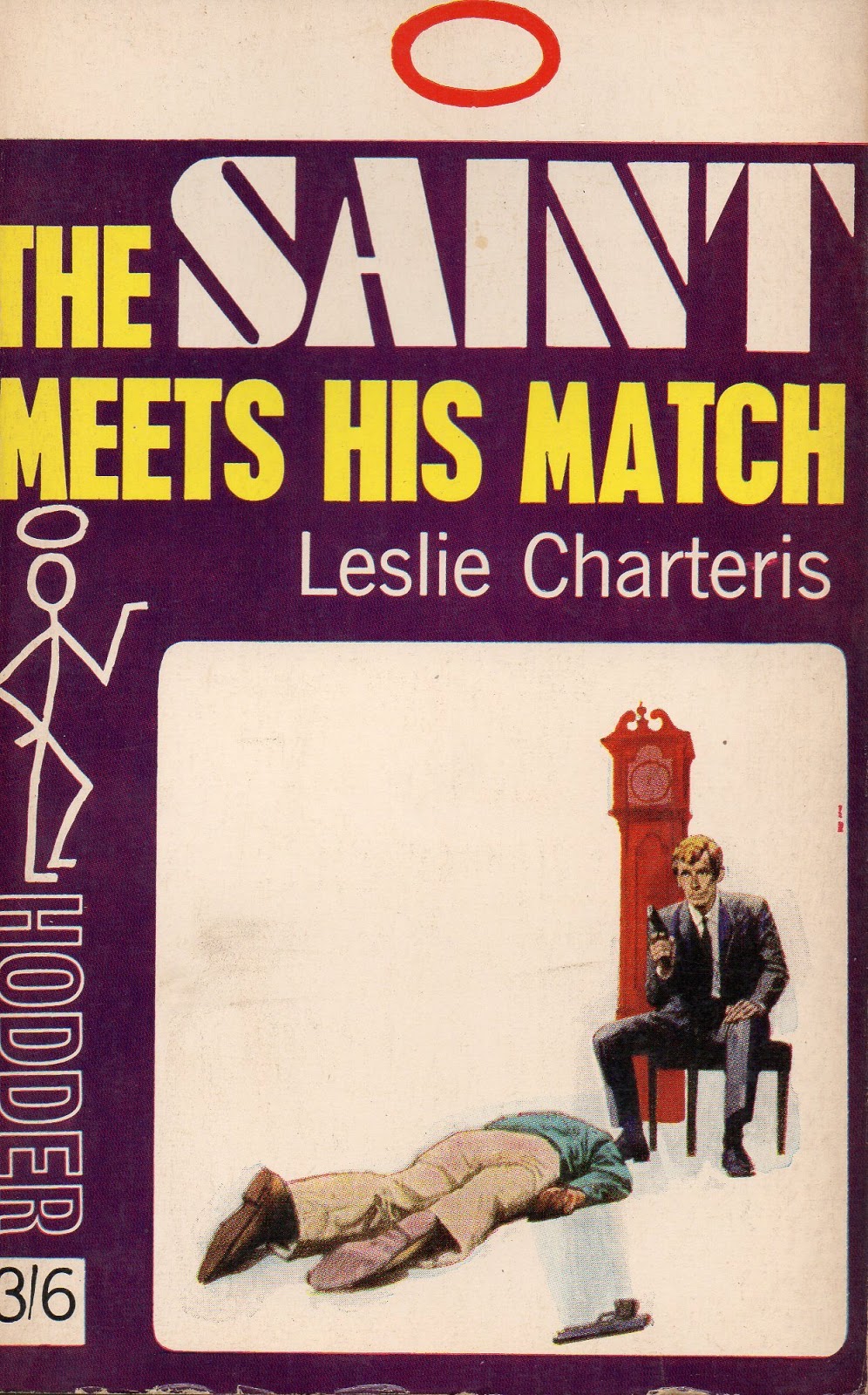

I discovered Agatha Christie and Raymond Chandler while being hospitalised with an upper respiratory tract infection, having been landed from my ship to the submarine base, HMS Neptune: at my bedside stood a small bookcase stocked with several books by these authors. And at sea I read the new breed of violent westerns epitomised by George G. Gilman’s Edge character.
 
Looking back, it is difficult to determine how my affection for various genre fiction authors came about. Genre authors write good stories, I suppose, and I’ve always liked a ‘good story’. It is so much easier these days, thanks to online stores and blog reviews, to be made aware of different authors, ‘new’ to you. The downside is now the choice is bigger than ever! Naturally, browsing in book shops, twirling the whirligigs of paperbacks, reading the few weekly book reviews in the newspapers all helped me identify unfamiliar but possibly interesting books. And there are phases I passed through – western, occult fiction, true war books, spy novels, detective tales, thrillers, and science fiction.

As a writer, I believe we scribes should read broadly – both fiction and non-fiction. My affection for genre fiction is still strong, but of course I read outside that label too, and always have done so.


BARNES & NOBLE books
SMASHWORDS books
KOBO books
AMAZON COM books
AMAZON UK books


Tuesday, 22 September 2015

Writing – the short story

For many years I’ve added to my home library collections of short stories. Until the advent of the e-reader, received wisdom in publishing was that short story collections ‘don’t sell’. What they meant, perhaps, was that they don’t sell in vast numbers so are not worthwhile expending effort on them. However, now any form of writing can be obtained on an e-reader, and enjoyed, and the collected works of many classic authors can be downloaded for very little financial outlay (check out the Delphi Complete Works).

A short story in its literary form is supposed to be a brief fictional prose narrative, often involving one connected episode, a concentrated form, dependent for its success on feeling and suggestion. The writer must attempt to succinctly create a fictional world in the moment. Stories attempt to reflect the life that is lived by all of us, and the short form has to do it without benefit of the depth and breadth of a novel.

And, as with the novel, a short story has the potential to invoke any number of aspects of writing.

·       The plot – the sequence of related events that shape the narrative.

·       The characters – the people who play their parts in the narrative.

·       Setting – the place and time where the story’s action unfolds.

·       Point of view - a consistent perspective on the characters and their actions.

·       Style – how the author chooses to relate the story.

·       Theme – often the submerged back-bone of the story, a unifying idea that provides insight into the human condition.

The length of the short story will be dictated by a number of factors:

·       Complexity of the plot

·       Number of characters

·       Duration of the tale

·       Intended audience

·       It doesn’t have enough content to be a longer piece

That intended audience might be a publisher, an editor, a competition, a magazine, or simply personal preference.

A short story can cover the events of a brief episode or encompass action that takes years to conclude.

The author needs to use a scalpel to excise anything that is not pertinent to the original intention.

If a short story has to fit into 2,000 words then there is little scope for detailed exposition and rising action, and so on.

The nub of the conflict – the problem to be resolved by the protagonist – must be introduced very early.

If the story is allowed more words, say 6,000, then a more leisurely pace can be adopted, though again every word has to do its job – creating the world, the atmosphere, the characterisation and the emotional journey of the protagonist.

Usually, the so-called literary short stories have more words while genre fiction writers are quite content to settle for less to do the job.
 
Regardless of length, the writer of short stories must show the reader what is important through the dramatic action of the plot and the other elements of the story, and not just explicitly tell the reader what to think.
 
The illusion of reality should always be sustained by the plot right up to the end. This reality is enhanced by character creation. Dialogue is a useful tool here, conveying mood and emotion. With the wordage permitted, the writer must suggest enough complexity in the individual to affect the reader’s emotions. Mood can be affected by time and place, and setting is important, though ideally this will be achieved with a few deft sketches rather than a full-blown travelogue. Creating a visual place enables the reader to ‘see’ the action more definitively, in effect to be part of the scene, involved in the drama.
 
Drama is perceived through the eyes of the protagonist. In short stories, it is preferable to limit the number of characters and viewpoints. The first-person narrator could be a major character or a minor character who is a good observer. The third-person narrator can be omniscient, seeing into all characters’ hearts and minds, or limited omniscient, seeing into one or, possibly, two characters.

Some novelists are not comfortable with the short story; in their case, there is not enough scope to create the world the writer perceives; only a novel will do. And the same goes for some readers: they can’t seem to get lost in a short piece while they can easily become immersed in a thick novel. To each their own.
 
Writing short fiction can help to hone your writing. You have to convey scene, character, plot, setting, and emotion within a concise form, so every word should be selected to that end. There is little room for extraneous padding or ‘fluff’. In some ways, certain short story writers are similar to poets – selecting the right word to convey the precise feeling or moment.
 
Just browsing along my bookshelves, these are some of the short story collections I can see:

Collected Stories by John Cheever, Roald Dahl, Ruth Rendell, Eudora Welty, E M Forster, O Henry, D H Lawrence, W Somerset Maugham, Elizabeth Bowen, Anton Chekov, Noel Coward, Saki, Jack London, Edith Wharton, Edgar Allan Poe, Guy de Maupassant, Katherine Mansfield, Henry James, Elizabeth Spencer; Truman Capote – A Reader; Stanley Ellin – The Speciality of the House; Leslie Charteris – SeƱor Saint; Willa Catha – Great short works; Frederick Forsyth – The Veteran; Ring Lardner – Best Short Stories; James Joyce – Dubliners; Hugh Garner – Best Stories; Hermann Hesse – Stories from Five Decades; Elizabeth Spencer – Stories; August Derleth – The Return of Solar Pons; Arthur Conan Doyle – The Memoirs of Sherlock Holmes; Ernest Hemingway – The Snows of Kilimanjaro and Other Stories; Jeffery Deaver – Twisted; Joseph Conrad – Typhoon and other stories; Doris Lessing – This was the Old Chief’s Country, Stephen King – Everything’s Eventual, and G K Chesterton - Father Brown.  


This limited list doesn’t touch upon the horror, fantasy and science fiction shelves; these genres have spawned many hundreds of short stories.
 
If you haven’t tackled short story writing – read a collection or two and see what can be achieved by the masters such as those mentioned above, or Margaret Atwood, Ambrose Bierce, Ray Bradbury, Nathaniel Hawthorne, Shirley Jackson to name a few more.
 
Even today, short stories definitely have a story to tell.

Friday, 25 February 2011

Lust to read will never dwindle with a Kindle


Some said it was the end of an era. After five years as Chairman of the Torrevieja Writers' Circle (TWC), I was stepping down. My last day wielding the gavel was Wednesday, 23 February. There were about 28 members in attendance and several apologies. The first half was a normal session of reading and critique, then cakes, buns (thanks to the bakers)and drinks for the halftime period. There followed a presentation of a Kindle, contributed by the members. I was very touched by this thoughtful present. (Some whispered I've been a bit touched for ages, hence the puns...) Mary K (Hasta Luego)and Chris (Woe...)read out poems, which were both appreciated and struck several chords. Several - about 22 stayed behind to eat a menu del dia. A really good day, thank you all!


I finished off with a small 'thank you':

After five years as Chairman, I ask myself, why do we come to the TWC meetings? Presumably, we all like to read – whether books or magazines. Most of us were brought up with a love of books – either imparted by our parents or our teachers. Even in this age of the e-book, books play an important part in our lives. As Cicero said, ‘A room without books is like a body without soul.’

The Canadian-Japanese Professor of English, Samuel Hayakawa said, ‘In a very real sense, people who have read good literature have lived more than people who cannot or will not read… It is not true that we have only one life to live; if we can read, we can live as many more lives and as many kinds of lives as we wish.’

They’re talking about books. But we aren’t a reading circle. We strive to write. As E L Doctorow said, ‘Planning to write is not writing. Outlining a book is not writing. Researching is not writing. Talking to people about what you’re doing, none of that is writing. Writing is writing.’

So it’s the placing of your bum on a chair and writing. No pressure, there then.
Still, as we know – no pressure, no diamonds.

Many of you have written for years and received little or no pecuniary reward, but that doesn’t stop you, nor should it. Richard Bach, who wrote Jonathan Livingston Seagull, says, quite rightly, ‘A professional writer is an amateur who didn’t quit.’

So, if it isn’t for the financial reward, why do we write? Is it because we must? Katherine Mansfield said, ‘Looking back, I imagine I was always writing. Twaddle it was, too. But better far to write twaddle or anything, anything, than nothing at all.’ Maybe we want to make sense of the world, or understand ourselves, our past. Indeed, the life of every person is like a diary in which he means to write one story, and writes another.

I think I’ve used this quotation from O Henry before, but make no apology for using it again: "A good story is like a bitter pill, with the sugar coating inside of it."

Maybe that’s it: we just like telling stories! To know is nothing at all; to imagine is everything. Of course, you don’t have to rely on imagination; you can reminisce about your past. You don’t have to write fiction. You can write memoirs and poems, rants and articles. It doesn’t matter, really, so long as you write. You write to be read, however. You write for an audience, even if that’s an audience of one or the circle members only. You don’t write for praise, though it’s always welcome. You write to affect others, to raise a laugh, stir an emotion, elicit a tear. You don’t write to slavishly copy your favourite authors. Each one of us is unique, and we see the world and humanity in different ways. The secret is that in our writing we invite the reader to see the world – our imagined world – as we see it.

In my five years of Chairmanship, I’ve been privileged to listen to a vast array of writing from the TWC members – poems that made me think or cry, stories that made me laugh and empathise, articles that made me see some aspect of life with a fresh eye. Many of you have already done it, but I would recommend that in your writing, make the most of yourself, for that is all there is of you.

Thank you for putting up with my terrible puns over the years. I’ll miss banging my gavel, and inevitably I’ll miss several gems that will be read out in future meetings, since I will no longer be a regular attendee. However, to use a final quotation, in the immortal words of the Terminator, ‘I’ll be back.’