Search This Blog

Showing posts with label Libraries. Show all posts

Wednesday, 28 October 2015

Writing – Affection for the genre

I’m fortunate in that I enjoy reading books in almost any genre – whether that’s crime, science fiction, fantasy, horror, western, romance or thriller. Not to mention all those sub-genres! To me, the genre doesn’t matter so much; it’s the story that counts.

Recently, a correspondent who was re-reading my genre fiction writing guide (Write a Western in 30 Days – with plenty of bullet points!) asked me how I gained my affection for the genre.

The quotation he had in mind is:

‘A good writer can get published in almost any field. They’ve studied their craft of storytelling and know the requirements implicit in each particular form. Less accomplished writers might contemplate trying a western, as it seems ‘easier than a contemporary detective novel.’ That approach is unlikely to work. To write a western, you need to have a strong affection for the genre. You don’t have to be a fan, but you should respect its roots. If you don’t, then it will show in the prose and storyline – and it will get rejected pronto.’ (p11)

Being a child of the 1950s, my diet of fiction from television was a plethora of western series – Cheyenne, Wagon Train, Laramie, Have Gun Will Travel, Gunsmoke, The Rifleman, and Range Rider, among others. Then there were plenty of western movies in the theatres besides at least two western series on TV in any week. At the same time there were many comics either wholly dedicated to Western characters – Pecos Bill, Hopalong Cassidy and Roy Rogers or they featured in other comics such as Comet and Eagle and the Buffalo Bill annuals. In the Eagle I discovered O Henry’s short stories and then went on to books by Louis L’Amour, Max Brand and Zane Grey and so on. And at school, we studied Jack Schaefer’s Shane.
 
 
Those western tales usually contained a moral core, where good triumphed over evil. The morality was black and white – as were the images. Moral ambiguity gained prominence with the Spaghetti Westerns in that particular genre. Of course grey characters and storylines existed before this – on the big screen in all genres.

Before I left school I was writing stories and drawing comic strips. My writing took me in another direction, however, towards science fiction and fantasy and then I was drawn to crime thrillers.  But I always hankered after writing a western one day.  Briefly I ran a fledgling literary agency and placed one lady’s excellent book with a publisher; I tried getting publishers interested in two good writers, one who had written the sequel to Shane no less, but to no avail, so sadly I packed that in. 

In those young teen days I couldn’t afford to buy books on a regular basis so made use of the local library; the hushed aisles were filled with hardbacks, not paperbacks. Over time, reading taste changed and included Dracula, Frankenstein and science fiction, the latter mainly within Gollancz yellow dust-jackets. My interest in the western tended to centre upon history books of that period, rather than fiction.
 
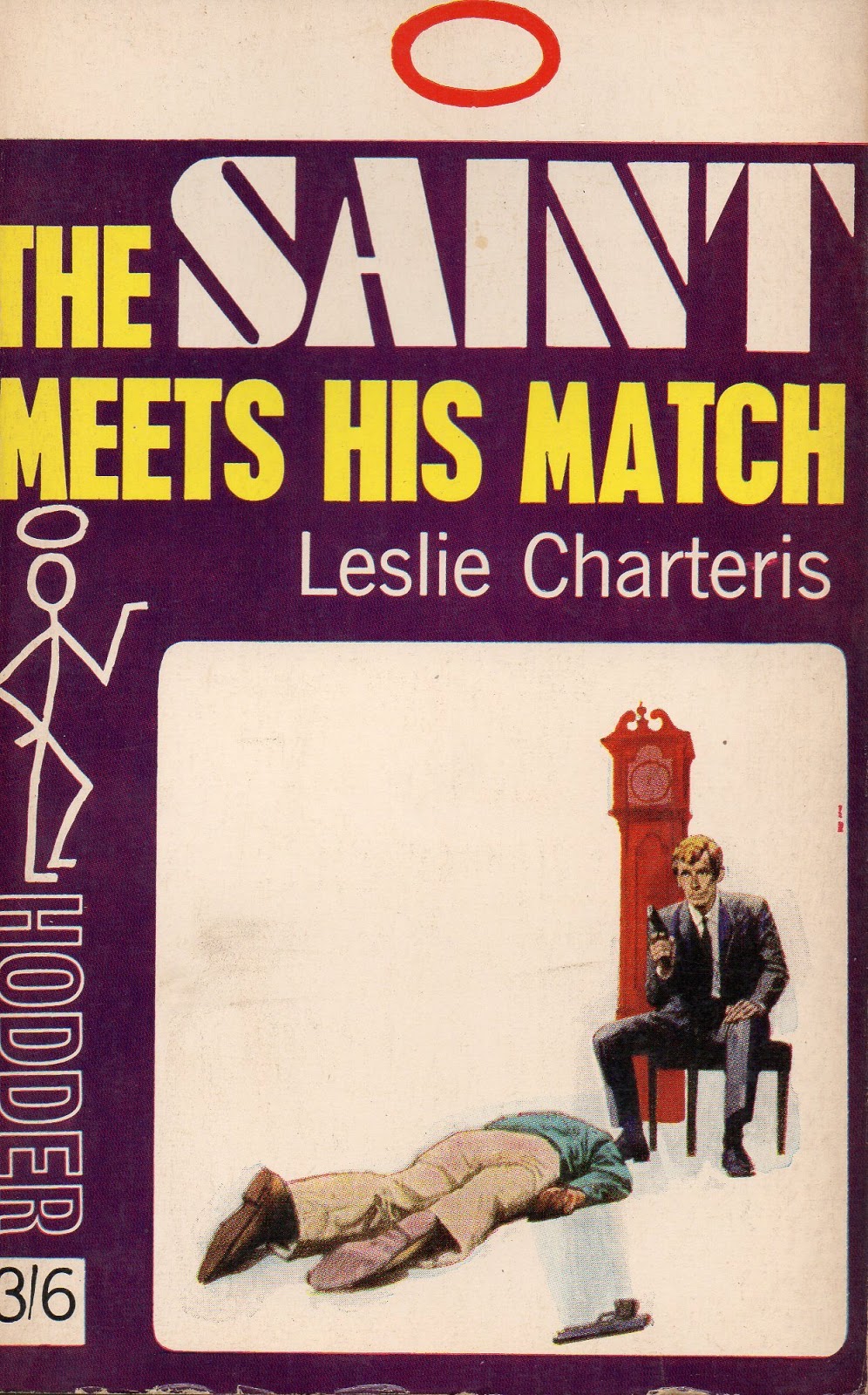
At about the same time I also enjoyed the modern adventurers on TV: The Saint, The Persuaders, Danger Man, Gideon’s Way, The Champions, The Prisoner et al. I discovered the Saint books when Hodder began publishing them as uniform paperbacks and particularly enjoyed the 1930s stories, Simon Templar’s character somewhat removed from Roger Moore’s portrayal.

I discovered Agatha Christie and Raymond Chandler while being hospitalised with an upper respiratory tract infection, having been landed from my ship to the submarine base, HMS Neptune: at my bedside stood a small bookcase stocked with several books by these authors. And at sea I read the new breed of violent westerns epitomised by George G. Gilman’s Edge character.
 
Looking back, it is difficult to determine how my affection for various genre fiction authors came about. Genre authors write good stories, I suppose, and I’ve always liked a ‘good story’. It is so much easier these days, thanks to online stores and blog reviews, to be made aware of different authors, ‘new’ to you. The downside is now the choice is bigger than ever! Naturally, browsing in book shops, twirling the whirligigs of paperbacks, reading the few weekly book reviews in the newspapers all helped me identify unfamiliar but possibly interesting books. And there are phases I passed through – western, occult fiction, true war books, spy novels, detective tales, thrillers, and science fiction.

As a writer, I believe we scribes should read broadly – both fiction and non-fiction. My affection for genre fiction is still strong, but of course I read outside that label too, and always have done so.


BARNES & NOBLE books
SMASHWORDS books
KOBO books
AMAZON COM books
AMAZON UK books


Thursday, 7 May 2015

‘Close libraries!’

That was the heading for a very brief report in a local paper that stated entrepreneur Annemarie van Gaal ‘says libraries across The Netherlands should be closed as they cost over 600m euros annually, and book-lending has become a marginalised activity due to the wealth of information to be found online.’

That’s the danger of condensed news, it misses out so much.  The actual article is here:


So the vital conditional is missing – ‘or made relevant again.’ She agrees that ‘… libraries have a social function. Making them free up to 18 gives every citizen, rich or poor, an opportunity to borrow books and use WiFi internet access, something which may not be available at home.’ That social function is important.
 
This brings to mind a modern phrase that seems pertinent: ‘Use it or lose it.’

Most of us probably tend to take for granted the existence of our town libraries – at least until they’re transformed into ‘information centres’ or threatened with closure.

In the old days – the 1920s and 1930s, many a self-made man (and woman) spent hours in the library in order to improve their lot. They understood that education – and knowledge – is power. Granted, much of that information is now available a mouse-click away. Though the source perhaps needs double-checking; and that was true of the printed word, too. Received wisdom was not always correct. But the inescapable fact was that libraries liberated young minds, and still can do so.

The demand on the town or city’s purse grows every year; yet they never seem to economise with smaller offices or make do with older furniture, I notice, but they do seem to want to make cuts, whatever the political affiliation. And repeatedly in their sights is the local library.

Be vigilant, fight for your library.

Many an author has written a dedication to his or her librarians. Here is but one, from my own library, slightly shortened:

‘During the 1930s and 1940s anyone writing science fiction did so almost exclusively for magazines. Then in the early 1950s the magazine market began to die and paperback books took over. But the paperback books were on the stand one week and gone the next.By the time an author’s newest book came out his older books had disappeared… a few of us could afford to be full-time writers of science fiction, and that was possible only because libraries continued to be the only real market for hardcover science fiction. The libraries bought these books on a regular basis, shelved them, and made them continuously available to readers; and in this way libraries kept both science fiction and those of us who wrote it, alive. To librarians everywhere, this book is dedicated.’ – Gordon R Dickson, Time Storm (1977)

So, I dedicate this blog to all librarians; you are greatly appreciated.
 

Monday, 14 October 2013

Treasuries of collective minds

Libraries are the repository of knowledge. Historically, when an important library was destroyed, knowledge was lost, perhaps never to resurface. The library of Alexandria springs to mind. There must have been so many blitzed in war. So the digital revolution is a marvellous boon – perhaps this knowledge can be distributed so much that it will never be lost (unless an ElectroMagneticPulse stills everything). Of course libraries contain more than knowledge; they contain dreams, visions, perceptions of dead people, the emotions that we label the human condition.

When an alien race discovers our planet, doubtless when we’re all dust, maybe they will disinter books, either in tree- or digital format. Maybe they will glimpse what we were, what promise we held…

A long time ago, while serving on HMS Diomede, a group of us were landed at Leith Harbour whaling station on South Georgia, Falkland Islands, an abandoned place, a ghost town.


Leith whaling station
 
Leith was established 1909 as a whaling station and by the end of the 1950s it was utilising every part of the whale, including the baleen which was used in the manufacture of brushes. Nevertheless whaling was going into a steep decline through over-fishing of the whales. Salvesen's ceased operations at Leith Harbour in the 1961/2 season but the station was sub-leased to a Japanese company which operated until December 15th 1965. This was the end of whaling at South Georgia but there is a postscript. Salvesen's bought the leases of all the whaling stations on the Island in the mid-1970s. In 1979, Constantino Davidoff of Buenos Aires contracted with Salvesen's to salvage machinery and other items from the abandoned whaling stations. The involvement of the Argentine navy in Davidoff's venture was a prelude to the invasion of South Georgia and the Falkland Islands in 1982…

Post-conflict, HMS Diomede arrived. Among the derelict buildings was a library that required a little tender loving care. The five of us spent two days and a night there, putting on a corrugated roof, sorting the books on the shelves. You see, from time to time a seafarer would pull into the harbour and might visit the library. I felt there were quite a few ghosts in the library, let alone the station.

Any derelict library is a sad sight to me. Now, having recently seen some pictures of the Mark Twain branch of the Detroit library, I was greatly saddened. The images showed shelves and shelves of books untended, with the roof caved in, serious structural damage. See here:


Yes, Detroit is in financial dire straits. Yes, people are more important than books (though some folk might change that to ‘some people’). I don’t know the full story. Initially, it was about eradicating mould, and then asbestos was discovered, so that called a halt. That was all to do with the structure, though. Not the contents. The books were left there – and were left from 1996. They were subsequently, eventually moved (somewhere) and the building was demolished in late 2011. A 2011 footnote with further explanations can be found here:

http://curiousfeet.wordpress.com/2011/07/19/marktwainbranc/


Whoever was responsible seemed pretty slow on the uptake to rescue the books.
 
Last image shows the building after demolition

Those books belonged to the community, bought by the local taxes, I assume. At the very least, they could have been distributed or sold to the people – unless the people didn’t want them, of course. Yes, how we treat books is very much a reflection of how some people treat people, perhaps: out of sight, out of mind?

I’ve seen photos and film of London, Liverpool and other British towns where libraries have been bombed in WWII and people scrabble over the rubble to rescue books. They, clearly, treasured books, the treasuries of collective minds.
