Search This Blog

Showing posts with label Arthur C. Clarke. Show all posts

Wednesday, 22 January 2014

Reminiscences, Naval-01 – ‘Journey of 16 hours’

When I joined the navy, I’d already succumbed to the writing bug, having written two spy novels (still unpublished). So it seemed logical for me to write down any impressions and events I encountered. As life and work intruded, these notes became thinner… and stopped after a couple of years; though my letters home did contain certain impressions and memories for some years afterwards.

It was October, 1965, and I was a few months over seventeen. Dressed very smartly, my parents saw me onto the train at the Newcastle upon Tyne platform, pleased to learn that I was travelling with other young men destined to join the Royal Navy at HMS Raleigh. My two fellow travellers were Michael (Mick) Siddle and Thomas (Tom) Gibbon.
Newcastle upon Tyne central railway station
 
We waved our good-byes as the train departed at 7:05a.m from the old Victorian station and settled down. We were so polite – would you like an apple, an orange? Sure? Would you like some chocolate? Oh, it’s melted… We buried our noses in our respective if not wholly respectable periodicals.

Even a short while afterwards, when I first jotted down these reminiscences, I found it difficult to recall the entire journey. Most of the time, for me, it seemed somewhere between wakefulness and sleep, and I always felt I was on the borderlines.

Even then, Tom was pretty tall, about 5ft 7 and he masterfully contorted himself into positions unimaginable to sleep in: legs on one side seat, body on the other, his midriff sagging in between; yet, he slept. He was about sixteen. Mick remained silent most of the journey, alternating between reading and sleeping, being on the same seat as Tom. He was seventeen and a half, a few inches taller than my 5ft 6.

We all had long haircuts. And we were thoroughly bored.

I ploughed through my book, prophetically Childhood’s End by Arthur C. Clarke, until my eyes became bleary and the words on the page floated away, far away. Then I would stretch awkwardly the length of my seat and sleep lightly, using my overcoat as a pillow.

At one station, well into the night, the train stopped. Tom and Mick left the carriage for some milk from a vending machine on the platform. I finished off my portion of Tom’s pomegranate.

Another time I was on the verge of sleep when our speed decreased, and we shunted into a station which glared out of the black night. This brightness was eye-watering to sleep-laden eyes. The place was undergoing modernisation – neon lights everywhere, cold white concrete, men’s badinage and hammering reaching our ears. Steam sifted from somewhere on the track. The train stopped there a while, then a shrill whistle and we left the raucous place behind, slid into the black night again, and the train’s motion encouraged sleep.

I felt a hand shaking my shoulder shortly after I had finished Childhood’s End, about 4:30a.m. Sluggishly, I climbed out of oblivion, reflexively but probably ineffectually chopped out at the disturbance, and checked my blow in time. Mick had awoken me as we were pulling into Bristol shortly. [In later training, all men were warned to have a care when waking someone to go on watch – many a black eye has been sustained as the sleeper jerks awake!]
 
At 5a.m. we alighted from the train onto a deserted station, which speedily filled up with sailors and airmen in uniform. Mail-trolley wheels rumbled, echoing. Doors banged. A porter was whistling somewhere. In the British Rail café, while we ‘partook of a light refreshment’ – I used to write like that, then – we looked about, at a couple of sailors and civilians. We must have appeared a woebegone sight, lost to our mothers if they could have seen us.
 
Around 5:30 we boarded the train for Penzance via Plymouth. As the train pulled out, a cock crowed and a Petty Officer in our carriage exclaimed, ‘Bloody hell!’ at realising he hadn’t returned the BR café’s cup.
 
A little later on, we glimpsed the red sunrise.
 
The second half of our journey was as tedious as the first. My stomach was in knots and I was just waiting to be sick, it seemed inevitable, but just then, as we passed through Teignmouth I was surprised to see phosphorescent breakers. The sea was angry, a brownish-blue, the cliffs coloured red. I ducked my head out the window and the wind thrashed my hair; it was exhilarating and quelled my roiling stomach.
 
We slept, if restively.
 
About forty-five minutes out of Plymouth, I glanced out to see a thick seething mist that meandered about skeletons of trees. Shortly afterwards, we pulled into Plymouth station, an ultra-modern building of glass panes and light brickwork. Outside the large glass doors, the three of us met up with a group of new recruits. It was easy to identify them; we all looked about the same, lost and all-in. Lads of all sizes, from towns and cities, from Scotland and Ireland, even Rhodesia, we gathered outside the RTO office to the left of the station entrance. A large well-built lad (we later learned his name was Mick Deering) collected the forms we’d brought with us.
 
Tired, in a cold station, surrounded by strangers, my first impression was resignation: I’d come this far, I wasn’t turning back now. I was blessed – or cursed – with a good imagination and it was tempting for it to go on overtime, but I decided to leave my mind open, prepared to meet anything. Those who had been in the Scouts were probably better prepared than most. Maybe my time in the Sea Scouts would serve me in good stead.
 
We clambered onto an RN bus which drove us down to the River Tamar, where we boarded the Torpoint Ferry, which was pulled across on chains. On the other side, we were herded into another bus, and some of us by then broke out into song, started up by Mick and Tom in typical Geordie fashion. Already, new friendships were being forged. What seemed like fifteen minutes’ later, the bus turned into the gateway of HMS Raleigh, our home for the next few weeks.
HMS Raleigh
 
We were in, almost beyond the point of no return. Silence fell then.
 
This was our journey’s end – at least as far as those who stayed were concerned.
 
Next reminiscence: New Entry

Saturday, 14 December 2013

Book list-1965

For many years now, I’ve kept a list of the books I’ve read.  In the 1980s, I used to review books for the British Science Fiction Association, and in the 1990s also for my semi-pro magazine Auguries. Then when I discovered the Internet, I continued to write reviews on Amazon. Looking back, it seems I started in 1965.

Then, I simply listed the book. Now, I show the book, the author and the date read.

I won’t present a full list, which might become tedious, but show a few selected titles, just for interest.

1965

Fittingly, I read Arthur C. Clarke’s Childhood’s End in October, 1965 on the fourteen-hour train journey to join the Royal Navy. That same year, I also read Len Deighton’s Horse Under Water, which began at HMS Vernon, the naval diving school. My first draft in the following year after training was to HMS St. Vincent, in Gosport, across the water from Vernon.
 
I enjoyed E.V. Cunningham’s Sylvia, actually written by Howard Fast, an excellent suspense novel that deserves to be reprinted; it was the first in an unconnected series, save that all the books had women’s names, such as Shirley, Phyllis, Lydia etc.
 
Winston Graham’s Marnie was much better than the Hitchcock film; his characters are always believable. Since then, I’ve read most of the Poldark novels and many of his suspense novels; he never disappoints.

I read a few true wartime exploit books too – The White Rabbit (Bruce Marshall, writing the exploits of Yeo-Thomas), Boldness be my Friend (Richard Pape) and The Colditz Story (P.R. Reid) – all excellent books about real heroes.

 
Some years earlier I’d read quite a few similar titles, such as Odette, Carve Her Name With Pride, the Cockleshell Heroes, the Dambusters et al. Richard Pape wrote an espionage novel Arm Me Audacity, which reads as though it was true, not fiction. Of additional interest is this thread:

I particularly enjoyed Ray Bradbury’s The Silver Locusts, alternatively titled The Martian Chronicles; a visionary and a poet at work. I still possess all his paperbacks, most of them the 1960s Corgi versions.

I was – and still am – a fan of Victor Canning, and his The Limbo Line didn’t disappoint. In those days I bought and read a lot of espionage thrillers – there seemed to be a great many around. One series I enjoyed featured Commander Shaw, by Philip McCutcheon, and in this year I read his Bluebolt 1 adventure.
 
For a few years prior to this, I’d discovered Dennis Wheatley, first his Duke de Richleau series (a few years earlier, my first foray was, prophetically, Vendetta in Spain), then Gregory Sallust; in this year, I read The Forbidden Territory and The Devil Rides Out, both landmark books for Wheatley.
 

The Forbidden Territory was Wheatley’s first published novel (1933) and introduced his modern trinity of musketeers in the epicurean Duke de Richleau, financier Simon Aron, and the wealthy young American, Rex Van Ryn. Happily, Bloomsbury is reprinting all of Wheatley’s books – www.bloomsbury.com/DennisWheatley

The Devil Rides Out (1934) was his second Richleau tale and his first black magic novel, which has become a classic of its kind (the recently released Kindle version is currently #1 in Horror and Occult categories, and #2 for Fiction Classics).

Wheatley’s point of view was generally omniscient when it suited the scene or third person when emotional conflict was necessary; though when the story called for it, he used first person narrative too (notably The Haunting of Toby Jugg). These books are two of his best adventures. The emphasis is on ‘adventure’; he wrote no-nonsense yet thoroughly researched thrillers with heaps of tension.

Another time, I’ll take a look at some books I read in 1966 – almost half a century ago!

Friday, 22 November 2013

FFB - The Man Who Drew Tomorrow

This large-format colourful book (published in 1986) is sub-titled ‘How Frank Hampson created Dan Dare, the world’s best comic strip’. Obviously, some purist comic collectors may argue over the word ‘best’, but there’s no denying that Frank Hampson exhibited a remarkable flair for invention and draughtsmanship, with incredible detail and colour in a period when post-war austerity still held sway (1950).


Dan Dare appeared on the front page of the
British comic Eagle on 14 April 1950.

In retrospect, Frank rationalised his creation of the famous pilot of the future: ‘I felt the prognostications about technology were too gloomy. Attitudes were too pessimistic, with The Bomb, the Cold War and rationing in the forefront of everyone’s mind. I wanted to give hope for the future, to show that rockets and science in general could reveal new worlds, new opportunities. I was sure that space travel would be a reality… Dan was the man I always wanted to be; Digby, his batman, was the man I saw myself as…’

In the early days, the Dan Dare strip was sent to Arthur C. Clarke to check that the sci-fi details were believable, but this arrangement lapsed when Clarke pointed out that the art studio was wasting its money on getting him to check it, the details were always authentic – so much so that an aeronautics engineer for RAF Farnborough asked for source material to help in the designs then of a space-suit!
From the beginning when the Reverend Marcus Morris approached Frank with the idea for a revolutionary boys’ comic of the highest calibre, Frank was inflamed with the ideals set. It was to have a morally uplifting tone, Christian in outlook, educational, and with artwork of superior craftsmanship. He set up a studio and hired associates and together with his father, Pop, Frank created Dan Dare.
A bust of Dan Dare, Southport, England

Almost every frame of the strip was sketched in rough first by Frank – he also wrote the storyline – and then photographs were taken of various team members to act as models for the finished strip drawings (Joan Porter, Greta Tomlinson, Robert Hampson, Harold Johns, Don Harley, Peter Hampson, and Eric Eden - Harley and Eden with Keith Watson were also artists on the strip). Most of the team members commented that even Frank’s rough sketches were good enough to be the finished article, but Frank was a perfectionist and this attitude often entailed the team working into the early hours of the morning to finish the strip: eight people to produce two pages of artwork may seem extravagant, but time has vindicated the approach – Frank was voted the best post-war writer and artist of strip cartoons in 1975 by an international jury of his peers.

This was in fact a long-overdue accolade, for prior to this he spent virtually fourteen years in the wilderness hiding from the fans that pursued him and suffering from a series of debilitating illnesses. He hid because he was deprived of the copyright to Dan Dare, his creation. Under the terms of his contract he was not allowed to draw Dan Dare after leaving. After completing the remarkable strip about Jesus, The Road to Courage in 1961, Frank left Eagle never to return.
My drawing, 1986

Eagle lasted from April 1950 until April 1969, 991 issues. It was reborn in 1982, though a pale reflection of itself, yet survived some 500 issues before its demise in 1994. Having just turned sixty in 1979, Frank was presented with his Open University BA, something he did to fill in the empty hours, though the studying of art was a lifetime love too. In July 1985, at the young age of sixty-six, he died.

Crompton’s book is very well illustrated, using pages from the old Eagles and studio photographs and sketches, plus glimpses of Hampson strips that were n ever taken up by Fleet Street. Dan Dare was a team effort, but the driving force was undoubtedly Frank Hampson. His treatment by Fleet Street, its accountants and editors, seems tragic, even if his personality and work methods didn’t suit them. This book, even now, is a must for anyone who remembers Eagle with a fond glint in the eye; it is useful to art students and comic enthusiasts alike, and is invaluable as an object lesson in the dangers of signing away copyright.
[Case in point: Jerry Siegel in 1975 launched a public-relations campaign to protest DC Comics’ treatment of Joe Shuster and himself, as in the early years they’d signed away their rights to Superman. Ultimately, Warner Communications, DC’s parent company, awarded Siegel and Shuster $20,000 a year each for the rest of their lives and guaranteed that all comics, TV episodes, films, and, later, video games starring Superman would be required to carry the credit that Superman was ‘created by Jerry Siegel and Joe Shuster’. The first issue with the restored credit was Superman #302 (August 1976)].


Saturday, 19 October 2013

Years before, the mast! - how I became a Writer

Today, October 19, marks forty-eight years to the day since I joined the Royal Navy. I served for twenty-four years. Before signing on, I’d written two (unpublished) novels and felt I needed to see the world – nowadays, you’re more likely to see the sea rather than much of the world, since the navy has shrunk and its commitments haven’t.

My parents waved goodbye to me at Newcastle upon Tyne’s railway station, tears in Mum’s eyes. I was sharing a carriage with two other fellow Geordie* lads, Tom and Mick, who were also travelling to Plymouth to join the Andrew. It was a long and tedious journey in those days, changing trains en route; it lasted about fourteen hours. Intermittently, I read a novel – Arthur C. Clarke’s Childhood’s End.
The final part of our journey entailed crossing the river Tamar on a chain-link ferry. I joined at HMS Raleigh, Torpoint, Cornwall where we went through a six week course of basic training – learning to march, fire weapons, tie knots, wash and iron our kit, use polishing machines (!) and generally adapt to teamwork.
First section of my Service Certificate

From there we split up to go to our various specialist establishments – HMS Collingwood for electrical training, for example. I joined HMS Pembroke, Chatham, Kent to learn the trade of Writer – handling ship’s correspondence, personnel records and pay.[Chatham barracks closed in 1984.]

Me - at Plymouth
 
Christmas occurred in the middle of this training, so I went on leave, carrying my enormous heavy kitbag, travelling in uniform. My proud parents welcomed me home for a too brief sojourn.
After about four months, I passed out as a Junior Writer and was drafted to HMS St Vincent, Gosport, Hants as ship’s company. St Vincent was a boys’ naval training establishment; it closed in 1968. Initially, I worked in the Captain’s Office, handling correspondence; later, I’d move into the Cash Office to deal with the trainees’ and ship’s company’s pay. Then, payment was almost entirely in cash, fortnightly, dispensed in a small brown packet at pay parade. The recipient marched to the pay table, removed his cap, and the pay packet was put into the hat. In retrospect, a lot of time was wasted on the pay routine.

While in training, I was not permitted to go ashore (termed such even when serving in a brick ship, a training establishment) in civilian clothing, only uniform. One Saturday, I travelled on the train from Chatham to London in uniform to see two movies – The Spy Who Came in from the Cold and then Thunderball. While walking from one cinema to the other, I was accosted by a posh gent in his swish car; I declined his offer of a lift and went on to watch James Bond’s fourth escapade. I still managed to catch the return train to get back to base in time.
Now, as ship’s company, I could wear civvies when not working. Problem – I had none; they were posted home when we joined Raleigh. With my post office savings in my pocket, I caught the bus into Gosport and bought an entire wardrobe of jacket, trousers, shoes, shirts, socks and tie; that was quite a good feeling.

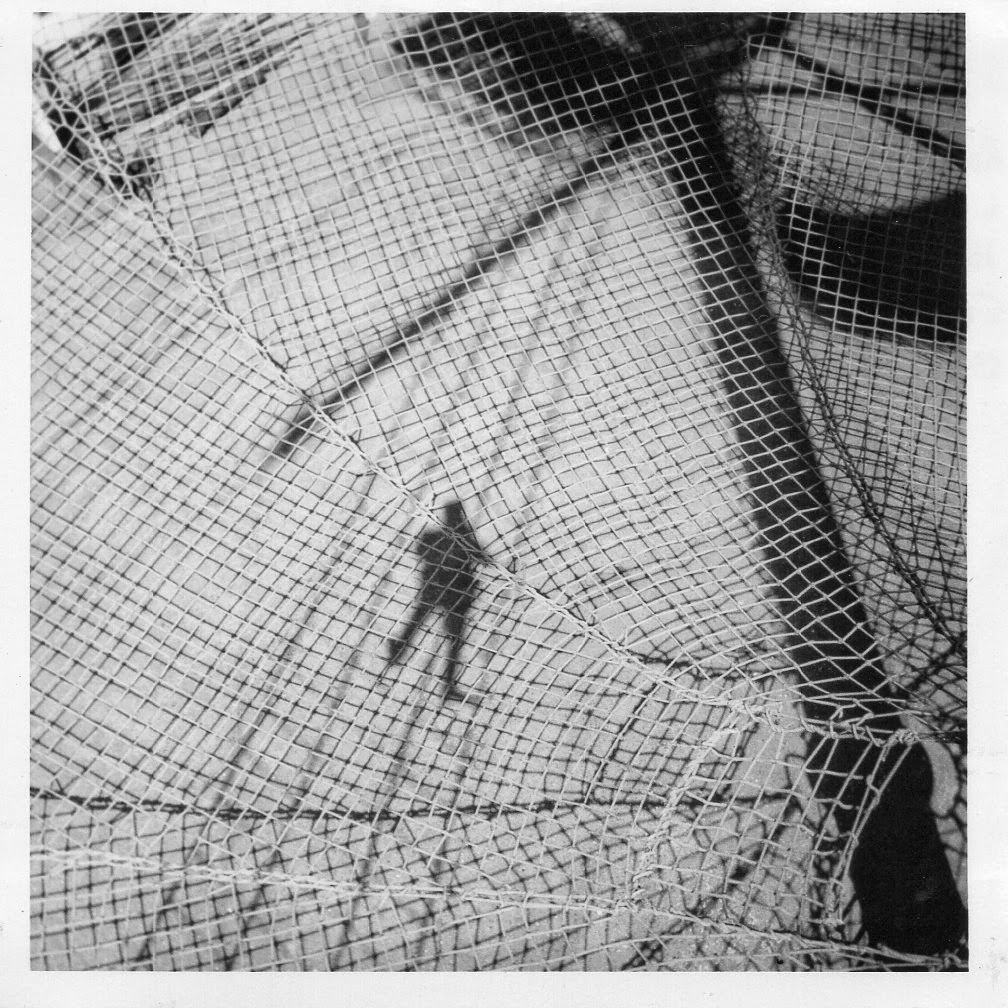
One Sunday afternoon, I approached the Officer of the Day of St Vincent and got permission to climb the mast at St Vincent to take photographs. I don’t know if anyone in civvies had ever done this before; he couldn’t see any regulations against it, so I started to climb the mast. Unlike the much younger recruits, who joined at HMS Ganges, Ipswich, I had never manned a mast. This was my first time. Close up, the ropes are quite thick. And, thankfully, firm, with only a slight bounce. I clung on and took my photos; I could only afford black and white film in those days.

My feet up the mast
 
Eventually, I climbed up to the crow’s nest. I wasn’t going to attempt the acme, the button, no, thanks. I did wonder if the net below would save me or make chips out of me...
In civvies up the mast
 
While there, I noticed a trainee in uniform climbing up. We got chatting; he couldn't understand why I'd willingly climb up, since I didn't have to. He was practising as he would soon have to man the mast with his mates. As it happened, he was a fellow Geordie. Small world.
Fellow Geordie up the mast
This is not the only occasion when I’ve met a Geordie in an unusual place – but that’s another tale.
-*-
*Geordie is someone who hails from the northeast of England, though purists might say Newcastle. In the wide world, northeast seems just fine to me!