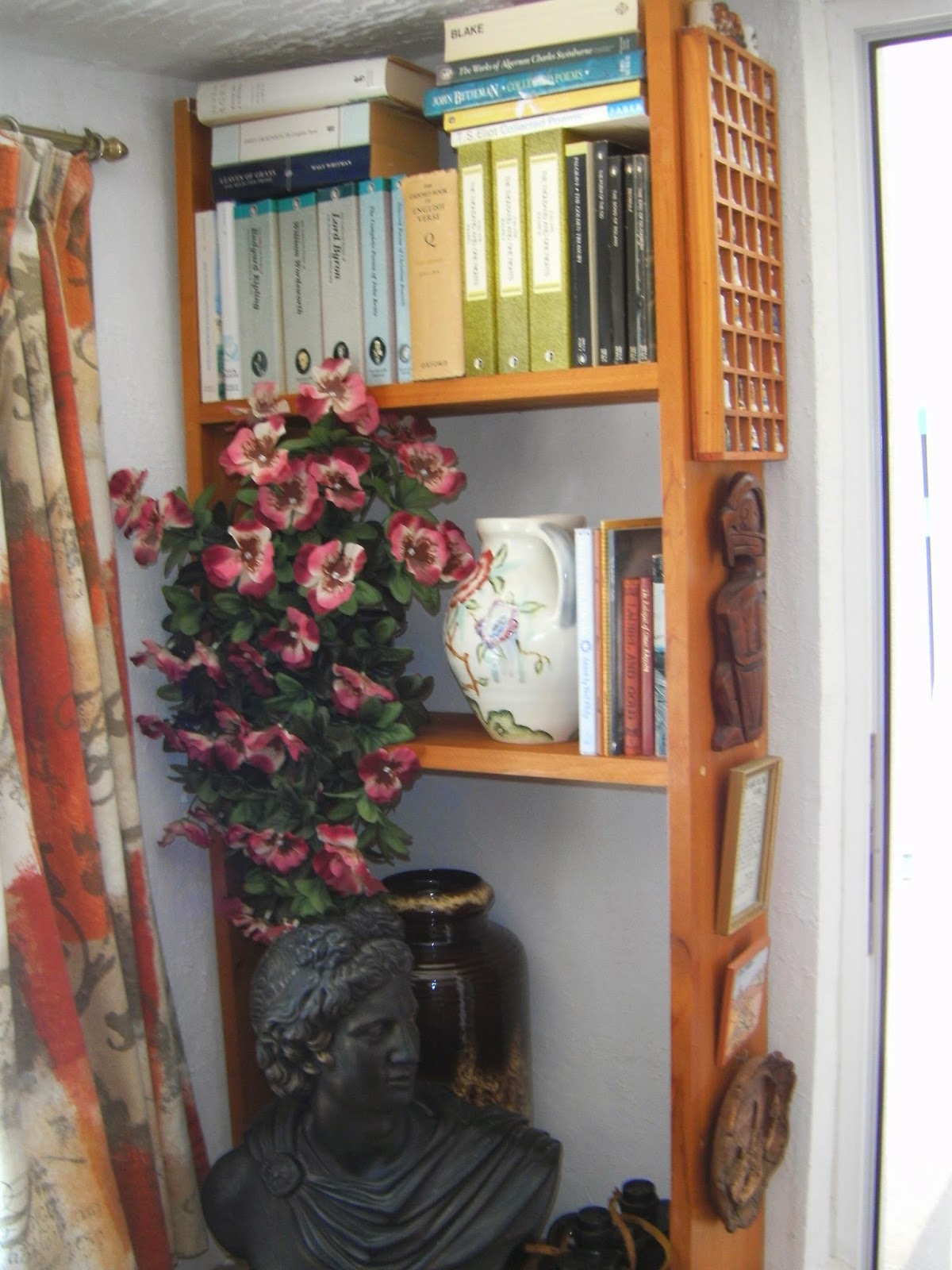
Some of my books - poets' corner
The
continuing skirmishing between Amazon and certain book publishers is in the
news. There are opinions from those affected – authors, booksellers and
publishers, yet there’s an elephant in the room that seems to get ignored.
The
big publishers price their new e-books too high, doubtless knowing that the
fans of the best-seller authors will buy regardless, thus boosting their profits.
The
business model quoted in a Sunday paper gives us this example:
Printed book
40%
of cover-price goes to the retailer, such as Amazon, or bookshop.
60%
goes to the publisher (two-thirds of which goes on production (paper, printing,
pulping unsold books, transport) [doesn’t mention warehousing], with 5-10% of
the price going to the author.
E-book
30%
to Amazon
70%
to the publisher with 17.5% of the cover price going to the author.
That’s
the simplified model, anyway.
Obviously,
some of these percentages will differ, depending on the author and the
publisher agreements. But the principle probably holds. Bottom line is that
publishers and retailers are in a business and need to make a profit.
Producing
a book has a lot of costs attached, though not mentioned specifically in the
example above. For instance, editing, page format setting up (should be minimal
in the digital age), cover design, marketing (if any).
So,
let’s assume the publisher is justified in getting 40% (two-thirds of 60%) for
print, which includes paper, printing, etc. That still means 20% is left over
for – the author? No, the author gets 5-10%, if he or she is lucky. So some
percentage (10-15%) is sort of floating somewhere… Maybe that’s the publisher’s
profit? Hmm…
Now,
for the e-book, there are no paper, print, delivery, warehousing, pulping, and transport
costs. So why does the publisher get 70% of the cover price? If the author gets that 17.5% (many don’t get
nearly as much), that means the publisher gets 52.5% and Amazon gets 30%. If
the publisher doesn’t spend on print, paper, printing etc for this version,
then that 40% is ‘unclaimed’ by any process for the e-book model. Of course,
subsumed within though not quoted must be the editing, layout, setting up,
cover design, marketing… which is necessary for the print book anyway. So if,
as is usual, the majority of books from the publisher are both print and
e-book, those costs are already accounted for in the print model so shouldn’t
be deducted from any percentage in the e-book model. Yes, setting up an e-book requires
additional work, but it’s fairly basic and cannot account for that 40% slice.
Whatever way you cut it, the costs of producing an e-book are negligible and
don’t warrant the high price.
There
is probably something else at work here. If the price of the e-book was lowered
to a realistic level, then that might affect print sales. At present a new
hardback and e-book are only about $5 apart in pricing (a hasty straw poll on the
B&N site). People who prefer print books will be content to pay that extra;
but they might baulk if the difference were greater. So it could be argued that
the artificially high e-book price is to protect the sales of the hardbacks.
Whatever
side of the fence we sit on, I suspect that authors – the originators, the
people who effectively create the books – are unlikely to see percentages
improve in royalties any time soon.
[This
view concentrates on the big publishing conglomerates, not the independent presses
who quickly grasped that e-books sell better if priced low. Certain
assisted-publishers/vanity publishers tend to price their e-books as high as
the big publishers’ model, thus denying their writers a viable outlet.]






.jpg)


