Search This Blog

Tuesday, 2 April 2013

Maxwell cleverly weaves her tale


JANE – The woman who loved Tarzan
by Robin Maxwell

This book’s release, authorised by the estate of Edgar Rice Burroughs, the creator of Tarzan, coincided with the centenary of the publication of Tarzan of the Apes. It’s a fitting re-invention.
            Many years ago, I read and re-read all two dozen of the Tarzan books and also the John Carter series. Like fans worldwide, I’ve always felt that the films never did Lord Greystoke justice. So, it was with a little trepidation that I tackled this book.
            What many film-makers neglected but this novel recognizes, ‘There is no Tarzan without Jane’, to quote John R Burroughs. As I became immersed in the tale, all fears for the treatment of the lord of the jungle evaporated. It was obvious that this was a work of love and respect for the original, a worthy homage.
            The book begins in 1912 Chicago where Jane Porter is giving a talk about the missing link she found in Africa. Her claims cause heated controversy among several academic and scientific attendees and, ultimately, a Mr E.R. Burroughs, a young author, takes her aside and expresses an interest in her tale about an ape man. Sequestered together, Jane tells all to Burroughs. This is Jane’s first person narrative we’re about to read, beginning in 1905.
            Maxwell cleverly weaves her tale, using the basic elements of the original but grafting on much that is new and intriguing. Seeing this tale from Jane’s perspective works exceedingly well for me. The period and character are beautifully captured – perhaps I should have expected nothing less from an accredited author of historical fiction.
            There is much that is familiar – the story of Tarzan’s origin, though shifted by date for purposes of realism, the Waziri, d’Arnot, Jane’s father, and the Mangani. The vain and dashing explorer Ral Conrath makes a suitable bad guy, but the real villain is Kerchak, the killer ape. Yet they’re given slight twists to fit this retelling; to stick to the original in every respect would have been a creative straitjacket and unworthy, and fortunately both Jim Sullos, custodian of the legend, and grandson John R Burroughs agreed. In his works, Burroughs did a lot of research for his books, and Maxwell has emulated him with a sure touch, delving into the paleo-anthropological details, the descriptions of the Dark Continent and even the history of Cambridge University, yet at no times imposing swathes of mind-numbing information on the reader.
            There are several poignant moments – not least the reading of Alice’s diary, the vaguely recalled past of young Tarzan and the erotic yet tasteful relationship between the ape man and his mate, Jane.
            You don’t have to have read any Tarzan book to appreciate this wonderful novel. If you have read some of the ape man’s adventures, then you’ll find much to please you in this retelling, bringing the lord of the jungle back to an adult readership, Burroughs’ intended audience.

Sunday, 31 March 2013

Bullets gets a new cover

Same story, new cover.

I was pleased with the latest review on Amazon.co.uk from Annie from Aberdeenshire, which in part goes like this:

This Cash Laramie outing, by yet another author, is about 119 pages long, and every one of them is full of action, following the twists and turns of what appears to be a straightforward tale of a corrupt mayor running for re-election, using every dastardly trick and opportunity for bribery that his immensely deep wallet makes easy. Oddly enough, the worst corruption comes from someone else.

The various authors of this series all seem to have at least one skill in common: they can each portray their characters with a very few words, and still give them distinctive identities. At the same time, both Cash and Gideon remain constant, regardless of who is describing them. In this book, a fresh piece of Cash's history is revealed, together with its consequences, and my only real criticism is that the author does not seem to make any effort to show the impact this would have on the Cash we already know. Anything more would be a spoiler, but see what you think.

There's a rather clever literary touch, in that the first and last sentence of the story are the same, but there's a gap of 16 years, and it's not necessarily referring to the same individual, nor true in both cases: read it and judge for yourself.
 
I'm pleased that little touch got noticed. It actually echoes someone else's last words in a book of 1953...

Saturday, 30 March 2013

Tarzan - centennial

It was just over a hundred years ago, October 1912, that Tarzan first appeared in print and since then he has become one of the most iconic fictional characters ever created. This large and quite weighty tome celebrates Tarzan in text, celluloid and comics, among other media, over that century.
            Perhaps it’s unnecessary, but I’ll briefly outline his story. John Clayton, Lord Greystoke and his young pregnant wife Alice were abandoned on the east coast of Africa in 1872 when the crew of the Fuwalda mutinied and set them ashore. They were left with two crates of belongings, a rifle and some ammunition. Bravely facing up to the terrors of a strange primitive land, Clayton built a small hut among the trees and there they retired to relative safety, frightened by the jungle noises. Alice gave birth to a boy, John. Nearby, huge apes congregated, issuing terrible grunts and growls: these creatures had their own language and called themselves mangani; they were more hominid than gorilla.
            Shortly after John’s birth, a great ape, Kerchak, attacked the couple and they barely escaped with their lives. However, a blow to the head permanently affected Alice: while she cared for her baby, she did not step outside the hut again. Some weeks later, she died while the infant slept. At about this time a female great ape, Kala, had lost her own infant, falling to its death from the emerald canopy of the rainforest. Hearing the wailing sound of John Clayton mourning the death of his wife, the apes approached the hut. Kerchak barged in and killed Clayton. But in that same instant Kala snatched up the baby from its makeshift crib, dropped her dead infant in John’s place, and rushed out with baby John clutched to her breast. Acting as John’s mother, Kala called him Whiteskin, ‘Tarzan’ in the mangani language.
            Little Tarzan survived by chance rather than his prowess, though his young mind quickly outstripped the mental capacity of his fellow apes. A child of nature, Tarzan discovered the world was not an Eden. It was harsh, filled with threat and danger from many sources. When he was about nineteen, he met Jane Porter and they eventually married and had many dangerous and bloody adventures.
            This book is lavishly illustrated throughout with colourful artwork and stills from the films. It’s a mine of information about the creation of all the books, with a brief storyline of the twenty-four novels. Hollywood never really did the ape-man justice – he wasn’t a monosyllabic tree-swinging hero; in fact, Tarzan became fluent in many languages, among them French, German and Russian.
Ron Ely, one of the many screen Tarzans, provides a Foreword in which he rightly states that he believes most of the films and TV productions misplaced the ape-man by putting him into contemporary society when the basic allure is the period he was created, the 1920s, an age when communication and travel were protracted and challenging; though the film Greystoke came close. It’s about time this great character was restored to his former glory, not as an adventurer in children’s fiction but as an exciting pulse-pounding adult hero, which was the original creation.
            Indeed, the books were considered inappropriate by the Soviet and Nazi regimes as Tarzan represented bold individualism, so the books were banned or burned. Burning didn’t have much effect, of course: over 100 million books by the author, Edgar Rice Burroughs, have been sold, in 37 languages, including Braille and Esperanto.
            Scott Tracy Griffin, a foremost expert on Edgar Rice Burroughs, has amassed a wealth of information about the ape man and his creator and provides insight into the creation of the novels.
            This is a book to enjoy and treasure, a slice of cultural history.

Monday, 24 December 2012

Wishing you a happy and peaceful Christmas!

Dateline Friday, December 14 – Town Hall square, Torrevieja, Costa Blanca, Spain


This was the tenth annual Christmas Carols in the Square event.

My wife Jennifer and I, along with many members of her choir, Cantabile (above), joined other choirs and citizens from the area to sing thirteen carols in front of the floodlit church and next to the splendid Belen diorama. Included were two Spanish carols, ‘Campana Sobre Campana’ and ‘Fum, fum, fum’. The music was provided by The Phoenix Concert Band.

Lots of Christmas hats and antlers were in evidence! A census wasn’t taken, but we reckon there were Spanish, English, Welsh, Scottish, Belgian, German, Dutch, Ukranian, Swedish, Danish, and Norwegian in attendance to celebrate the nativity. Also present, representatives from the town hall and the Salt Queen and her Dama, Nuria Zaragoza and Elsa Martinez respectively (below).


The collection amassed €985 for the local charity Alimentos Solidarios, which provides meals for those in need.


There was no religious message, save that implicit in the nativity; Mass followed for those who wished to attend.

The international community of Torrevieja and environs is a beacon for co-existence among all peoples. Yet again it was wonderful to be a part of this event. The world is a better place than we sometimes wonder when we learn about the horrors and destruction, natural and man-made.


Sunday, 9 December 2012

Louise Clarke – R.I.P.

Louise Clarke, 38, was a reporter for the local English language paper Round Town News for a number of years, a familiar face known to hundreds in the area. Louise & Lee lived in Edgeley in Stockport before emigrating to Spain, where they have been living for the past five years. An ebullient and friendly person, she commented on and fought on behalf of the local community on a number of issues, from dodgy housing developers, poor sewerage, intransigent politicians, to the provision of the Coastal Nursery school. She was a lovely people person and thrived on news, in particular political infighting and even took a year’s sabbatical to work at the Playa Flamenca town hall.


Last month she was hospitalised after unexpectedly collapsing. She hadn’t been ill and the cause of her serious illness baffled the medical fraternity and she remained unconscious ... Those who knew her were shocked at the suddenness of it all – especially when she was known to be so active and full of vitality.

Tragically, Louise died yesterday, still a young woman with much to give, leaving behind her husband Lee, daughter Lilly and son Charlie.

A good person, taken too soon.

Note: Before Louise’s demise, a fundraising effort was started, to help her family over the Christmas, as Lee has not been able to work while juggling hospital visits and looking after the children. A ‘Christmas Glitter Ball for Lou’ event was arranged to be held at The Emerald Isle, La Florida, on Wednesday 12th December from 7.30pm, organised by media friends and colleagues; the entertainers giving their time for free. It is now going to be a sombre occasion; all the more poignant as so many who have already donated wished Lou a speedy recovery… In three days 24 people have already donated £1,230.

http://www.gofundme.com/1muzd8

Friday, 2 November 2012

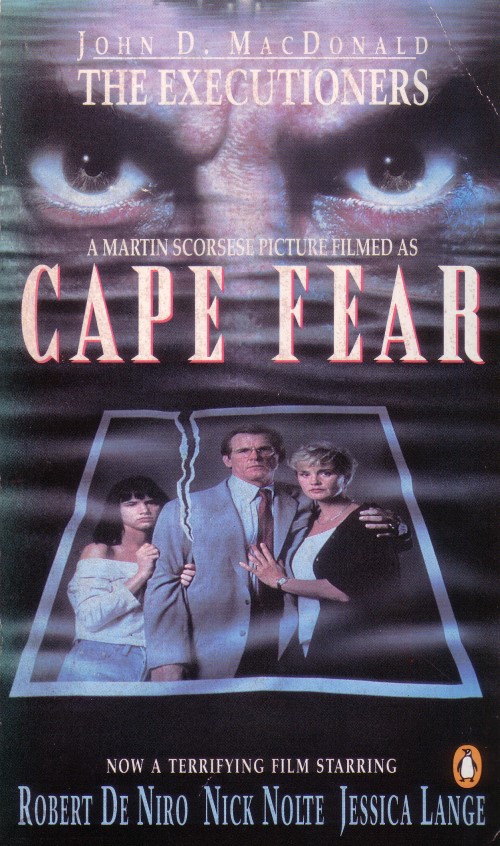
CAPE FEAR – The book of the films

Written in 1957 by John D. MacDonald, The Executioners has the distinction of being filmed twice – in 1962 and 1991. MacDonald died in 1986 so didn’t get to see the Scorsese remake. The title was changed to Cape Fear by Gregory Peck, who produced and starred in the first film. I have to agree with Peck, The Executioners is not really an appropriate title for the book and its theme. (The Executioner series featuring Mack Bolan by Don Pendleton didn’t appear until 1969).


It’s 1956 and Sam Bowden is a dedicated lawyer, a happily married man with a lovely wife, Carol, and three children, Jamie, Bucky and Nancy. Way back in 1943, Bowden was a First Lieutenant on the Judge Advocate General’s Department and became a prime witness in the trial and conviction of staff sergeant Max Cady for the assault on a young woman in an alley. Significant memory – ‘I hard a whimpering in an alley. I thought it was a puppy or a kitten. But it was a girl. She was fourteen.’

Cady got life, but was let out after thirteen years. And Cady began stalking Bowden.

There was no law of harassment in those days. The law seemed helpless, as did Bowden. ‘He swam out with furious energy, but he could not swim away from the sticky little tentacle of fear that had just fastened itself around his heart.’ MacDonald’s prose is littered with gems like this. Another: ‘He could have been a broker, insurance agent, advertising man – until he looked directly at you. Then you saw the cop eyes and the cop look – direct, sceptical and full of a hard and weary wisdom.’

All of the characters are deftly drawn, particularly Bowden’s wife. Although there’s a pall of incipient doom hovering in the absent guise of Cady, there’s humour too. ‘Carol was a good but emotional cook. She talked to the ingredients and the utensils. When something did not work out, it was not her fault. It was an act of deliberate rebellion. The darn beets decided to boil dry. The stupid chicken wouldn’t relax.’

Cady issues veiled threats, but never in anybody else’s hearing. Even when the Bowdens’ dog Marilyn is poisoned, there’s no evidence that it was Cady. In order to protect his family – ‘his four incredibly precious hostages to fortune’, Bowden arrives at the unpalatable conclusion that he must go outside the law to deal with Cady.

‘There are black things loose in the world. Cady is one of them. A patch of ice on a curve can be one of them. A germ can be one of them.’

Near the denouement, MacDonald returns to that significant memory. ‘… heard a faint mewling sound, a hopeless sound of fright and pain and heartbreak so like the unforgettable sound he heard long ago in an alley…’

The book begins and ends with the family on their boat, but unlike the movies the vessel doesn’t play any notable or dramatic part in the story. The beginning is a slow fuse, not recommended in modern thrillers. But it works because MacDonald paints a happy family, creating characters you’re going to care for and worry about. The ending, while realistic, is quite tame by modern standards and much of the action occurs off-screen, which adds to the psychological concern but diminishes the graphic assault on the senses. The ending lingers and perhaps shouldn’t – the screenwriter’s axiom is ‘enter late, leave early’ – and yet it’s a satisfying ending, the calm after the storm. Both Mitchum and De Niro bring suitable menace to a villain who doesn’t have to be in every scene to yet dominate the entire film. As Max Cady does in the book.

Sunday, 30 September 2012

Bob Jenkins – ink in his veins


A native of Portsmouth, England, Bob died on the evening of 24 September as a result of bone and prostate cancer. I first got to know him when he was publishing a short story magazine, Ad Lib in the late 1980s. He was an ex market stallholder, an ex journalist and could turn his hand to almost anything. This was before the computer and the Internet would dominate publishing. I illustrated a few editions of Ad Lib before it folded, among them stories by Arthur C Clarke and Jeffrey Archer. After that, we met infrequently, usually at his market stall in Portsmouth, where he sold second-hand books, or the nearby pub. My career in the navy took me away and we lost touch. Then he hit upon his money-changing concept and Intercash was born in 1993. Rumour has it that he soon became a millionaire. True or not, he employed a number of staff and Intercash expanded over the years. The origins can be read here, http://intercashuk.com/newsite/aboutus.php, written in Bob’s inimitable style.

Some years later, while I was redundant and looking for a change in direction, away from IT, I stumbled on a copy of the Portsmouth Post magazine and realized that Bob was not only the editor but publisher. He was looking for a sub editor so I got in touch and the job was mine. It was a popular monthly magazine, and great fun to work on. Incredibly, workaholic Bob handled the magazine and also his Intercash empire at the same time, no mean feat. He fought the weed and demon drink, two accessories that seemed appropriate for his journalist personality. He was quick witted and sharp as a knife where puns and article headlines were concerned. His DIY articles were written under the pseudonym of Matt Black, gardening tips by Daisy Cheyne and general articles by Doug Deepdown. He wrote short stories and novels under several names, too. His output was literate and prodigious. Recently he was working on the final draft of a 200,000-word Victorian crime novel set in Portsmouth.

When I moved to Spain, Bob kept me on at the Portsmouth Post and we worked on the magazine remotely. However, he flew me back to UK once a month for a week to get the magazine finished and ready for print. I still remember those bacon butties we’d enjoy of a Saturday morning, just the two of us, while beavering away in the office.

Above all, Bob was a people person. He seemed to be known by people from all walks of life, a genuine character. He didn’t suffer fools gladly but he repaid loyalty with trust, help, his time and advice, and was very protective about his staff. He championed local causes in his magazine, from the victims of illegal car clampers to the local hospice. He loved cricket, dog racing, radio and history, writing about all of them with great flare and passion. His great loves were Portsmouth city and Pompey soccer team and the former is enshrined in the website he created: http://nowportsmouth.co.uk/about-2.html

He thought the world of his extended family, and wasn’t averse to a little nepotism from time to time, putting family members on his magazine’s cover. The Christmas 2004 issue featured his grandchildren, nephews, nieces. Bob Jenkins was a very generous soul and he will be greatly missed.

Funeral at Portchester crematorium, October 10, 3pm. I’ll be there in spirit. R.I.P., Bob, old mate.

Sunday, 15 July 2012

JOHN CARTER - WORTH THE 50 YEAR WAIT

A bit late, perhaps, but I’ve finally watched John Carter and, surprise, surprise, I find that the film I saw wasn’t the same as that viewed by several critics! At least, that’s how it seems.

The film suffered a severe savaging from many critics on both sides of the pond. Almost without exception, the majority of them hadn’t read the source material and bemoaned the fact that there wasn’t much original in the film. Some had the good grace to accede that the Edgar Rice Burroughs Martian tales were often the inspiration for the many sci-fi flicks over the last hundred years (that is, his ideas were pinched). Some blamed the poor marketing of the film. Others targeted the main actors, and the dialogue. A few didn’t quite grasp information that was offered in the script – maybe they were tucking into their gourmet cinema meal at the time – such as Carter’s ability to leap great distance, attributed to the lower gravity of Mars. One reviewer in UK commented that A Princess of Mars was ‘hailed as a geek classic’ – that must therefore include those well known geeks, astrophysicist Carl Sagan and literary luminary Ray Bradbury, both of whom went on record more than once that Burroughs’ Barsoom novels inspired them to follow their respective careers.

Well, all those naysayers are mightily wrong. Maybe they were all suckered into ‘adulation of The Artist mode’? Just take a look at the reviews on Amazon. When I ordered the DVD there were already many very favourable comments, deriding the critics. Now, as I write this, the combined 4 and 5 star reviews total 602 out of 698 – that’s 86%. The rotten tomato reviews clock it at 52% ‘suffers from uneven pacing, incomprehensible plotting and characterisation.’ Forget all that. The plot and characterisation are not incomprehensible, though in common with most modern action movie scripts you do have to pay attention to what is being said… If ever a film was badly served by the media, then this was it.

Cinema has many purposes – but primarily it’s intended to entertain. John Carter did that with gusto. This was a fantasy film designed for the big screen, with spectacular scenery, epic scenes, gorgeous colour, fabulous costumes, characters true to the books, and a sense of wonder tinged with modern sensibilities. Utah served well as Barsoom. The tharks were superb, in creation and depiction, seeming totally natural. The flying machines were definitely otherworldly. The city of Helium was impressive, as was the thunderous mobile city of Zodanga. There was pathos, humour, irony, romance, bravery and betrayal within the 127 minutes of film; the time flew by – and I for one wanted more!

Direction, script, music score, film, actors, and special effects – none deserved the mauling the critics dished out. This was a splendid visualization of an imaginative adventure lovingly plucked from the pages of a 1912 best-selling story. There were clever touches in the script, notably including Burroughs in the bookend vignettes. This also rang true to the first person narrative of the original. The evil Therns were endowed with additional powers and knowledge, granted, but they were not far removed from the conniving beings of the books. (See my drawing of August 1963, ‘Attack on the holy Therns’ (The Gods of Mars).)


Maybe another fifteen minutes would have deepened the characterisation of some. But essentially this was a fast-paced exotic story and in-depth characterisation would only have slowed it down. Taylor Kitsch delivered a strong man tired of war and death, while Lynn Collins as Dejah Thoris embodied in every way the beauty and strength of the princess of Mars. Though heavily disguised by CGI effects, Samantha Morton (no relation) captured the essence of Sola, her fragility and compassion. William Dafoe’s Tas Tarkas was great, too. And Mark Strong as the inimical Matai Shang, chief Thern, proved he can play villains with consummate ease, but never hams it up. Woola was engaging, even with six legs and deadly incisors – and not dissimilar to my drawing of Woola and John Carter battling the deadly Sith (Warlord of Mars).


I agree that the marketing was poor. The DVD cover is lacklustre. And as for putting up the quote ‘Star Wars for a new generation’, they’d have been better employed stating: ‘Before Avatar, before Star Wars, before Star Trek, before Flash Gordon – there was John Carter of Mars!’ Initially, I sympathised with the critics of the choice of film title and felt that John Carter of Mars would have been better, as it would leave no filmgoer in doubt. But then I saw the end of the film and it seemed right – until the end, he’d been John Carter of Earth. But at the end, when he married Dejah Thoris, he became John Carter of Mars, and that’s the title that’s shown – heralding at least two sequels. Two sequels that are sadly now probably stillborn due to the misguided marketing and reception of this first epic adventure.

If you haven’t seen this film because you were put off by the critics, then ignore them and buy it. Buy it and prove them wrong. It’s escapist fantasy of the highest order.

Friday, 13 July 2012

FFB – Free Fall in Crimson by John D. MacDonald

Published in 1981 – some five years before MacDonald’s death, aged 70. This was the 19th Travis McGee adventure. Besides each novel title featuring a colour, they also contained delectable female companions, nasty villains, exotic locals such as Florida, Mexico and the Caribbean. McGee’s sidekick, friend and sounding-board is Meyer, an economist and Ph.D. McGee lives on his 52-foot (16 m) houseboat, the Busted Flush, named for the poker hand that started the run of luck in which he won her, and introduced in the first novel, The Deep Blue Goodbye. She is docked at Slip F-18, Bahia Mar marina, Fort Lauderdale, Florida.

This time around, McGee is tasked with finding out who murdered the millionaire cancer-riddled Ellis Esterland. His enquiries take him into the macho world of outlaw bikers, the crazy lives of film producers and actresses, and the dangerous pursuit of hot-air ballooning. This time around, his female companion is the luscious Anne Renzetti, ex-secretary of the murdered tycoon. Sometimes, his prose is hard-nosed and at other times, it’s lyrical, viz: ‘… moving in that sweet silence across the scents, the folds, the textures of the soft green April country’ when describing McGee’s first air-balloon journey.

MacDonald’s McGee crime books are hardboiled. Along the way, his first person narrative reveals the flawed American Dream.

Surprisingly, times haven’t changed – some 31 years later. As one character says, ‘But lots of terrible things are happening everywhere, I guess. Why is everybody getting so angry?’

Today, lack of driving standards is bemoaned. Nothing new there, then: ‘growling traffic, the trucks tailgating, the cowboys whipping around from lane to lane, and the Midwest geriatrics chugging slowly down the fast lanes, deaf to all honkings.’

Craftily, MacDonald uses Meyer to write about things that irk him, such as declining literacy. The Meyer speech is too long to reproduce here, but this is a taster: ‘In a nation floundering in functional literacy, sinking into the pre-chewed pulp of television, it heartens me to know that here and there are little groups of younguns who know what an original idea tastes like, who know that the written word is the only possible vehicle for transmitting a complex concept from mind to mind, who constantly flex the muscles of their heds and make them stronger… Nor will these children be victimized by the blurry nonsense of the so-called social sciences. The muscular mind is a cutting tool, and contemporary education seeks to take the edge off it.’

Yes, he breaks the rule about characters spouting long swathes of speech, but he seems to get away with it. Because he’s good, very good. I'd recommend any Travis McGee to anyone who has never tried one. This, like the others, is well crafted, with believable characters.


Thursday, 5 July 2012

Iwan Morelius 14 Nov 1931-21 June 2012

My wife Jen and I were saddened to learn that Iwan died suddenly last month, leaving his wife Margareta.


I only knew Iwan for the last four years of his life when I discovered by chance that he lived a half-hour’s drive away from me here in Spain.


Iwan was a consummate bibliophile. Margareta loves reading too – and music. Indeed, Iwan and Margareta’s home is a bibliophile’s heaven, with so many signed copies.

Born in Stockholm, Iwan and his family moved some eleven times in fourteen years. His parents owned a private library of about 400 books and Iwan caught the reading bug early. He devoured the translations of English and American authors and finally began collecting the Dennis Wheatley novels. In 1961 he wrote to Wheatley and struck up a lifelong correspondence. In 1971 Iwan was invited for dinner at Wheatley’s London home in Cadogan Square.


Iwan with Dennis Wheatley
Rather than wait for a Swedish translation of his favourite authors, Iwan bought the English versions and read those. He began writing to many of his favourites – Alistair MacLean, Helen Macinnes, Ian Fleming, Desmond Bagley, Hammond Innes, Leon Uris, Joe Poyer, James Hadley Chase, James Leasor, Edmund Crispin, Georges Simenon among others. Almost all of them answered his letters and several continued to keep in touch over the years.

In 1968 Iwan brought out the first issue of DAST magazine – (Detective, Agent, Science Fiction and Thriller). In 1974 Iwan was commissioned by Lindqvist Publishing to acquire a strong list of thrillers and mysteries – Hedman Thrillers, publishing many Swedish translations of Iwan’s favourite authors, among them Jack Higgins.

Iwan became a good friend of Geoffrey Boothroyd – Ian Fleming’s and Bond’s armourer – and they visited each other’s home regularly. Indeed, he visited a number of authors in their homes in the US, including Joe Poyer and Raymond Benson. He interviewed Ray Bradbury at the time of Bradbury’s first mystery being published and kept in touch. Bradbury is one of Margareta's favourite authors.


Margareta with Ray Bradbury, 1988
The list of authors Iwan has met, interviewed and kept in touch with over the years is quite remarkable: Mickey Spillane, Brian Garfield, Isaac Asimov, Colin Forbes, Duncan Kyle, John Gardner, Tony Hillerman, Frederick Forsyth, Michael Avallone, Elmore Leonard and Ed McBain, to name but a few. He taped some interviews, for example with Jack Higins and Leslie Charteris, and I have copies.

In 2009 I wrote an article about Iwan for the Levante Journal: ‘The Bond Connection’, one of a planned series that didn’t get taken up. For some time Iwan had badgered Raymond Benson to set one of his James Bond books in Spain; Raymond duly obliged with his thriller Doubleshot, written in 2000, which is partly set here. It also features a number of acknowledgements, not least Iwan. And to top that, on p233 there is a ‘Dr Iwan Morelius, a Swedish plastic surgeon’ who works for the villainous organisation! (As an aside, I’ve included Iwan as a Swedish chef in my novel The $300 Man (Hale Black Horse Western, as by Ross Morton). I also dedicated my crime novel A Sudden Vengeance Waits to him.


Geoffrey Boothroyd
Iwan was a generous host and virtually ran a private lending library for his friends. He had so many fascinating tales to tell, often with that distinctive twinkle in his eye. He will be missed.

Saturday, 23 June 2012

Forswear swearing, or not

The other day, an author expressed concern when a reader castigated her over her use of swearing in her book. I pointed out that expletives had become commonplace since the 1980s. Sure, they were around before then, but not in such number to the point where they now seem all pervasive.


I recall the minor furore when Dick Francis first used the F-word. [As these blogs can potentially be family reading, I’ll refrain from spelling out the various examples]. Francis probably lost a few readers in libraries, but otherwise his inclusion of expletives didn’t affect his sales. Lincoln Child’s debut novel The Relic was spoiled in my view by the profusion of ‘in character’ expletives, yet the book helped the writing duo embark on a successful career. While s*** and f*** are now commonly used in books, there’s still a certain reluctance to use c***. In my library of reference books, I’ve got the dictionary of contemporary slang and the thesaurus of American slang: there are plenty of more colourful variations for insults and swear words.

So, putting expletives in your characters’ mouths is really a gut decision. If you’re not comfortable about it, there are alternatives. You simply type: ‘He swore.’ Or variants of that. The reader still gets the message. For my Leon Cazador crime short stories (collected in Spanish Eye), I simply wrote ‘He swore colourfully’ or whatever, since the stories appeared in magazines and children or a maiden aunt could pick them up.

What is the purpose of swearing? It can be seen as a lack of vocabulary. Some use it as punctuation and don’t even know they’re doing it. As someone said, ‘Once the expletives were deleted, he didn’t say much.’ A character swears because he’s exasperated, is in mortal danger, hurt, wishes to insult or is alarmed. It can be used as a pressure valve, to release tension, too. Whatever the reason, I feel that in writing that book or story, swearing should be used sparingly, to convey shock or other emotions; so yes, I used the F-word nine times in my crime thriller about Sister Rose.

Yes, in the real world expletives are as commonplace as those ums and ers with which people pepper their speech. But as writers we’re not writing the real world, we’re creating the impression of a real world – a different thing entirely.

My late father was in the army during WWII and was wounded in Sicily. I never heard him swear. Maybe he did, but clearly not in front of women or children.

If you’re writing a western, there’s some guidance, at least. The so-called code of the West has this to say, ‘Cuss all you want… but only around men, horses and cows.’ Though the writers and producers of Deadwood probably ignored that advice. And George Sicking said, ‘Real cowboys are tough but not vulgar. You can tell them by the way they treat women. If a man doesn’t respect women enough to clean up his mouth, he doesn’t respect himself.’ That’s not a bad credo to live by, in my book.

Thursday, 7 June 2012

Ray Bradbury - R.I.P.


Sad to learn that Ray Bradbury died, aged 91, during the transit of Venus across our sun. Not only a science fiction and fantasy writer of broad talent, but a crime novelist, screenplay writer, playwright, poet and generous man. He was an inspiration to generations of writers and film producers worldwide.

The world may be a poorer place with his passing, but it's a very much richer place with his phenomenal imaginative output, which will live on.


Despite illness in his later years, he never stopped writing. His essay on the inspiration for his writing was published in the New Yorker a week before his death. He was given many accolades, not least an asteroid discovered in 1992, named 9766 Bradbury.