Search This Blog

Showing posts with label Gregory Peck. Show all posts

Friday, 2 November 2012

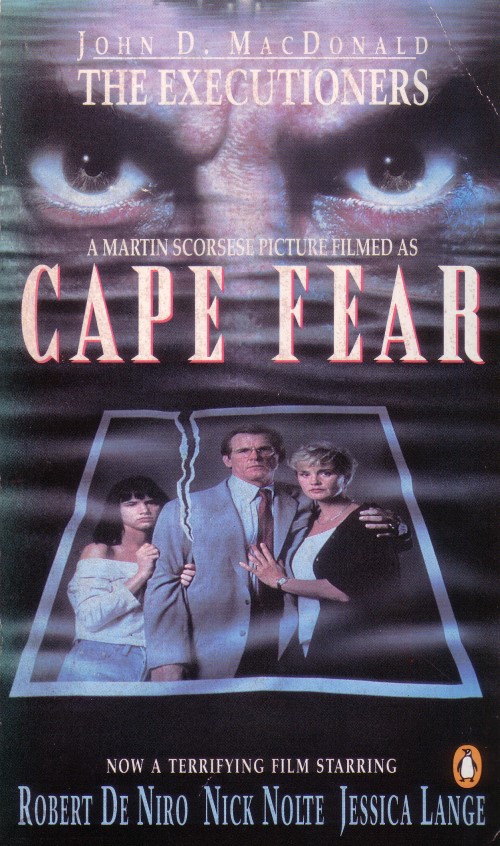
CAPE FEAR – The book of the films

Written in 1957 by John D. MacDonald, The Executioners has the distinction of being filmed twice – in 1962 and 1991. MacDonald died in 1986 so didn’t get to see the Scorsese remake. The title was changed to Cape Fear by Gregory Peck, who produced and starred in the first film. I have to agree with Peck, The Executioners is not really an appropriate title for the book and its theme. (The Executioner series featuring Mack Bolan by Don Pendleton didn’t appear until 1969).


It’s 1956 and Sam Bowden is a dedicated lawyer, a happily married man with a lovely wife, Carol, and three children, Jamie, Bucky and Nancy. Way back in 1943, Bowden was a First Lieutenant on the Judge Advocate General’s Department and became a prime witness in the trial and conviction of staff sergeant Max Cady for the assault on a young woman in an alley. Significant memory – ‘I hard a whimpering in an alley. I thought it was a puppy or a kitten. But it was a girl. She was fourteen.’

Cady got life, but was let out after thirteen years. And Cady began stalking Bowden.

There was no law of harassment in those days. The law seemed helpless, as did Bowden. ‘He swam out with furious energy, but he could not swim away from the sticky little tentacle of fear that had just fastened itself around his heart.’ MacDonald’s prose is littered with gems like this. Another: ‘He could have been a broker, insurance agent, advertising man – until he looked directly at you. Then you saw the cop eyes and the cop look – direct, sceptical and full of a hard and weary wisdom.’

All of the characters are deftly drawn, particularly Bowden’s wife. Although there’s a pall of incipient doom hovering in the absent guise of Cady, there’s humour too. ‘Carol was a good but emotional cook. She talked to the ingredients and the utensils. When something did not work out, it was not her fault. It was an act of deliberate rebellion. The darn beets decided to boil dry. The stupid chicken wouldn’t relax.’

Cady issues veiled threats, but never in anybody else’s hearing. Even when the Bowdens’ dog Marilyn is poisoned, there’s no evidence that it was Cady. In order to protect his family – ‘his four incredibly precious hostages to fortune’, Bowden arrives at the unpalatable conclusion that he must go outside the law to deal with Cady.

‘There are black things loose in the world. Cady is one of them. A patch of ice on a curve can be one of them. A germ can be one of them.’

Near the denouement, MacDonald returns to that significant memory. ‘… heard a faint mewling sound, a hopeless sound of fright and pain and heartbreak so like the unforgettable sound he heard long ago in an alley…’

The book begins and ends with the family on their boat, but unlike the movies the vessel doesn’t play any notable or dramatic part in the story. The beginning is a slow fuse, not recommended in modern thrillers. But it works because MacDonald paints a happy family, creating characters you’re going to care for and worry about. The ending, while realistic, is quite tame by modern standards and much of the action occurs off-screen, which adds to the psychological concern but diminishes the graphic assault on the senses. The ending lingers and perhaps shouldn’t – the screenwriter’s axiom is ‘enter late, leave early’ – and yet it’s a satisfying ending, the calm after the storm. Both Mitchum and De Niro bring suitable menace to a villain who doesn’t have to be in every scene to yet dominate the entire film. As Max Cady does in the book.

Sunday, 24 May 2009

Book of the film: To Kill a Mockingbird


It has taken me a long time to get round to reading this book, first published in 1960. Maybe I was daunted by the fact it was a Pulitzer Prize winner and had sold in excess of 30 million copies. I’m glad I waited since I suspect I gleaned more from this as a mature reader than as an adolescent, though I could be wrong there as its appeal is very wide indeed.

Set in the 1930s Deep South, it deals with truth, the lot of Negroes, a small town’s prejudice and hypocrisy, and the bravery of an individual with principles – ‘The one thing that doesn’t abide by majority rule is a person’s conscience.’ – Atticus Finch.

Its author, Harper Lee, was 34 when she wrote this, her only book. Its huge success – the film of the book being released in 1962 – must have had some effect on the racial Civil Rights politics at the time. From 1865 to 1877 strides were made toward equal rights for African-Americans; Southern black men began to vote and were elected to the United States Congress and to local offices such as sheriff. Yet it was not until 1965 that an Act was passed to outlaw discriminatory voting practices that had been responsible for the widespread disenfranchisement of African Americans in the United States. Maybe Harper Lee’s popular book helped in some small way.

The book begins in classic mode, reflecting on events that are actually revealed at the end of the narrative. Eight-year-old Scout (Jean Louise) and her thirteen-year-old brother Jem (Jeremy) are the children of widower Atticus Finch, a lawyer of the town of Maycomb, Alabama. The narrator is Scout who is reminiscing about her childhood past, hence the adult language used in her descriptions. It’s never explained why she is nicknamed ‘Scout’. Anyway, she immediately endears herself to you with her self-deprecating good humour and generally amusing observations: ‘With a click of her tongue she thrust out her bridgework, a gesture of cordiality that cemented our friendship.’

The siblings refer to their father by his first name, much to the consternation of their disapproving and distant relatives; it makes for easier reading, anyway.

The household helper and cook is Calpurnia, a Negro with infinite patience and a heart of gold, more a member of the family than hired help. She, along with so many characters in the town, is drawn with sure strokes so we get to know them, which is the true measure of a good author.

Most towns probably have a house that invokes gossip and tall tales about things going bump in the night. Maycomb is no different. The Radleys’ place is where, at risk of some unspeakable death, children dare to sneak into the yard and touch the walls. Boo Radley hasn’t been seen in years and this causes more stories. Gregory Peck, who starred as Atticus and won an Oscar for the part, said: ‘The characters of the novel are like people I knew as a boy. I think perhaps the great appeal of the novel is that it reminds readers everywhere of a person or a town they have known. It is to me a universal story – moving, passionate and told with great humor and tenderness.’

When Tom, a Negro, is accused of raping a white woman, Atticus is selected as his defence lawyer. It’s obvious that Tom is innocent, but prejudice runs deep, it seems. During the court case, Atticus makes a moving strong plea about all men being equal, not in accomplishment or talent, which is nonsense, but in the eyes of the law – a laudable ideal that, even today, is tarnished by those with money.

Lee never completed another book and shunned interviews. Several sources state that her book was in large doses autobiographical; whether it is or not, the characters shine through as real people, a great accomplishment.

My copy was a reprint dated 1997; and it had been reprinted no less than 42 times in this paperback imprint. That annoys me just a little: there are easily thirty typing errors in the text – even one on the first page – yet no publisher considered correcting them in all those years. A shameful way to treat a classic.

From an editorial perspective, I found the first person narrative spot on. One very minor quibble which her editor Tay Hohoff seems to have missed: ‘One day… we did not see Atticus standing on the sidewalk looking at us, slapping a rolled magazine against his knee.’ (p44) If he wasn’t seen, he couldn’t be written about. Still, the image is a striking one and maybe that’s why it was left in.

From the outset, this was going to be a difficult novel to film. Inevitably, voice-over was employed (by Kim Stanley), ostensibly the mature voice of Scout. Horton Foote won an Oscar for his Adapted Screenplay, deservingly so, considering the difficulties of transferring Scout’s memories to a visual medium. It’s an accomplished piece of work, judicially leaving out certain scenes, events and characters from the novel while combining the odd character here and there, all the time preserving the truth and integrity of the original.

Any re-reading of the novel will mean that the mind’s eye sees Gregory Peck as Atticus, the part he was born to play.
