Search This Blog

Showing posts with label Salamanca. Show all posts

Monday, 27 April 2015

Two-for-one cathedrals and one forbidden book – Salamanca, Spain

Our day trip (15 April) by coach to Salamanca started out from Segovia with an overcast sky. We passed about six storks’ nests; enormous and weighty structures in a field: some buildings in Segovia have specially constructed platforms on their roofs to cater for these birds, in the hope that they will do no damage to the structure.

About thirty minutes from our destination, the heavens opened. Luckily, we’d consulted the Internet and carried waterproofs and umbrellas. We were dropped off a short walk from the Plaza Mayor, the famous 18th century square – one of Spain’s largest and grandest. Here we stopped for a coffee and empanadilla. On the east side of the square is the Royal Pavilion, decorated with a bust of Felipe V, who built the square (though I believe he had some help…) 1729-1755. I spotted a bust of the Duke of Wellington, too.
 
Jen in Plaza Mayor                         Bust of Wellington
 

Cathedrals, old and new
We risked the rain and headed for the Cathedrals; there’s an old one and a new one. The terms ‘new’ and ‘old’ are relative, however: the 16th century new cathedral didn’t replace the old but was constructed beside it. So you enter the new and turn right to enter the old, the 12th and 13th century Romanesque cathedral. Here, you can see surviving wall paintings and the astonishing altarpiece with its 53 panels in lustrous colours. In the vault above is a fresco depicting scenes from the Last Judgement.

Roman Bridge
When we finally emerged from the new cathedral, the rain had stopped and we walked to the roman bridge, which crosses the river Tormes and was built in 1AD. It still retains fifteen of its original 26 arches (some have been reconstructed due to damage by flooding over the years. Still visible on the ashlars of the arches are the holes of the Ferrei forceps or ‘big tweezers’ used to place them. Similar holes can be seen on the aqueduct of Segovia.
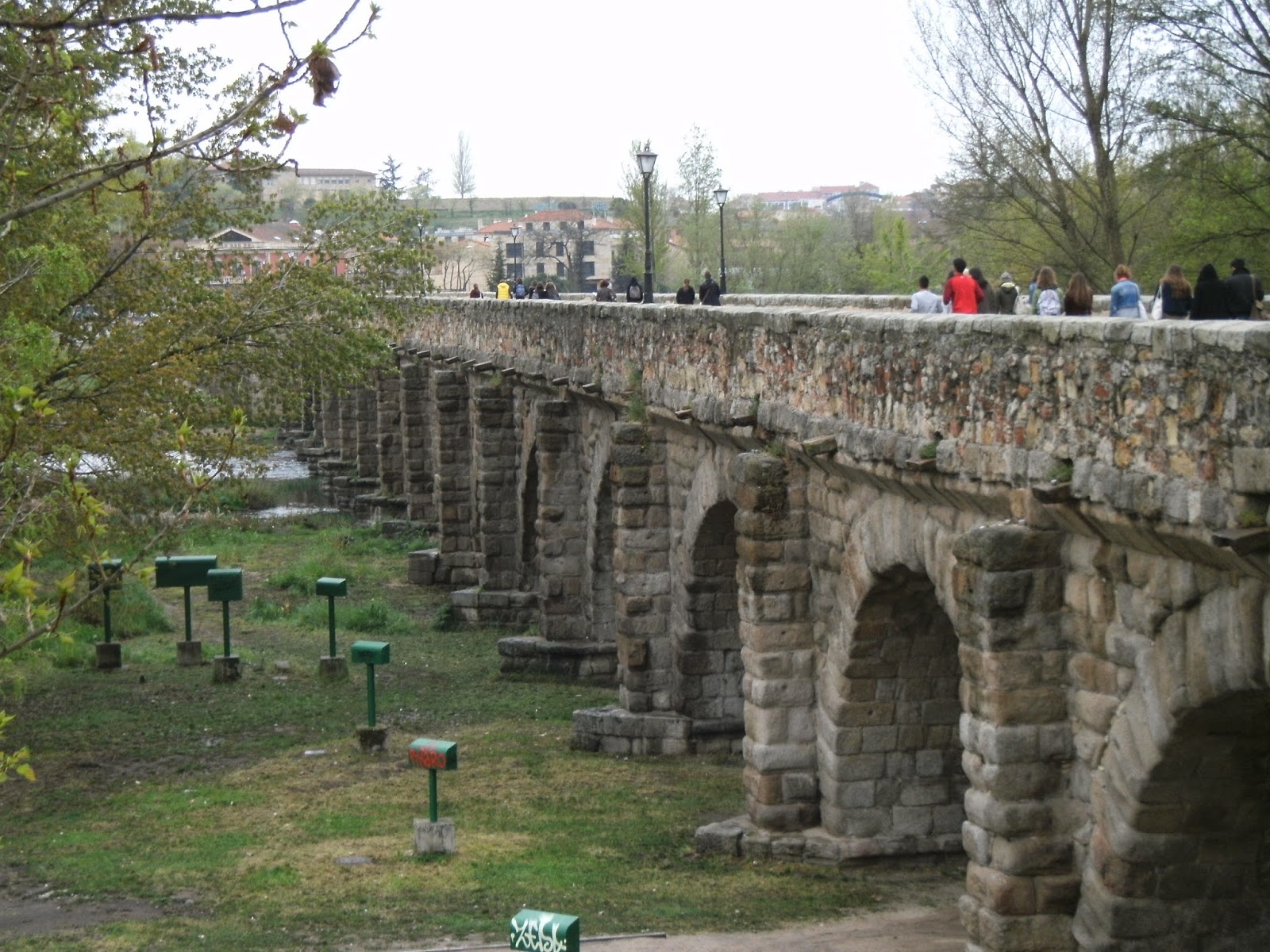
Roman bridge

Lazarillo de Tormes
Overlooking the roman bridge and the river Tormes is a charming statue dedicated to the novella The Life of Lazarillo de Tormes and of His Fortunes and Adversities, a picaresque book published anonymously in 1554. It concerns a boy, Lázaro, from Salamanca; his mother gives little Lázaro (Lazarillo) to a blind beggar to serve an apprenticeship, where he learns about the various levels of society, the ills, and the hypocrisies. Lazarillo is the fore-runner of anti-heroes such as Tom Jones and Huckleberry Finn. The book appeared on the list of forbidden books of the Spanish Inquisition, due to its critical stance regarding authority (the Catholic Church and the aristocracy). [http://www.classicspanishbooks.com/lazarillo-de-tormes.html]

Jen in front of the statue to Lazarillo de Tormes


Next: University and the conch house

Thursday, 12 December 2013

Happy New Year, Salamanca!

Students in Salamanca celebrate New Year tonight (Thursday, 12 December).


Founded by Alfonso IX of Léon in 1218, Salamanca University is the oldest in Spain. Opposite is the statue of Fray Luis de Léon, who taught theology at the university; within, his former lecture room is preserved in its original style. The university’s ancient library houses some 40,000 volumes, while its modern counterpart contains over 165,000.
 
 
In its early days it made major contributions to the development of international law, and Columbus sought support for his voyages of  discovery from the enlightened faculty of astronomy. The university continued to flourish under the Reyes Católicos, even employing a woman professor, Batriz de Galindo. It resisted the Inquisition but extreme clericalism of the 17th and 18th centuries stifled free thought; books were banned as being a threat to the Catholic faith, and mathematics and medicine disappeared from the curriculum. Decline worsened when Napoleon’s armies demolished twenty of the 25 colleges. Salamanca is still a prestigious seat of learning and runs a highly successful language school.

The premature celebrations are held in the Plaza Mayor (Main Square). This magnificent square was built by Felipe V to thank the city for its support during the War of Spanish Succession, completed in 1755. Once used for bullfights, the square now belongs to shopping arcades, cafés and the people.
 
Instead of the Spanish tradition of eating 12 grapes as the clock chimes midnight, the students eat gummy sweets (ugh!). A sweet manufacturer in Madrid has even created a bag of sweets specifically for the occasion, with 12 grape-shaped sweets.

This celebration began in 1999 when a group of Salamanca students got together to celebrate the new year early before they parted for home at the end of term. They drank cava and ate sweets while the clock chimed. In subsequent years, more and more students took part and now it is organised by an event co-ordinator and supported by the city hall. The event is broadcast on Castilla y Leon regional TV.
