Search This Blog

Showing posts with label #Paperbacks. Show all posts

Tuesday, 21 August 2018

Review - Hot Lead #2


This second homage to the western is as lavishly illustrated as the first. Not only a pleasure to read, to view, but also a collector’s item!  The full colour images justify the cost of the magazine. And what images!


Although this issue covers the art of the western, it kicks off with an article about the film – and book – Charro! It makes fascinating reading, concerning the original written treatment, the novelisation and the mediocre Elvis film itself.
 

#2 features the western artwork of Tony Masero, who has been supplying paperback covers since the 1960s – in all genres. Besides an interesting interview with many accompanying covers there’s a gallery of six full-page paintings. Tony painted the cover of my 2012 Black Horse Western Old Guns.

Then there’s an overview of the western illustrations of artist Frank Bellamy, who died too young at  59. He was one of my favourite illustrators of the 1960s with his Dan Dare, Fraser of Africa and Heros the Spartan strips. He drew three western adventures for the sci-fi Garth series, every black-and-white panel a work of art.

Germany had a vast following of westerns from the late 1940s until the 1980s, and a good portion of the output is considered here; the artwork and storylines were heavily influenced by the Spaghetti western explosion, though censorship reared its head, too…

Finally, author Paul Bishop gives us a colourful overview of western comics, ranging from the 1930s to the rather sparse present. I fondly remember some of the covers depicted!

Recommended for fans of westerns and nostalgia buffs.

Wednesday, 26 October 2016

Sleuths, Spies and Sorcerers


This alliterative title covers three episodes concerning Andrew Marr’s Paperback Heroes on BBC4. Last week we had Sleuths, this week we had Sorcerers (which is repeated tonight on the same channel), and next week it will be Spies.

Within the limited time of an hour, Andrew Marr attempts to deconstruct these popular genres; you know those books that never seem to win prizes, that the literary snobs decry and dismiss, those books that sell in their millions.

Sleuths was patchy, giving over many minutes to the genius of Agatha Christie, leaving less time for other practitioners. We had the John Dickson Carr’s locked room mysteries, Ian Rankins’ Rebus, Chandler’s Marlowe, Dashiell Hammett’s The Continental Op and Sam Spade to name a few. Interviewees comprised Val McDermid, Ian Rankin, and Anthony Horowitz, among others.

The psychology of the sleuths was examined, and the times they lived in obviously affected them. A long time ago, a reviewer of John D. McDonald said the author didn’t need to write The Great American Novel (a holy grail for American authors at one time), since he was doing that in his installments of Travis McGee and his other crime novels. That’s more or less the conclusion Marr makes concerning the crime writers, whether of the past or the present: they reflect the society from which they sprang, a rich trove to delve into for future archaeologists and historians.

Logically, Spies should have been next but for some reason Sorcerers followed. Here we entered the realms of fantasy.  While fantasy has been around throughout the ages, in many cultures, Marr suggests that its modern popularity probably stemmed from the publication of The Lord of the Rings books. One of the prime attractions of fantasy is the world-building that is required; that means multifarious aspects of life in the fictional world, all logically fitting.
Besides Tolkien, Marr touched upon George R.R. Martin’s A Song of Ice and Fire sequence of  novels, now filmed as Game of Thrones. Apparently, Martin was inspired to write the series when visiting Hadrian’s Wall and studying medieval English history and also the Wars of the Roses. The books contain ambivalent characters, people who are not wholly good or completely bad, as in life, perhaps, with conflict caused by ideology, greed, lust and a thirst for power. Other fantasists mentioned include Ursula K. Le Guin (Earthsea series), C.S. Lewis (Chronicles of Narnia), J.K. Rowling (the Harry Potter phenomenon) Alan Garner (The Weirdstone of Brisingamen), Philip Pullman (His Dark Materials trilogy), Neil Gaiman (American Gods), and of course Terry Pratchett (Discworld novels et al).

This episode seemed more coherent and covered a wide range within the genre.

As with Sleuths, however, there are bound to be many favourite authors omitted from this genre. It is now impossible to read all books within any single genre (nor would that be a good literary diet anyway), because there is so much choice.

Next, Spies. I can guess that certain names will crop up, among them Deighton, Le CarrĂ©, and Fleming, but who else? I’ll be tuning in to find out.

Besides being about books and authors, this series touches upon several genres I enjoy to read and write: Spanish Eye (Sleuths), Wings of the Overlord (Sorcerers), and ThePrague Papers (Spies).

Monday, 26 September 2016

'It's one of those most wicked of things...'

A big thank you to Jack Owen across the Pond, writing an Amazon review of Catalyst:

A nice nostalgic drop of mayhem, sex and fashion with an avenging poster-child for haute couture fighting murderous conglomerates. It is a welcome escape from insoluble world affairs.

Nik Morton's fashionably correct antagonist 'Cat' (Catherine Vibrissae) is the smartest avenger since Emma Peel was teamed with John Steed.

I enjoyed dipping into Morton's smorgasbord of tidbits which reintroduced me to southern England, Wales, Spain and a splash in the Med. All the while following the scent of blackguards tormenting caged furry pets; then sadistic scientists using refugees to test-drive a sex cocktail which would shame Viagra's prowess.

Not sure if my Granny would approve, but its a great read for frequent flyers stuck at airport terminal, bathers at the beach or coffee shop habituates. It might also rock the chairs of 'Enquiring Minds' readers of a certain vintage.

I should caution you it's one of those most wicked of things – a series.

And this is just Cat's first recorded adventure.


Catalyst - obtained at these Amazon sites worldwide.

Tuesday, 9 August 2016

Paperback trilogy - the cat's meow...


  • Three exciting paperback action romantic adventures featuring ‘the avenging Cat’! 
  •  With superb uniform covers from Crooked Cat Publishing.


Catalyst - £7.99

Kindle also available – (series introductory bargain!) - £0.86

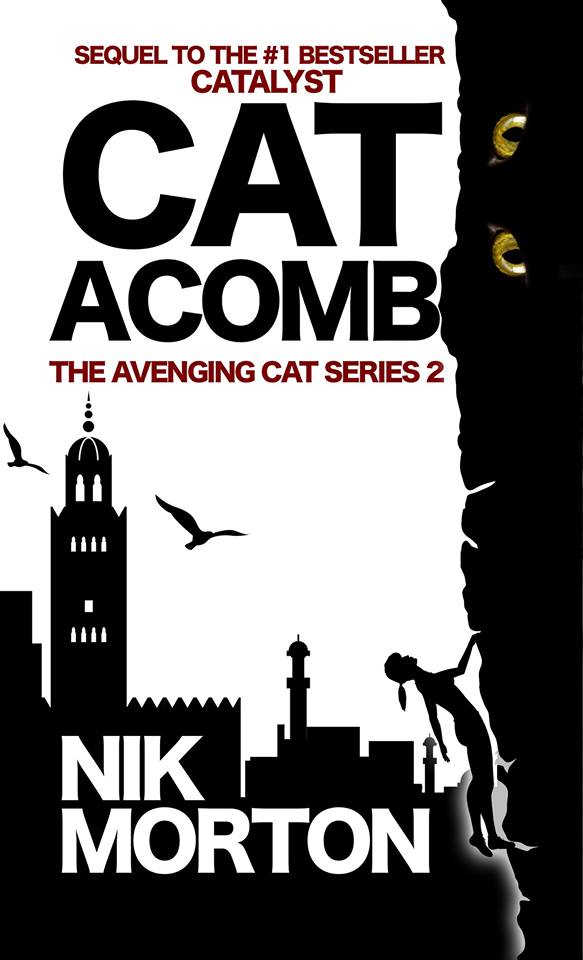
Catacomb - £5.99

Kindle - £2.58

Cataclysm - £6.99

Kindle - £2.58

Other e-book formats are also available.

CATALYST
The Avenging Cat series #1
Catalyst: a person that precipitates events.
That's Catherine Vibrissae. Orphan. Chemist. Model. Avenging Cat. She seeks revenge against Loup Malefice, the man responsible for the takeover of her father's company. An accomplished climber, Cat is not averse to breaking and entering to confound her enemies. Ranging from south of England to the north-east, Wales and Barcelona, Cat's quest for vengeance is implacable. But with the NCA hot on her tail, can she escape the clutches of sinister Zabala and whip-wielding Profesora Quesada?

CATACOMB
The Avenging Cat series #2
Catacomb: a subterranean cemetery: a place where ancient corpses are found – or new ones are dumped.
After their recent success in Barcelona, Cat and Rick continue their vendetta against Loup Malefice and his global company, Cerberus, penetrating the lair of Petra Grimalkin in Nice. But death stalks the pair, as do the dogs of law from the NCA, Basset and Pointer. Cat’s trail of vengeance next leads to the Cerberus health food processing plant in the Maghreb. She puts her skills to good use in Morocco where she again confronts the psychotic killer, Zabala. From the exotic streets of Tangier to the inhospitable High Atlas Mountains, danger lurks and a deadly ambush awaits…

CATACLYSM

The Avenging Cat series #3
Cataclysm:  a political or social upheaval
Some months after their adventure in Morocco, Catherine Vibrissae receives devastating news from Rick – news that will change her life. Still determined to go to Shanghai to face down her arch enemy Malefice and end her vendetta once and for all, she thwarts an ambush by Cerberus’ head of security, Mr Soong. To complicate matters, oligarch and people smuggler Belofsky is in Shanghai with his own agenda. While Cat plays cat-and-mouse with Soong, she uncovers a conspiracy that could lead to war between China and Japan


Tuesday, 17 November 2015

Crime Tyne


CRIME ON TYNE

If you're in the Newcastle Upon Tyne area on 23 November, it would be a crime to miss this evening event. [If you can't make it, you can still enjoy the books!]
 
Crime-thriller author Frank Westworth will host an evening’s discussion about telling the truth through lies, as part of the Books On Tyne literary festival this month.

Crime writers have always used fiction to tell the truth and Frank Westworth, author of the Killing Sisters novels and JJ Stoner short stories, is no exception. His gritty, no-holds-barred neo-noir books feature hard as nails hitmen, ice cold killers, intimate encounters on sleazy backstreets, manipulated men and bewildering women.

Surely it’s all made up? Then again, maybe it isn't…

'A Last Act Of Charity' is the first book in the Killing Sisters series and received widespread critical approval when it was published last year. 'Charity' was selected by crime genre guru Maxim Jakubowski for his end-of-year recommended reads, and was short-listed by Wordery for their Best Independent Books of 2014. (Paperback and e-book)

 
'The Corruption Of Chastity' was published in September and already has 10 good reviews (how did he do that?) 'The story explodes into life with astonishingly graphic violence and an almost surreal eroticism,' said Crime Fiction Lover. 'The writing is stylish, clever, razor-sharp and we are left in awe of the Killing Sisters, with all their murderous skills and their sexual savagery.'
 
Confessions Of A Reviewer said 'Frank Westworth has an undeniable talent for writing thrillers and packing a story full of all the punches it needs.'

Author Simon Duke commented; 'stylistically, the book’s certainly got something cool going on,' while author Eden Sharp applauded Westworth's 'true talent for creating a rich cast of characters who genuinely pique the interest; an original set of henchmen, Chastity the assassin plying her tradecraft like a badass, and JJ Stoner himself, an aging, whisky-soaked, blues-loving alpha male rendered all the more interesting because of his maturing years.'

The  JJ Stoner short stories are published as e-books.

‘True Lies’ with Frank Westworth starts at 6pm on Monday 23rd November 2015 at the City Library, Newcastle Upon Tyne. Tickets £3 from:


The Corruption of Chastity is available as an ebook or paperback, along with Frank’s other Stoner stories and the Killing Sisters series: www.amazon.co.uk/Frank-Westworth/e/B001K89ITA/

Friday, 18 September 2015

FFB – Blood of the Dragon Trees

Sales of Blood of the Dragon Tree have decreased in the last few months, which I find puzzling since it has picked up a good selection of favourable reviews.

They say never believe your own publicity, and that’s true enough. Yet when reviewers use phrases like ‘difficult to put down’, ‘excellent holiday read’, ‘a breathless read’, ‘well-drawn characters’, ‘evocative descriptions’, ‘felt like I had physically and emotionally travelled’, ‘add another layer’, ‘a memorable villainess’, ‘emotive and gripping thriller’, ‘stomach-churning danger’, and ‘a visual feast’ I have to wonder why the book is still not finding a bigger readership. [I write to be read, not to become rich].

This is a problem with any so-called mid-list author – finding a wider audience. Word-of-mouth isn’t working, maybe. And, to be fair, there are thousands of books out there to choose from, so why pick this one?

What’s the book about? It isn’t a fantasy and there are no dragons in it. It’s a romantic crime thriller. The blood and gore is minimal, but it isn’t a cozy crime book either. Certainly, the subject of people smuggling is ever-present in today's news reports, and the book reflects several aspects of this.

Crime on the sunny island of Tenerife. Something to do with dealing in the products from endangered species and people trafficking...

Laura Reid likes her new job on Tenerife, teaching the Spanish twins Maria and Ricardo ChĂ¡vez. She certainly doesn’t want to get involved with Andrew Kirby and his pal, Jalbala Emcheta, who work for CITES, tracking down illegal traders in endangered species. Yet she’s undeniably drawn to Andrew, which is complicated, as she’s also attracted to Felipe, the brother of her widower host, Don Alonso.

Felipe’s girlfriend Lola is jealous and Laura is forced to take sides – risking her own life – as she and Andrew uncover the criminal network that not only deals in the products from endangered species, but also thrives on people trafficking. The pair are aided by two Spanish lawmen, Lieutenant Vargas of the Guardia Civil and Ruben Salazar, Inspector Jefe del Grupo de Homicidios de las Canarias.

Very soon betrayal and mortal danger lurk in the shadows, along with the dark deeds of kidnapping and clandestine scuba diving…

Here are samples from a selection of reviews, gleaned from Amazon UK, Amazon COM and newspapers:

1) Blood of the Dragon Trees is a fast paced thriller and a book that is difficult to put down… but it is the characters rather than the crime that stand out in this book…
 
2) What a fantastic fast-paced read this is! The plot twists and turns and keeps us guessing… Morton has cleverly illuminated this text with his knowledge of Tenerife and of Spanish. Yet he does not overwhelm the reader with these details. They just allow the story to seem more real…I actually read the book whilst staying on Tenerife. That probably enhanced my enjoyment of the novel - many of the places mentioned I knew from this visit… It certainly made this an excellent holiday read on this beauty-endowed island.
 
3) We are introduced to some colourful characters as the flavour and nature of the island is revealed, and the hint of romance hangs in the air…There is also something deliciously sensuous about the description of Senora Pineda, the cook, vigorously slicing open a fresh wholemeal roll, her pendulous chest and upper arms wobbling with the cutting motion. And when she lops off thin slivers of cucumber and places them on top of the cheese and tomato, why do I think of knives, and blood, and sliced flesh? This is vigorous, dramatic writing, and sends shivers down my spine. Another scene where Laura takes a bath is blissfully described. These gems give pause while the story races on, scene giving way to action-packed scene, where neither the characters nor the reader knows exactly what is happening or why. Despite the danger, with surprisingly little bloodshed, the Dragon Tree wins out, and the cleverly crafted story comes to a surprising but credible close. This is a breathless read - totally satisfying.

4) When Laura Reid, a linguist, comes to work for the Chavez family in Tenerife, she cannot imagine the terrifying twists and turns her life will take… crimes committed by the well-drawn characters on this seemingly peaceful and beautiful island. Lots of pace, a really good yarn and a skilfully painted picture of Tenerife made it an excellent read.

5) Visitors to the Island of Tenerife will recognise the beauty of the island in Morton's evocative descriptions of what the island has to offer to the tourist, but few, if any, will recognise the darker side so vividly portrayed in this novel… It is a fact that immigrants head for the Canary Islands from Africa, but here Morton has added spice to the tragedies that often unfold through people trafficking… Morton takes the story along at a fine pace, and readers of his past novels will not be disappointed in his narrative, his characterisation and careful plotting.

6) Mr. Morton’s skilful descriptions of the environment put the reader there, and his careful delineation and development of the characters lead to a thoroughly enjoyable read. There is romance, action, and danger as the novel carries the reader through more twists and turns than a roller-coaster. The reader journeys with Andrew, Laura, Felipe and others as the thieves, murderers, and kidnappers are hunted down. Morton drops clues for the perceptive reader along the way as to the identity of the mysterious “el Jefe” making Blood of the Dragon Tree a delightful, enriching, informative puzzle wrapped in mystery and intrigue… I felt like I had physically and emotionally travelled hand in hand with the characters through their arduous ordeals.

7) Set in Tenerife, a place I have visited several times, I hoped the author would be able to recreate the setting without giving it the feel of a travelogue. I needn't have worried. His clear knowledge of the place enables him to put the reader on the island without overdoing the settings in the slightest… The action is fast paced and the romantic elements don't slow this down, rather they add another layer to the intrigue. For those who like to try to guess who the bad people are while reading (like me) there are plenty of artfully placed clues and misdirection, which only become obvious towards the end of the novel. The crimes are appalling, the characters well-drawn and credible, and the settings superb. What more can I add, except this: go and buy a copy…

8) This book benefits from an exotic setting that may be new to many (as it was to me). This setting has a very strong bearing on the story line, including quite a few exciting chase scenes. The crimes that drive the plot are interesting and highly relevant to the world today. The characters have good depth, and there's a memorable villainess. There's no small measure of violence, but it's tempered in a rather surprising way. The story also has a strong romantic element.

9) Morton has woven a masterfully written fictional story based on these appalling facts - a thriller and romance rolled into one that draws you in with plenty of suspense and fast paced action. Each chapter ends with a hook leading you eagerly on to the next. The characters and all the location settings on the island are colourfully realised. The author, who clearly knows Tenerife well, gets it absolutely right. Not once did I feel that all the research that must have gone into writing such an emotive and gripping thriller becomes too obvious…

10) …The intense contrast between stomach-churning danger and the relief of rescue is terrific. And it doesn’t just happen once, either, so hang onto your hat. The story never lets up, but somehow finds time to immerse the reader in the beauty and atmosphere of Tenerife.

11) … Without ever falling into the trap of being a tourist guide of Tenerife, Morton's book offers the reader a visual feast, a detailed view of the island, its scenery, its people and its culture. For any Canary aficionados, this is a must… It's a well-constructed love story and thriller with plenty of suspense, false trails and derring-do. The bad people get their comeuppance, the good find the justice they seek, and love conquers all. And there's a final twist in the tail to tantalise the most critical reader. Well written, visually descriptive but fast-paced, this is a must for any holiday anywhere!

My sincere thanks to all the readers who have made the effort to review the book, many at such great length too. Your views are greatly appreciated!
 
 
Blood of the Dragon Trees – paperback and e-book

Amazon UK here
Amazon COM here

And if you like Blood of the Dragon Trees, you might also like Spanish Eye, 22 cases from Leon Cazador, half-English, half-Spanish private eye, 'in his own words'.
 
Spanish Eye - paperback and e-book
Amazon UK here
Amazon COM here


Thursday, 27 August 2015

Writing – supporting characters (2)

In an earlier blog (here) I touched upon supporting characters, prompted by a guest post from Nancy Jardine (here) I promised to return to the subject.

A few minor characters – essential to keep the story moving – sometimes push themselves into more than one book. Naturally, if you’re writing a series, it’s a good idea to feature regular minor characters; besides offering some familiarity for the reader, they can grow with the main character too. That can be regarded as a given, also, for series characters: they need to develop and change as their story unfolds from book to book, rather than be untouched by preceding often traumatic events.

In my book Write a Western in 30 Days, I stated ‘While minor characters don’t need as much description, it’s useful to give each of them some identifying feature, whether the hair colour or nose shape. Or a humorous trait. If a barkeep simply serves the drink, don’t dwell on him too much; if however he has information to divulge to our taciturn stranger in town, then imbue the barkeep with a little more life.’ (p91).

This is true for any genre novel. Minor characters are there to add flavour, colour, texture, realism, even humour, and most importantly to move the story forward. They are not there simply for padding and inconsequential chat.

When building up your back-story (which may never see print), there are several instances where character motivation should be embedded. People generally don’t do something without a reason. They’re motivated by pride, greed, altruism, love, anger, jealousy, hate and a lot more besides, much of which is created in their past.

In my book The $300 Man, Lydia hates Mexicans, because her husband found love and solace in a Mexican woman’s arms. The child of that union was Corbin, the hero – so she doesn’t like him, either – his mixed race is a constant affront to her. So her past shapes how she feels towards the Mexican workers at the silver mine in the story. Her past provides her with powerful motivation for her current actions and intent.

Certainly, incidents or people in their past might return to haunt them. By building a past for your characters, they cease to be made of cardboard. Within a short while, they’ll seem alive. And to a certain extent this applies to minor characters as well.

Somerset Maugham has said that every action of a character must be the result of a definite cause – significantly related to the entire fiction, of course.

Each motive must be in keeping with the character’s behaviour pattern that you’ve established. Otherwise, you lose credibility; again, consider applying this to minor characters.

In Last Chance Saloon (2008), which takes place in 1866, Jonas the deputy sheriff is featured; he’s in love with an older woman, Ruth, a widow; the relationship is not resolved at the end. A year later, 1867, there’s a passing mention of Jonas and Ruth in Blind Justice at Wedlock (2011), ‘Ruth Monroe who’d scandalised the town with her new beau, Deputy Johnson, a man some thirteen years younger than her.’ However, in Old Guns (2012), which mainly takes place in 1892, we see that they are now happily married and Jonas is the town’s sheriff. Of course, their descriptions have aged in the intervening quarter-century!

My main protagonists in Blood of the Dragon Trees, a modern-day thriller set in Tenerife, are Laura Reid and Andrew Kirby, aged 25 and 34 respectively; they are fighting the trade in endangered species, among other things. In Catalyst, the first in a new crime series, the hero Rick and heroine Cat meet up with a private eye in Barcelona who is instrumental in helping them obtain incriminating evidence; the private eye is half-English, half-Spanish, Leon Cazador, whose cases are told ‘in his own words’ in Spanish Eye. At the end of Catacomb, the second in the ‘Avenging Cat’ series, the plot necessitates that the hero Rick fled with a minor character to Tenerife, leaving behind the heroine Cat in Morocco. The sequel Cataclysm then logically begins with a villain from Blood of the Dragon Trees escaping police custody in Tenerife and doing harm… which involves Rick and, ultimately, Cat, Laura and Andrew!

These inter-relationships move the story forward, create additional threat, and hopefully keep the reader turning the pages wanting to know what will happen to people they’ve come to know vicariously; I hope too that regular readers will enjoy meeting some of these characters again. However, it is not essential to following the novel to have read all of the linked books.

To a certain extent, these characters elbowed their way into the books I write. Life is stranger than fiction, so it’s not too outlandish to postulate that some characters will know each other in different works! Well, that’s my excuse, anyway.

I’m not alone in this, of course; plenty of authors return to minor characters in their books. Perhaps you can think of a few?

***

Blood of the Dragon Trees - paperback and e-book

Amazon UK here (it has clocked up 8 good reviews, but for some reason no more than that, sadly)

Amazon COM here

Spanish Eye - paperback and e-book

Amazon UK here

Amazon COM here

Catalyst - paperback and e-book

Amazon UK here

Amazon COM here