Fellow blogger and author Liz Harris recently posted her
disenchantment with series books, prompted by Linwood Barclay’s novel
Broken Promise (see
her blog).
She’s a fan of Barclay (I believe his writing style needs work, yet despite
this he has the knack of drawing the reader in to keep turning the pages). But she
was disappointed to find the book was the first in the Promise Falls series –
some covers say this, some don’t, the latter being misleading, perhaps. Even
so, Liz found the end of the book akin to ‘continued next book’ which can be
deflating for a reader. Many readers, and Liz among them, want a resolution at
the end of each novel. Yes, the series can present new challenges for the
protagonists in later books, but some issue should be resolved in the current
volume.
Series books by their nature are difficult to categorize for
readers. For one thing, there are different kinds of series, all of them having
their advocates.
Types of series
(not exhaustive)
1) Main character(s) engaged in solving crime/mystery/fighting
common enemy. These are probably the most popular, because there is usually no
continuity between books, yet they do supply the reader with familiar
characters and environment. Police procedural and some historical books fall
into this category. Ed McBain’s Precinct 87 and Bernard Cornwell’s Sharpe, for
example.
2) Main character(s) have intertwined stories to tell, which
eventually define a resolution at the conclusion for all concerned. Nora
Roberts is adept at these – quartets and trilogies, and even sometimes duets,
relating to families (no pun intended).
3) Main character(s) in a dynasty/exotic location combat
threats from outside, which can be warlike, business, personal or even
supernatural. These can be interlinked sagas as penned by Barbara Taylor
Bradford, A Song of Ice and Fire by
George R.R. Martin, et al.
4) Main character roams the land and becomes involved in
murder, mystery or mayhem. Each tale is stand-alone; the character rarely
changes through experience. Lee Child’s Jack Reacher and E.C. Tubb’s Dumarest
Saga, for example.
Why read/write a
series anyway?
Regular characters in a series have been around in genre
fiction for decades, which proves the popularity of the concept. TV and film
franchises benefit from series productions, again emphasizing the attractiveness
to the audience.
Readers feel comfortable meeting again familiar characters
who encounter variations on a theme – murder, mystery, etc.
Writers build up a ‘bible’ for their characters, which
includes their past, the current situation, and often where they’re going. The
writer is familiar with the characters. I don’t believe it’s lazy writing,
because you still have to present obstacles for the protagonist, and these
difficulties must be overcome according to the character’s known traits.
Will the series end?
Depending on the type of series, it’s possible that some
readers will not tackle the first book in the series until they know the last
one is published or imminent. This hasn’t
prevented The Game of Thrones books
amassing a vast readership (before the TV series, in fact), or Archer’s ‘Clifton
Chronicles’. Fans of popular authors will buy in, regardless. It’s tough for
relative unknown authors to gain this readership until they’ve amassed several
books in a series.
A finite series I’ve recently read is Night Hunter by Robert Faulcon (six books published between 1983
and 1987; all reviewed in this blog). It’s a supernatural quest series, with a
resolution published three years after the penultimate book.
Certainly, you’d think that before the author could ‘sell’
the series idea to a publisher, they’d have some appreciation of the conclusion.
J.K. Rowling’s Harry Potter books are in
effect one novel in seven parts. I imagine the resolution was conceived at the
outset, even if much of the glorious detail that runs throughout was not.
Of course, some series don’t need a final book, because they’re
not a continuing saga but individual incidents in the main protagonist’s life
(indeed, some characters don’t age though their authors do!) The character
simply fades away – Charteris’ The Saint and Simon Brett’s Mrs Pargeter, to
name two.
Series where the protagonist ages and evolves through his
experiences are especially popular in crime fiction, because their back stories
of family schisms affect the protagonist – Peter Robinson’s DCI Banks, for one;
there are plenty of others.
I read all types of series and certainly don’t feel deprived
if I haven’t reached ‘the end’. As in life, we enter other people’s lives,
sometimes stay around, and at other times move away, not always consciously,
but it happens. Art imitates life – so some stories will remain incomplete. I
can live with that.
Having said as much, I do prefer to attain a resolution in the
series books I write, though there always has to be an exception (see
Floreskand below)!
The Avenging Cat
series
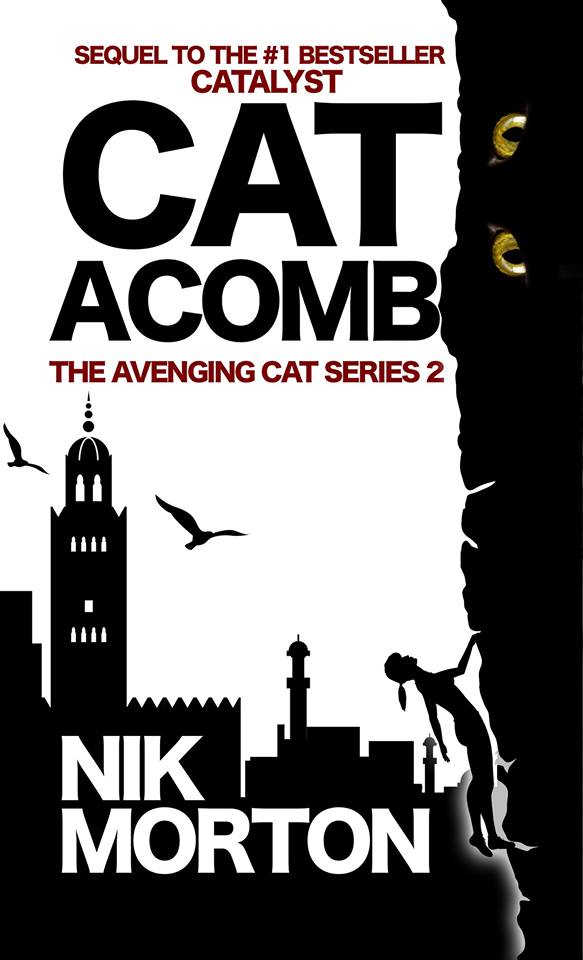
Contemporary thrillers. Catherine Vibrissae has set herself
the task of destroying the man who was responsible for her father’s death. To
begin with, she sabotages his dubious business interests, but over time it
seems to get more personal – on both sides. Each tale has a conclusion, though
it promises more to come, for her vendetta is not complete.
#1 – Catalyst
#2 – Catacomb
#3 – Cataclysm
Work-in-progress - #4 – Cat’s Eye
The Tana Standish
psychic spy series
Set in the 1970s/1980s, this features Tana Standish, a psychic
British secret agent, who as a child survived the Warsaw ghetto of 1942. Her credo is simple: fight evil.
Unfortunately, she soon learns that the Soviets have a special secret unit in
Kazakhstan that is employing psychics to spy on the West, and they have
targeted her as well…
#1 – The Prague Papers (Czechoslovakia, 1975)
#2 – The Tehran Text (Iran, 1978/1979)
Work-in-progress - #3 – The Khyber Chronicle (Afghanistan,
1979/1980)
The Chronicles of
Floreskand
‘by Morton Faulkner’
Co-written with Gordon Faulkner, the creator of mythical Floreskand,
this series spans a fantasy continent that has been evolving for forty years.
These stories have resolutions at the end, yet a great deal is left hovering
for later books, with recurring characters and unintended consequences from
earlier events.
#1 – Wings of the Overlord
#2 – To Be King
Work-in-progress - #3 – Madurava
Love them or loathe them, series books will be around for a
long time yet. Long may that be so!
To play fair with the reader, however, publishers should
make it clear that a book is part of a series.