Search This Blog

Showing posts with label #comics. Show all posts

Friday, 11 February 2022

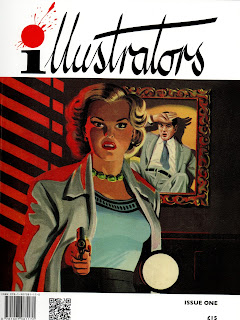
Illustrators Quarterly Magazine - #1


The ongoing series of quarterly perfect-bound full colour magazines began with this issue in 2012.

Anyone interested in illustrating art will cherish these magazines.

This issue features a lengthy article about Denis McLoughlin – 44 pages lavishly illustrated with his often gritty book covers. McLoughlin mainly concentrated on hard-boiled crime but also westerns, including the Buffalo Bill annuals I recall from my childhood. Indeed, McLoughlin, who hailed from Bolton, Lancashire, was so knowledgeable about the Old West that he produced The Encyclopedia of the Old West (original title Wild and Woolly) in 1975: a veritable mine of information!

There follows 22 pages of an interview with artist Ian Kennedy. Again, every page features samples of his comic illustrations and paintings, notably from the Commando comics that have been around since 1961. An outstanding artist, sadly missed (he died 5 February this year).

Next is a feature on the ‘Alluring Art of Angel Badia Camps’, one of a host of Spaniards who began plying their trade in Britain to good effect in the 1960s. We get fifteen pages of samples of his work from the covers of romantic fiction and women’s magazines; distinctive, atmospheric and colourful.

Two regular features are: The Gallery and The Studio. For the Gallery there are six pages of ‘the Fin de Siรจcle Erotica of Cheri Herouard’. He illustrated the covers of La Vie Parisienne, but also posters, postcards and menus. The Studio features Mick Brownfield’s iconic Christmas cover of the Radio Times in 2009 with Santa and a Dalek. The end pages consist of art-book reviews and contact details for art supplies, illustrators, museums and other related subjects.  

Copies of most back issues are still available, many at reduced prices.

It’s published by The Book Palace and can be obtained through their website www.illustratorsmag.com. Back issues can also be obtained from www.booksaboutart.co.uk.

The Book Palace also issues, from time to time, special issues on certain illustrators, and most of these are destined to become collectors’ pieces.

Tuesday, 21 August 2018

Review - Hot Lead #2


This second homage to the western is as lavishly illustrated as the first. Not only a pleasure to read, to view, but also a collector’s item!  The full colour images justify the cost of the magazine. And what images!


Although this issue covers the art of the western, it kicks off with an article about the film – and book – Charro! It makes fascinating reading, concerning the original written treatment, the novelisation and the mediocre Elvis film itself.
 

#2 features the western artwork of Tony Masero, who has been supplying paperback covers since the 1960s – in all genres. Besides an interesting interview with many accompanying covers there’s a gallery of six full-page paintings. Tony painted the cover of my 2012 Black Horse Western Old Guns.

Then there’s an overview of the western illustrations of artist Frank Bellamy, who died too young at  59. He was one of my favourite illustrators of the 1960s with his Dan Dare, Fraser of Africa and Heros the Spartan strips. He drew three western adventures for the sci-fi Garth series, every black-and-white panel a work of art.

Germany had a vast following of westerns from the late 1940s until the 1980s, and a good portion of the output is considered here; the artwork and storylines were heavily influenced by the Spaghetti western explosion, though censorship reared its head, too…

Finally, author Paul Bishop gives us a colourful overview of western comics, ranging from the 1930s to the rather sparse present. I fondly remember some of the covers depicted!

Recommended for fans of westerns and nostalgia buffs.

Monday, 18 January 2016

Michael Moorcock and Tarzan Adventures


A long time ago, far away from my home here in Spain, I used to buy comics. Unfortunately, in those days there was no guarantee that each weekly issue would be available. I wasn’t savvy enough to order them through the local newsagent; I had no guarantee of a fixed income (pocket money!)

One such comic was Tarzan Adventures. The first issue I obtained was dated 28 April, 1956 (Vol 6 no.4). It was hit-and-miss, alas. Most of the copies I have are not in particularly good shape.

At the time, little did I appreciate that a new editor for these comics would become an internationally famous author.

Michael Moorcock announced taking over editorship in the 21 September 1957 issue (Vol 7 no.25); he was seventeen. 

The comic had featured some of his fantasy stories about Sojan the Swordsman, and continued to do so while he was editor. 

When he was nineteen, he also edited the Sexton Blake Library (which first saw publication in 1915, ending its run in 1968.)


Tarzan Adventures reprinted American comic strips in black and white, often chopping up the illustrations to fit the page format, as can be seen in this example (Vol 7 no.43), art by Burne Hogarth.


Moorcock started writing at school in 1950 and still continues, aged 76. His output is prolific and prodigious. At one time he could produce a fantasy novel (about 50,000 words) virtually over a weekend. He has said he could write 15,000 words a day, and asserts that his Hawkmoon books were written in that manner (1967-69).

His bibliography can be found here:


Wednesday, 25 November 2015

Writing – Visualise this: read a comic

It’s an old axiom: writers should read. We read all sorts, of course – from cereal packets to literary masterpieces. It’s all grist to the mill – the brain. Naturally, if you write in a particular genre, it makes sense to read works in that sphere. But if you want to bring freshness, sometimes it’s a good idea to read outside your favoured genre – outside your comfort zone, even.

If you’re writing contemporary fiction, you may believe you can wing it by not doing any research. That’s possible, but not highly likely. The modern world is complicated.

If your fictional world is in the future or on an alien planet, then you may think that since everything is ‘made up’, then ‘anything goes’ – but you’d be wrong. Characterisation, motivation, logic, genetics, science, history, magic – any or all of these subjects may be pertinent, not to mention types of clothing, armour, weaponry.

If you’re writing a historical novel, then research is definitely required; but don’t just stick to the history books, read fiction set in your chosen period – not to slavishly copy, but to absorb the place, the patterns of speech, the manners, and the everyday lives.
 
One resource writers might not consider is comics.
 
Comic books have been around a long time and have developed to a high degree of sophistication.

Comics – like those story-boards for movie-makers – help the viewer/reader visualise a scene and the action. Not all modern comics are action-packed, some are emotional in content, their characters with real-life issues. Not all comics are for kids, either.

Delving in my pile of magazines the other day, I came across a March 2003 copy of Write Now! ‘the magazine about writing for comics, animation and science fiction’. No longer in print, copies can still be purchased online. Within its pages is a lengthy article by Dennis O’Neil that may be of interest to all writers of genre fiction.  Dennis O’Neil is an award-winning writer and editor, now retired.
 

O'Neil first asks what is a story? His answer is that it isn’t a random slice of reality, but a structured narrative. That’s the essence: structured. Within that structure it should aim to evoke an emotional response from the reader and reveal character. Usually, without character there is no story. In the best stories, everything must count, and quotes from Poe: very word must be aimed towards a final effect. And with Poe we know what that effect should be!
 
He advises the writer not to waste words or images, because that’s a sure-fire way to bore the audience.
 
Naturally, for stories in comics, there are advantages: the visuals tell much of the tale. But good comics are a symbiosis of word and image. Fiction writers can do the same, to a certain extent, by visualising the scene – imagine you’re detailing the scene for an artist to draw. If you do that, then the reader can ‘draw’ the scene in their head.
 
Comics invariably have constraints thrust on the writers/artists – number of pages and preferred ratio of image/text, often depending on the publisher. Genre writers have similar constraints, in all probability – length of book (word-count). So, descriptions may have to be broad visual brush strokes and not contain too many complex sub-plots – unless you’re writing a series!
 
He pleads for clarity – establishing characters and conflicts early on. Within scenes, make sure there is no confusion – do you know where everybody is standing, what they’re doing? Employ that inner artist to ‘draw’ the scene.

Dialogue: it should be obvious who is talking at any time. In comics, this is easy – we have those speech bubbles, but even these cues are cunningly placed to move the story forward, from character to character, panel to panel. In your fiction, you can attribute speech without labouring the point. If there are only two characters speaking in the scene, then you don’t need ‘he said’ or their names most of the time. Speech in comics is usually brief – minimum number of lines per bubble. In reality, that’s the case too: avoid lengthy speeches, edit it down to fit the ‘bubble’.
 
He advocates never simply inserting a character; that person has to have a reason, a purpose for being in the story.

Always keep in mind what he calls the ‘story spine’: what the story is about. Its theme, its ‘message’, its reason for being!
 
Story must have conflict – it may be emotional rather than physical. There must be something at stake: the set up.
 
The story must lead to the most powerful moment: the win or lose instant.

In all likelihood, if you use ‘structure’ in your story, you’re going to provide pacing which will produce a page-turner.
 
Basic structure can vary, as nothing is immutable, but it’s always worth knowing what works, and then twist it afterwards to your own ends:
Hook
Inciting incident
Situation and conflict
Complications
Climax
Denouement
 
Critically reading comics can emphasise these guidelines and prove helpful in your genre fiction writing.

Tuesday, 3 February 2015

Book Review - The Happy Warrior

To all intents and purposes The Happy Warrior can be regarded as a graphic biography. It tells the life story of Sir Winston Churchill from birth until 1955. He died in 1965.


A full-colour page was printed on the back cover of the Eagle comic each week from 4 October 1957 up to 6 September 1958. The text was by Clifford Makins and the artwork was by Frank Bellamy.

This slim book collects the full story as published, all 62 pages of it, though it has been slightly reduced in size from the original comic dimensions. I was pleased to get hold of a copy as it has been out of print for many years; reprinted 2014.

To accompany the graphics there is an introduction about the Eagle and its place in British culture, plus a 5-page commentary by Richard M. Langworth, CBE, who sketches in several historical points that were not included in the graphic narrative.

What is remarkable is the amount of detail and information Makins does include in what is, essentially, a war story – Churchill fighting in Cuba, Omdurman, South Africa and of course his tenure as war-time Premier. 

Churchill was not unstinting in ensuring that it was his allies, but most especially his countrymen who deserved the thanks for delivering Great Britain from defeat:

‘This will was resolute and remorseless, and as it proved, unconquerable. It fell to me to express it, and if I found the right words you must remember that I have always earned my living by my pen and by my tongue. It was a nation and race dwelling all round the globe that hade the lion heart. I had the luck to be called upon to give the roar. I also hope that I sometimes suggested to the lion the right places to use his claws.’

The title ‘The Happy Warrior’ is taken from William Wordsworth’s poem of 1806. And of course Churchill was not strictly a man of war, though that seems to be the impression. He said, ‘Much as war attracts me and fascinates my mind with its tremendous situations – I feel more deeply every year – and can measure the feeling here in the midst of arms – what vile and wicked folly and barbarism it all is.’
 
Frank Bellamy was born in 1917 and died too soon, in 1976, aged 59. Besides the superb artwork of Churchill’s story, he illustrated The Shepherd King (the Story of King David, 1958-59), Fraser of Africa (1960-61), Heros the Spartan (1962-63) and many Dane Dare, Pilot of the Future episodes, all for Eagle (1959-60), before moving on to other projects, notably the black-and-white Garth newspaper strip for the Daily Mirror (1971-76).
 
Clifford Makins was born in 1924 and died in 1990. He wrote a number of comic strips with Frank Bellamy, was deputy editor of Eagle and took over editorship and finally left to become sports editor of the Observer. He co-wrote a cricket murder mystery Testkill with Ted Dexter (1976).