Search This Blog

Showing posts with label #Japan. Show all posts

Wednesday, 15 February 2023

TOKYO STATION - Book review


Martin Cruz Smith’s standalone thriller Tokyo Station was published in 2002. I’ve read several of his books and haven’t found a bad one yet. This one is very impressive indeed.

The book spans three time periods: 1922 in Tokyo when the main character Harry Niles is a young boy; 1937 in Nanking, mainly a flashback of Harry’s that reveals the many atrocities committed by the Japanese against the Chinese; and 1941 in Tokyo, some days before the Japanese attacks on Pearl Harbour.

The amount of detail seems prodigious but never swamps the narrative.

Harry was the son of an American missionary couple Roger and Harriet who were absent and busy proselytising most of his formative years. He gets involved with a gang of Japanese kids and quickly learns the language and the tricks of pickpocketing and generally conning people. A chance encounter with a local artist Kato ends up with him running errands and fraternising with his models, among them the beautiful Oharu. ‘To Americans a whore was a whore unless she was willing to be rescued; to the Japanese, a girl sold by her family to a brothel was a model daughter’ (p262).

Harry’s close friend Gen undertakes one of Harry’s errands as a favour and becomes involved with one of Kato’s clients, the enigmatic samurai Ishigami. Years later, Harry is responsible for Ishigami losing face in Nanking and thereafter he is hunted by the samurai. And neither he nor his friends and lovers are safe from the samurai sword…

The switches between the timelines are not labelled, but in most instances it’s obvious when that shift occurs.

Harry’s parents didn’t have much success in converting the citizenry: ‘The Japanese would smile, bow and say anything to move the gaijin along. Or would accept Jesus as a mere backup to Buddha’ (p101).

Harry owns and runs The Happy Paris nightclub. His jukebox operator is Michiko, who possesses a fiery temper and shares his bed. To complicate matters Harry lusts after Alice, the wife of the British ambassador, Beechum: ‘She did crossword puzzles in four languages. Most of the day, she was a brainless thing who spent her life at the Ginza’s shops and smart cafes, but every morning she spent in the code room of the British embassy’ (p168).

The imminent war with the United States is like an oppressive shroud over the Tokyo of 1941.  ‘A cart with metal-rimmed wheels went by, the nocturnal visit of the night-soil man visiting homes without plumbing, gathering what kept the rice fields fertile, the cycle of life at its most basic. The cart moved aside to let pass a van with the crossed poles and looped wires of a radio direction finder on the roof. The van sifted the air for illegal transmissions the way a boat night-rolled for squid. Or, Harry speculated, if the van was from the Thought Police, perhaps they were trying to sift dangerous ideas out of the air’ (p54).

Unusually, there is an instance of a single paragraph running to almost six pages (pp241-247), but Smith can be forgiven as it’s a painful reminiscence of his time in Nanking and his encounter with Ishigami – powerfully done.

Harry’s sexual awakening is finely judged and well told without being prurient. It’s almost poetic: ‘Followed by a profound sleep with Harry folded around  Oharu as if they were riding with their eyes closed slowly through the rain, the heart’s rhythm like a black horse. A faint electric haze lay in all directions. They rode through high grass soughing in the wind’ (p257).

A willow house was an establishment where geishas entertained, and there were plenty of them about. ‘A willow suggested something yielding and feminine, the sort of tree that knelt by water to admire its own reflection’ (p266).

There are suspenseful moments, some others quite grisly, and several finely tuned wisecracks pepper the tale. The characters are fallible, complex and believable. Throughout, Smith captures the time and the place convincingly. Recommended.

Thursday, 25 April 2019

Charlie Whipple - R.I.P.

I was greatly saddened to learn that Charlie died last week from pancreatic cancer. We'd been distant writing friends for about a decade - distant in the sense that he lived in Japan and I live in Spain. He was a prolific writer of fiction and non-fiction and with wide interests and he touched many lives. We co-edited a western anthology, A Fistful of Legends (2009). He wrote his excellent westerns under the pen-name Chuck Tyrell; his Japansese historical adventure stories with the overarching title The Masacado Scrolls are written as Charles T. Whipple.


A good and sincere friend with a sense of humour.

Fellow author Tom Rozzo has posted a tribute to Charlie here:

Those who knew Charlie are diminished by his passing.

Condolences to his family.

R.I.P, Charlie.

Friday, 26 January 2018

Book review - Leviathan (Erast Fandorin #3)


Boris Akunin’s third Erast Fandorin adventure Leviathan was published in 1998, English translation from the Russian by Andrew Bromfield, 2004.  I read and enjoyed his first adventure, The Winter Queen in October, 2004. The second book in the series is The Turkish Gambit.

Fandorin started out as a police detective, and then worked for the secret police, and in this book he’s a diplomat, destined for service in Japan.


Leviathan possesses several idiosyncratic features. It begins with notes from French police commissioner Gauche’s file, regarding the mass murder of ten individuals in a Parisian mansion. Then there’s a medical report concerning the deaths – all but one being poisoned. A statuette of the Indian god Shiva was stolen, together with a painted shawl. The owner of the house, Lord Littleby was bludgeoned to death. Next, we have two press cuttings – one of which reveals that the statuette is found… A single clue suggests that the murderer would be a passenger on the luxury British steamship Leviathan sailing from Southampton to Calcutta. Gauche booked passage.

Gauche deduces that the criminal he seeks is one of the following: Sir Reginald Milford-Stokes, exhibiting signs of mental aberration; Mr Aono, a Japanese nobleman, silent and diffident; Mrs Renate Kleber, a pregnant wife of a Swiss banker en route to join her husband; Miss Clarissa Stamp, a newly rich English spinster; Mr Truffo, the ship’s chief physician; Mr Sweetchild, an opinionated Indologist; Mr Boileau, a tea trader and philanthropist; and, finally, the Russian diplomat, Fandorin.

The story is told from the point of view of a number of characters: Gauche himself (third person narrative), Milford-Stokes writing first person to his absent wife, Renate Kleber and Clarissa Stamp (both third person), Mr Aono (printed in two columns sideways on, no doubt to suggest the first person diary entries are written in Japanese [gimmicky, but not distracting]).

To be expected, there are other deaths and suspicion builds. There are revelations, and some poignant tales to tell. Gauche comes across as a bombastic self-important detective (‘It was possible to tell a great deal about a man from his moustache’) (p26) who tends to arrive at the wrong theories, often corrected by the imperturbable Fandorin.

Akunin captures the period – it’s 1878 – and the opulence of the steamship. ‘The breakfast served on the Leviathan was not some trifling Continental affair, but the genuine full English variety: with roast beef, exquisite egg dishes, blood pudding and porridge.’ (p43) He also reveals Mr Aono’s culture with great effect – which is not surprising since under his real name the author is an expert on Japan, has translated Japanese and served as the editor-in-chief of the 20-volume Anthology of Japanese Literature.

He exhibits a fine eye for detail and imagery, too. ‘in the flickering lightning the rain glittered like steel threads in the night sky, and the waves frothed and foamed white in the darkness. It was an awesome night.’ (p188)

The set-up, the mix of characters and the crime itself echo Agatha Christie, and this is not surprising since Akunin apparently set out to write Fandorin novels in every sub-genre of the detective novel. His first was a conspiracy, his second a spy case, his third this Agatha Christie homage, and so on. He has identified sixteen sub-genres, in all, and has written fourteen so far. In addition, he wanted to create different types of human characters. Indeed, the Wikipedia entry for Grigol Chkhartishvili (Boris Akunin) makes fascinating reading in itself.

In the entry List of best-selling books the Erast Fandorin series has sold in excess of copies. Typically, a new book in the series sells about 200,000 copies in the first week.

Tuesday, 9 August 2016

Paperback trilogy - the cat's meow...


  • Three exciting paperback action romantic adventures featuring ‘the avenging Cat’! 
  •  With superb uniform covers from Crooked Cat Publishing.


Catalyst - £7.99

Kindle also available – (series introductory bargain!) - £0.86

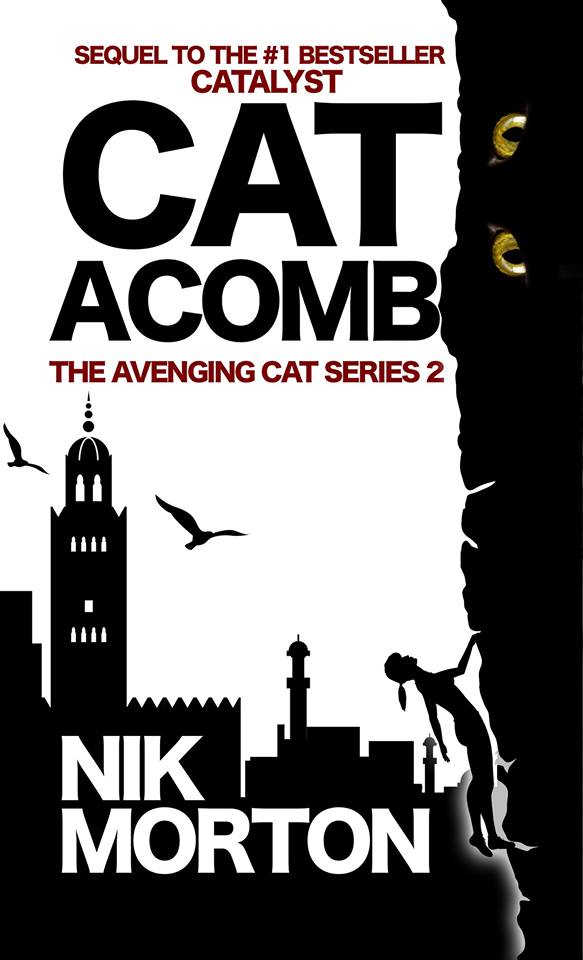
Catacomb - £5.99

Kindle - £2.58

Cataclysm - £6.99

Kindle - £2.58

Other e-book formats are also available.

CATALYST
The Avenging Cat series #1
Catalyst: a person that precipitates events.
That's Catherine Vibrissae. Orphan. Chemist. Model. Avenging Cat. She seeks revenge against Loup Malefice, the man responsible for the takeover of her father's company. An accomplished climber, Cat is not averse to breaking and entering to confound her enemies. Ranging from south of England to the north-east, Wales and Barcelona, Cat's quest for vengeance is implacable. But with the NCA hot on her tail, can she escape the clutches of sinister Zabala and whip-wielding Profesora Quesada?

CATACOMB
The Avenging Cat series #2
Catacomb: a subterranean cemetery: a place where ancient corpses are found – or new ones are dumped.
After their recent success in Barcelona, Cat and Rick continue their vendetta against Loup Malefice and his global company, Cerberus, penetrating the lair of Petra Grimalkin in Nice. But death stalks the pair, as do the dogs of law from the NCA, Basset and Pointer. Cat’s trail of vengeance next leads to the Cerberus health food processing plant in the Maghreb. She puts her skills to good use in Morocco where she again confronts the psychotic killer, Zabala. From the exotic streets of Tangier to the inhospitable High Atlas Mountains, danger lurks and a deadly ambush awaits…

CATACLYSM

The Avenging Cat series #3
Cataclysm:  a political or social upheaval
Some months after their adventure in Morocco, Catherine Vibrissae receives devastating news from Rick – news that will change her life. Still determined to go to Shanghai to face down her arch enemy Malefice and end her vendetta once and for all, she thwarts an ambush by Cerberus’ head of security, Mr Soong. To complicate matters, oligarch and people smuggler Belofsky is in Shanghai with his own agenda. While Cat plays cat-and-mouse with Soong, she uncovers a conspiracy that could lead to war between China and Japan


Sunday, 15 March 2015

A dangerous place

There’s a lot of publicity over the fly-by activities of the Russian warplanes close to the UK. If a mistake is made, the consequences could be dire. The Cold War seems to be hotting up, to mix metaphors.

Yet little notice is taken of another Communist state despatching its warplanes in similar fashion – and risking conflict by default.

Several Japanese islands in the East China Sea are in dispute with China. And the Japanese air base at Naha, scramble on average more than once a day – and achieved a dubious record of more than 400 times last year.
Wikipedia commons
 
China outnumbers Japan almost eight-to-one in air force manpower and is building its capacity. Apparently, the Chinese pilots lack the training and experience of their Japanese counterparts, raising the risk of a near miss or collision. These fly-bys also imperil ties between these two economic giants.

When Major General Yasuhiko Suzuki was first posted as a fighter pilot to subtropical Naha in the 1990s it was a military backwater. Now the commanding officer, he says China’s assertiveness has made it Japan’s most important base.

Japan’s defences, particularly in the southwest islands, are being increased; they’re set to establish a new military observation unit on Yonaguni island, close to the contested islets.

Japan and China each claim ownership of the uninhabited islets - known as Senkaku in Japan and Diaoyu in China - that are administered by Japan. This dispute has apparently affected Japanese investment in China. China says it has records of the islands going back about 600 years and that it administered them until it lost a war to Japan in 1895.

Japan sent aircraft to head off foreign military planes flying close to its airspace in excess of 740, heading for the highest annual total since the end of the Cold War. While dispatches against Russian aircraft are back down after an increase last year, sorties against Chinese aircraft, have continued to rise.

China is probably seeking to glean data through its fly-bys, a similar technique employed by the Russians in the West.  

Right now, the world is a dangerous place.

***
Read about the old Cold War in two explosive e-books featuring psychic spy Tana Standish, published by Crooked Cat Publishing.


THE PRAGUE PAPERS - Czechoslovakia, 1975

THE TEHRAN TEXT - Iran, 1978