Search This Blog

Saturday, 13 August 2016

Book review - Halcyon Drift


Brian Stableford’s series of six books concerning star-pilot Grainger and his spaceship The Hooded Swan begins with this novel, Halcyon Drift (1972); they’re regarded as classics by the science fiction fraternity. Stableford has written in excess of seventy novels; yes, he’s prolific. I met his mother when she briefly attended a few of my writers’ circle meetings here in Spain. A brief review of his book Young Blood appears here


Stableford is a good writer who presents effective visuals with his prose: ‘Brown clouds move sullenly across the sulky face of the sky, washing the black mountain faces with hazy tears.’ (p7) Other examples from page 128: ‘Alien night is always a bad place to be.’ And ‘The horizon glowed white, surrounding us like a vast silvery ring set with a jewel-like flare at the point where the sun had vanished.’

The story begins with a prologue in the present tense, outlining the fact that Grainger has crashed his spaceship Javelin on an uninhabited rock, killing his partner, Lapthorn. So he’s alone.  The inhospitable place is plagued by winds, always blowing down the grave marker. Through his reminiscences, we get an insight into Grainger’s nomadic life with Lapthorn, trading and dealing from planet to planet, encountering fascinating and intriguing life-forms. Grainger is cynical: ‘A lot of spacemen are like me. Cold, emotionless men who don’t inherit any part of the worlds and the people that they see.’ (p13)  He reminisces about his friend Alachakh, a Khormon trader, whose life he saved once. That’s all he’s got, stranded on this rock for two years, waiting to die.

And then the wind starts to talk to him in his head. He isn’t going nuts: it’s an alien mind-parasite. It’s quite a lengthy prologue, ending with him being rescued by a passing ramrod ship, the Ella Marita. He gets away but he’s stuck with the mind-parasite – for life.

The rest of the tale is told in the usual past historic and it's inventive, in description and the alien life-forms, and in the leaps to a possible future: ‘I dialled through to the Illinois cybernet… a credit card, punched and banded, oozed out of a slot… I tapped out a query on the keyboard, asking how much the card was carrying…’ Bearing in mind this was written in 1972 or earlier: not bad. (I didn’t get my first credit card until 1987, when I was 39!)

There’s also irony and humour, to be enjoyed. Here’s the mind-parasite speaking in Grainger’s head: ‘I’m an expert on you, Grainger, and I’m learning more all the time. I’m right inside you. I’m with you every decision you take. I’m riding your every thought, and feeling everything you feel. This isn’t the most comfortable of minds to live in, my friend. I would appreciate it greatly if you could get it sorted out a little. Come to terms with yourself and the universe.’ (p34)

The nameless mind-parasite isn’t the only great invention in this story. Meet The Hooded Swan, a ship that can fly ‘like a bird. She’s jointed and musculated. She has the most complete and most sensitive nerve-net any mechanical device has ever had.…’ In fact, Grainger the pilot is connected to the nerve-system of the spaceship and feels what the craft feels; his body becomes part of the body of the ship. Grainger literally flies by feel.

One of the several inventions is the quite tragic Khormon race. When these people have filled their memories – nothing is ever forgotten – they have reached their end. As Alachakh says, ‘I wish I could forget a little and create some space, but I cannot. I am stuck in the day before yesterday. There can be no question of a long tomorrow, and I doubt the latter hours of today. Soon even the minute swill become painful to squeeze away into tight corners…” (p89) Another invention is the metamorphic life system Grainger encounters in his quest: ‘Our presence and progress would cause the plants which we touched unbearable pain.’ And: ‘… the feel of the furtive, glutinous chaos through which we moved. Myriads of tiny creatures were accidentally transferred from the plants to me, and I hoped none of them was adapted for chewing tough plastic.’ (p134)  

Grainger is hired to pilot The Hooded Swan and enter the Halcyon Drift in search of a spaceship that was lost in the drift eighty years ago; a distress signal has bleeped since then but due to the awesome peculiarities of the drift it hasn’t been located yet: ‘Drift space casually disobeys principles which are called laws in saner corners of the galaxy.’ (p97)

Perhaps the ending was a little rushed, but he was writing to fit into a specific format. How Grainger resolves his quest is intriguing – and moral, to boot. Needless to say, he survives to fly The Hooded Swan in another novel, and I’ll be reading all of the series.


Wednesday, 10 August 2016

To Be King - cover reveal

Knox Robinson have released the cover for the upcoming paperback To Be King (Book Two of the Chronicles of Floreskand).  The artist has captured the essence of the story, we feel.


To Be King - sequel to Wings of the Overlord


TO BE KING

When Ulran and Cobrora Fhord left Lornwater on their quest to resolve the mystery of the red tellars (Wings of the Overlord), the city was ripe for rebellion against King Saurosen, holder of the Black Sword.


In charge of the Red Tellar Inn, Ulran’s son Ranell is drawn into a conspiracy with nobles to support Prince Haltese, the king’s heir, to overthrow the tyrant. Inevitably, as a mining disaster and a murder in a holy fane stoke the fires of discontent, open rebellion swamps the streets.

Conflict turns into civil war, where the three cities’ streets become a battleground. Conflict is not confined to Lornwater, however. There’s fighting below ground in the mysterious tunnels and caves of the Underpeople, and within the forest that surrounds the city, and ultimately in the swamps and lakes of Taalland.

Subterfuge, betrayal, conspiracy, intrigue, greed, revenge and a thirst for power motivate rich and poor individuals, whether that’s Lord Tanellor, Baron Laan, Gildmaster Olelsang, Lord-General Launette, ex-slave-girl Jan-re Osa, Captain Aurelan Crossis, Sergeant Bayuan Aco or miner Rujon. 

Muddying the fight are not only bizarre creatures – the vicious garstigg, the ravenous lugarzos or the deadly flensigg – but also the mystics from the Sardan sect, Brother Clen, Sisters Hara, Illasa and Nostor Vata.

At stake is the Black Sword, the powerful symbol that entitles the holder to take the throne of Lornwater. 
 

Tuesday, 9 August 2016

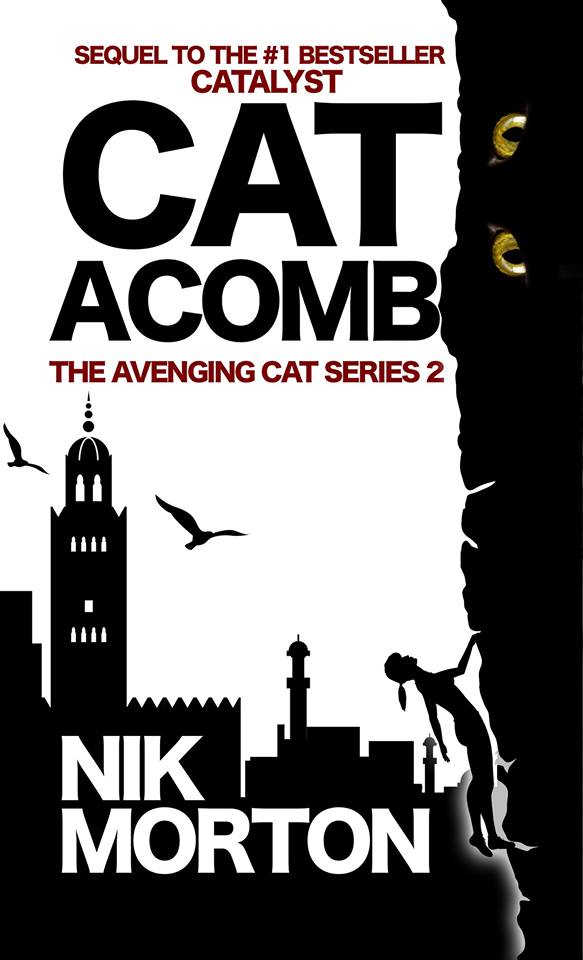
Paperback trilogy - the cat's meow...


  • Three exciting paperback action romantic adventures featuring ‘the avenging Cat’! 
  •  With superb uniform covers from Crooked Cat Publishing.


Catalyst - £7.99

Kindle also available – (series introductory bargain!) - £0.86

Catacomb - £5.99

Kindle - £2.58

Cataclysm - £6.99

Kindle - £2.58

Other e-book formats are also available.

CATALYST
The Avenging Cat series #1
Catalyst: a person that precipitates events.
That's Catherine Vibrissae. Orphan. Chemist. Model. Avenging Cat. She seeks revenge against Loup Malefice, the man responsible for the takeover of her father's company. An accomplished climber, Cat is not averse to breaking and entering to confound her enemies. Ranging from south of England to the north-east, Wales and Barcelona, Cat's quest for vengeance is implacable. But with the NCA hot on her tail, can she escape the clutches of sinister Zabala and whip-wielding Profesora Quesada?

CATACOMB
The Avenging Cat series #2
Catacomb: a subterranean cemetery: a place where ancient corpses are found – or new ones are dumped.
After their recent success in Barcelona, Cat and Rick continue their vendetta against Loup Malefice and his global company, Cerberus, penetrating the lair of Petra Grimalkin in Nice. But death stalks the pair, as do the dogs of law from the NCA, Basset and Pointer. Cat’s trail of vengeance next leads to the Cerberus health food processing plant in the Maghreb. She puts her skills to good use in Morocco where she again confronts the psychotic killer, Zabala. From the exotic streets of Tangier to the inhospitable High Atlas Mountains, danger lurks and a deadly ambush awaits…

CATACLYSM

The Avenging Cat series #3
Cataclysm:  a political or social upheaval
Some months after their adventure in Morocco, Catherine Vibrissae receives devastating news from Rick – news that will change her life. Still determined to go to Shanghai to face down her arch enemy Malefice and end her vendetta once and for all, she thwarts an ambush by Cerberus’ head of security, Mr Soong. To complicate matters, oligarch and people smuggler Belofsky is in Shanghai with his own agenda. While Cat plays cat-and-mouse with Soong, she uncovers a conspiracy that could lead to war between China and Japan


Monday, 8 August 2016

Book review - The Enemy I Kill


Alexander Knox, the well-known actor, had written two novels and three plays prior to this adult adventure yarn (1972). The story is set in the area of the Great Lakes of Canada in 1770. Seventeen-year-old Calvin Heggie, fairly fresh from Berwick-on-Tweed, is fired from his post with the Hudson’s Bay Company and finds himself isolated in the wilds.


He’s fearful of Indians, yet manages well enough when encountering three old warriors who seem harmless enough, even amusing and witty. A short while later, he meets up with a man called Red and two very attractive Indian girls, Moonluck and Kittypet. Before long, they come to an island and enjoy an idyllic life; soon he is bathing naked with these three and loses his virginity: ‘She was the first woman and he was the first man… The island lurched about, churning his teeth, bones, brains and guts, and erupted into what he recognised quite clearly, even at such a time, as the creation of a vast new life. Nothing as small as a baby, or himself, but a whole new universe.’ (p84)

Knox spent his childhood in Canada and was steeped in the traditions he wrote about. He brings observant descriptive power to the natural world that Calvin and the others inhabit: ‘The flock was two miles wide – so wide it concealed a lake, so dense it cast on the hills a moving shadow, blacker than the shadows of the clouds. The immense flock settled slowly and was swallowed by the tree-tops.’ (p51)

Overshadowing their idyll is the thought that the families of the two girls are searching for them. And then there’s the rumour that the warrior Longhair is abroad, even though he was supposedly killed. Their glorious summer is marred by capture and horror, and gruesome torture involving genitalia, while women and children look on: ‘The pain of a foreigner isn’t really pain, he thought.’ (p208)

Some scenes are not for the squeamish. Yet there are moments of tenderness as well as violence, dry humour, insanity and despair.  

Knox died in Berwick-on-Tweed in 1995, aged 88.

Saturday, 6 August 2016

Absent without leave...

Sorry, I haven't been posting much lately.

At present I'm absent writing.

I'm in Afghanistan, Nimruz and Herat Province, in 1979. Time-machines are wonderful contraptions.

It's March, and a little bit on the cold side, though.

An armed confrontation is about to explode, followed by an armed insurrection. So please excuse me for a while... If I should survive, I hope to move on to Kabul eventually...

Wednesday, 3 August 2016

Book review - Apocalypse Soon


Second in the Continuity/Time Police series featuring Kyler Knightly and his uncle Damon Cole, Apocalypse Soon is penned by Garnett Elliott. I liked the play on words – not 'Apocalypse Now', but 'Soon' – which is explained in the text. 


The first, 30-page title story sends Kyler and Damon off to Old Vegas, circa 2035. Joining them is Melody Fischer, an aikido instructor – handy to have around in a fight, maybe. A Continuity technician, Paul Dirac, has gone rogue and hitched a ride to Pre-Apocalypse North America (hence the 'Soon' of the title). The Zygma time-travel projector transports Kyler with the aid of a ‘focus object’, something specific to the destination timeline; ergo, it can’t shunt anyone to the future.   

Unfortunately, the trio are split up on arrival and separately get involved in a zany demolition derby gladiatorial monster truck contest where the loser faces a mob baying for an excruciating death. 

Visual and visceral, it’s a fast-paced ride into Mad Max territory.

The accompanying twenty-page story 'Babylon Heist' takes Kyler to ancient Babylon, in search of another time-traveller who was after a priceless artifact for a collector in the twenty-third century. Why plunder antiquated tombs when you could pillage history itself? To help him get by undercover as Kyros the Eel, his mastoid was implanted with a linguistic chip. Inevitably, betrayal is on the menu. When the two protagonists finally confront each other, their witness observes, “What language are you two speaking? It sounds like goats farting.” 

Fast, furious fun.

A final story, unrelated, is 'Strontium Dreams', which takes place in an unspecified future, where it pays to have your tattoo GU (Genetic Undesirable) – otherwise you’re liable to be collected for organ donation to the rich in their ivory towers or, just as bad, minced  up for fast food. Sometimes, the mixture doesn’t quite work and a nervous affliction could spread: ‘… when the vendors had been mixing too much nervous tissue with the long pork.’

Two reprobates, Lev and Mac survive, barely, by scavenging. Then they find a secret place, seemingly hidden behind a wonky hologram. Unfortunately, they’re accosted by murderous seven-foot tall lean mean men of the Man-Plus type. (A nod here to Frederick Pohl’s classic novel Man Plus, perhaps). 

Some good visuals of a noir world, and good description too: ‘… the figure stirred. He raised his head and his eyes were hallways with no doors and no lights at the end.’ (p67)

Escapist sci-fi with a gory, noir edge. Try it – soon.