Search This Blog

Showing posts with label torture. Show all posts

Saturday, 20 January 2024

PRISONER WITHOUT A NAME, CELL WITHOUT A NUMBER - Book review

Jacobo Timerman’s autobiographical book Prisoner without a name, Cell without a Number was published in 1980, its English translation released in 1981.

Timerman was the editor of La Opinión, Argentina’s leading liberal newspaper. The paper was not popular with the military government because he was not averse to castigate both the Left and the Right for human rights abuses. Inevitably, it came to a head one dawn in ‘April 1977 some twenty civilians besieged my apartment in midtown Buenos Aires. They said they were obeying orders from the Tenth Infantry Brigade of the First Army Corps’ (p9). He was covered with a blanket and bundled in a car and taken away. Eventually, blindfolded and handcuffed, he discovered he was kidnapped ‘by the extremist sector of the army’ (p29) ...which was at the heart of Nazi operations in Argentina...  In effect, they mistakenly believed he was part of a Jewish anti-Argentine conspiracy!

He was held for two and a half years – tortured, abused and humiliated – without charges ever being brought against him.

It was probably because he was internationally known and his wife continued to raise awareness of his plight that he was not murdered – or ‘disappeared’. Certainly, he believed that his only crime was to be born Jewish.

‘Entire families disappeared. The bodies were covered in cement and thrown to the bottom of the Plata or Paraná rivers. Sometimes the cement was badly applied and corpses were washed up along the coasts of Argentina and Uruguay... (others were) thrown into old cemeteries under existing graves... (and some) heaved into the middle of the ocean from helicopters... (while others were) dismembered and burned... Small children were turned over to grandparents or more commonly presented to childless couples in Chile, Paraguay, and Brazil ...’ (p50/51).

Then in late 1979, his citizenship of Argentina was revoked and he was expelled from the country, and then resided in Israel.

Timerman was born in Bar, Ukraine, to Jewish parents. To escape the Russian persecution of Jews and pogroms there, the family emigrated to Argentina in 1928, when he was five years old.

This is a searing account of a brave man. He died in November, 1999, aged 76.

Monday, 6 November 2023

JACKDAWS - book review


The prolific Ken Follett’s Jackdaws was published in 2001. His output is varied and broad in theme and place and time. Here, he returns to the Second World War and spies – some twenty-three years after his WWII debut novel Eye of the Needle.

The story covers the nine days before D-Day, June 6, 1944. Twenty-eight-year-old Felicity 'Flick' Clairet, an SOE agent is leading a Resistance assault on a French chateau in the village of Sainte-Cecile, the German communications hub for the area. But it goes wrong and she and her French husband barely manage to escape. Some of their team are killed and others are captured.

The German interrogator is Colonel Dieter Franck who, while not enjoying inflicting pain on his victims, is good at it. The Germans are aware that an invasion is about to occur soon and that will entail the rising up of many Resistance cells. He is certain that if he can break the will of his captives, he can learn details about the various groups.

Flick returns to England and is given permission to try again to crack the chateau communications hub. She recruits the Jackdaws, a ‘dirty half-dozen’ – all-female team to infiltrate in place of the regular cleaners. Not all of them will survive...

This is a typical Follett page-turner with characters you soon come to know and care about. Even Franck evokes a measure of sympathy. The interrogators, the invaders, considered the SOE agents as terrorists. Both sides were ruthless. In these sensitive times perhaps some readers will find certain aspects of the violence depicted as distressing; yet this kind of thing – and worse – happened. I’ve read a number of nonfiction and fiction books about the SOE and Follett’s research seems very accurate – and never slows the pace.

If you want an involving fast read, this suspenseful thriller will fit the bill.

Editorial comment:

Blame the editor. On p312 a coded message mentions Friday 1 June. Yet on p315 we’re told that Friday is 2 June. Oops. [Hopefully it has been amended since my 2002 edition].


Monday, 8 August 2016

Book review - The Enemy I Kill


Alexander Knox, the well-known actor, had written two novels and three plays prior to this adult adventure yarn (1972). The story is set in the area of the Great Lakes of Canada in 1770. Seventeen-year-old Calvin Heggie, fairly fresh from Berwick-on-Tweed, is fired from his post with the Hudson’s Bay Company and finds himself isolated in the wilds.


He’s fearful of Indians, yet manages well enough when encountering three old warriors who seem harmless enough, even amusing and witty. A short while later, he meets up with a man called Red and two very attractive Indian girls, Moonluck and Kittypet. Before long, they come to an island and enjoy an idyllic life; soon he is bathing naked with these three and loses his virginity: ‘She was the first woman and he was the first man… The island lurched about, churning his teeth, bones, brains and guts, and erupted into what he recognised quite clearly, even at such a time, as the creation of a vast new life. Nothing as small as a baby, or himself, but a whole new universe.’ (p84)

Knox spent his childhood in Canada and was steeped in the traditions he wrote about. He brings observant descriptive power to the natural world that Calvin and the others inhabit: ‘The flock was two miles wide – so wide it concealed a lake, so dense it cast on the hills a moving shadow, blacker than the shadows of the clouds. The immense flock settled slowly and was swallowed by the tree-tops.’ (p51)

Overshadowing their idyll is the thought that the families of the two girls are searching for them. And then there’s the rumour that the warrior Longhair is abroad, even though he was supposedly killed. Their glorious summer is marred by capture and horror, and gruesome torture involving genitalia, while women and children look on: ‘The pain of a foreigner isn’t really pain, he thought.’ (p208)

Some scenes are not for the squeamish. Yet there are moments of tenderness as well as violence, dry humour, insanity and despair.  

Knox died in Berwick-on-Tweed in 1995, aged 88.

Friday, 11 September 2015

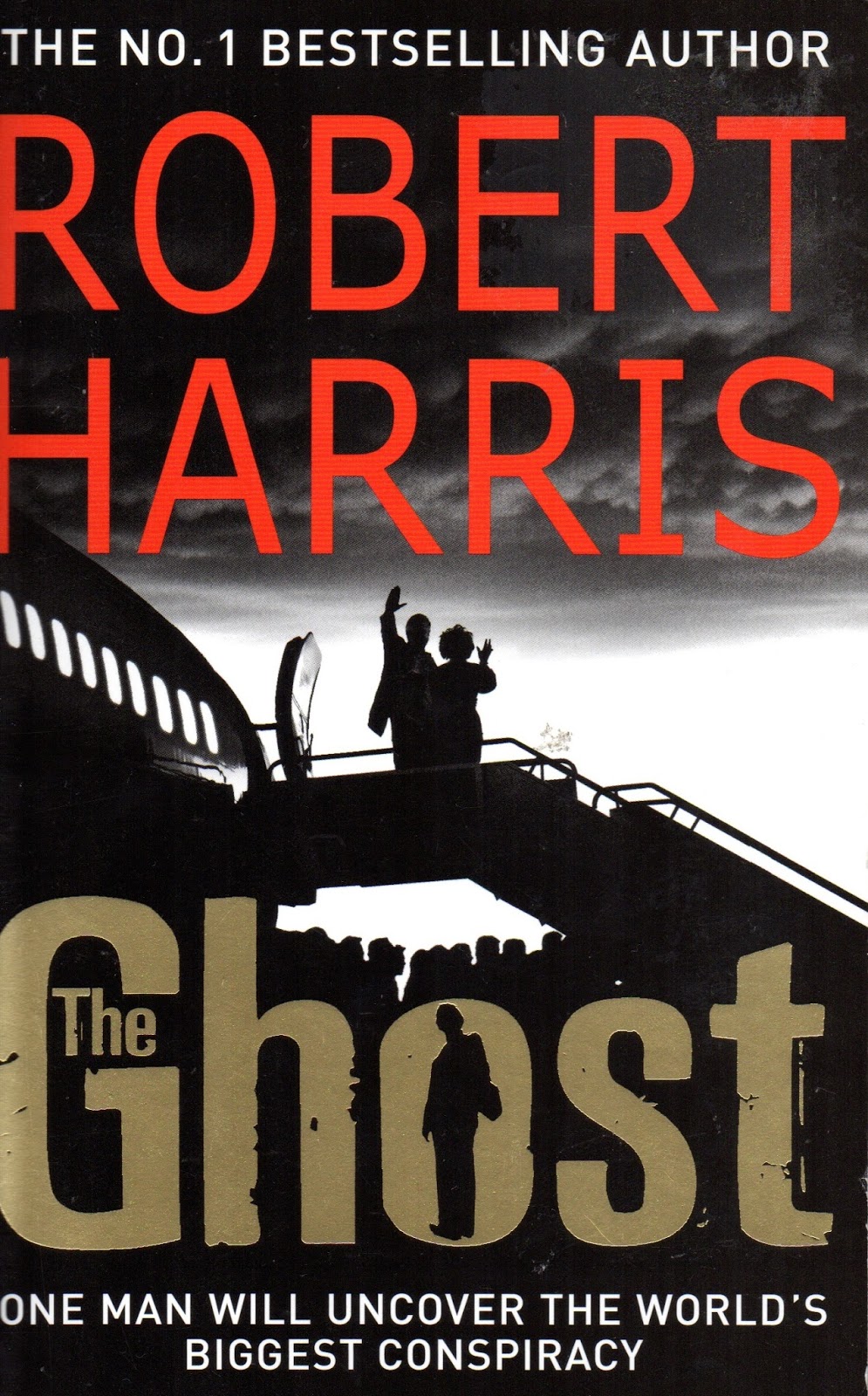
FFB - The Ghost

Robert Harris’ best-seller The Ghost (2007) gripped me from beginning to end. And what a beginning: ‘The moment I heard how McAra died I should have walked away. I can see that now.’

Mike McAra was the political friend and ghost writer of Adam Lang, Britain’s former prime minister. Sadly, McAra’s body was washed up on the American coast. So the unnamed narrator gets the job; it pays well, after all. He felt a slight unease about taking over from the dead man: ‘But I suppose that ghosts and ghost writers go naturally together.’

From that foreboding start, we get sucked in to the claustrophobic millionaire’s holiday home in Martha’s Vineyard, where the narrator meets Lang and his wife Ruth, the devoted fixer, Amelia and assorted bodyguards.
 
The style is deceptively easy, laced with humour, and the odd dash of cynicism and irony. The fictitious publishing company who paid the advance is Rhinehart. It ‘consisted of five ancient firms acquired during a vigorous bout of corporate kleptomania in the nineties. Wrenched out of their Dickensian garrets in Bloomsbury, upsized, downsized, rebranded, renamed, reorganised, modernised and merged, they had finally been dumped in Hounslow…’

The book is set very close to 2007, when Al Qaeda terrorist bombings are not only a real threat, but actual occurrences. There are questions being asked about the extraordinary rendition of four British citizens from Pakistan to Guantanamo Bay, and the use of waterboarding to torture prisoners. The ex-PM is accused of committing an illegal international act, namely authorising the abduction of those four men. So he is being hidden away in Martha’s Vineyard in order to complete his memoires. [Echoes resonate even now, as British so-called IS terrorists are vaporised by a drone’s missiles.]

‘Heathrow the next morning looked like one of those bad science fiction movies set in the near future after the security forces have taken over the state. Two armoured personnel carriers were parked outside the terminal. A dozen men with Rambo machine guns and bad haircuts patrolled inside…’(p41)

Harris is a good observer, giving us splendid description and can turn a good phrase. For example: ‘New England is basically Old England on steroids – wider roads, bigger woods, larger spaces; even the sky seemed huge and glossy.’ (p48) Another excellent example: ‘… passed a marker buoy at the entrance to the channel swinging frantically this way and that as if it was trying to free itself from some underwater monster. Its bell tolled in time with the waves like a funeral chime and the spray flew as vile as witch’s spit.’ (p50)

And he’s not without his humour, either: The bar ‘was decorated to look like the kind of place Captain Ahab might fancy dropping into after a hard day at the harpoon. The seats and tables were made out of old barrels. There were antique seine nets …’ (p95)
 
Insightful writing, too. Read this passage – ‘… it’s curious how helicopter news shots impart to even the most innocent activity the dangerous whiff of criminality.’ – and wonder about the heavy-handed police raid on Sir Cliff Richards’ house, which happened several years later than the publication of this book.
 
Writers too will empathise with the narrator, for obvious reasons: ‘Of all human activities, writing is the one for which it is easiest to find excuses not to begin – the desk’s too big, the desk’s too small, there’s too much noise, there’s too much quiet, it’s too hot, it’s too cold…’ (p180)

Those excerpts give you a little flavour, anyway. The Ghost is well written, in turns amusing, witty, thoughtful and incisive concerning the corruption of power. Despite the fact that we know there wasn’t a prime minister called Adam Lang, his wife Ruth etc., the first person narrative manages to suspend disbelief.
 
If you enjoy the drip-feed of tension rising towards paranoia, then you’ll appreciate this skilfully written novel.

Some of the paperback’s review quotes seem adrift. ‘An unputdownable thriller about corrupt power and sex…’ – the sex is minimal and not graphic in the slightest: the door stays closed.

‘Guaranteed to keep you awake and chuckling after dinner.’ – Does the reviewer usually sleep during dinner? It has many amusing asides and one-liners (as hinted at above), but it isn’t a comedy.

‘… satirical thriller…’ – The thriller elements are minimal, and only evident towards the end. It’s more psychological suspense up to that point.
 
‘Truly thrilling.’ – No, it isn’t. It is tense, however, and most convincing, with an excellent twist at the end.

Highly recommended.

Saturday, 29 November 2014

Saturday Story - 'Hell for Leather'


Tiananmen Square - Wilipedia commons
 

HELL FOR LEATHER


Nik Morton


China, 1977


Keith Tyson shivered although he was wearing full survival gear. At least the cave in this godforsaken cliff offered him shelter from the icy winds coming off the Yellow Sea. But it wasn’t the cold; he was suffering from the after-effects of the drugs they’d pumped into him barely ten hours ago. 

It had been a simple enough mission. Flown out of South Korea, they’d dipped over the wave crests and under the radar, avoiding any aircraft sorties from the bases at Yantai, Tianjin and Qingdao. Parachute drop at the rendezvous point outside Zuzhou. As planned, he’d been met by a group of seven activists. Their English was rudimentary, so he spoke in Mandarin. They helped him with his disguise, though they couldn’t do much about his height, abnormal for most Chinese men. To compensate, he adopted a subservient stoop.

His mission was simple enough. The death of Zhou Enlai and Mao Tse-tung the previous year, followed by the end of the Cultural Revolution and demonstrations, suggested that perhaps the country was ripe for a people’s revolution that might even lead to democracy. It was Tyson’s job to organise the popular uprising against the government, before anyone could be nominated as top leader of the nation.

But someone in the activist group - an idealist, a hater of the West, or perhaps someone who wanted position, power, money or all three - had betrayed them. At his second arranged meeting in a basement in Shanghai, the Chinese military organised a raid and his small group was arrested. The suicide pill would have worked but he and his contacts were quickly gassed and the false tooth removed before he regained consciousness.
 
They would have been justified in secretly executing him without a trial. Certainly, they had no intention of parading him in front of the world press. There was already talk of the proposed new leader, Deng Xiaoping approaching the West, and in particular the United States, in a push for economic reform. This promise of Western finance was too precious to jeopardise over one spy. 

The Central External Liaison Department got its way and Tyson was handed over to this espionage system. They wanted to brainwash him, to learn about his contacts and his secret organisation. For many years, ‘Interprises’ had managed to stay separate to MI6, since its creator swore that MI6 leaked like a sieve.
 
Tyson had studied the methods employed during the Korean and Vietnam Wars. In the first few hours, he realised that they were very good at inflicting pain and demolishing self-belief and faith. Yet he discovered depths of will and strength he never knew he possessed.

To begin with, they set about him with the so-called softening-up process. Physical trauma combined with drugs tended to bear the best results in the quickest time, or so the manuals stated. Fortunately, he’d read those manuals and he was able to employ mind-games of his own which enabled him, up to a point, to combat the drugs and retain a sense of self. It was like fighting the influence of alcohol, only ten times more difficult.
 
They discovered nothing, but Tyson knew that he had to escape within the first twenty-four hours, before his body clock and senses were thoroughly disoriented, before he was so tired and hungry and hurt that his meagre defences would crumble.

Five times in the first day, his hands were tied behind his back with a leather strap and then they ducked his head in a bath of icy cold water until his lungs were fit to burst. He gasped for air and floundered, his hearing muzzy. Normally, they untied him and threw him into his stinking dank cell; but this last time they forgot. 

It seemed to take Tyson an age to work loose that leather strap.

When his plate of maggot-riddled rice was brought, he sat unmoving, hardly looking at the guard in his fatigues. But he was poised, every aching muscle in readiness to spring.

The guard made his mistake and turned to the cell door, keys in his hand.

Tyson sprang, looping the leather strap round the man’s neck, cutting off any cry of distress. 

When he was done, he checked the cell door and the corridor. All clear.

He exchanged his stained and torn clothing for the guard’s. The trousers were tight and too short and the tunic threatened to pop its buttons, but it would have to do.  He locked the dead guard inside and strode hurriedly down the passage and passed the interrogation room but didn’t give it a second glance. If he ever got out of here, he guessed that he’d suffer many sleepless nights reliving his time in that room. He climbed up a flight of stone steps.
 
Luck is everything, Tyson knew. Some people are blessed with plenty of it. His held. He located the Commandant’s offices on the third floor. There was only the one guard and he didn’t suspect anything until it was too late. Now Tyson was armed with a revolver and cartridges. He slipped into the office and soon found the safe behind a painting of Mao. It was an old model and, after a few moments, he opened the safe door. Inside he found an assortment of documents, an automatic pistol and some money. He identified what he wanted, however, a list of names of those suspects who planned demonstrations against the State. Destroying them would not accomplish anything, he knew, since there were bound to be copies. He thrust them inside his jacket. The analysts at Fenner House would be interested. If any survived the inevitable clampdown, then they might be worth contacting in the future.
 
Along another passage he located a changing room filled with clothing - an assortment of gear, including that appropriate for survival at sea. He picked out the biggest sizes and donned as much as he could wear.
 
Clinging to shadows, he descended to the cells, surprised the guards and released twenty-two prisoners. The breakout was a distraction to the establishment’s sentries and gave him precious time to make his way over the wall and along a little-used coastal track. Behind, the siren blared and gunfire echoed, the sounds snatched away by the growing wind-howl. He hoped some dissidents would get away.
 
About two hours later, he found his cache of equipment, hidden in the cliffs where he’d left it. Tyson switched on the beacon and shoved it inside his rucksack. Weak from the beatings and the drugs, his stomach rumbling, he trudged along the goat track cut into the cliffs.
 
He found the cave and sat hunched against the rock wall, shuddering while he forced chocolate into his mouth. He couldn’t taste it. He was seeing double now too. His fingers were numb. Frostbite, gangrene – no, it was the after-effects of the drugs.
 
‘Charabanc approaching bus-stop.’ The radio set up in front of him crackled and the phrase was repeated. Thank God. They’d been constantly monitoring since he penetrated China. His beacon meant he needed extraction fast.
 
Easing his aching body upright, he sought purchase from the cave wall and stood. Shuffling to the entrance, he saw two dots – no, that was his double vision. The conning tower of a conventional diesel submarine, just surfacing: the charabanc. Risky, ploughing through the Yellow Sea.
 
He slithered down the ragged rocks in front of the cave mouth. Gulls called raucously as they fled their cliff-side nests. He triggered the orange flare. A bigger risk.
 
A red flare shot into the night sky, its source about a mile south. The Chinese were still hunting him. Now it was a race against time.
 
Bracing himself, he stumbled into the surf that beat against the rocks. Spume frothed everywhere. At last, he spotted the rigid raider and two dark shapes in it, the wake glinting in the faint moonlight as help headed towards him.
 
The buoyant craft veered next to him, Tyson grabbed a rope handhold and for the first time since his escape he really thought he might make it. He scrambled up and over the side of the bobbing craft. ‘Let’s go!’ shouted a sailor. Then they headed back to the black monolith, the conning tower.
 
Not a moment too soon. Rifle fire sounded, echoing. Ineffectual.
 
Tyson didn’t remember getting inside or the boat submerging. He regained consciousness in a bunk bed. The smell of stale air and oil filled his nostrils. A medic leaned over Tyson, checking his eyeballs. ‘I’ll give you a shot to combat the drugs, sir.’
 
Two faces loomed out of the shadows but with a bit of concentration Tyson recognised it was only one man. Swann.  ‘Did you get anything, Keith?’
 
‘Here.’ He fished the sheets out of his jacket and handed over the names, a list of brave souls who might one day create an historic upheaval.
 
It was twelve years later before the demonstrations erupted in earnest, the pictures televised and beamed around the world. The Tiananmen Square massacre, resulting in hundreds of deaths at the hands of the military, signified a tragic episode in China’s history. In 1992 Deng restarted economic reforms.

***

This story has been gleaned from certain manuscripts provided by several secret agents who served in International Enterprises, an adjunct to the British Intelligence Service, in the 1970s. Swann and others are featured in the full-length adventures of psychic spy Tana Standish, beginning with the e-book The Prague Papers (Crooked Cat Publishing).
 
Please purchase from
Amazon UK here
Amazon COM here
 
'Hell for leather' Previously published in The New Coastal Press, 2010.
Copyright Nik Morton, 2014.

Note: This story was originally written in response to the writers' circle theme 'leather'...