Search This Blog

Wednesday, 10 December 2014

Christmas with Crooked Cats – ‘Inn Time’

Crooked Cat is a UK publisher who has produced many popular and best-selling books in a variety of genres – romance, thriller, crime, fantasy, young adult and horror – in e-book and paperback formats.

Christmas with Crooked Cats began on 29 November and runs through into 5 January 2015. On their Facebook page – https://www.facebook.com/groups/737252102990447/

– you can access seasonal poetry, short stories and articles penned by a host of Crooked Cat authors.

So, to continue celebrating Christmas with Crooked Cats, here is a Christmas story.

 
INN TIME
 

Nik Morton

 
“...about time you got a new belief system.”

 
Wikipedia commons
 

Surveillance took longer than I’d hoped. By the time the criminals were arrested, I was two days late setting off for my cousin Ignacio’s home in Zaragoza. As I loaded my suitcase in the Seat’s boot, I rang him from my mobile phone to let him know I’d be there later. Just my luck, snow had started to fall in the north the day before I left and by the time I drove into the mountains it was lying quite thick, though at least the main road was clear, if treacherously wet and slippery. To make matters worse, fog descended, which further reduced my speed. Not the most auspicious start to the Christmas holidays, I thought, as the windscreen wipers beat a monotonous rhythm interspersed with squeaks of complaint at not being changed during the last service.

The road climbed and twisted and turned. Oncoming traffic headlights glared, shards of light reflecting from the wet windows, blinding. My heart lurched as I instinctively touched the brake, padded it gently, repeatedly slowing down. If I’d been driving a little faster or been inattentive, I’d have hit the rear end of the parked car, its blinking yellow hazard lights quite dim in the conditions.

I let the engine idle, the climate control wafting warm air over me. I was late and the weather was hell out there. Drive round and move on. Ignoring my better judgment, I fished in the glove compartment for a torch, turned off the engine, switched on the hazard lights, shoved the shift into gear and ratcheted the handbrake one notch more. As soon as I opened the door, I felt reluctant to brave the elements.

Still, I stepped out and, as if on cue, the snow stopped. Keen to take advantage of the respite, I hurried over to the car parked in front of my Seat. It was a Fiat Punto, and the interior light was on, the windows steamed up. I swore. Not the best place for courting couples, I thought, as I rapped my knuckles on the roof.

The driver’s electric window lowered, and a young man peered out. “Thank God, you stopped,” he said. “The car won’t go and my wife, she’s pregnant! I was taking her to the hospital!”

Leaning to my left, I shone the torch inside. Sure enough, she was half-lying, half-sitting on the rear seat. One hand rested on her bump, the other gripped the headrest post. She blinked and glanced away. “Sorry,” I said and lowered the torch.

“We need to push your car off the road or it’s going to cause an accident,” I told him. “Then we’ll see about getting your wife to the hospital.”

“Yes, yes, of course,” he said. “Thank you.”

“When I tell you, take off the handbrake, and I’ll push. Steer over to that piece of waste ground,” I indicated to the right about ten feet away. “Should be safe enough there until you can get the garage to send someone out.”

He nodded and I walked to the back of the car. I pocketed the torch and braced myself, ready to push. The road surface was firm enough, at least, to give me purchase. “Handbrake off!” I called.

Fortunately, this section of road was relatively level, not too steep. After a few seconds of intense effort and my shoulder muscles protesting, the car started to move forward, and gradually it turned off the road. The driver braked as the rear wheels ran onto the waste ground.

At that moment, a truck bore down on my Seat, its horn blaring, brakes squealing. It wasn’t going to stop in time. My heart pounded as I backed against the Fiat.

The massive crunch was deafening, my car jammed under its front bumper. Sparks flew as the heavy vehicle dragged mine with it and slewed across the road. It demolished the crash barrier. My car and the truck tumbled over the edge, leaving only a flurry of snow in their wake.

My mouth was dry, even though damp white fronds of my breath filled the air. My flesh ran cold, and I shuddered. I’d been close to death many times, but the body never gets used to it.

I glanced at the expectant father. He stared in shock at the gap in the road barrier.

I took out my mobile phone, but there was no signal, weather or the position affecting it, without doubt. I enquired but the husband’s phone was inoperative as well, so we couldn’t alert the emergency services.

There was no more traffic, it seemed. I ran across the empty road and peered down, but there were no headlight beams, just blackness. I pulled out my torch and directed its shaft of light down the snow-laden mountainside, but there was no sign of the unfortunate truck driver.     

Suddenly, there was an enormous explosion and flames briefly spouted up from where the vehicles had fallen off the mountain. I jerked back, turned my head away and in the fleeting flash of light, I thought I saw something that gave me hope.

Now, the snow started up again, but this time it came at us horizontally, driven by the cierzo, the cold dry wind from the northwest.

I moved to the other side of the Fiat and opened the door, slumped into the passenger seat. Grateful for the relative warmth, I slammed the door shut. I explained that we could sit in there and slowly freeze to death, or try to get to some shelter. “Not the greatest options, I know,” I said, “especially in your condition, Señora.”

“Maria Delacruz,” she supplied. “My husband, he is Jacobo.”

I hunched round and nodded. “Leon Cazador.”

“But we don’t know of any shelter,” said Jacobo. “I don’t recall passing a building for many kilometres.”

“When the truck blew up, I think the flames highlighted a rooftop over there.” I pointed down a rough track on our right. Maybe somebody lives there.”

“They might have a phone!” Maria said.

“Very well, we’ll risk it,” Jacobo said. “But we must be careful, Maria.”

“I’m not an invalid,” she replied and opened the door.

 
***
The track sloped downwards. It led to a double gate with a chain and padlock, which opened to useful skills I’d learned some years ago.

Jacobo whispered, “How’d you—?”

“Don’t ask,” I said.

The slope continued for a further ten metres or so and curved towards a large two-storey building, its roof covered in snow. So, either they had good insulation or it was empty. The sign by the door read: Posado del Belén. Inviting enough, I reckoned and rang the doorbell.

While I waited for any response, I glanced around. The trees were already snow-laden, and the gardens were virgin white. I hoped there wasn’t a frustrated writer acting as a caretaker with a penchant for axing doors. In a way, I was relieved there was no answer. I paced to the left. A bay window revealed a large lounge, an empty hearth and a wall mounted full bookcase. On the right, another window showed a bar area, a small dance floor and tables with chairs stacked on them. “Closed for the season,” I said.

“What do we do now?” Jacobo wailed, one arm round Maria, shifting from foot to foot as if that would warm them.

In response, I picked the lock. Easy enough, in my business. “This way,” I said. I shut the door behind us and was immediately grateful for the relative warmth of the place. The lobby echoed to our footsteps as we stamped to be rid of the clinging snow. Then I shepherded them into the lounge on the left. There were plenty of logs stacked to one side. “Let’s get a fire going.”

It didn’t take long to warm the place. Maria removed her coat and lay on the leather sofa in front of the roaring log fire. Jacobo and I raided the kitchens and found in-date lamb in the fridge and made sandwiches. While Jacobo heated some vegetable soup, I checked out the rest of the building, in search of a couple of blankets for Maria.

The reception desk phone didn’t work, which was frustrating. I pored over the guest book. The last visitors departed two months ago. I wondered how long the place had been left empty. It didn’t have a musty or damp smell about it.

The inn seemed to serve as a hotel, too. It had eight double rooms, and the furniture in all of them was draped in dustsheets. In one wardrobe, I found a cache of weapons and explosives, but I decided to keep the discovery to myself for the time being. 

“The baby, it’s coming!” shouted Jacobo.

I raced downstairs and asked Maria about her contractions. She nodded and wheezed, taking great breaths, doubtless to fight the pain.

“There’s still time to eat something,” I told Jacobo. “But, sorry, Maria, you must abstain from any food.” She didn’t look particularly hungry, anyway. Her whole concentration seemed to be on the intermittent and quite crippling pain.

A couple of hours later, the signs were there. I told Jacobo, “Now it’s time. Hot water, towels.” He got up and obediently hurried towards the kitchens. I moved over to the drinks cabinet. Its lock was flimsy and I encouraged it to open. A small brandy seemed necessary. It was a few years since I’d delivered a baby, but I told myself it was like riding a bike. As long as no wheels came off, I thought.

 
***
In the event, some six hours later, Maria gave birth to a lovely boy, and the procedure was without any complications.

I left Jacobo with his wife and newborn while I cleaned up and took the washbasin, towels and cloths to the kitchen.

I was on my way back to the lounge when the front door was opened with a key. Most civilised, I thought. Two men and a woman stood in the doorway, all dressed in snow-covered leather jackets with fur collars and hoods, and jeans and boots with fur edges. I was surprised to see anybody. Their expressions reflected more shock than surprise. If they were the owners, I could understand that.

My sixth sense kicked in, though, and the hairs on the nape of my neck stood on end.

They exchanged glances with each other. The woman lowered her hood and demanded, “What the hell are you doing here?” Her voice echoed in the lobby. “Who are you?”

Hola,” I said, offering a smile. “We took shelter from the storm.” I gestured at the half-open lounge door that emitted a warm glow. “It was an emergency. I hope you don’t mind?” That last was probably from my English side, even if delivered in Spanish.

“Emergency?” she said.

“We’ve just delivered a baby. Come and see.”

With some reluctance, the three of them followed me inside.

“Hey, Maria, Jacobo, we’ve got visitors,” I said.

Jacobo stood up and Maria hugged her son to her.

I eyed the woman. “Are you the owners, then?”

“Yes,” she said. “I’m Melita Reyes and this is my husband, Beltran, and my brother-in-law, Casimiro.” She looked at the empty plates and glasses.

“We’ll clear up and pay for what we’ve used, of course,” said Jacobo.

Melita removed her gloves, pocketed them and moved over to the fire. “No need. It can be our gift.” She warmed her hands with the flames.

“Thank you,” whispered Maria.

Melita’s husband strode over to her and tugged at her sleeve. He gruffly whispered something in her ear. She shook her head and shrugged her shoulders. “You go with Casi,” she said, dismissing him.

He nodded, turned on his heel, and the two Reyes brothers turned and left the lounge.

“I’m just going to the kitchen,” I told Melita. “Do you want a drink?”

She unzipped her jacket and sat on the edge of a seat by the hearth. She seemed intent on the mother and child. “No, thank you,” she said, without looking up.

I eased the door back and was in time to observe the brothers climb the topmost stairs, two steps at a time. I sighed, because I knew where they were headed.

There was an alcove under the staircase. Here, I pulled out from my ankle holster the lightweight Colt Officer’s ACP LW automatic. The Astra A-100 automatic was still in its shoulder holster, packed away in my suitcase, amidst the burnt-out wreckage of my Seat. I had an uninterrupted view of the door to the lounge and the foot of the staircase. I waited.

After about ten minutes, Casi and Beltran descended the stairs. Their hands were full with canvas bags and machine-guns. When their feet landed on the bottom tread, I stepped out, my gun leveled on their chests. “Is this the new version, eh? Instead of frankincense, myrrh and gold, you bring the babe explosives, detonators and bullets.”

“What are you talking about?” Beltran snapped.

Melita emerged through the doorway. As she noticed my weapon, she reached inside her jacket.

“Don’t,” I warned. “I’m a good shot.”

“You cannot shoot all three of us.”

“I don’t want to shoot any of you, but I can’t let you leave here, either.”

“This is our property, Señor. You have no right to—”

“You’ve no right to blow up people, either.”

“It is what we believe in,” said Beltran gruffly.

“Then it’s about time you got a new belief system.”

“We want self-determination and territoriality,” said Casi, shaking the weapons he cradled. “This is how we will get it.”

“No, it isn’t,” I said, anger rising. I had to control it, otherwise, I was liable to make a fatal error.

“We fight injustice and tyranny,” said Beltran.

I swore. “Franco’s been dead over thirty years, and our country’s now a democracy. Open your eyes, and look around the world. If you and Melita ever decided to have children, no dictator is telling you to restrict yourselves to one child. You’re free to follow any religion or none, without persecution. If you’re law-abiding, you need not fear the knock on the door at three in the morning. You have drinking water on tap and shops filled with food. Cheap clothing is available for all. You can read any material you wish without censorship. Need I go on?”

“The government tramples on our aspirations!” snapped Casi.

“Your bombs kill innocent people,” I said.

“They’re not innocent,” said Casi. “They work for the government. They’re fair game!”

“Those murdered Guardia Civil men and women were fathers and mothers, sons and daughters. They were not government tyrants.” I gestured at the lounge doorway. “Inside there, is a mother and baby. Innocents.”

“What would you have us do?” Melita said, her tone quite sombre.

“Give yourselves up. Renounce violence. If your aims are just and legitimate, fight for them by peaceful means. Don’t create orphans and widows.”

Beltran laughed. “You’d have us surrender, for the sake of that one baby in there?”

“Yes,” I said, “and why not?”

“It’s absurd!” said Casi.

“Is it? Just over two thousand years ago, another baby boy came into the world to spread the word. Peace to mankind. His Word’s been diluted over the centuries, maybe, but it still holds true tonight, today. This is Christmas Day, after all.”

“It’s just a baby,” said Casi.

Beltran pursed his lips and looked at his wife. Her eyes were moist, and she nodded briefly. Then he lowered the weapons and bags to the floor.

“Your weapon, please.” I held out my hand to Melita.

Carefully, she pulled the revolver free and I took it from her, shoved it in my pocket.

Casi swore. “This is stupid! We’ve sworn to fight together until—”

“Until one or more of you are dead?” I said and shook my head. “Your so-called cause has killed over eight hundred people, including women and children and maimed hundreds more, ruining so many lives. Lives that are for living.” I could easily have been talking to godless killers, but I’d seen the look in Melita’s eyes when she sat with the mother and child, and I believed her maternal instinct had been deeply stirred. And, strangely, these two men looked to her for leadership.

Melita glanced at the lounge doorway again then moved over to her brother-in-law. “Bury the hate and love life,” she whispered. “It’s a good belief system, I think.” She laid a hand on his arm. “Please, Casi, let’s try it.”

Casi glared at me then flung his bundle to the floor. I flinched as the bag’s contents made a noise but they didn’t explode. Melita hugged him, her lips pecked his cheek, and then she went back to her husband’s side.

“What will you do with us now?” she asked.

“Leave your munitions here. And when the snow stops, go and send an ambulance.”

“Then we’re free to go?” Casi asked.

“Go, yes,” I said. “But on the way, bury the hate.”

Melita nodded and held Beltran’s hand. “Very well.”

At that moment, Jacobo stepped out of the lounge. He trembled as he stared at the discarded weapons and explosives. “Madre de Dios!”

            I nodded. It seemed an appropriate exclamation. “Maybe this time there won’t be any death of the innocents. Let’s go in and look at the Christmas child.”

 ***

Notes:
This is one of 22 short stories, all previously published, that can be read in the collection Spanish Eye published by Crooked Cat Publishing.

e-book from Amazon UK here
e-book from Amazon COM here
Also available as a paperback from these sites and post-free worldwide the book depository

‘Inn Time’ was originally commissioned by Costa TV Times for their Christmas 2009 edition, and was published as a double-page spread.

Leon Cazador has a guest appearance in Catalyst, which is released tomorrow:
 
e-book from Amazon UK here
e-book from Amazon COM here


Tuesday, 9 December 2014

Thank you to reviewers!

As we’re approaching the season of Goodwill, it seems appropriate to thank all the readers of my books who have made the effort to write a review. Yes, that includes those who for one reason or another didn’t get on my wavelength; you can’t please all the people all of the time. I don’t write to please everyone, though I hope to (that’s the unrealistic romantic in me, I suppose)!

Today, I’m featuring a few samples of reviews for Spanish Eye. Why have I chosen this book rather than the other eighteen or so I’ve had published? Tomorrow, I’m posting a Christmas story that was previously published (and commissioned by a local periodical) and it featured this tale, which can be found in Spanish Eye.

Be assured, if you wanted to find a suitable book gift for Christmas, Spanish Eye would fit the bill, as it has something almost for everyone. (I should have been a politician, using ‘almost’… well, you can’t please…)

Amazon UK here
Amazon COM here
 
From Goodreads: Mairi Cameron: I wouldn't usually choose short stories, generally the longer a story the better, and if it's part of a series then better still! However, this book features a series of tales about the same private investigator, and gives a real feel for the characters and locations …I enjoyed it immensely and look forward to further books featuring Leon!

From Laura Graham, actress, novelist: Spanish Eye is a collection of short stories set in the heat and the dust of Spain. Our courageous private eye, Leon Cazador, half-English, half-Spanish, and sometimes disguised as Carlos Ortiz Santos, guides us through the action. These stories are humorous, insightful and sometimes tragic. Leon Cazador is not afraid to bring the bad men to justice, and so help to restore the balance in this world. Beautifully written … with a simple and uncluttered style which draws you in to the heart of the story.

From George R. Johnson, USA: The tales run the gamut of the usual crime stories(con men, kidnappings, car theft ring, crooked politicians) and the odd stuff (smuggling, both exotic animals and illegal aliens, terrorists). All fun stories, a bit of humour here and there, others deadly serious. One story had me grinning at the beginning, but sobering quickly as the end approached.

From Elizabeth Sullivan, author: Spanish Eye is a fabulous read. In his crisp depiction of Leon Cazador, Nik Morton paints a portrait of everyone's hero. This cross-cultural character is dashing, daring, and delightful. He does whatever it takes to make good triumph over evil. While reading these exciting stories I experienced myriad emotions. I laughed, cried, and became incensed. I cheered and clapped, but most of all I felt a confirmation of universal values.

From Paul Mutter, journalist: A particular difficulty with short stories is that they are exactly that – short. All too often they can be over before they have really begun, leaving the reader somewhat frustrated. But Nik Morton has managed to create a collection of 22 individual stories … which are absolute little gems. The pace of each is perfectly judged to reach its conclusion at just the right time and in just the right way. Nik has also managed in many of them to weave in topical Spanish themes and issues such as immigrants trying to get into Spain from North Africa, drug running, memories of the Civil War and the corruption of Land Grab in Valencia to name but a few. I can thoroughly recommend this book. Not only will the tales appeal to general lovers of short stories but in particular those with experience of living in Spain will I’m sure feel a certain resonance with these stories.

From Truth42, Amazon review: This collection of detective stories is a really great read. Linked together by the main character Leon Cazador there is a wide variety of complex cases; some of them take you back to detectives such as The Saint. Beautifully written by someone who obviously knows how to tell a story... Fantastic stuff!

From Kay Reeve, expat, Spain: Living on the Costa Blanca, I found much that was familiar combined with an insight into a very different and darker side of Spanish life. The colourful characters and intriguing twists made these stories a really enjoyable read and one I would really recommend.
 
If you do enjoy Spanish Eye, you might also like: these (paperback or e-book, they're good value for money; I've just linked the e-books but you can easily get the paperback, where appropriate):
 
Blood of the Dragon Trees (Crooked Cat Publishing, eight 5-star reviews), a romantic crime thriller set in Tenerife; Amazon UK here; Amazon COM here;

Sudden Vengeance (Crooked Cat Publishing, 4 good reviews on Amazon), a vigilante thriller set in Southern Hampshire, UK; Amazon UK here; Amazon COM here;

 
The Prague Papers (Crooked Cat Publishing, e-book only, just published), the first in the Tana Standish, psychic spy series; Amazon UK here; Amazon COM here;

 
Catalyst (Crooked Cat Publishing, e-book and paperback, released 11 December, but you can pre-order now), the first in the ‘Avenging Cat’ crime thriller series; Amazon UK here; Amazon COM here;

 
Wings of the Overlord by Morton Faulkner (Knox Robinson Publishing, hardback, co-author Gordon Faulkner), the first in the ‘Chronicles of Floreskand’ series. Amazon UK here; Amazon COM here:


Monday, 8 December 2014

Christmas with the Crooked Cats - "I'm with you in spirit"

Over on Christmas with the Crooked Cats Facebook page you’ll find an amusing, touching short story by one of the authors of Crooked Cat Publishing – Sue Barnard. The story's entitled 'I'm with you in spirit.'
  Damson gin

Sue’s books are The Ghostly Father and Nice Girls Don’t.

The Ghostly Father has picked up an enviable collection of good reviews on Amazon UK (33). Blurb reads: Romeo & Juliet - was this what really happened? When Juliet Roberts is asked to make sense of an ancient Italian manuscript, she little suspects that she will find herself propelled into the midst of one of the greatest love stories of all time. But this is only the beginning. As more hidden secrets come to light, Juliet discovers that the tragic tale of her famous namesake might have had a very different outcome... A favourite classic story with a major new twist.
 
Nice Girls Don’t was released in June and has already received 9 good reviews. Blurb reads: Who knows what secrets lie hidden in your family's past? Southern England, 1982. At 25, single, and under threat of redundancy from her job in a local library, Emily feels as though her life is going nowhere - until the day when Carl comes into the library asking for books about tracing family history. Carl is baffled by a mystery about his late grandfather: why is the name by which Carl had always known him different from the name on his old passport? Fascinated as much by Carl himself as by the puzzle he wants to solve, Emily tries to help him find the answers. As their relationship develops, their quest for the truth takes them along a complicated paper-trail which leads, eventually, to the battlefields of the Great War. In the meantime, Emily discovers that her own family also has its fair share of secrets and lies. And old sins can still cast long shadows... Can Emily finally lay the ghosts of the past to rest and look forward to a brighter future?


Sunday, 7 December 2014

Saturday Story - 'An Interrupted Journey'


Wikipedia commons
 
 
AN INTERRUPTED JOURNEY
 

Nik Morton

 
She wore a pale blue suit whose pleated skirt revealed long shapely legs. She sat in the corner of the train’s compartment, motionless save for the incessant rocking of the speeding night express. Dusk settled in over the fleeting countryside but neither occupant noticed. The overhead dim light reflected in the metal of the automatic pistol in her gloved right hand.

            She said, ‘I know all about you. I’m going to kill you.’

            Daniel Prestwick nervously brushed back his wavy brown hair. All about me? What was she talking about? His mouth was dry, his palms wet, and he was incapable of saying anything. All he could do was stare at her angry blue eyes and that gun!

            It must be Rag Week or something? She can’t be serious!

            She fired directly into his chest.

*

Zora replaced her automatic pistol in its holster beneath her jacket. As she knelt by the prone figure she heard shouting from further up the corridor. The racket of the train had not altogether drowned the pistol-shot.

            She stopped her professional search of the man’s body, slid open the compartment door and peered intently along the swaying corridor.

            Bermanos and Lyudin would be waiting a little further up the railway track.

            The carriage’s other occupants hammered on doors, enquiring about the sound of a shot, heading in her direction.

            She pulled the emergency handle.

            The small group of disturbed sleepers were bundled into one another as the train braked.

            Zora swung open the carriage door and leapt out into the pitch night, the cries of the train’s passengers drifting away.

            Her feet hit soft turf and she rolled over – as she’d been trained with paratroops – rolling down the damp grassy slope.

*

A torch beam joined in the chaos and probed a wide arc from the diesel engine to encompass the coarse grass of a field across which ran a dark figure that appeared to be female.

            Then, as the engine driver and guard descended the slippery slope in pursuit, they heard a massive chomping sound.

            They hesitated, suddenly afraid.

            The guard’s torch beam illuminated a small helicopter.

*

Breathless now, Zora loped beneath the whirring rotor-blades. Sliding into the cockpit, she looked back at the torch beam. She gave co-pilot Bermanos a sidelong glance and clicked her fingers.

            He understood the simple gesture and grabbed a bazooka-like weapon alongside his seat and placed it in Zora’s waiting hand.

            She rested the weapon on her shoulder, aimed at the torch beam’s source. The thing jarred her shoulder and she heard the whooshing sound of the ejected missile. Minor singeing of the cockpit’s upholstery resulted, burnt by the back-blast.

            The two dismayed railmen backed away as they noticed the cockpit light up. They ducked instinctively and lay very still on the damp grass. Acrid smoke filled their nostrils and mouths and made them cough and retch – smoke temporarily paralysing the nervous system.

            Lyudin gently levered on the joystick and the helicopter climbed gradually into the night.

*

The doorway of the compartment was crammed with a knot of onlookers. The speculative mumbling increased as a tall brown-haired man waded through the corridor of sensation-seekers.

            Paunches and breasts, concealed by gaudy and colourful night-attire, gave way. His unwavering deliberation in the way he headed for the compartment gave the onlookers the impression that he was some kind of authority – a policeman, perhaps?

            When the lean newcomer reached the doorway he was confronted by a corpulent hirsute fellow in blue-striped pyjamas who said, grumpily, as he scratched the hairs covering his belly, ‘And what, sir, gives you the privilege to push your way to the fore?’ He jutted out his lower lip.

            ‘Are you a doctor?’ the man asked, ignoring the animosity.

            ‘Yes, I am.’

            ‘Good.’ The tall man’s blue eyes sparkled as they met the doctor’s. He turned, said to the attentive crowd, ‘Everything is under control. Please return to your compartments. There’s been a slight accident, that’s all.’ He gently pressed the foremost spectator’s chest and the crowd receded into the corridor, a little indignant. ‘The train will be late.’ He closed the compartment door and rolled down the blind.

            ‘Gun-shot to the heart,’ said the doctor. ‘Mr, er –?’

            ‘Strong. Adam Strong, doctor.’ Strong began examining the contents of the dead man’s pockets. As he scanned the wallet he wondered about the similarity between the deceased and himself – in looks, build and eye-colour... And Strong’s line of work forced upon him the more than coincidental contingencies of his resembling a murdered man: he was employed in the ostensible firm of International Enterprises, a branch of the British Secret Intelligence Service.

            ‘I’m Dr Stafford Ord,’ said the doctor, intruding on Strong’s thoughts.

            ‘I’m a detective sergeant on leave,’ Strong lied. ‘Such a violent death necessitates an on-the-spot–’

            Then the bazooka blast mutely reached them.

            The sound animated Strong immediately. He raised himself from his haunches and leapt out the compartment door.

            Landing on the cinder track, he sank to one knee, picking out the loud sound of a helicopter from the other side of the carriage.

            Gingerly, his bare feet impregnated by cinders and chippings, he ducked beneath the train’s undercarriage.

            Diesel fumes and oil and the smell of metal filled his nostrils as he reached inside his housecoat. Still under the motionless carriage, he withdrew an ArmaLite rifle from its sheath strapped to his waist. Swiftly his deft fingers removed the barrel lock and ammunition from the fibreglass stock, then assembled the lightweight eight-shot automatic.

            Strong emerged and slid down the grassy slope, jumped the fence. But his housecoat snagged on barbed wire so he discarded it and then ran towards the diminishing sound of the helicopter.

            Through the night-sight he watched the aircraft, about twenty feet above him and still climbing.

            His first shot pierced the cockpit and splintered the glass.

            Shocked, Bermanos screamed and fell into the rear of the cockpit.

            Zora growled, ‘Quick – NG9!’ She was handed the bazooka and a large capsule in its mauve housing; mauve signified it comprised a chemical nerve-agent. A second bullet shattered some instrumentation: the altimeter read thirty feet.

            The blast from the bazooka thrust out an orange-tinted glow and the capsule rushed down at Strong.

*

Diving to one side, Strong rolled over and over, away from the dangerous cloudburst.

            His limbs were shaking uncontrollably as he reached the fence: motor nerves losing control.

            He shakily picked up his housecoat, placed it on the barbed wire and clumsily clambered over using his arm on the material-covered wire for support. He thumped drunkenly onto the grassy slope.

            Vision blurred. Hands felt leaden. Couldn’t sense the damp grass: sensory nerves affected already...

            As he crawled under the carriage, he could smell and feel nothing. Everything was grotesquely distorted.

            Mustering all his latent strength, Strong pulled himself up to the doorway of the dead man’s compartment, croaked, ‘Doctor Ord...!’

            The rhesus face of the medical man appeared unreal.

            ‘Compart - ment - four - on bed - jacket - quick - b-b-bring it!’

            Doctor Ord bent down to raise Strong into the carriage but the agent weakly waved refusal. ‘Please - compart - ment - four...’

            As the doctor rushed away Strong dimly heard the voices of disturbed travellers descending to the track, echoes of frustration and indignation: the usual commuter complaints, he thought absurdly...

            It was becoming impossible for Strong to keep his unseeing eyes open. It seemed as if a mountain had erupted and cast its detritus out and over his world, buried him alive, the choking, tasteless dust – the nerve-gas – sending its biochemical message of death to his brain.

            Dr Ord hurried into the compartment carrying Strong’s jacket over his arm.

            Somehow, Strong registered the doctor’s presence. ‘Ball-point pen – atropine inside!’

            Ord obediently removed the pen and unscrewed its case to discover a miniature liquid-filled hypodermic syringe. He was suddenly afraid of what this man was, this man who possessed secret nerve gas antidotes and God knows what else.

            He ripped open Strong’s pyjama jacket and noticed the rifle holster round the man’s waist, soaked in a thin film of sweat, as was Strong’s entire body. He professionally punctured the skin and injected the atropine.

*

‘You killed the wrong man,’ said the bald cadaverous Onetti. ‘My sources say Adam Strong survived and is recuperating.’

            Unflinchingly, Zora replied, ‘I followed instructions. He was supposed to be in that compartment.’

            Onetti sighed. That was the trouble with brainwashing people to be killers. They never used any initiative! ‘Never mind, my dear,’ he said. ‘It was just bad luck there happened to be someone closely resembling Strong.’ He shrugged, the wasting of an innocent life forgotten. ‘Better luck next time, eh?’

 
A Network South-East spokesperson regretted the delay of last night's Inter-City express from Kings Cross London to Newcastle and said that it was due to a foiled terrorist attempt to blow up the line outside Thirsk. (Reuters)

 ***

 
Previously published in The New Coastal Press, 2010.

Copyright Nik Morton, 2014.

Note: The character Adam Strong featured in my first ever novel way back in 1964, unpublished. He worked for an adjunct of MI6, International Enterprises, which features in the first Tana Standish psychic spy novel, The Prague Papers, now an e-book. Some ideas are so tenacious, they survive…


Purchase from Amazon UK here
Purchase from Amazon COM here


Friday, 5 December 2014

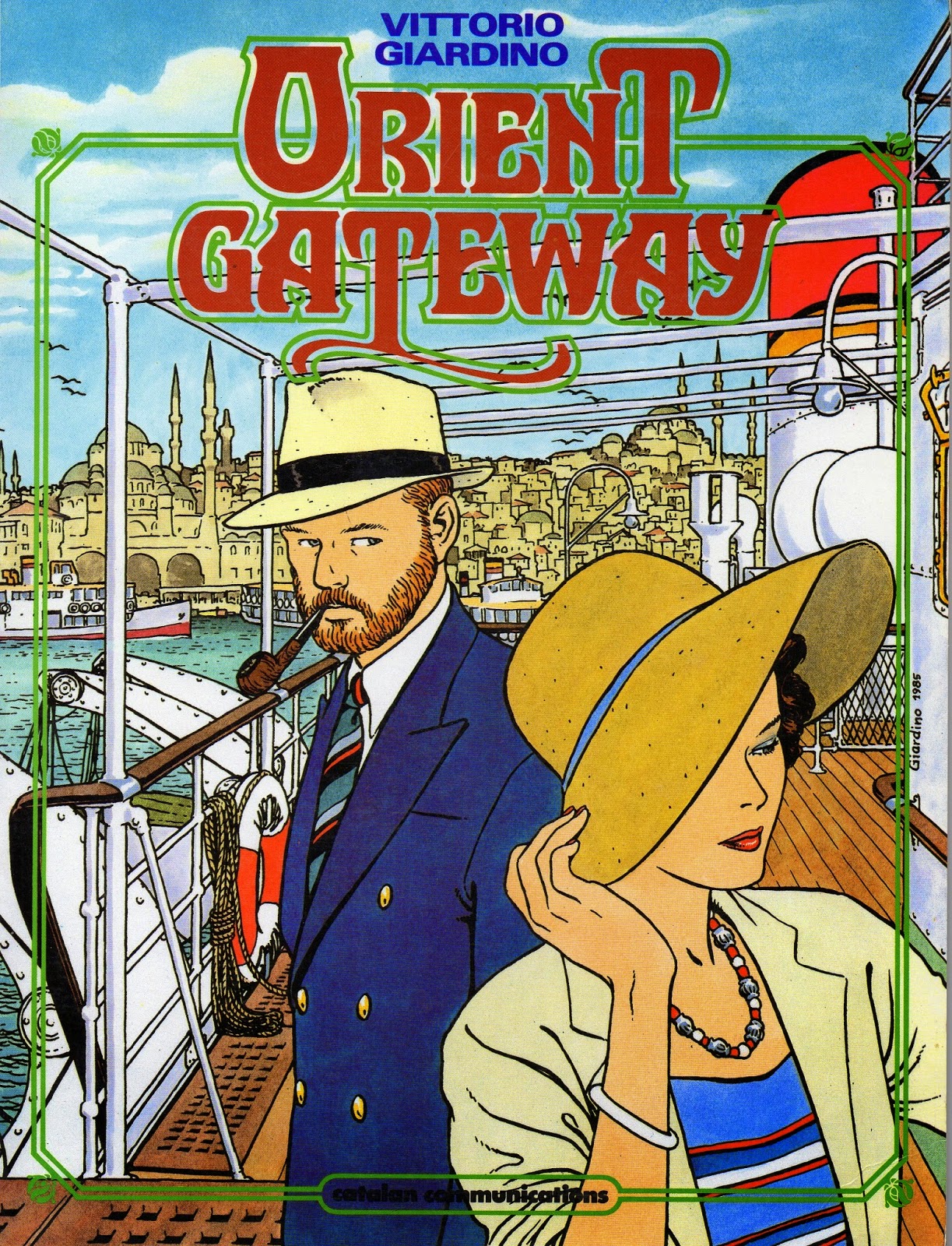
FFB - Hungarian Rhapsody & Orient Gateway

Four years separate these two graphic novel stories by Vittorio Giardino (original publication dates 1981 and 1985, then later translated from the Italian), but the quality of Giardino’s artwork doesn’t differ – it’s a joy to look at. Both books feature Max Friedman, a former spy who becomes embroiled in the secret machinations preceding the Second World War.

HungarianRhapsody (89 pages, 1986) begins with a quotation from Graham Greene: ‘Danger was a part of him. Not like a coat that one gets rid of from time to time, but like skin. One dies with it.’ The story leads up to Hitler’s Anschluss in 1938. Friedman is blackmailed into helping ‘The Company’ to discover the Abwehr’s undercover strategy in Budapest. Pipe-smoking Friedman is a sympathetic, realistic character: this hero actually has the shakes after a shooting or bombing incident – such mortality is endearing. Gradually, as we and Friedman get sucked into the plot, encountering double-agents and provocative people, it is obvious that Friedman is being manipulated. The reason why is kept concealed convincingly until the end. He becomes romantically involved with the only survivor of a secret cell, Ethel, who slowly transforms from a timid, freckled bespectacled pawn into a sensual, brave yet vulnerable woman. Perhaps other characters possess less depth, exhibiting the stereotypical traits of 1930s/1940s villains, but the air of menace they engender is almo0st palpable. Indeed, the only wood to be seen is either the furniture or the trees: the physical movements of all the characters is fluid, their dialogue is generally realistic. Inevitably, because of the obligatory plot-twists and double-crossing, the plotline is complex for an illustrated story.


Written and illustrated by Giardino, it’s obvious that the artist only uses text where necessary, to add either character or plot; the pictures say a lot without words; indeed, panel captions are a scarcity, employed merely to denote time-shifts or scene changes; words are often not needed to create mood, for the detailed artwork, vital facial expressions and hand mannerisms, complemented by superb colouring amply supply the appropriate ambience. Attention to detail is outstanding without dominating the story; all the clothes, vehicles and buildings seem to be of the period, while the colouring is rich and varied, even to the intricate patterns of carpets!

The sequel, Orient Gateway (61 pages, 1987) is also set in 1938 and involves the Russian NKVD’s search for one of their engineers, Stern, who has absconded and is hiding in Istanbul. Friedman is mistaken for a French spy and is sucked into the intrigue. Beautiful Magda Witnitz seems to be entwined in the plot too, and provides him with romantic interest and an additional problem: is she for or against him? Throughout, Friedman maintains a calm cynicism: he only trusts himself, though he does admit to starting to trust Magda…
 
The details of the old Istanbul are as eye-catching as the earlier Budapest, and repay study. The gallery of exotic characters encountered suggest that Friedman’s cynicism wasn’t misplaced: few people are what they seem. But even Friedman discovers that in power-politics there are depths still to be plumbed.

In their subtle way these two stories seem to be saying that the loss of innocence began with the build-up to the Second World War. Though interestingly, perhaps it goes back to 1936 – Giardino has also produced a three-volume graphic novel about Friedman in the Spanish Civil War, NoPasaran!

If you appreciate good illustration, you’ll enjoy these books. They’re virtually story-boards for films, but more detailed.

Monday, 1 December 2014

Writing – self-edit – over-used words

I’m currently re-editing a novel that’s due to be published early next year.

The new version of Word makes this easier – and more alarming – than before.

Using the search facility, I can discover how many times I’ve used particular words. We all have words we tend to over-use, and it’s quite easy to gloss over their frequent usage in an entire piece of work. In my years as editor, I’ve encountered a number of common words and outlined some of these in my book Write a Western in 30 Days (p152).

Here is a list of words I’ve searched for and discovered that I’ve over-used. In many instances, the word probably can be dispensed with entirely; in other cases, it should be replaced; in some situations, it must stay to do the job intended.

Suddenly – this slips in so easily; all of a sudden, it's there.

Down – really, deep down, most instances of this can be excised; at least cut down on the use of this one.

Up – again, the same as ‘down’, often in the same paragraph… Look them up and you’ll be surprised…

Out – not often necessary, or use an alternative word or phrase; cut out as many as you can.

In – the same as ‘out’, the word sidles in without knowing…

Just – these just keep sneaking in, too, suddenly, it seems; most can be excised. Most often just used in speech – but don’t overdo that too.

Began to – this is passive; act now and use an active variant!

Grinned – you have to laugh at how often this occurs; excise, or find another mannerism.

Laughed – don’t grin and bear it, make sure it is appropriate; often the dialogue conveys the humour/laughter anyway.

Sighed – see my blog of 2 October 2013 to size up this one…
 
Chuckled – an alternative, but also overdone.
 
Smiled – often used as a speech attribution, as is ‘sighed’, ‘laughed’, ‘chuckled’ and ‘grinned’ – wrongly, since you can’t speak and make those facial actions at the same time; it’s shorthand for lazy writers, meaning ‘I wanted to say that he laughed,’ he said and smiled – not, ‘I wanted to say that he laughed,’ he smiled.
 
Shrugged – a useful gesture, but perhaps overdone; seek other gestures, perhaps?
 
Nodded – oh, yes, this crops up a lot, and I’ve been tempted to give the nod to some instances, but generally excise 50% - let the speech or mannerism convey the nod.
 
Shook – often hands are shaken (not stirred), but it can be other body parts; are they all necessary (the use of ‘shook’/’shake’, not the body parts)?

Snapped – another useful term, but have a care as its strength can be diminished if over-used.

Back – I keep coming back to this one; I see it in the same paragraph and repeated frequently on the same page. I have to be ruthless with this, and tend to cut back quite a few of them!
 
Good luck.
 
 
From Amazon UK - here
 
From Amazon COM - here


Book review - Ice Cold

Continuing the espionage theme, Ice Cold is a new anthology of fresh short stories written by twenty members of the organisation Mystery Writers of America. It may even be considered timely to have written tales of intrigue around the Cold War; the prospect of a new version of that clandestine conflict seems imminent. As you’d anticipate, these stories deal with psychological warfare, the paranoia of the times, sleeper agents, sabotage, honey traps, and the usual paraphernalia and venues familiar to readers of espionage thrillers over the last fifty-odd years. (More or less what my Tana Standish series is attempting to do, beginning with The Prague Papers; end of plug - and plug at end).

Jeffery Deaver (co-editor) starts the ball rolling with ‘Comrade 35’, a neat exposé about the Kennedy assassination; it’s in his inimitable style, well researched, believable and with a neat twist, as you’d expect.

None of the stories are duds, though for me some resonate more than others. The writing team of Lynds and Sheldon heartbreakingly evoke a grim image of East Germany under the brutal heel of the dreaded Stasi in ‘A Card for Mother’. Sara Paretsky’s ‘Miss Bianca’ is a little girl’s perspective on research into germ warfare, cleverly told.

In ‘Crush Depth’ Brendan Dubois brings a fresh insight into the loss of the Thresher submarine, while T. Jefferson Parker exposes in ‘Side Effects’ the dangers of mind-altering drugs that were often used to subborn individuals.

Other authors included are: Gary Alexander, Raymond Benson (co-editor), Alan Cook, Vicki Doudera, Joseph Finder, JA Jance, John Lescroart, Katia Lief, Laura Lippman, Robert Mangeot, Katherine Neville, Jonathan Stone, Gigi Vernon, Bev Vincent and Joseph Wallace.

The uprising in Hungary is dealt with, and its repercussions, as is the fall-out of the Vietnam War. Religion, patriotism and romance are all affected by the looming shadow of the Cold War and brilliantly conveyed within the pages of this selection.

If you’re interested in good short story writing, this is worth reading. If you’re into Cold War fiction, you won’t be disappointed, though I think they could have found a better book title and cover design.
 

Please purchase from
Amazon UK here
Amazon COM here