Search This Blog

Showing posts with label Graham Greene. Show all posts

Monday, 26 May 2025

THE HEART OF THE MATTER - Book review

Graham Greene’s novel The Heart of the Matter was published in 1948. It became an instant best-seller and has been reprinted many times and won awards and high praise.

In 1926 Greene was received into the Roman Catholic Church and, not surprisingly, several novels of his deal with characters bound by that faith. Major Scobie, the police chief of a flyblown West African colony during the Second World War, is one such.

Inspector Wilson is a new arrival: ‘He was like the lagging finger of the barometer, still pointing to Fair long after its companion has moved to Stormy’ (p11). Wilson shares accommodation with Harris and there’s an amusing episode where the pair start a cockroach hunt – The Cockroach Championship – to alleviate boredom (p70).

Scobie has been here for fifteen years and feels comfortably bound to the place. ‘Why, he wondered, swerving the car to avoid a dead pye-dog, do I love this place so much? Is it because here human nature hasn’t had time to disguise itself?’ (p35).

Unfortunately, his rather faded wife Louise wants to have a break, to go away on holiday. Scobie feels guilty that Louise is not happy. The bank won’t lend Scobie the money as his salary is not generous and, indeed, he has just been passed over for the post of Commissioner. In a moment of weakness, he accepts a loan from a local Syrian merchant, Yusef, who is a known black marketeer though no proof has ever been found. ‘He never reaches the freezing-point of knowing absolute failure. Only the man of goodwill carries always in his heart this capacity for damnation’ (p60).

While Louise is away in South Africa Scobie begins a clandestine affair with a refugee from a sunken transport ship, a young widow, Helen. He is aware he is committing the grave sin of adultery. He argues it is not a sin, it is love. And doomed.

There are several themes: guilt, sin, avarice, blackmail, deceit, love and trust. ‘Trust was a dead language of which he had forgotten the grammar’ (p264).

As the book blurb indicates, ‘inexorably, his conscience and his love of God lead him to disaster’.

There are too many examples of Greene’s prose imagery to note here, but the following are examples:

‘There was nothing to be read in the vacuous face, blank as a school notice-board out of term’ (p55).

These two, among many other insights in the book, suggest he drew upon his time as an Intelligence Officer in Freetown, British Sierra Leone:

‘The mosquitoes whirred steadily around them like sewing machines’ (p112). ‘... a mosquito immediately droned towards his ear. The skirring went on all the time, but when they drove to the attack they had the deeper drone of dive-bombers’ (p122).

‘Only the vultures were about – gathering round a dead chicken at the edge of the road, stooping their old men’s necks over the carrion, their wings like broken umbrellas sticking out this way and that’ (p230).

Editorial comment:

I’ve brought this up before; something that editors don’t spot: the tendency for writers to state a character thought to himself or herself. This really is tautological.  ‘He thought’ is adequate; ‘to himself/herself’ is superfluous.

‘He thought to himself, poor Louise’ (p17). Also on p53...

Tuesday, 21 March 2023

THE HUMAN FACTOR - Book review


Graham Greene’s 1978 novel The Human Factor is a gripping and believable story about spies without gunfire and hectic action, but plenty of suspense, tension, intrigue and perfect characterisation. 

Maurice Castle is an aging agent in MI6, working in the African section with a younger man, Davis. His new boss is Daintry who has been brought in to review various sections as a leak is suspected. Castle was previously deployed in apartheid South Africa where he fell in love with one of his black agents, Sarah. When his relationship was about to become an embarrassment he fled with her, aided by local Communist Carson. Now working in London, Castle is married to Sarah and has adopted her young boy fathered by another.

Gradually, as the investigation into the supposed leak ensues, suspicions fall upon young Davis… It would be unreasonable to reveal more.

The sleight-of-hand of the people involved, such as C himself, Sir John Hargreaves, and the firm’s creepy doctor Percival provide suspense and tension. The arrival of Cornelius Muller, a powerful man in South Africa’s BOSS, assigned to liaise with Castle on the secret operation Uncle Remus adds drama, since Muller had known Castle in South Africa. Loyalties are questioned; everything is not what it seems; and the morality of Castle’s seniors are decidedly dubious. All the characters are rounded, and seemingly flawed – that is, very human.

Intriguingly, Davis, a tippler, tends to mix his whiskies, notably White Horse and Johnnie Walker: ‘You know, this blend of mine tastes quite good. I shall call it a White Walker. There might be a fortune in the idea – you could advertise it with the picture of a beautiful ghost…’(p66) I wonder if George R. R. Martin stumbled on that moniker when creating his Game of Thrones (1996)?

Greene wanted to get away from the violence and action depicted in popular espionage fiction; in his experience the real thing was more down-to-earth, though doubtless treacherous, and slightly sleazy. After attending a funeral, Daintry has a drink or two with a few people he’d met at Sir John’s house party. Daintry is quizzed about his work: ‘one of those hush-hush boys. James Bond and all that.’ Another states ‘I never could read those books by Ian.’ Another reckons the books were ‘too sexy for me. Exaggerated’ (p165).

This is a book about sacrifice, disillusionment, and love. Greene’s eye for detail, the telling mannerisms, and the secret world’s manipulation of people are laid bare, uncomfortably so. This is as good as any John Le Carré novel.

Editorial note

We writers are advised not to use character names that begin with the same letter or seem or sound similar. I can’t see why Greene was fixated on similarities of names: Castle and Carson. Then there was another ‘c’ – Cynthia, the secretary Davis pines for. Not that it affected the story at all. So much for advice to writers, hm?

Tuesday, 1 November 2016

Spies and more spies


Last night BBC4 TV aired the final part of Andrew Marr’s series on genre paperback fiction – Sleuths, Spies and Sorcerers. (See my earlier blog here).


This time it was the turn of the spies.

We visited Berlin, the remnants of the Wall, the prison where betrayed agents were incarcerated and tortured physically and mentally, and glimpsed old images of traitors such as Blake and Philby. All grist to the mill for John Le Carré’s breakthrough novel The Spy Who came in from the Cold. An old interview revealed that he wasn’t surprised that no communists liked his spy tales!

Another interview was with Frederick Forsyth; we’re shown film clips from The Day of the Jackal, whose protagonist was not a spy but an assassin; the point was that both Le Carré and Forsyth, along with several other scribes of this genre had some background in intelligence work. One of the first of these was Somerset Maugham (notably Ashenden), who confessed that looking back on his fiction he found it difficult to separate fact from fiction in his work.
 Maugham's Ashenden

Perhaps too much attention was given to the (admittedly interesting) William Le Queux’ popular sensationalist novel The Invasion of 1910 (1906) regarding a fictional account of a German armed invasion of Britain. The furore following its publication prompted the setting up of a British secret intelligence department, The Secret Service Bureau headed by Mansfield Smith-Cumming in 1909.

Other interviewees were Stella Rimington, a former director general of MI5 and author of the MI5 officer Liz Carlyle books, author Charles Cumming who has written eight spy novels since 2001, an early snippet from Len Deighton, and William Boyd who wrote a new Bond novel, Solo (reviewed here.

Other authors who are examined include (inevitably) Ian Fleming, Gerald Seymour, John Buchan, Graham Greene, and Eric Ambler, with intriguing interpretations and motivations.

Quite rightly, Marr states that he is annoyed at the literary snobbery with regard to spy fiction and genre fiction in general. It’s as if being “popular” is anathema.

At their best, spy novels delve into the dark recesses of the human condition, examining the repercussions of betrayal, corruption and deceit. 

Despite the high-tech surveillance in the present, there is still a place for the human spy.

As in the earlier two episodes, there were bound to be some deserving authors omitted, among them Adam Hall (Elleston Trevor), author of the Quiller books, Erskine Childers (The Riddle of the Sands), Dennis Wheatley (Gregory Sallust novels), Helen MacInnes, Alan Furst, David Downing, Desmond Cory (Johnny Fedora series), Colin Forbes (Tweed series), John Gardner (Railton family series, Bond), and Craig Thomas (Aubrey & Hyde series), among others!

The programme is re-broadcast on BBC4 TV tomorrow, Wednesday evening. The series is also linked to the Open University - see here
where you can 'dig deeper into crime, fantasy and spy fiction'...


Friday, 5 December 2014

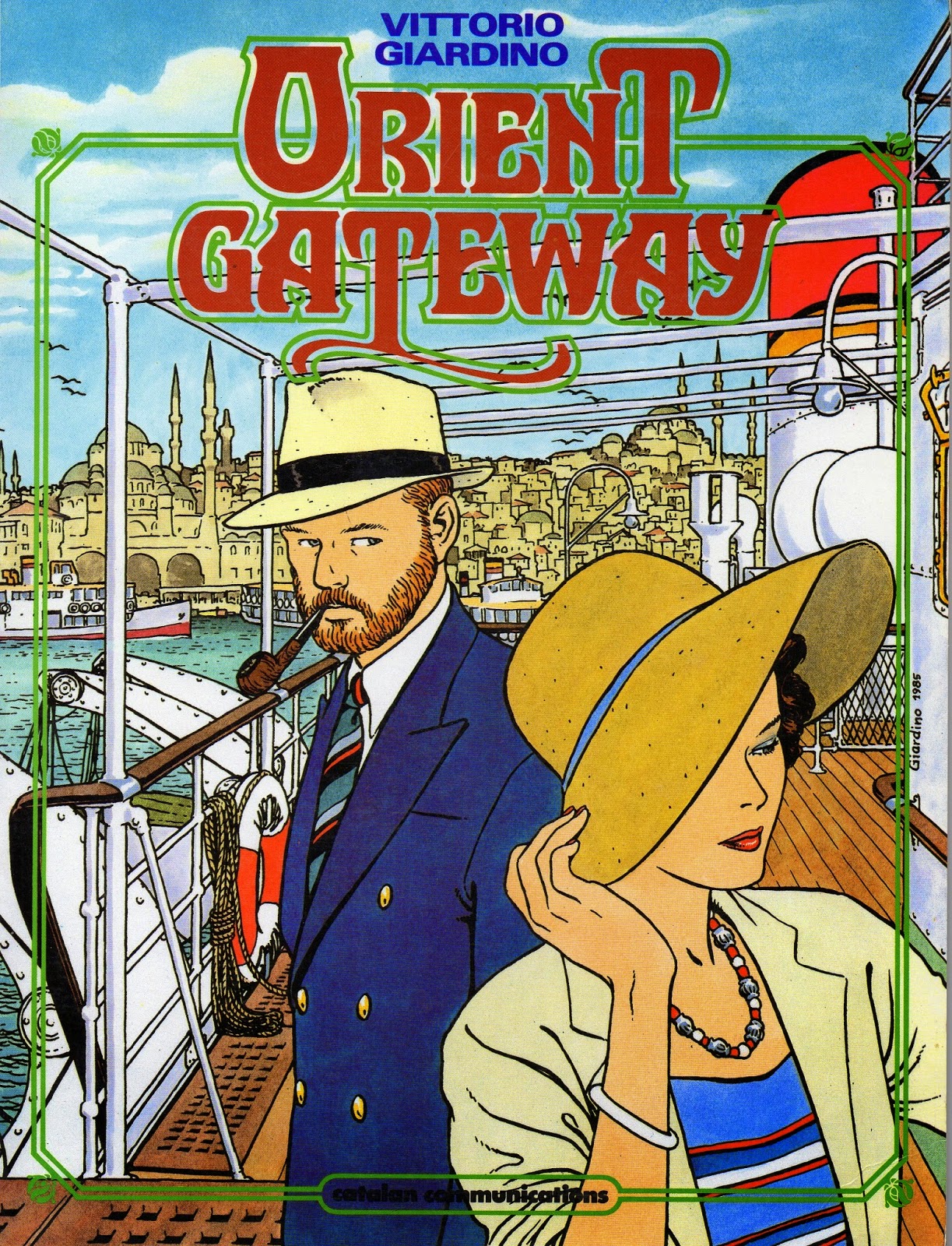
FFB - Hungarian Rhapsody & Orient Gateway

Four years separate these two graphic novel stories by Vittorio Giardino (original publication dates 1981 and 1985, then later translated from the Italian), but the quality of Giardino’s artwork doesn’t differ – it’s a joy to look at. Both books feature Max Friedman, a former spy who becomes embroiled in the secret machinations preceding the Second World War.

HungarianRhapsody (89 pages, 1986) begins with a quotation from Graham Greene: ‘Danger was a part of him. Not like a coat that one gets rid of from time to time, but like skin. One dies with it.’ The story leads up to Hitler’s Anschluss in 1938. Friedman is blackmailed into helping ‘The Company’ to discover the Abwehr’s undercover strategy in Budapest. Pipe-smoking Friedman is a sympathetic, realistic character: this hero actually has the shakes after a shooting or bombing incident – such mortality is endearing. Gradually, as we and Friedman get sucked into the plot, encountering double-agents and provocative people, it is obvious that Friedman is being manipulated. The reason why is kept concealed convincingly until the end. He becomes romantically involved with the only survivor of a secret cell, Ethel, who slowly transforms from a timid, freckled bespectacled pawn into a sensual, brave yet vulnerable woman. Perhaps other characters possess less depth, exhibiting the stereotypical traits of 1930s/1940s villains, but the air of menace they engender is almo0st palpable. Indeed, the only wood to be seen is either the furniture or the trees: the physical movements of all the characters is fluid, their dialogue is generally realistic. Inevitably, because of the obligatory plot-twists and double-crossing, the plotline is complex for an illustrated story.


Written and illustrated by Giardino, it’s obvious that the artist only uses text where necessary, to add either character or plot; the pictures say a lot without words; indeed, panel captions are a scarcity, employed merely to denote time-shifts or scene changes; words are often not needed to create mood, for the detailed artwork, vital facial expressions and hand mannerisms, complemented by superb colouring amply supply the appropriate ambience. Attention to detail is outstanding without dominating the story; all the clothes, vehicles and buildings seem to be of the period, while the colouring is rich and varied, even to the intricate patterns of carpets!

The sequel, Orient Gateway (61 pages, 1987) is also set in 1938 and involves the Russian NKVD’s search for one of their engineers, Stern, who has absconded and is hiding in Istanbul. Friedman is mistaken for a French spy and is sucked into the intrigue. Beautiful Magda Witnitz seems to be entwined in the plot too, and provides him with romantic interest and an additional problem: is she for or against him? Throughout, Friedman maintains a calm cynicism: he only trusts himself, though he does admit to starting to trust Magda…
 
The details of the old Istanbul are as eye-catching as the earlier Budapest, and repay study. The gallery of exotic characters encountered suggest that Friedman’s cynicism wasn’t misplaced: few people are what they seem. But even Friedman discovers that in power-politics there are depths still to be plumbed.

In their subtle way these two stories seem to be saying that the loss of innocence began with the build-up to the Second World War. Though interestingly, perhaps it goes back to 1936 – Giardino has also produced a three-volume graphic novel about Friedman in the Spanish Civil War, NoPasaran!

If you appreciate good illustration, you’ll enjoy these books. They’re virtually story-boards for films, but more detailed.

Wednesday, 23 October 2013

Blog guest – Charles Ameringer – ‘more than a grain of truth’

Today, my blog guest is Charles Ameringer. Charles is professor emeritus of Latin American history at Penn State University and a former captain in the USAF Reserve. Before beginning his teaching career, he served as an intelligence analyst in the U.S. Department of Defense.
 
His book The Old Spook is a spy/detective novel about a burned out CIA operative Tom Miller that morphs Richard Burton (Alec Leamus) into Humphrey Bogart (Sam Spade)—and back again! A tale of espionage and sleuthing that engages the reader in the culture and tradecraft of the CIA and the dilemma of government secrecy in a democratic society.  The novel begins with a flashback of the old spook’s career that reveals the stress of shady dealings with sinister characters and transports the reader to such places as Mexico, Guatemala, Costa Rica, Bolivia and Chile. Miller has hair-raising encounters with the Russian agent who recruited Lee Harvey Oswald and meetings with Miami Mafia figures. He’s involved in several plots to assassinate Fidel Castro.

In the wake of the Watergate scandals and Jimmy Carter’s purging of the clandestine services, Miller takes forced retirement.

Not ready to call it quits, however, he goes home to Milwaukee where he opens a detective agency and takes on a missing-person case that unwittingly puts him on the trail of a Mafia hit-man. This case gains the attention of Detroit crime bosses and the CIA itself and then there’s an attempt on his life…

The novel covers the 1950s to the 1990s and plenty of names are dropped – Dulles and Helms of the CIA, the Kennedys, Guevara, the missing union boss Jimmy Hoffa, the Mafia chieftains Sam Giancana and Johnny Roselli, Oliver North et al. In the style of Upton Sinclair and Herman Wouk, the fictional Tom Miller interacts with actual events and personalities to provide an entertaining and intriguing read.

All author royalties will be donated to the Wounded Warrior Project.

Review

The fictional Tom Miller interacts with actual events and personalities through recent history played out on the global stage. Often, it reads as though Miller was there, liaising with shady wheelers and dealers in South and Central America.

If you have any recollection of some of these events, you’ll soon begin to wonder if this fictional account contains much more than a grain of truth. Fans of John Le Carré, Len Deighton and Charles McCarry will enjoy this revelatory novel. - Pastimes Costa Blanca magazine, May 2012.
 
Charles Ameringer
 
Q & A

This is your debut fiction book. When you were writing your non-fiction works, did you ever hanker after writing fiction at the time?

No, not really.  I was thoroughly committed to the methodology of the History discipline, that is, seeking empirical evidence and striving to relate events as accurately as possible.  At the same time, I always tried to write well, in order to be stylistic and literary.  After I retired, I had the urge to combine that creative instinct with imagination.  Inspired by Upton Sinclair’s Lanny Budd series and Woody Allen’s “Zelig,” I did so by placing a fictional character at the scene of historical events as they were happening.  Drawing on my experiences as a professor travelling abroad to interview persons of interest and conduct archival research, I created a CIA operative to go where I had gone and meet with whom I had met, only at another time and under different circumstances.     

Charles, I suspect that the character of Tom Miller has been bouncing around in your head for a number of years. Can you tell me when you first decided to write about Tom?

It’s true that he had probably been there for some time, and popped into my consciousness after I finished my last scholarly work in 2009.  Although an octogenarian and retired, I still had the urge to write, but I wanted to free myself of methodological restraints and have some fun (although there is absolutely no distortion of factual material in The Old Spook).  Tom Miller is essentially my alter ego.  As noted, he retraces my steps, but only to provide authenticity to the places he goes and people he meets.  Many novels are autobiographical in nature.  For example, Ernest Hemingway was an ambulance driver in Italy during the First World War, providing the template for Frederic Henry in A Farewell To Arms.  As a result, such novels are unique; there is none other like each and there never can be.     

Your book reminds me of Richard Pape’s Arm me Audacity, because when I finished that I really wondered if the narrative was true. Obviously, you feature real people and the big events you relate were true – but are you able to enlighten us as to how much of the double-dealing and political chicanery actually occurred?

As you say, the big picture is a factual account, being based on the extensive research I completed for my non-fiction study, U.S. Foreign Intelligence: The Secret Side of American History, which David Kahn (The Codebreakers) describes as “one of the first and one of the best surveys of American foreign intelligence.”  Tom Miller’s presence at these events is the product of my imagination, but his specific actions in no way alter the truth of what was occurring around him.  As Dean Andrade, the host of the “Milwaukee Authors” website, writes in his review of The Old Spook: “I really enjoyed the blend of real history with fiction, with a story that weaves together famous names and events—the Bay of Pigs, Che Guevara, the Kennedy assassination, Jimmy Hoffa, Oliver North, Aldrich Ames, and much more—all told with sharp historical accuracy and keen insight.”  However, there is a story within the story; the novel is divided into three parts and Part Two, “Where’s Aldo?” is pure fiction.  None of what occurs there is true, which may explain why it’s the most exciting portion of the book, given that Tom’s character enjoys a free rein.  Still, it wouldn’t make sense without the context of the truthful double-dealing detailed in the other parts.  Nor, is this to suggest that the other parts of the novel are lacking in thrills and suspense; as the popular author Debra Hartmann states in her review, “A great read, entertaining and powerful, a story that leaves you constantly on the edge.”          

You definitely gave The Old Spook a sense of place. Do you think this is important in fiction, and why?

Combining the places where I lived and worked with my travels as a professor engaged in research, I sought to give Tom and the reader a “real feel” of the venues in the novel   Perhaps it’s the teacher in me, but I think a work ought to be informative; if you’re going to take the reader to the campus of the National University of Mexico, for a drink in La Floridita in Havana, a stay in a pensión in San José, Costa Rica, or a trek to the copper mine in Chuquicamata, Chile, you are obliged to make it as realistic as possible.  To have been there helps, although some place descriptions may be unavoidably second-hand.. 

I believe your wife is a strong support in your writing. How do your family/friends feel about your switch to fiction?

Initially, my wife and sons were sceptical when I put on my novelist’s hat, but subsequently were quite sincere in saying that they really liked the novel and wondered “if we have a grandma Moses phenomenon here.”   However, my sons were a bit taken aback by my use of obscenities in the text, but I explained that it wouldn’t do to clean up the language of the fictional Mafia hit man Jack Aldo, a central figure in the story.  .      

You’ve just celebrated your 87th birthday and I know that time marches on. Do you have plans for another fiction book, or do you feel you’ve said all you needed to say in The Old Spook?

I don’t intend ever to stop writing and I have a number of ideas in mind.  Right now, I’m toying with a story about a freshly-minted assistant professor coping with a Berkley-inspired campus movement during the 1960s. 

A tall order, I know, but what is your favourite book? And why?

It is a tall order, but I think it’s Graham Greene’s Our Man in Havana.  In my opinion, there’s no place as fascinating as Old Havana (pre-Fidel, that is), which Greene portrays beautifully, and it’s a whimsical and tragic tale of an unwitting screw-up that somehow fate permits to end well.    

Where can readers find you?

You can find me on Facebook, Goodreads, and Amazon.com
and The Old Spook on the following links:
Amazon.com = http://goo.gl/J8S403
Amazon.co.uk = http://goo.gl/IO3tKt
 
Thank you, Charles.

Books by Charles Ameringer:

The Democratic Left in Exile: The Antidictatorial Struggle in the Caribbean, 1945-1959  

Don Pepe: A Political Biography of José Figueres of Costa Rica 

Democracy in Costa Rica 

U.S. Foreign Intelligence: The Secret Side of American History

The Caribbean Legion: Patriots, Politicians, Soldiers of Fortune, 1946-1950

The Cuban Democratic Experience: The Auténtico Years, 1944-1952 

The Socialist Impulse: Latin America in the Twentieth Century