Search This Blog

Showing posts with label art. Show all posts

Friday, 13 October 2023

BATMAN SON OF THE DEMON - Book review


This 78-page graphic novel was published in 1987. Written by Mike W Barr and illustrated by Jerry Bingham.

A terrorist attack on the Gotham chemical plant is underway. Two hostages have been taken. This is a job for Batman. There’s an intense fight, and Batman is wounded. He recovers consciousness in the Bat-cave – with Talia Al Ghul in attendance. A madman called Qayin needs to be stopped – and Talia’s father R’As Al Ghul has personal reasons to get involved.

The Al Ghuls and Batman join forces and all mayhem is let loose. Talia is a previous love interest of Bruce Wayne; she knows his secret. Their relationship becomes strengthened as they begin to track down Qayin and his men.

There are a few amusing if familiar asides, for instance: Bruce insists on donning his costume even though still recovering from a bullet wound. Talia says, ‘You can be most exasperating at times.’ And Alfred simply says, ‘Indeed.’ (p16).

Bingham’s artwork is clean, slick and fast-paced with plenty of action – and explosions! This is good storytelling in pictures.

A fine addition to any Batman fan’s collection. 

Tuesday, 11 April 2023

The Art of Robert McGinnis - Overview of book


Over the years, I’ve bought quite a few art books featuring a variety of artists and illustrators. This is a recent acquisition to add to that visual library – published by Titan Books in 2014, text by (appropriately) Art Scott. 


McGinnis has been around a long time, born in 1926, and has produced a remarkably varied body of work, whether featuring femmes fatales, heroic characters from history, stunning scenery, animals and transport, he is a master of all. 


Sumptuous illustrations, the majority in full colour, are featured in a number of sections: Seven decades of McGinnis book covers; the movies (posters etc); magazine illustrations (The Saturday Evening Post, Men’s magazines and National Geographic; McGinnis’s West; Gallery art, mostly nudes; and Landscapes.


There’s a four-page introduction, an interview covering another four pages, then each pictorial section is introduced briefly. 


If you appreciate good art, then this is a book for you.

Friday, 20 January 2023

FOLLY - Book review

Alan Titchmarsh’s 2008 novel is a romantic story set across generations with a couple of twists.

He’s done this time-jumping before; it’s always a risk: maybe the reader will get confused or even lost. Here, it works well enough. The story begins in 2007 and concerns two long-established businesses in Bath – the Ballantynes and the Kings – both involved in the sale of artwork.

We fleetingly meet Jamie Ballantyne during an auction of some famous paintings, and Artemis (‘Missy’) King. He’s selling, she’s buying. They’d been friends for a long time and then she went off to the US and stayed for five years.

Then we step back into Oxford in 1949. There are four art students who go around together: the rich Honourable Leo Bedlington; John (‘Mac’) Macready, a Glaswegian; Harry Ballantyne; Richard King; and Eleanor Faraday. Both Harry and Richard desired her but neither did anything about it.

Jamie mulled about Missy and her appreciation of the painter Munnings. ‘Where dogs craved affection and cats demanded respect, horses inspired admiration and awe, and any artist who could catch their spirit seemed to her to be peerless. (p76).

In 2007 Missy’s grandfather is Richard and Jamie’s is Harry. Neither knows why, but their grandparents have been at loggerheads for almost sixty years! Nobody talks about it. Jamie’s mother has a streak of common sense to her: the feud’s ‘origins are lost in the mists of time and I think everyone would be better diverting their energies into today, rather than yesterday’ (p271). If only the ‘woke’ who want to rewrite history would listen!

Jamie and Missy reawaken their previous attraction and indeed fall in love. Yet the family feud threatens to confound them.

Skipping back and forth through time, we see how chances are lost, love is not reciprocated, and indeed the reader becomes irritated at the folly of these people who are incapable of revealing their true feelings. Except for Mac; he did just that, with disastrous results!

The descriptions of the period, the art world and the countryside sometimes verge on the poetic and at other times Titchmarsh delivers humour: ‘It seemed as if his inquisitor was in danger, at any moment, of bursting out of his clothes and sending buttons flying to the four corners of the book-lined room. All three chins wobbled as he made his point, and his cheeks were the colour and shade of Worcestor Pearmain apples… (p219).

The final twist was a mite too convenient but clearly Titchmarsh wanted to avoid an unhappy ending! An enjoyable novel, nevertheless.

I blame the editor:

When there only two characters in a scene, there is little need to constantly repeat their names to show who is speaking. In most cases, it will be obvious by what is being said. Also, ‘he said’ and ‘she said’ is adequate. There are a few instances of this issue; and one can be found on page 175.


Friday, 11 February 2022

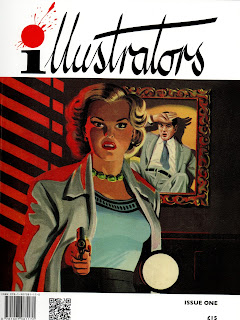
Illustrators Quarterly Magazine - #1


The ongoing series of quarterly perfect-bound full colour magazines began with this issue in 2012.

Anyone interested in illustrating art will cherish these magazines.

This issue features a lengthy article about Denis McLoughlin – 44 pages lavishly illustrated with his often gritty book covers. McLoughlin mainly concentrated on hard-boiled crime but also westerns, including the Buffalo Bill annuals I recall from my childhood. Indeed, McLoughlin, who hailed from Bolton, Lancashire, was so knowledgeable about the Old West that he produced The Encyclopedia of the Old West (original title Wild and Woolly) in 1975: a veritable mine of information!

There follows 22 pages of an interview with artist Ian Kennedy. Again, every page features samples of his comic illustrations and paintings, notably from the Commando comics that have been around since 1961. An outstanding artist, sadly missed (he died 5 February this year).

Next is a feature on the ‘Alluring Art of Angel Badia Camps’, one of a host of Spaniards who began plying their trade in Britain to good effect in the 1960s. We get fifteen pages of samples of his work from the covers of romantic fiction and women’s magazines; distinctive, atmospheric and colourful.

Two regular features are: The Gallery and The Studio. For the Gallery there are six pages of ‘the Fin de Siècle Erotica of Cheri Herouard’. He illustrated the covers of La Vie Parisienne, but also posters, postcards and menus. The Studio features Mick Brownfield’s iconic Christmas cover of the Radio Times in 2009 with Santa and a Dalek. The end pages consist of art-book reviews and contact details for art supplies, illustrators, museums and other related subjects.  

Copies of most back issues are still available, many at reduced prices.

It’s published by The Book Palace and can be obtained through their website www.illustratorsmag.com. Back issues can also be obtained from www.booksaboutart.co.uk.

The Book Palace also issues, from time to time, special issues on certain illustrators, and most of these are destined to become collectors’ pieces.

Tuesday, 8 February 2022

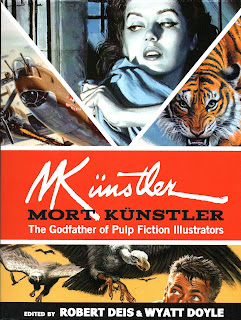
Mort Kunstler - The Godfather of Pulp Fiction Illustrators

Mort Künstler – The Godfather of Pulp Fiction Illustrators

Edited by Robert Deis & Wyatt Doyle


My daughter bought this for me for Christmas.

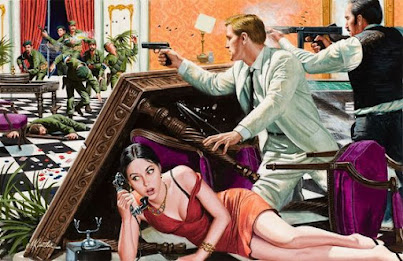
There are 110 pages; the first ten comprise illustrated text – reminiscences by Mort about how he got into the illustrating business. For many years he’d turn out three covers and two interior illos for men’s adventure magazines. He also worked for other publishers at the same time, ‘twelve-hour days, fifteen-hour days, sometimes seven days a week.’

The remaining pages are full colour full page paintings full of action from magazines between 1952 and 1972. He also produced lots of film posters for adventure films such as The Poseidon Adventure and The Hindenburg, as well as advertising promotions and then broke into historical paintings for The National Geographic.

He relates that the word 'künstler' means ‘artist’ in German.


If you appreciate art, this book is an excellent addition to your collection.

Tuesday, 16 January 2018

Book review - WONDER WOMAN – The art and making of the film


Titan Books has produced yet another lavish offering. This is a big book - 27.9 x 2.2 x 31.1 cm and a weighty 192 full-colour pages. Written by Sharon Gosling, foreword by Patty Jenkins, director.


If you’ve seen the film, you might want to own this book. If you haven’t seen the film, this tells you a great deal – through pictures and words! – about the film without providing too many spoilers. Certainly, we could have done with more text (though what is there is enlightening), but it's clear that the writer and company have gone for the credo 'a picture is worth a thousand words' - and it works well enough.

The layout is broken down into various parts: Themyscira features short chapters on the design of the island, the armoury, the characters, the weapons and the exciting beach battle – all enhanced with anecdotes from the production team and artwork and stills. The Journey is a brief account of Diana’s departure from the island and the construction of the boat – a vessel that never in fact touched water, thanks to CGI wizardry. The final part is Man’s World with chapters about London recreated in 1918, Etta Candy, Steve Trevor, the villains, and the trench warfare, again enhanced with illustrations and movie stills.

Reading this book it’s obvious that Director Patty Jenkins found the film a labour of love, as did so many others involved. The palettes of colour were deliberately chosen – the bright shades for the Themyscira section, the sombre leached shades of Man’s World at war.

Like the film itself, this book is an excellent homage to the icon created in 1941, Wonder Woman.

***
See also 
http://nik-writealot.blogspot.com.es/2017/10/book-of-film-wonder-woman.html


Monday, 10 October 2016

Book review - Becky


E.V. Thompson was a very popular storyteller with over forty historical novels to his name. Becky was published in 1988.

Impecunious artist Fergus Vincent arrives in Lewin’s Mead, a slum area in Bristol in the early 1850s. He’s seeking a friend and mentor, Henry who lives there. Henry told him ‘A good artist is accepted wherever he chooses to work, but he must observe the rules there – their code. Break that code and he might as well pack up and leave.’

Fergus virtually trips over an urchin as he’s seeking his friend. Becky, the unkempt girl of about fourteen summers offers to take him to the attic room, informing him that Henry died from alcoholism, owing rent. On their way, Fergus is involved in an affray with the blackguard bully Joe Skewes and barely escapes, thanks to the intervention of Becky. The Skewes family will haunt his life for a long time afterwards…

With Becky’s aid, Fergus finds his friend’s abode, which is filled with drawings and paintings that will serve to pay for the outstanding rent. On an impulse, Fergus decides to rent the room himself.

Thompson immerses you in the story immediately, with plenty of colourful description and characterisation and humour. His landlady, Ida Stokes is a hard case but with a good heart. Becky soon realises that Fergus has considerable artistic talent when he quickly sketches her admiring some birds outside the attic window. This first sketch will become a much-prized painting much later. Becky is bold, irreverent and says what she feels. ‘You’ve drawn the me that’s inside. Not the me that other people see…. I’m not sure I like it.’

Having been invalided out of the navy, Fergus hasn’t a lot of money. That’s why he elected to live in this attic room, as it was cheap. He grasped the idea that he would sketch the people of the slums, those on the dockside and in the taverns, and perhaps he could earn enough to live off his efforts.

Gradually, he becomes accepted by the local populace, the police, and particularly Becky. There’s nothing untoward between him and the girl, but he does become very fond of her and sketches her a great deal. At one point, he comes into contact with Fanny Tennant, the daughter of an alderman and a teacher of poor children. Fanny becomes his champion, wanting him to succeed in his art. Unfortunately jealousy is aroused in Becky’s breast and problems arise. 

Throughout, Thompson presents the unpalatable but real situation for the slum dwellers. There are good souls who want to help, like Fanny. But it seems that the majority of the Bristol upper class would rather turn a blind eye. This is brought to a head when Fergus gets involved with the plight of a number of Irish immigrants who become prey to cholera. Women and children die, and they’re shunted out of the area, without much medical aid. Fergus recorded their harrowing ordeal with his sketches and managed to prick many a conscience.

The relationship between Fergus and Becky is fraught with obstacles, and their friends suffer too. There do not seem to be any easy answers; how do you pull yourself out of the slum environment and make something of your life? For able-bodied men, they could join the army or navy, but for the women, there was little hope. Thompson captures the despair and the injustice of the time. 

Here’s Fergus’s viewpoint as he approaches a pawn shop with one of his paintings: ‘There were many varied items offered for sale, each one mute evidence of human failure, carrying price-tags that put a pathetic value on heartbreak and poverty. Wedding rings were here aplenty, with brooches and bangles. Few were of any great value, but most had meant far more than money to their late owners…’

The ending is not a happy one. Yet there is a sequel, Lewin’s Mead (1996) which returns to the travails of gutsy Becky in the slum. I have yet to read that, but the romantic in me hopes for a happy ending, even if real life at that time probably had very few of those.

E.V. Thompson can always be relied upon to tell a good tale, whether that's embedded in social deprivation or conflict. He died in 2012, aged 81.