Search This Blog

Showing posts with label Robert Harris. Show all posts

Sunday, 4 May 2025

CONCLAVE - Book review


Robert Harris’s novel Conclave was published in 2016 and became a ‘major motion picture’ in 2024. 

I haven’t seen the film yet but certainly enjoyed the book. Harris has a writing style which draws the reader in, no matter what the subject – and, let’s be honest his subjects have been remarkably varied over many novels.

When not employing the omniscient viewpoint we get 75-year-old Cardinal Jacopo Lomeli’s. He’s the Dean of the College of Cardinals in the Vatican and is responsible for organising the upcoming conclave following the recent death of the Pope.

There are 118 cardinals allowed to vote – that is, those who are under eighty years of age.  As is the case today following the demise of Pope Francis, there is a handful of front-runners who are likely to figure in the final voting.

Besides the concerns for the imminent conclave, there were worries about the reporting of the Holy Father’s death. ‘Once, God explained all mysteries. Now He has been usurped by conspiracy theorists. They are the heretics of the age.’ (p16).

Lomeli’s ‘guilty recreation was detective fiction.’ (p40). Certainly there are mysteries for Lomeli to tackle before the final vote and the white smoke is released to announce a new Holy Father has been selected. Lomeli is feeling his age, too. ‘Once, in his youth, Lomeli had enjoyed a modest fame for the richness of his baritone. But it had become thin with age, like a fine wine left too long.’ (p115).

The cardinals are locked in during the day to cast their votes. After which they are transported to accommodation where they can eat and sleep, abiding by the injunction not to discuss the vote in the hearing of outsiders such as drivers. The food is served by nuns. ‘If anything forces this Conclave to a swift conclusion, thought Lomeli, it will be the food’ (p100).

The Sistine Chapel is taken over for the Conclave.  ‘The freshly laid carpet smelled sweet, like barley in a threshing room.’ (p32).

Lomeli does not wish to be Pope yet he appears to be a good contender. ‘Once we succumb to “the dictatorship of relativism” as it has been properly called, and attempt to survive by accommodating ourselves to every passing sect and fad of modernism, our ship is lost. We do not need a Church that will move with the world but a Church that will move the world.’ (p152).

(I always use a bookmark when reading and in this case it proved useful. At a glance I could see the tabulated vote score for a half-dozen cardinals on the page but before actually reading it I covered it up with the bookmark until reaching that point in the narrative.)

There is a poignant interlude when a nun is holding a precious photograph of a boy: ‘The creases where she had folded and refolded it over the past quarter-century had cracked the glossy surface so deeply it looked as if he were staring out from behind a latticework of bars.’ (p218).

As certain revelations surface, the voting alters and it is obvious that it will take several days to reach a ‘winner’. ‘If it drags on much longer, I wonder what the actuarial odds are that one of us will die before we find a new Pope’ (p237).

Inevitably, there is intrigue and squabbling and a few skeletons emerge from the past. The final vote does indeed come as a surprise.

Dan Brown’s thriller Angels & Demons (2000) relates some of the aspects of a conclave; however, Harris goes much further – and depicts it more accurately. On the face of it, writing a mystery/suspense novel about the selection of a pope shouldn’t be riveting, and yet it proves to be so.

If you’ve seen the film then I suspect that the surprise ending (if it’s the same!) won’t work; however, the narration itself is a pleasure and doubtless the reader can superimpose the actors on characters while reading.

Recommended.

Sunday, 14 July 2024

THE SECOND SLEEP - Book review

Robert Harris’s 2019 novel The Second Sleep is most intriguing and certainly kept me reading.

It is set in 1468 when we meet the young priest Christopher Fairfax on his way to the remote Exmoor village of Addicott St George. The local vicar, Father Lacy has recently died and Fairfax is to conduct the funeral rites and sort out the dead clergyman’s possessions.

‘(Fairfax) was always hungry, yet he remained as thin as a stray dog. His body seemed determined to make up for all the food it had missed during the years when he was at the seminary’ (p41).

Fairfax is disturbed to find that Lacy was not only an amateur archaeologist investigating fragments from the pre-Apocalypse time, which is deemed heresy by the powerful Church, but also harbours a large collection of forbidden antiquarian books.

Worse, in the dead vicar’s display cabinet were examples from his unearthings: ‘coins and plastic banknotes from the Elizabethan era... a plate commemorating a royal wedding, a bundle of plastic straws... toy plastic bricks all fitted together of vibrant yellows and reds... one of the devices used by the ancients to communicate...He turned it over. On the back was the ultimate symbol of the ancients’ hubris and blasphemy – an apple with a bite taken out of it’ (p23).

‘Centuries earlier, as part of its rejection of scientism, the Church had rooted out the heretical modernised texts of the time before the Apocalypse’ (p32).

Fairfax discovers a letter written by a Nobel laureate, Morgenstern, written in 2022 – a pre-Apocalypse date. In this missive he warns that civilisation and science-based life could collapse if any one or more six catastrophic events occurred, among them climate change, a nuclear exchange, a pandemic... ‘All civilisations consider themselves invulnerable; history warns us that none is’ (p58).

By now, Fairfax is sorely troubled. ‘He wished he could unsee what he had read, but knowledge alters everything, and he knew that was impossible’ (p62).

It’s clear that Fairfax is in our future, following an apocalyptic event that destroyed most of science as we know it. The calendar was reset after the Apocalypse so that it started in the year 666, the number assigned to the Beast of Revelation. Eight hundred years in our future.

There is a standing army, in conflict with the Northern Caliphate, an Islamist enclave; but this is not really touched upon in any detail...

‘The drive was a track, no better than the lane. Waterlogged potholes, smooth as mirrors, held blue fragments of sky, and curved in a glittering archipelago for a hundred yards until they disappeared behind a pair of ancient cedars’ (p92).

‘As it opened, (the door) dragged in tendrils of ivy that clutched at the doorposts as if the house was reluctant to allow these rare visitors to escape’ (p114).

Fairfax teams up with Lady Sarah Durston, a widow. Her husband, Colonel Durston, had also been interested in excavating items owned by the ancients, notably near the mystical Devil’s Chair on a nearby hill. Sarah has an unwelcome suitor, the gruff mill-owner Hancock.

These three hook up with a heretic, Shadwell, who provides his version of the past: ‘these devices were small enough to be carried in the palm of one’s hand; that they gave instant access to all the knowledge and music and opinions and writings in the world; and that in due course they displaced human memory and reasoning and even normal social intercourse – an enfeebling and narcotic power that some say drove their possessors mad...’ (p158)

Perhaps the message here is that, despite human hubris, no matter what the calamity that befalls, humanity will survive.

As ever, Harris’s prose is a delight to read, and, for me, his characters came alive, especially with regard to the relationship of Sarah, Fairfax and Hancock. There are other individuals in the tale, all finely drawn, perhaps with a nod or two to Thomas Hardy. And there is a twist or two in the plot.

Sadly, I found the ending disappointing. But that cannot detract from the pleasure of meeting the characters and of the actual journey the book took me on.

Editorial comment:

Visually, we should have been aware of Fairfax’s beard on the first page, rather than the third.

Tuesday, 18 April 2023

ACT OF OBLIVION - book review


Robert Harris’s 2022 novel Act of Oblivion is yet another bestseller, and justifiably so.

It begins in 1660, after Charles II has been proclaimed king (the Restoration). In the new regime those involved in the trial and execution of Charles I are hunted by the regicide committee of the Privy Council and ‘brought to justice’, charged with regicide. A small number of individuals have fled to the Continent; two, however, have sought sanctuary in the other direction, the American colonies: Colonel Edward (Ned) Whalley and his son-in-law Colonel William Goffe.

Richard Nayler, secretary of the regicide committee has his personal reasons to hound Whalley and Goffe. The majority of individuals in the novel existed; Nayler is an exception, though it’s highly likely somebody like him did exist. ‘… a most useful shadow; a shadow who causes things to happen’ (p41).

The Act of Oblivion of 1660 effectively pardoned everyone who had committed crimes during the English Civil War (1642-1649) with a few heinous exceptions, particularly those individuals named in the actual death of Charles I. The Interregnum was to be legally forgotten. Unfortunately, ‘There is no end to it. Only four men were to die for murdering the King. Then we found records of the trial… and the four became eight, then twelve and now there are dozens of them’ (p44).

The story and much of the hunt takes place in Massachusetts, New Haven, Connecticut, Germany, France, and London. Harris conveys the period with deft visual word-strokes that put the reader in the scene, amidst the squalor of London and the strangely beguiling New World, as well as the sinister dark panelled recesses of powerful men.

‘The destitute of London, mere bundles of rags, crouched in the shadows of the walls. Wounded veterans, missing limbs and hobbling on crutches, swung themselves between the graves. A fearful, horrid place, it seemed to him, more a prison than a hospital. It reminded him of his long period of sickness after Naseby, and the gaol where he was kept after his wife had died’ (p80).

Harris does not flinch from showing the appalling graphic beastliness of the time, notably when Nayler is tasked by the Lord Chancellor Hyde with exhuming the corpse of Cromwell. Nayler is not keen on the ‘foul work’: ‘Since when did that deter you? The idea is certainly not mine, believe me. But Parliament commands it, and really, Mr Nayler, if you cannot find any more living regicides to bring to justice, you might as well at least employ yourself in hanging the dead’ (p121). On 30 January Cromwell’s body and two others were hanged in view of thousands of witnesses and towards the day’s end decapitated, their heads impaled on poles above Westminster Hall, the trunks tipped into a common grave.

There are many instances where Harris’s descriptions put the reader in the scene. ‘No sun tempered the iron frost, just the occasional flurry of snow and a grey sky so heavy it seemed to press all the colour from the buildings. Time itself felt frozen’ (p17). And of course much of their time in hiding would be like that, empty days blending together…

 ‘… stood in the water, inhaling the peace of the wood, the scent of the pine resin, the cooing of the pigeons, the gentle splash of the flow over the stones. Midges swirled above the surface, like dust thrown into a shaft of sunlight; occasionally a fish rose to a mayfly’ (p226). [Though he couldn’t inhale cooing and splashing of water; a semi-colon missing, perhaps].

‘The waves breaking on the shore made a sound no louder than an intake of breath, followed by a long withdrawing sigh’ (p313).

During his investigations in Holland, Nayler encounters ‘the Blackamoor, a ship of the Royal Africa Company, owned by the Duke of York, that lay moored in Rotterdam’ (p273). A topical reminder concerning the slave trade of the period. One regicide, Sir John Lisle, was living under the pseudonym of Mr Field in Switzerland. [Coincidentally, a character in recently reviewed Michael Connelly’s The Black Echo, Billy Meadows, used the pseudonym Fields!] Nayler’s thirst for vengeance acknowledged no obstacles…

This was the time when New Amsterdam was taken from the Dutch and became New York (pp323, 357) which would mean war between the two nations.

During their lengthy periods of hiding the two fugitive regicides dwell on the past, in particular their association with Cromwell: ‘One could never be sure with Oliver. Ambition and godliness, self-interest and the higher cause, the base metal entwined with the gold’ (p342).

Also covered in the story are the terrible Black Death and the Great Fire of London; both well realised.

This is a gripping book about an unrelenting manhunt right up to the last two pages.

Excellent writing and storytelling!

Editorial comment

A minor quibble, which I appreciate as a writer: the book is in four parts – Hunt, 1660; Chase, 1661; Hide, 1662; and Kill, 1674. Yet (inevitably) those dates are exceeded by the storyline; for example on p308 (Hide) it is 1664, and of course the Plague and Fire were in 1666; perhaps inclusive dates would have been more appropriate.

Part vs Book. I’m pleased to see that as the book is broken into parts, the chapter numbering continues. In some books, when instead of Part, the divisions are referred to as Books , in some of these cases the chapter numbering still continues. Logically, in my view, if a book is broken into Parts, the chapter numbering continues; if it is broken into Books, then each Book begins with a chapter one.

History lesson for POTUS Biden:

The two principal New York boroughs were King’s (for King Charles) and Queen’s (for Queen Catherine); while the first is now Brooklyn, the second has retained its English royal name. The Duke of York granted control of the land between the Hudson and Delaware rivers to John, Lord Berkeley and Sir George Carteret. They named the land ‘New Jersey’ after the island of Jersey in the English Channel where Carteret was born. Shortly after the Restoration Charles II granted a wide tract of North America to a group of nobles who founded the colony of Carolina (from the Latin form of their monarch’s name) and its capital was Charlestown.

Thursday, 22 October 2020

V2 - Book review

 V2

 Robert Harris


Bestselling author Robert Harris meticulously relates in this novel events that take place over five days at the end of November 1944, involving both British and German protagonists in the Second World War.

On the German side is rocket engineer Rudi Graf, friend and associate of Wernher von Braun, working on the new V2 rockets that can break the sound barrier and are unstoppable, unlike the earlier V1s. Like von Braun, Graf dreamed of building spaceships that could reach the moon, but the only way to finance that dream was to engage with the army. Hitler was won over by von Braun and development was well under way by November 1944. They were firing several per day at London with devastating effect.

On the British side is Kay Caton-Walsh, an officer in the WAAF, who experiences first-hand the explosive effects of a V2 when in London conducting an affair with a married senior officer. Shortly after her close shave with death, she is recruited to join a select group on a mission in Mechelen, in newly liberated Belgium. Their task is to track the parabolic course of launched V2s, aided by radar reports and information of the coordinates of the actual hit, working backwards armed with slide rules and mathematical calculations to identify the launch sites for RAF bomb attacks.

As you’d expect from an accomplished writer, you’re speedily involved in the lives of these two characters and the realistic detail and characterisation of everyone puts you there.  There is added tension as you follow the track of a deadly V2 on more than one occasion.  Also, the forced labour by prisoners is duly acknowledged; some 20,000 slave labourers died in the manufacture of V2 rockets. Yet at no point did I feel that the story was spoiled by being swamped with technical detail.

Highly recommended.

Friday, 11 September 2015

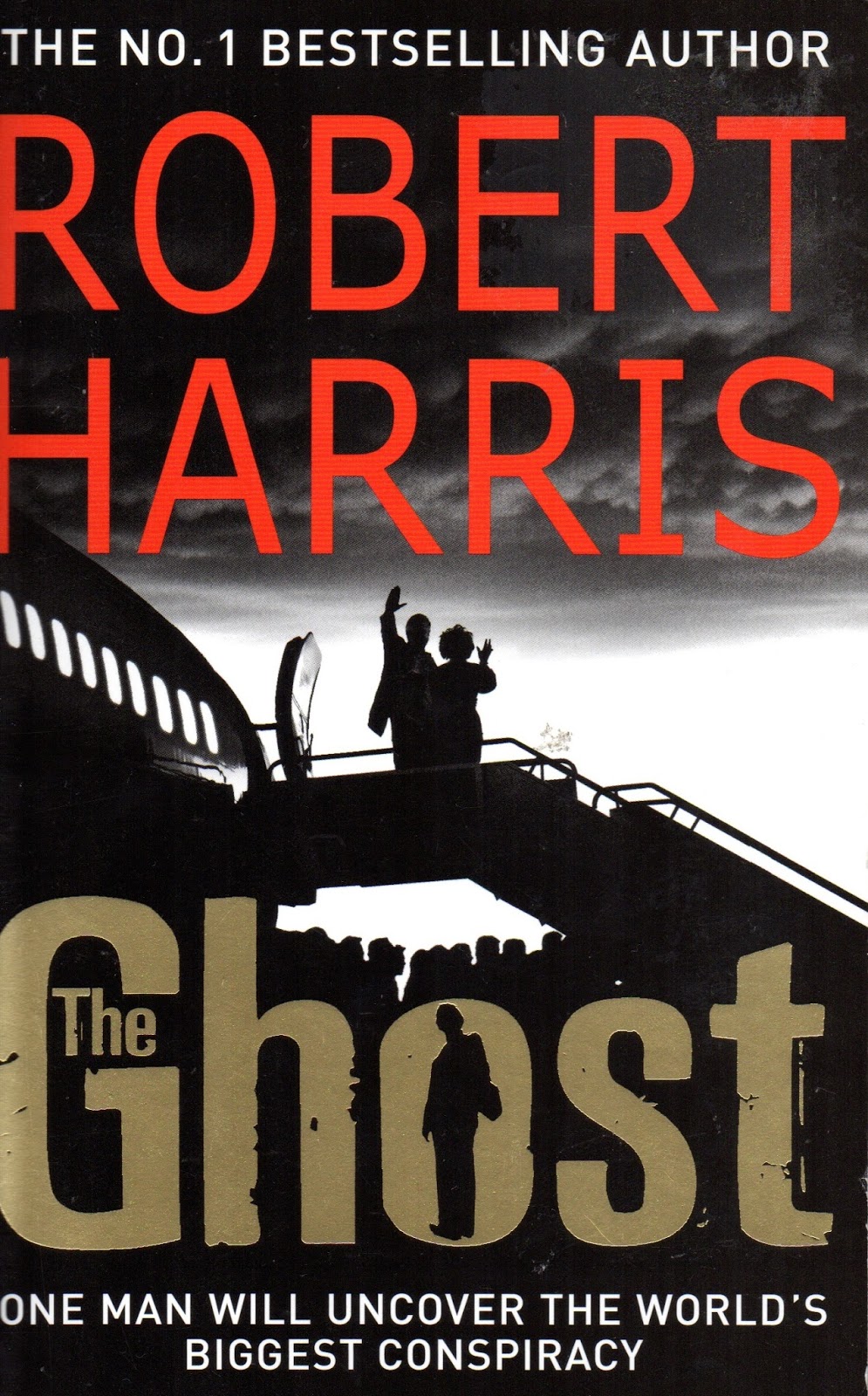
FFB - The Ghost

Robert Harris’ best-seller The Ghost (2007) gripped me from beginning to end. And what a beginning: ‘The moment I heard how McAra died I should have walked away. I can see that now.’

Mike McAra was the political friend and ghost writer of Adam Lang, Britain’s former prime minister. Sadly, McAra’s body was washed up on the American coast. So the unnamed narrator gets the job; it pays well, after all. He felt a slight unease about taking over from the dead man: ‘But I suppose that ghosts and ghost writers go naturally together.’

From that foreboding start, we get sucked in to the claustrophobic millionaire’s holiday home in Martha’s Vineyard, where the narrator meets Lang and his wife Ruth, the devoted fixer, Amelia and assorted bodyguards.
 
The style is deceptively easy, laced with humour, and the odd dash of cynicism and irony. The fictitious publishing company who paid the advance is Rhinehart. It ‘consisted of five ancient firms acquired during a vigorous bout of corporate kleptomania in the nineties. Wrenched out of their Dickensian garrets in Bloomsbury, upsized, downsized, rebranded, renamed, reorganised, modernised and merged, they had finally been dumped in Hounslow…’

The book is set very close to 2007, when Al Qaeda terrorist bombings are not only a real threat, but actual occurrences. There are questions being asked about the extraordinary rendition of four British citizens from Pakistan to Guantanamo Bay, and the use of waterboarding to torture prisoners. The ex-PM is accused of committing an illegal international act, namely authorising the abduction of those four men. So he is being hidden away in Martha’s Vineyard in order to complete his memoires. [Echoes resonate even now, as British so-called IS terrorists are vaporised by a drone’s missiles.]

‘Heathrow the next morning looked like one of those bad science fiction movies set in the near future after the security forces have taken over the state. Two armoured personnel carriers were parked outside the terminal. A dozen men with Rambo machine guns and bad haircuts patrolled inside…’(p41)

Harris is a good observer, giving us splendid description and can turn a good phrase. For example: ‘New England is basically Old England on steroids – wider roads, bigger woods, larger spaces; even the sky seemed huge and glossy.’ (p48) Another excellent example: ‘… passed a marker buoy at the entrance to the channel swinging frantically this way and that as if it was trying to free itself from some underwater monster. Its bell tolled in time with the waves like a funeral chime and the spray flew as vile as witch’s spit.’ (p50)

And he’s not without his humour, either: The bar ‘was decorated to look like the kind of place Captain Ahab might fancy dropping into after a hard day at the harpoon. The seats and tables were made out of old barrels. There were antique seine nets …’ (p95)
 
Insightful writing, too. Read this passage – ‘… it’s curious how helicopter news shots impart to even the most innocent activity the dangerous whiff of criminality.’ – and wonder about the heavy-handed police raid on Sir Cliff Richards’ house, which happened several years later than the publication of this book.
 
Writers too will empathise with the narrator, for obvious reasons: ‘Of all human activities, writing is the one for which it is easiest to find excuses not to begin – the desk’s too big, the desk’s too small, there’s too much noise, there’s too much quiet, it’s too hot, it’s too cold…’ (p180)

Those excerpts give you a little flavour, anyway. The Ghost is well written, in turns amusing, witty, thoughtful and incisive concerning the corruption of power. Despite the fact that we know there wasn’t a prime minister called Adam Lang, his wife Ruth etc., the first person narrative manages to suspend disbelief.
 
If you enjoy the drip-feed of tension rising towards paranoia, then you’ll appreciate this skilfully written novel.

Some of the paperback’s review quotes seem adrift. ‘An unputdownable thriller about corrupt power and sex…’ – the sex is minimal and not graphic in the slightest: the door stays closed.

‘Guaranteed to keep you awake and chuckling after dinner.’ – Does the reviewer usually sleep during dinner? It has many amusing asides and one-liners (as hinted at above), but it isn’t a comedy.

‘… satirical thriller…’ – The thriller elements are minimal, and only evident towards the end. It’s more psychological suspense up to that point.
 
‘Truly thrilling.’ – No, it isn’t. It is tense, however, and most convincing, with an excellent twist at the end.

Highly recommended.