Search This Blog

Showing posts with label Spain. Show all posts

Saturday, 2 December 2023

SHARPE'S COMMAND - Book review


Bernard Cornwell’s latest (2023) Sharpe adventure
Sharpe’s Command places our hero at the battle of the Bridge at Almaraz, 1812 – as usual, based on historical events.

Major Sharpe is leading his Chosen Men, with sergeant Harper and the familiar other characters. They are behind enemy lines, intent on preventing the French from crossing the bridge to reinforce one of their forts which is soon to be under British siege.

Needless to say, he triumphs after a number of setbacks, this time aided by his wife Teresa and her guerrillas. Some of the impediments are due to betrayal by presumed allies, and others by the incompetence of British officers.

If you’ve watched any of the Sharpe TV films then you’ll be familiar with the characters and can even hear their voices as they speak from the page. If you haven’t, you’ll still enjoy an engaging and fascinating adventure sprinkled with knowledge about rifles, muskets and big guns! We meet again major Hogan who this time opines ‘A wise man once said that the best way to win a war is to do it without fighting’ (p210). He was doubtless quoting from Sun Tzu’s Strategy of War: ‘To subdue the enemy without fighting is the supreme excellence.’

It would be unfair to go into details (spoilers) about the book. There’s historical fact, humour, bravery, and blood and gore. The usual ingredients for a fast-paced Sharpe read.

***

Like C S Forester with his hero Hornblower, Bernard Cornwell’s Sharpe novels are not written in historical chronological order. Of his twenty-three Sharpe books, this is the fourteenth in chronological order, preceded by Sharpe’s Company and followed by Sharpe’s Sword. It’s not essential to read them in historical order, though it’s recommended as some main characters do die in the series (though it’s a good way to meet again some who later die, if that isn’t too confusing!)

Friday, 14 October 2022

THE LUTE AND THE PEN - Book review


 This is Jennifer Morton’s second book and both are romantic adventures set in Spain. Her first, The Wells Are Dry was a contemporary novel; The Lute and the Pen is a historical story primarily set in Al-Andalus in 960AD.

Orphaned nineteen-year-old Qamira is accompanying Talha, her grandfather on his journey to Cordoba, where they plan to start a new life away from Baghdad. The Spanish city promises much, as it is a centre of learning and religious tolerance where Qamira hopes to pursue her twin passions of music and writing. She has also learned a great deal about herbal medicines and ointments from her learned grandfather.

Talha is the guest of his old friend Solomon, a Hebrew. Here, Qamira meets his wife Rebekah, Yuhana, Mirza and Tabitha, his daughters. Their neighbour is Urvan, a Muslim, who is widowed. Urvan has two sons, Izmael and Tariq, and two daughters, Shira and Dafna. Izmael’s best friend is Zayd, a swordsman, teacher and poet from El-Maghreb.

Into the mix is another household which is run by Vevian, a Christian, a trader and friend of Solomon.

Qamira settles down and takes in the delectable sights, smells and sounds of the place and her writing and lute-playing flourish. However, she is soon aware that Urvan begins to make unwelcome advances upon her during her grandfather’s absence on medical business. Fortunately, Qamira befriends Yuhana and Dafna, and gradually falls under the thrall of the handsome Zayd. Yet the relationships are not smooth as Shira is wilfully jealous of Qamira and, plotting with Nadim, Urvan’s personal bodyguard, they intend to have Qamira spirited away.

Qamira’s abrupt absence cannot be explained. Zayd is crestfallen and, after a fruitless search, he volunteers to sail off to contend with several raiding corsairs that threaten Urvan’s trading ships. After a while, word returns that he is missing, presumed dead.

Unaware of Zayd’s fate, Qamira wakes up in an Emir’s harem!

Throughout the narrative we are treated to exotic scents and images, capturing the period and its people. There is poetry both poignant and amusing, and personal conflict between several characters. Suspense, misunderstandings, betrayal and swordplay figure in the tale as well.

The author brings alive her characters and their emotional turmoil, and I was sorry to come to the end of her heartfelt tale.

Recommended.

Sunday, 4 September 2022

THE CALL – A novel that never was…

While on a school cruise ship MS Dunera around about 1963, I thought of a story idea: a young student hearing a call… and diving overboard to rescue the caller. He was considered lost at sea… but in fact survived and had many adventures…

From that evolved a series of drawings featuring the young man and a young woman he met – and continued having to rescue! Well, I was only fifteen! And I was clearly influenced by the books of Edgar Rice Burroughs. (See below for the drawings)

The Dunera was built in 1937 on the Clyde by Barclay Curle. Originally it was a troop ship then later was converted to a floating school by The British India Steam Navigation Co Ltd.


Dunera anchored off St Hellier, Jersey

The ship had dormitory accommodation for the pupils together with classrooms, lecture theatre/cinema, library and deck space for sports. There was also accommodation for teachers and independent travellers. As a floating school it first set sail from Greenock, Scotland on April, 12 1961 and completed fourteen more trips in that year.

While onboard we visited St Helier in Jersey (Channel Islands), Vigo in Spain, and Lisbon in Portugal.

The ship was scrapped in Spain in 1967.

Here are some drawings of adventures that were never written about.


 Deck sport on Dunera-1963


The Meeting-1964

This picture was put on the art class wall by the teacher for several weeks; 

he pointed out that all the wristwatches had the same time!


Split-second timing - April 1963


Is this a dagger I see before me? - April 1963


Desperate rescue attempt - May 1963

Precipitous rescue - April 1963

and finally...

Wings of Death - August 1964


Friday, 5 August 2022

LEON CAZADOR - HIS LIFE

 On the occasion of the publication by Rough Edges Press of three novels featuring Leon Cazador, Private Eye – Rogue Prey, No Prisoners, and Organ Symphony, you will find below a brief biography of the character and a time-line for guidance 

LEON CAZADOR, P.I.

Brief biography

The world needs brave souls like Leon Cazador who is not afraid to bring the ungodly to justice and so help, in his own words, to hold back the encroaching night of unreason.

Leon was born on 16 February 1963 in Spain. He has an English mother (Julia), Spanish father (Paco), a married sister, Pilar, and an older brother, Juan, who is an officer in the Guardia Civil. Leon Cazador sometimes operates in disguise under several aliases, among them Carlos Ortiz Santos.

When he was twenty-one, rather than wait for conscription, he decided to jump and joined the Army, graduating as an Artillery Lieutenant. (Spain’s conscription didn’t cease until 2001). 

About a year later, he joined the Spanish Foreign Legion’s Special Operations Company (Bandera de operaciones especiales de la legión) and was trained in the United States at Fort Bragg, where he built up his considerable knowledge about clandestine activities and weapons. Some months afterwards, he was recruited into the CESID (Centro Superior de Informacion de la Defensa), which later became the CNI (Centro Nacional de Inteligencia). Unlike most Western democracies, Spain runs a single intelligence organization to combat both domestic and foreign threats. 

Part of his intelligence gathering entailed his transfer to the Spanish Embassy in Washington, D.C. There, he met several useful contacts in the intelligence community. 

At the close of the Soviet occupation of Afghanistan he embarked on a number of secret missions to that blighted land with CIA operatives. By the time the Soviet withdrawal was a reality, Leon was transferred to the Spanish Embassy in Tokyo, where he liaised with both intelligence and police organizations.  

Secret work followed in China, the Gulf and Yugoslavia. 

In 1987, Leon was attached to a secret section of MI6 to assist British operatives in Colombia. 

Although he has been decorated four times in theaters of conflict, reports imply that his bravery justifies at least three more medals. 

A year after witnessing the atrocity of the Twin Towers while stationed with the United Nations, he returned to civilian life and set up a private investigation firm. 

During periods of leave and while stationed in Spain, he had established a useful network of contacts in law enforcement, notably Captain Silvano Lopez of the Guardia Civil. 

One of his early cases resulted in him becoming financially set for life, so now he conducts his crusade against villains of all shades, and in the process attempts to save the unwary from the clutches of con-men, rogues and crooks.


Leon Cazador’s life timeline

(His age is shown in brackets)


1984 - Graduated as Artillery Lieutenant in Spain’s Army (21)

1985 – Joined Spanish Foreign Legion, Special Ops Co. (22)

1986 – Joined CESID (Later to become CNI, 2001) (23)

1987 – Spanish Embassy, Washington DC (24)

1987 – Secretly deployed in Afghanistan (Soviet withdrawal May/88-Feb/89) (24)

1988 – Spanish Embassy, Tokyo, Japan (liaising with intelligence and police re Yakuza) (25)

1989 – Secretly deployed in China, providing intelligence on the protests (Tiananmen Square) (26)

1990 – Gulf War special operations. Medal. (27)

1991 – Yugoslavia – special operation then aiding the UN peacekeeping forces. Medal.  (28)

1992-1993 – special ops during Bosnian War (NATO peacekeeping began 1995); wounded/escaped. (29-30) Medal.

1994 – Hospitalized. (31)

1995 – Spanish Embassy, London (32)

1997 – Attached to MI6 adjunct International Enterprises and deployed to Colombia to investigate the formation (in April) of the United Self-Defense Forces of Colombia. (33)

1998-1999 – secret operations in Kosovo, in preparation for NATO bombing campaign. Medal. (34-35)

2000 – United Nations secondment (36)

2001 – Witnesses 9/11 atrocity (37)

2002 – Leaves service. Returns to Spain and begins career as a private investigator. (38)

2003 – Relic Hunter case – now financially set for life to conduct his crusade against the ungodly (39)

2014 – Involved in Cat’s Crusade: Catalyst with Cat and Rick in Barcelona (51)

2015 – Attended wedding of Monica and Detective Francis Attard in Malta (52)

2017 – Working with FBI, Sister Cristina in Charleston, SC (December): see also Organ Symphony (54)

2018 – Involved in endangered species case: see Rogue Prey (June) (55)

2019 – Rogue Prey (July); recruits Carlota Diaz as PA; see also No Prisoners (September) (56)

2022 – The Organ Symphony case (August) (59)


Monday, 8 February 2016

Exhumed - from today's news

Here's another instance where one of my stories echoes what is going on in the real world...

https://uk.news.yahoo.com/spanish-grave-opened-order-argentine-judge-unearths-painful-102157757.html

The story is 'Grave Concerns' and can be found in Spanish Eye, which this week is on special offer at Amazon!

Amazon UK - under 80p for kindle, £4.99 paperback
http://www.amazon.co.uk/gp/product/B00GXK5C6S?keywords=nik%20morton&qid=1454945399&ref_=sr_1_5&s=digital-text&sr=1-5

Amazon COM - $1.08 kindle, $6.99 paperback
http://www.amazon.com/Spanish-Eye-Nik-Morton-ebook/dp/B00GXK5C6S/ref=sr_1_9?s=digital-text&ie=UTF8&qid=1454945458&sr=1-9&keywords=nik+morton


Sunday, 17 May 2015

Jihadis bound for Britain

In the news recently there have been voices of concern raised about Islamic State terrorists sneaking into Europe amidst the thousands of refugees crossing the Mediterranean.

In 2006 I wrote the short story ‘Adopted Country’ and it was published in an English magazine in Spain, and this tale posited this very real threat from Islamic terrorists. Here are some excerpts:

On a clear day like today, I felt I could almost reach out and touch Africa. I stood alongside my brother, Juan, on the seashore of Tarifa, Spain’s southernmost tip. Juan was the Guardia Civil officer supervising the capture of yet another boatload of illegal immigrants.
       Earlier, squinting out to sea as the Guardia Civil launch intercepted the over-laden longboat, Juan had said, “It isn’t surprising, Leon, is it? North Africa is only fourteen kilometres away from where we stand. They want an easier and better life here in Europe so they’ll risk everything in the attempt.”


A week earlier, I helped break up an al-Qaeda terrorist cell in Torrevieja. It wasn’t the first of its kind, nor would it be the last, though perhaps these deranged murderers would think twice about setting up shop in this area. There were forty officers involved and five suspects were arrested—three Algerians and two Moroccans. Three houses and two commercial units were searched, netting twenty kilos of cocaine, a variety of weapons, false documents and €15,000 in cash.


These people are not pleasant. The majority are cowards. They’re quite content to brainwash their form of cannon fodder while skulking in shadows, killing innocents by remote, all in the name of a truly warped view of a great religion.


Nowadays, illegal immigrants slipped into Spain through the airports on short term work or holiday visas, and of course never left. But al-Qaeda knew that the airports were watched. So, for over a year they’d been sending their best fanatics over among the boatpeople.

***

'Adopted Country' is one of 22 cases concerning half-English half-Spanish private eye Leon Cazador, ‘in his own words’ featured in Spanish Eye, published by Crooked Cat Publishing.

Amazon UK paperback currently at a giveaway price (£1.10)! -


Amazon Com e-book(currently $3.34, a bargain!):


Amazon UK e-book:


Amazon COM paperback:

Monday, 27 April 2015

Two-for-one cathedrals and one forbidden book – Salamanca, Spain

Our day trip (15 April) by coach to Salamanca started out from Segovia with an overcast sky. We passed about six storks’ nests; enormous and weighty structures in a field: some buildings in Segovia have specially constructed platforms on their roofs to cater for these birds, in the hope that they will do no damage to the structure.

About thirty minutes from our destination, the heavens opened. Luckily, we’d consulted the Internet and carried waterproofs and umbrellas. We were dropped off a short walk from the Plaza Mayor, the famous 18th century square – one of Spain’s largest and grandest. Here we stopped for a coffee and empanadilla. On the east side of the square is the Royal Pavilion, decorated with a bust of Felipe V, who built the square (though I believe he had some help…) 1729-1755. I spotted a bust of the Duke of Wellington, too.
 
Jen in Plaza Mayor                         Bust of Wellington
 

Cathedrals, old and new
We risked the rain and headed for the Cathedrals; there’s an old one and a new one. The terms ‘new’ and ‘old’ are relative, however: the 16th century new cathedral didn’t replace the old but was constructed beside it. So you enter the new and turn right to enter the old, the 12th and 13th century Romanesque cathedral. Here, you can see surviving wall paintings and the astonishing altarpiece with its 53 panels in lustrous colours. In the vault above is a fresco depicting scenes from the Last Judgement.

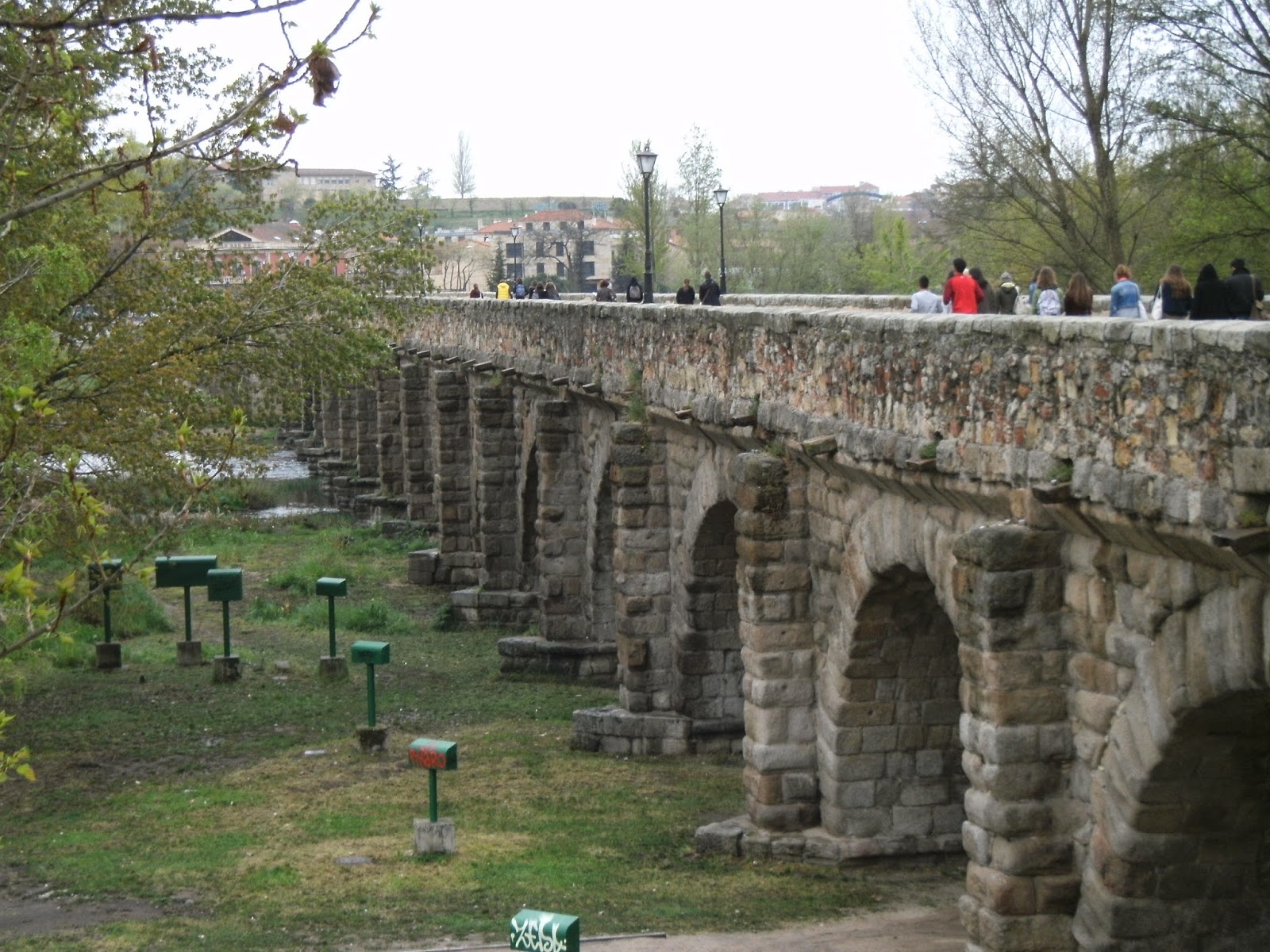
Roman Bridge
When we finally emerged from the new cathedral, the rain had stopped and we walked to the roman bridge, which crosses the river Tormes and was built in 1AD. It still retains fifteen of its original 26 arches (some have been reconstructed due to damage by flooding over the years. Still visible on the ashlars of the arches are the holes of the Ferrei forceps or ‘big tweezers’ used to place them. Similar holes can be seen on the aqueduct of Segovia.
Roman bridge

Lazarillo de Tormes
Overlooking the roman bridge and the river Tormes is a charming statue dedicated to the novella The Life of Lazarillo de Tormes and of His Fortunes and Adversities, a picaresque book published anonymously in 1554. It concerns a boy, Lázaro, from Salamanca; his mother gives little Lázaro (Lazarillo) to a blind beggar to serve an apprenticeship, where he learns about the various levels of society, the ills, and the hypocrisies. Lazarillo is the fore-runner of anti-heroes such as Tom Jones and Huckleberry Finn. The book appeared on the list of forbidden books of the Spanish Inquisition, due to its critical stance regarding authority (the Catholic Church and the aristocracy). [http://www.classicspanishbooks.com/lazarillo-de-tormes.html]

Jen in front of the statue to Lazarillo de Tormes


Next: University and the conch house

Wednesday, 22 April 2015

Water and not-graffiti - Segovia, Spain

On 13 April we caught a coach for a trip to Segovia. This was a short holiday break (13th-16th), staying in that ancient city, and then spending a day visiting Salamanca, and an hour at Avilla and three hours in Madrid on our return.

Jen had been to Segovia before, but I hadn’t. It is a quite spectacular sight, the old town set high on a rocky spur, surrounded by the rivers Eresma and Clamores. The twelfth century Alcazar is perched on a rocky outcrop, like the prow of a ship, its towers and turrets like something out of a fairy tale. To extend the nautical metaphor, the pinnacles of the splendid cathedral rise like masts, and the 1st century Roman aqueduct trails behind like a rudder.

The beauty of the city is that so many sites are within walking distance. Here, I’ll briefly look at two.

Aqueduct
The aqueduct was in use until the late 19th century. This construction still takes your breath away, standing tall and slicing through the city. It consists of two tiers of arches, about 2,400ft in length and follows the contours of the ground. Its maximum height is 95ft. The design, incorporating sufficient gradient for the water to flow from the river source, through a series of tanks along the way, is impressive too. And the structure is constructed without benefit of mortar.


Sgraffito
So many building facades are endowed with attractive and elaborate geometric shapes, almost like tapestry, covering the entire wall. The technique involved scratching the plaster coat to create the symmetric shapes and goes back to the 16th century. In Segovia there are in excess of 300 different sgraffito examples.


Next: the Alcazar and the Cathedral.

Monday, 16 March 2015

'Clever in conception and execution...'


My collection of short crime stories Spanish Eye has received a great review from American author Ron Scheer.

A glimpse can be gleaned here, but please consider popping over to Ron’s blog and read the whole thing - see below. (And while you’re there, browse his other blog entries, which all make fascinating and enlightening reading):

‘A recent resident (for part of a summer) of Madrid, who came to enjoy that city’s laid-back culture, I felt some pleasant déjà vu in the world of Morton’s stories which are peopled by the men and women I observed there on the leafy avenidas, in the busy neighborhood plazas, and among the fountains in the parks. The stories are often clever in their conception and execution. Reading them you get to enjoying Cazador's congenial, wise company.’


Sunday, 18 January 2015

You want obscene, Mr Smith?

‘It’s absurd and offensive that tax-payers are funding these payments (Winter Fuel Allowance) for people who have retired to the Mediterranean and enjoy warmer weather… we’re able to satisfy EU rules as well as prevent this obscene waste of taxpayers’ money.’ – Ian Duncan Smith

An open letter - please feel free to copy and distribute as you see fit...

Dear Mr Ian Duncan Smith

Even though I am an ex-pat resident in Spain, I’m still paying UK taxes. And as a tax-payer, I find your comments offensive.

It is obscene that there should even be a need for a Winter Fuel Payment for pensioners. If the state pension was adequate, then this payment would not be needed. In the European pension payment stakes, Britain was 21st out of 27 countries; Spain was in the top ten.

It is obscene that your so-called ‘temperature based eligibility’ is blatantly manipulating statistics to obtain a vote-catching result.

It is obscene that tax-payers’ money is squandered on MPs’ dubious expenses and heating bills.

It is obscene that tax-payers’ money finances fact-finding jollies abroad for MPs.

It is obscene that the right to vote in our home country is removed after residing abroad for over fifteen years; if we still pay British taxes, then we should have the right to vote: taxation without representation is unjust (and lost us certain colonies on the other side of the Atlantic).

It is obscene that taxpayers’ money is sent abroad to India, where their poverty is ignored while they spend millions on space exploration.

It is obscene that tax-payers’ money is sent abroad to finance warlords and despots.

It is obscene that the government makes a profit on passport applications from British citizens abroad.

My earlier blogs on the subject

 
http://nik-writealot.blogspot.com.es/2013/10/lets-get-political-winter-fuel-payments.html

Petitions are being completed as I write, but do we really believe that the mandarins in Whitehall will take note or even care a jot? They've got their gold-plated pensions, after all, and won't need to be concerned about getting cold in winter evenings.