Search This Blog

Showing posts with label Nuns. Show all posts

Sunday, 26 July 2015

Writing – ideas and synchronicity

In my review of Gravity by Tess Gerritsen, I mentioned her lawsuit against Warners.


That has now been dropped. The situation pertaining to that is of some interest, regardless of the outcome.

Many new writers worry about copyright infringement, fearing that unscrupulous literary agents and editors will steal their book and republish it under their name. Plagiarism does exist, though it is rare and not worth losing sleep over. As soon as you commit your words to paper, those words are your copyright. They are protected by law. However, should your words be stolen, then you have to prove the theft and could spend considerable sums of money in the attempt. The greater concern is the concept of ideas. Sadly, ideas are not copyright. Over the decades I’ve seen some of my ideas appear elsewhere after I’d committed them to paper, but I must be philosophical about this.

It could be something to do with Jung’s collective unconscious, or even the so-called collective consciousness. In essence, ideas (and this includes inventions) often seem to percolate through the ether and lodge in several minds at once – or they’re submerged very much like being entombed in an iceberg and gradually surface as the ice melts, spreading to receptive centres. Coincident with this is the idea of synchronicity. As an aside, Jung suggested that parapsychology and occult religious ideas could contribute understanding of the collective unconscious. These ideas have a certain attraction – particularly when linked to my psychic spy Tana Standish (The Prague Papers and The Tehran Text). Based on Jung’s interpretation of synchronicity and extra-sensory perception, he argued that psychic activity transcended the brain. This is all moot.
 
I tend to believe that synchronicity has been at work regarding some of my past efforts.

In the early 1970s I conceived and roughly plotted a sci-fi book set underground after some apocalypse (doubtless inspired by Daniel F Galouye’s Dark Universe). The characters communicated by telepathy, they’d been there so long. At the time I was interested in the plight of whales, too – having read Farley Mowat’s A Whale for the Killing (1972) among other books and tracts. I thought of linking the underground people telepathically to whales (it’s explained in the notes…) Some years later, along came that most endearing movie, Star Trek IV: The Voyage Home which neatly combined whales and sci-fi. The ideas I had then are still in a file; they may resurface one day.

Also in the mid-1970s I decided to write a vampire book. I’d found it difficult (!) to square the mass of a human being converting into the mass of a single vampire bat (which seemed to be the norm up to this point). It wasn’t scientific – well, no, it was fantasy.  Anyway, I developed my vampire from the past of Malta and he would transform into forty-six bats, each with his mind and sight, slightly splintered. True, even that number of bats would not equate to the mass of a man, but I felt it was marginally more believable! It began life as a short story but had no success so then harboured dust until I got around to writing the novel it was meant to be. In the meantime, along came Alan Moore and Kevin O’Neill’s comic, The League of Extraordinary Gentlemen (1999) [subsequently filmed in 2003] and the vampire splits up into many bats… I finally found a publisher for my vampire tale, Death is Another Life (2012); though it picked up good reviews, it’s now out-of-print.
 
 
In the early 1990s, I wanted to enter a crime story competition and did a bit of research to find out what, if anything, hadn’t been done before. I settled on a nun who used to be a cop and set it in the US (since I thought at the time that there was likely to be much gun-play and there are plenty of guns floating around there, unlike UK). She would run a hostel for the homeless in Charleston (a place I’d visited); she had been a cop in New York. I sent off the short story, but it failed to win. Yet I found that the concept and characters cried out for a novel (this happens quite often, I find!)  So I wrote the novel and sent it out and got very very close to an acceptance on three separate occasions.

Imagine my surprise when I found Alison Joseph’s Sacred Hearts (1994) on a bookstore shelf – ‘a Sister Agnes mystery’. Coincidentally, her agent was one of those I’d approached with my nun manuscript. The only vague similarity was that Sister Agnes ran a hostel for runaway teenagers. Her series ran to nine novels, the last being published in 2008. My nun book won a prize in the Harry Bowling competition in 2006 and in 2007 it was published as Pain Wears No Mask (now set in Newcastle upon Tyne and London; it had featured Sister Hannah but now featured Sister Rose; it picked up rave reviews!); it’s presently out of print.
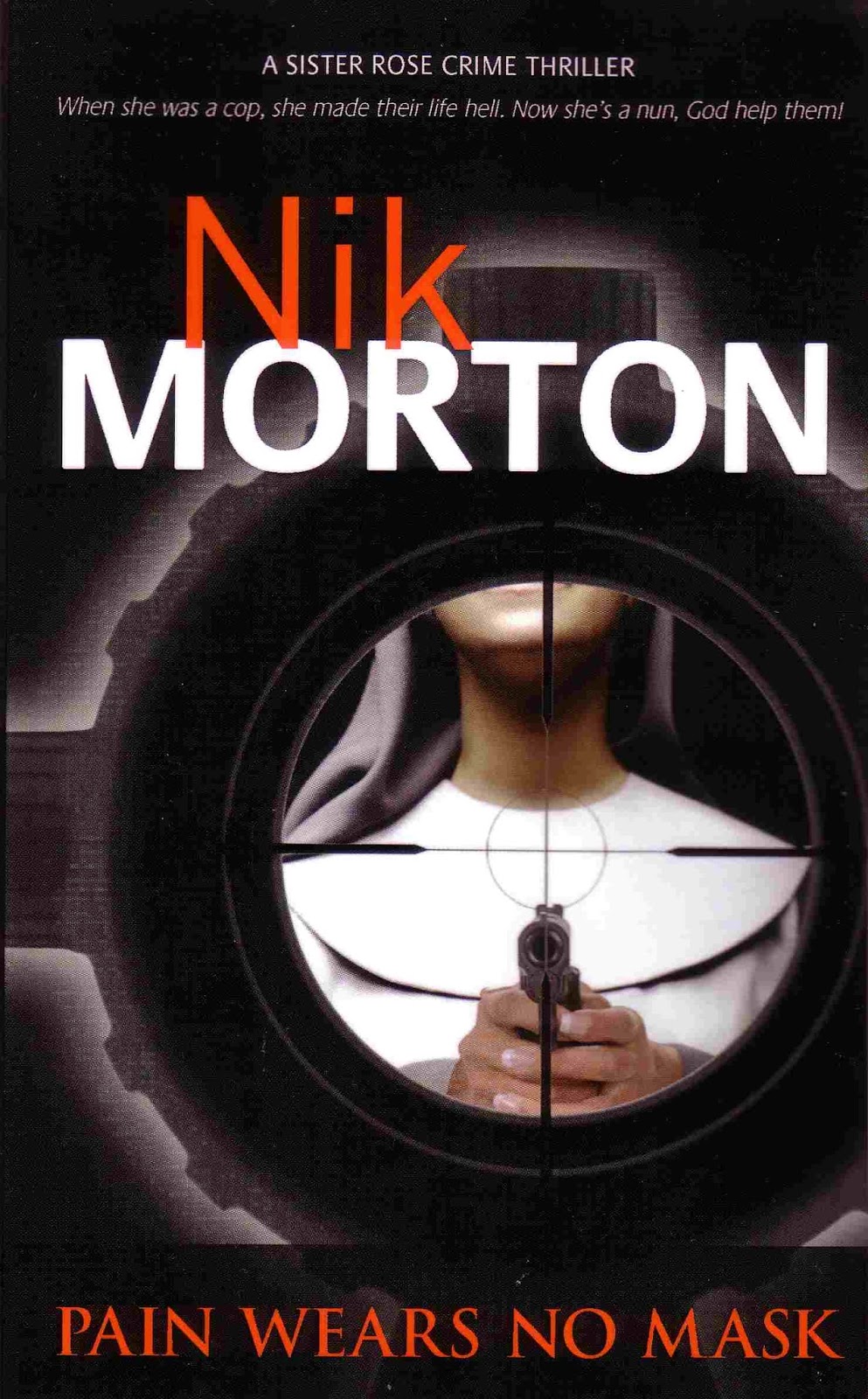
 
So, there you have it, synchronicity at work. There are other instances where ideas have lodged in my head and then been given life elsewhere, going as far back as the 1960s. That’s the nature of synchronicity – it happens all the time; that ether’s all around us!

The moral of all this? Don’t get anxious about your work being stolen. It probably won’t ever happen. I’m sure that, like me, most writers have more than enough of their own ideas to work with to bother filching them from newcomers. But bear in mind, ideas are floating out there, and they could be part of a shared consciousness!
 
If you wish, you can try my in-print books here… (e-books/print)

PS - The Prague Papers is selling as a bargain e-book all this week!


Saturday, 30 May 2015

Saturday Story - 'Not so bare after all'


NOT SO BARE AFTER ALL

 
Nik Morton
 
 
Moses stepped forward hesitantly, baseball cap in hand. His T-shirt proclaimed he was a student of Yale when he was merely a student of life, old before his time. Twelve next month, he was cunning yet with a streak of honesty running through him. Careful not to let her feelings for individuals cloud her treatment of all her people, Sister Hannah still loved him.

            In the crown of his cap were four dirty scrunched-up dollar bills.

            "Where'd you get these, Moses?"

            "Holy shi - ah, sorry, Sister - I did a good deed, downtown. This lady, her Chevy was bein' hitched to a tow-truck. Real upset she was, pregnant an' all. Well, I heard some bystanders sympathisin' with her, so I took my hat round, paid her on-the-spot fine straight off afore they could tow her auto away."

            "But if you paid off the fine - "

            "This is half of what's left over - "

            "And the other half?"

            His dark eyes crinkled. "The bystanders, they said she could keep the rest. But she insisted I took half. Nobody seemed t' object. Strange, really, ever'body seemed to feel good, giving away their dough to help th' lady. If'n I'd cut a purse or two, they'd've had th' opposite feelin' for sure, more'n like ready to lynch me outright!"

            "More'n like, Moses." She took the grubby notes. "Thank you,"

            He grinned, revealing a missing tooth.

            The mischievous grin had not always been there. When he came into the hostel he'd been morose.

            She gradually brought him round and Moses became invaluable; he was a useful go-between for the hostel and the street-smart neighbours. He did not join a gang, but was on fairly good terms with more than one.

            Months ago, as she finished praying in the chapel just off the entrance foyer, she rose to see him in the doorway.

            Rather sheepishly, he was holding a golden candle-stick.

            "Where did you get that, Moses?"

            "Does it matter, Sister?"

            "Yes," she said, pursing her lips.

            "Well, it sort of fell out the door of St Dominic's..."

            Sister Hannah groaned. "You can't just take - "

            "But the chapel's so bare, Sister! Holy shit, they're a rich church, they won't miss one lousy - "

            "Pretty adornments don't matter, Moses. It's the feelings inside that count..." Her eyes glistened; he meant well, for God's sake! "What am I going to do with you?" she asked, embracing him.

            Later, she telephoned St Dominic's. They were surprisingly understanding. The candle-stick stayed.

***

Sunset slanted red rays through the chapel's high narrow window above the altar, lending the crucified Christ a sanguinary appearance. Sister Hannah rose, prayers completed. She gathered her skirts just as the hostel's front doors clattered noisily open.

            Swearing and shouting echoed in the entranceway.

            Her heart sank as she opened the chapel door.

            Four youths, attired in leisure-ware patterned with violent-looking transfers, stood in the hallway. In the arms of the tallest of the gang was Moses. Blood dribbled down the boy's outflung inner arm onto the foyer tiles.

            She gulped in air, fought down the anxiety and shock. "What happened?"

            "He asked to be brung here, Sister." The tall leader held the lad out to her as if he were a bundle of clothes. He couldn't be more than fifteen; over his shoulder was slung an automatic rifle; one of the others carried an Uzzi machine pistol.

            She said austerely, "If you intend staying, leave your guns in Mario's office there..." And she stepped forward, arms outstretched.

            Bracing herself for the weight, she took Moses in her arms, surprised at how light he was. She repeated, "What happened?"

            "Moses was hit in the gang crossfire. Guy in a pickup shot him - didn't hang around for autographs..."

            She carried Moses through the chapel door. He was already a deathly grey pallor.

            Sister Theresa rushed down the stairs, alarmed. "I heard the - " She paled at sight of the youths, and of Moses's blood staining Sister Hannah's clothes.

            "Don't worry, Sister Theresa, they mean no harm, they're friends of Moses. Now, go to the sickbay, call an ambulance and bring some dressings and pain-killers."

            Nodding, the nun rushed through the double doors.

            The youths stood awkwardly in the chapel's doorway; they'd relinquished their weapons. She said over her shoulder, "Come in, sit at the back, the religion won't bite you..."

            As she stopped in front of the altar with its single candle-stick, the candle poignantly guttering, fighting for air, their chairs scraped on the floor.

            She knelt with him cradled in her arms.

            Moses opened his eyes, winced as frothy blood ran out the corner of his mouth. "Holy - shi - Sister," he coughed, "I'm sorry!"

            "Sh, don't talk - "

            He painfully coughed up blood onto her clothes. "Sister, I'm sorry t' make a mess an' all..." Each spasm sent knives into her.

            "God won't really mind me cussin', will he, Sister?"

            "No, Moses. Hell, no," and she forced a smile.

            Sister Theresa rushed in, then, realising where she was, slowed her pace to a hurried decorous walk and knelt beside them. Sister Hannah shook her head to the offered bandages. Sister Theresa bit her lip, rested the medication in her lap, and couldn't stop blinking.

            Moses smiled, weakly. "I'm dyin', ain't I?"

            "Yes. The good die young." Like so many clichés, it held a grain of universal truth.

            "Exceptin' for you, Sister - 'ceptin' you..."

            Through a sudden skein of gauze across her vision she could see that for the first time he noticed where they were; "You know, Sister, it's not so bare in here, after all... I can feel - "

            She commended his soul to heaven and closed his staring, empty eyes; eyes that had been so full of mischief, so insolent yet generous, so alive...

            Sister Theresa sobbed uncontrollably; the youths mumbled something about only a bit of a lad and shuffled out.

            The paramedics arrived but she hardly noticed.

***

Previously published in TV Choice, 2013
Copyright Nik Morton, 2015

I’m never comfortable writing in vernacular, as I reckon it’ll never be correct.
I’ve left this as it appeared in the magazine, for what it’s worth;
perhaps the motto should be: avoid vernacular like the plague!
This is a short story from St Anselm’s Hostel for the Homeless, Charleston, South Carolina, which is run by an order of nuns, presided over by Sister Hannah. Two out-of-print novellas feature Sister Hannah – A Sign of Grace and Silenced in Darkness.

Sister Hannah was my first incarnation of the nun who used to be a cop. I transposed the stories from New York and Charleston to Newcastle-Upon-Tyne and London and renamed the main character Sister Rose, and the novel was published as Pain Wears No Mask (out of print).

If you’d like to see more of my short stories, please consider the collection, Spanish Eye, published by Crooked Cat (2013), which features 22 cases from Leon Cazador, private eye, ‘in his own words’.  He is also featured in the story ‘Processionary Penitents’ in the Crooked Cat Collection of twenty tales, Crooked Cats’ Tales.

Spanish Eye, released by Crooked Cat Publishing is available as a paperback and as an e-book.


http://www.amazon.com/Spanish-Eye-Nik-Morton-ebook/dp/B00GXK5C6S/ref=sr_1_5?s=digital-text&ie=UTF8&qid=1399382967&sr=1-5&keywords=nik+Morton


Or you could try my co-authored fantasy novel Wings of the Overlord (by Morton Faulkner) currently available in hardback (5 good glowing reviews):
 
http://www.amazon.co.uk/Overlord-Chronicles-Floreskand-Morton-Faulkner/dp/1908483857/ref=sr_1_cc_1?s=aps&ie=UTF8&qid=1427540952&sr=1-1-catcorr&keywords=wings+of+the+overlord
 

Floreskand, where myth, mystery and magic reign. The sky above the city of Lornwater darkens as thousands of red tellars, the magnificent birds of the Overlord, wing their way towards dark Arisa. Inexplicably drawn to discover why, the innman Ulran sets out on a quest. Although he prefers to travel alone, he accedes to being accompanied by the ascetic Cobrora Fhord, who seems to harbour a secret or two. Before long, they realise that it's a race against time: they must get to Arisa within seventy days and unlock the secret of the scheduled magical rites. On their way, they stay at the ghostly inn on the shores of dreaded Lake and meet up with the mighty warrior Courdour Alomar. Alomar has his own reasons for going to Arisa and thus is forged an unlikely alliance. Gradually, the trio learn more about each other -- whether it's the strange link Ulran has with the red tellar Scalrin, the lost love of Alomar, or the superstitious heart of Cobrora. Plagued by assassins, forces of nature and magic, the ill-matched threesome must follow their fate across the plains of Floreskand, combat the Baronculer hordes, scale the snow-clad Sonalume Mountains and penetrate the dark heart of Arisa. Only here will they uncover the truth. Here too they will find pain and death in their struggle against the evil Yip-nef Dom.

Friday, 29 May 2015

FFB - Ebola

William T Close, MD, wrote Ebola in 1995 in response to the second major outbreak of the deadly disease in Zaire (now the Democratic Republic of the Congo), affecting 315 and killing 254. Close’s book is a documentary novel about the outbreak in Zaire in 1976. The book concerns the Belgian nuns (the Sisters of the Sacred Heart of Mary), priests (Fathers of Scheut) and African staff of the Yambuku mission hospital. At the time of this outbreak, Close was in his last three months in the Republic, having spent sixteen years as a physician and surgeon to the Zairians and their president. So his voice is an authoritative one as he narrates from an omniscient point of view.

Sister Augustina is the Mother Superior of the mission, however the main character is Sister Veronica, or Vero as she’s called. She is full of energy, drives her Vespa scooter between villages, doing good work. Though the country is ravaged by the greed and corruption of the privileged handful around the president, a few missionary schools and hospitals like Yambuku continued to function effectively.

There’s insight into the Zairian village culture, too. ‘When the old died, they moved to the village of the ancestors and were served by the living… Infants who died before undergoing initiation ceremonies that made them full members of the clan went into limbo and were forgotten. Such losses were difficult, but other children could be created. Far more devastating was the death of a young man or a young woman in their most productive and energetic years. Those deaths were a threat to the survival of the family. Their lives had not yet been filled by experience. Those who died before they had played their part in the perpetuation of the clan could be denied a place with the ancestors.’

The medicine man or native healer was the conduit to the ancestors and sought advice from them.

The priest, Father Gérard believed there was ‘nothing as simple or as stubborn as a Flemish nun.’ Close’s book lends the lie to that statement: he truly looks into the hearts of the valiant nuns as the insular world they inhabit crumbles.

Father Dubonnet is another priest, often spouting pithy observations: ‘We are all a little different after we have lived in Africa for a while.’ Which seems true, if you listen to anyone who has lived in that diverse continent.

A late arrival is Dr Aaron Hoffman, an expert on tropical disease; He reminisced about his time in Africa, not long before he was called back to assist in the outbreak at Yambuku: ‘… slow-flowing, mud-coloured streams and naked kids jumping up and down, family groups sitting outside wattle huts, bright cotton prints drying on thatched roofs, small log spokes around a fire, sweet-smelling smoke curling up and fading into blue sky, muscular clouds flexing and writhing before the evening storm. He could smell the hot earth and hear the whine of mosquitoes, the barks of dogs, the clucking of scrawny chickens around the manioc bushed scratching for grubs, and the laughter of children – happy, round faced and round bellied…’
 
Hoffman, a lapsed Jew, questioned why God did not intervene when disasters claimed so many innocent lives. In response, the Mother Superior stated: ‘Dogma controls through fear; spirituality through love. God gives each of us the freedom to choose how we behave in the face of nature’s disasters or even our own defeats.’ We have freedom to choose – and missionaries and nurses like these depicted – western and African – literally risk their lives to help their fellows. Despite their religious calling, Close does not dwell on religion. It’s the people that he’s interested in – those who die, those who succumb yet survive and those who win through though at great cost. Indeed, Close has captured the humour and character of the nuns and the priests. Sister Augustina says of Veronica, ‘Although you have added to my grey hairs, your vitality has helped sustain me… In an exhausting sort of way.’

At the deathbed of a nun who has so many ‘sins’ to confess, Dubonnet says, ‘I will give you a general absolution that will cover the big sins and all the little ones.’

This is far from a western- or white-centric novel. The character of Masangaya, who ran the mission hospital, is developed like all the others, with compassion and dedication beaming through. The various villagers and the medicine man are treated with great empathy as they suffer.

Reading this, knowing that death’s pall would fall upon them, I found the book to be suspenseful, making me wonder who would survive. And of course at this time they didn’t even have a name for the disease (it was eventually named after the nearby river, Ebola). Certainly, the spectre of death, as one after another patient was claimed, caused concern and fear in the whole area, aided by superstition: ‘He is afraid because he has a wife and children,’ says Sister Théofila of a clinic doctor who refused to enter the hospital.
 
On several levels this is a good novel: suspenseful, heart-rending, yet clinical and terrifying in its authenticity. And the characters seem alive and you feel for them in their bewilderment. As you may have already glimpsed from the few excerpts, the writing is eloquent and often beautiful; the opposite of the disease itself.

***
 
Between 1976 and 2013 there have been 24 outbreaks involving 1,716 cases, according to the WHO. What seems appalling is that the latest outbreak in West Africa has over 27,000 cases and in excess of 11,000 deaths. Prior to this latest outbreak, no specific treatment or vaccine for the virus was available; some opinion has debated that perhaps the giant pharmaceutical firms didn’t see any money in developing one.
 
***
 
TV: BBC2 – Monday, 1 June – Outbreak – the truth about Ebola. This is a documentary examining the response to the epidemic, looking at why it was not stopped earlier.
 
***
 
William T. Close is the father of actress Glenn Close. He died in 2009, aged 84.

Friday, 29 August 2014

Saturday Story - 'My life's most important work'

In a departure from the norm for our regular weekly slot, the following ‘story’ hasn’t been published in this format before.

In 1995, I wrote a couple of novellas featuring a nun, Sister Hannah – A Sign of Grace and Silenced in Darkness. Prior to joining the order of nuns, she’d been a cop in New York. The mother house was situated in Stockbridge – of Norman Rockwell fame. Silenced in Darkness was written in a day and was a runner-up in the One Day Novel Writing Competition, 1995.


Some years later, while responding to a writers’ circle prompt - My life’s most important work – I decided to incorporate something about Sister Hannah, extracted in letter format from the fledgling novel. (These scenes do not appear in the two novellas, only the novel).
 
That novel eventually transmogrified from its setting in the US to UK, swapping Sister Hannah for Sister Rose, and exchanging New York and Charleston, South Carolina with Newcastle Upon Tyne and London! I also changed it from third person to first person. Quite a rewrite, really. The first chapters of the new version won the Harry Bowling prize in 2006.

I hope it’s of interest, anyway.

***

                                                                                                                                    Mission, Peru

Dear Reverend Mother,

I appreciate you asking me to send you an epistle from time to time.  I’m only sorry that there is so little time to spare here to write more regularly. I hope the snows are not too severe at Stockbridge.  Of course I miss the other sisters at the Mother House, but I console myself with the thought that each day I am doing my life’s most important work.

It is strange, how before I took the veil I thought having children would be the most important work in my life, to nurture them and to teach them responsibility and the wonders of the world all around them.  But sadly after that terrible experience while I was a cop, I was never destined to become pregnant.  If I wanted to have children, then they would be adopted, and there, on reflection, I have been blessed.

When we novices were sent out to our various missions, I was apprehensive about coming to Peru.  It’s so unlike the life I was used to.  Still, the months I’ve spent here may have been harrowing yet they have also been most enriching.

            I worked hard and long, in the mud, in the rain, in the strength-sapping heat and in the mind-numbing cold. 

            During the hot months I wore the white cotton habit, and in the cold the black serge. I endured the bites of mites and lice and more than once had to dig out fleas that burrowed under my toenails to lay their eggs.  

            For the first few weeks I wondered how Saint Francis Solano, a seventeenth century Andalusian priest, survived twenty years among the Indians and Spanish colonists. Like him, I learned a number of Indian dialects, but was never going to be in his league - the possessor of a ‘supernatural gift of tongues’. 

            At first, too, I never thought I’d become accustomed to the variety of unpleasant smells: burned grease, onions, smoke, and mildew, body odour, faeces and urine.  The comb of eucalyptus trees, planted to break the tearing Andean winds, offered some relief.

            Sister Colette - named after the fourteenth century nun, not the French writer - was the Mother Superior of the mountain-side white-washed adobe mission.  She was frail of body but strong in spirit; she was untiring, wise and full of good humour. 

            Sleeves of my white habit rolled up, I hoed the hard sun-baked red earth.

            Alongside me worked four villagers, all resplendent in their bright coloured clothes, weathered faces creased by their harsh existence in the mountains.

            For a moment, I paused and straightened up to massage my lower back.  The secret was to stop frequently, to change the body's position.

            The mountains were glorious at this time of year. Purples and rich greens, cleft with mauve shadows, surrounded by white fleecy clouds and brilliant blue sky.  And the air I gulped in was a heady concoction, delightful, filling my chest with a fresh invigorating tang.  I felt I could almost touch the sky from here - or even God.

            Truly, the training at Stockbridge hadn't prepared me for the real thing: nothing could.  For the hard work, the dirt and smells were all mitigated by the generosity of spirit these native people exhibited.  Their loyalty and innocent humour carried me through many a mood-swing - as did prayer, of course.

            Now that I had adapted I found it difficult to recall my existence before coming here: the time at Stockbridge and in New York seemed a very distant memory, almost a dream. 

            Since I came to this mountainside village as a novice, my hands had hardened so no longer broke out in blisters. Occasionally, a stray vain thought made me wonder if I would ever be rid of the calluses.  But time will heal, I reminded herself.  Time was already building a fresh veneer over my New York trauma and tragedy.  Thankfully, the nightmares were less frequent.

            Crows called from the tall trees that skirted the field.  The sowing would have to be carefully done if those sinister birds were not to enjoy a free lunch!

            When the terraced fields were finally flush with maize, I sat in the warm breeze on an outcrop and experienced a pleasant glow of satisfaction.  The crop was good for a change.

            ‘I don't think God will mind you feeling pleased with yourself, Sister,’ said Mother Superior gently.

            Startled, I stood up and turned.

            Sister Colette was smiling.  ‘Yes, indeed, my dear.  In the fields of the Lord, truly it is a labour of love.’

            Two months later, during an abortive attack by four Shining Path terrorists, the old lady was fatally wounded. 

            Remembering Isaiah, Therefore have I set my face like a flint, I stoically buried Sister Colette while the nasal five-note songs of the Andean Indians - in Spanish - echoed the loneliness of their bleak mountain country and the lostness of a people stripped and despoiled. 

            With the aid of the villagers and a little cunning, we beat off the next assault and, surprisingly, thereafter came to arrange an uneasy truce with the terrorists. For the remaining eight months until a relief arrived, I was in charge of the mission. 

            In that time I was strengthened by my own faith and the people's belief in my ability; I bargained with and cajoled the authorities to get medicines and to protect the villagers' meagre lands; and I taught the children. 

            The stands of trees, palm and banana, often shrouded by vines and air plants, presented a gorgeous natural cathedral for our prayers.  I will always be able to picture the villagers milling around the huge boles of those trees, their heads bowed, the men in their wool ponchos and the women in their heavy shawls, the bright colors of their clothing vying with that of the lush flora.

      When the time comes for me to depart - the people from all around have already pleaded for me to stay - I know I will be truly reluctant to go.  But Obedience decrees that I must.

            I must close now, the children are asking for their history lessons.  They have such a thirst for knowledge.  It’s wonderful. 

God be with you,

Your Sister Hannah
 

***
The finished novel became Pain Wears No Mask and was published in 2007; it is now out of print.
 
If you liked this, you might like the first person narrative in Spanish Eye, published by Crooked Cat. Leon Cazador, private eye, half-English, half-Spanish, ‘in his own words’.


Spanish Eye

Amazon UK – 2 good reviews
http://www.amazon.co.uk/Spanish-Eye-Nik-Morton-ebook/dp/B00GXK5C6S/ref=sr_1_3?s=digital-text&ie=UTF8&qid=1408896228&sr=1-3&keywords=nik+morton

Amazon COM – 6 good reviews
http://www.amazon.com/Spanish-Eye-Nik-Morton-ebook/dp/B00GXK5C6S/ref=sr_1_4?s=digital-text&ie=UTF8&qid=1408894106&sr=1-4&keywords=nik+morton


Tuesday, 22 October 2013

NUN MORE WORTHY

Nuns, even before the haunting Nun’s Story, have carried with them a certain mystique. Granted, there are those bad apples who, like wicked stepmothers, delighted in inflicting pain on children, yet the vast majority have done good work and many have given their lives for their charges and their faith. (The book excerpt below is based on real events...)

I’ve just seen an announcement that Hodder’s going to run a 12-part serial about a gun-toting nun. Bookseller states: ‘Hodder & Stoughton has bought a "groundbreaking digital serial Western", Nunslinger by Stark Holborn. Anne Perry bought world rights in a deal with Ed Wilson of Johnson & Alcock. Set in 1864, the story sees nun Sister Thomas Josephine on her way to California, and finding she has to pick up a gun, in a plot featuring "varmints, lowlifes, cowboys, drifters, desperadoes, high-plains adventure and page-turning excitement". [Who'd have thought Hodder was so pro-westerns?]

The story will be published as a 12-part serial digital original, with parts 1, 2 and 3 published on 26th December 2013 and nine more parts following in March, June and September 2014. Nunslinger is to be promoted with a "spectacular" digital campaign across online communities starting on Boxing Day 2013. Author Stark Holborn is said to be "shrouded in mystery", with Nunslinger "his or her" first published work.’ [I don't think it's J.K. Rowling this time...]

Nuns in fiction are not new, of course – not even in westerns. A far cry from the nunslinger is Thomas Eidson’s brilliant St Agnes’ Stand (1994), an excellent character-driven story. There are a good number in crime fiction: Sister Mary Helen Sister written by real-life nun Sister Carol Anne O’Marie (books 1994-2006), the Sister Mary Teresa series by Ralph McInerny (creator of Father Dowling) writing as Monica Quill (1981-1997), Sister Fidelma, a 7th century nun in Ireland, written by Peter Tremayne (1994-2012), and Sister Agnes by Alison Joseph (1994-2011).
 
A beginners’ guide to detective nuns, (of whom, the compiler states, there are too many, particularly medieval ones) can be found at this website: some 35 are listed: http://www.detecs.org/intro.html

There’s also a slew of comicbooks, notably in the US, about warrior nuns. Some of these are juvenile with buxom barely clad nuns, while some are sci-fi incarnations such as Avengelyne – the emphasis on ‘avenge’, I suspect.

In the early 1990s I wrote a short story about a nun who used to be a cop. I entered it for a competition but it didn’t win. It featured Sister Hannah who ran a hostel for the homeless in Charleston, South Carolina (I’d been to Charleston). Inevitably, the story grew, and involved her traumatic past as a cop in New York.

In 1995 I went to London to compete in the ‘novel in a day’ competition, which took place at the Groucho Club. I borrowed a laptop from work and spent two days there, two 12-hour stints, and produced roughly 18,000 words, Silenced in Darkness. Prior to going, I’d plotted the storyline and used the nun character, visualising the scenes in my head so that when it came time to write it down, I could simply transcribe as if from a movie. Of course, it wasn’t as simple as that, but the preparation helped. These were the judges’ comments: ‘Sister Hannah is a deeply felt character’ – Terry Pratchett. ‘I kept turning the pages, wanting to find out what happened next! Sister Hannah is an original!’ – Kathy Lette. ‘I too enjoyed Silenced in Darkness’ – Melvyn Bragg. I was joint fourth, so no cigar!
 
By now, I was keen to write a full-length book about Sister Hannah. In the meantime, to establish my claim on the nun who was a cop, I published two novellas – A Sign of Grace, the extended short story, plus Silence in Darkness, both as Robert W. Nicholson. The Bookseller announced it and I sold a number of copies, and gleaned local press coverage, but that was it. The day-job probably got in the way too.

I had a few close calls with literary agents. One wanted me to provide more violence for the modern reader; another said the same, but seemed squeamish when I delivered. Once, I spent an hour or so in a publisher’s office and they seemed keen on using Sister Hannah as a lead crime character, but then declined to take it further. A major literary agent spent a few months with me but eventually decided to back off. After which, I moved to Spain and finally found time to write almost continuously. I rewrote the original book, changed it from Charleston and New York to Newcastle upon Tyne and London, altered its title and  made it first person narrative instead of third person. The first chapters won a prize in the Harry Bowling competition for first-time novelists. The judges wondered if I was in the police, and before meeting me wondered about the author’s gender, and even considered I might have been a nun! No, I explained, it was all down to research. I thought I’d arrived. Alas, no, again the book was declined. I took time off to write my first western, which was accepted within a week. This goaded me to return to the nun, now renamed Sister Rose.

Finally, in 2007, Pain Wears No Mask was accepted and published by a new publisher on the block. It gained a good selection of reviews. Two psychic spy thrillers followed from the same publisher, both very popular. Then, sadly, the publisher shut its doors and I was left with three books effectively out of print. And that’s where they are now.
 
An excerpt: Policewoman Maggie Weaver is in a hospital run by nuns, recovering from serious trauma; she’s bitter, heartbroken. Unlike the rest of the book, this section is third person, for good reasons.

On the following day another nun entered her room. ‘I’m Sister Veronica,’ she said. She was Irish, tall, with a long austere face, a thin hooked nose and almond-shaped eyes. ‘Sister Gonzalez is indisposed.’ She kissed her rosary, murmured, ‘Hail Mary, Mother of God.’
            ‘So? Look, Sister, I don’t need religion and all this forgiveness nonsense.’
            ‘You will soon be free to do whatever you wish – presumably within the law.’
            ‘Yes. Presumably.’
            ‘Sister Eulalia Gonzalez took the name of Saint Eulalia of Merida, the most celebrated virgin martyr of Spain?’
            ‘I don’t really care. A bit thin-skinned, is she?’
            ‘No. On the contrary. May I sit here with you?’
            ‘So long as you cut the sanctimonious bits.’
            Sister Veronica smiled thinly, clasped her hands together as she sat on the bedside chair. ‘No, I won’t inflict anything religious on you, to be sure.’
            Despite herself, Maggie liked this nun. Well, she’d liked the Gonzalez one as well, even if she was a bit docile. ‘About Sister Eulalia Gonzalez?’
            ‘Oh, she comes from Guatemala.’
            ‘So?’
            ‘A mission down there. You may have read that some ultra-right forces have long considered the Catholic Church to be supporting leftist terrorists?’
            ‘No. Get to the point, Sister, will you. I’m not in the mood for a history lesson.’
            ‘Sister Gonzalez was kidnapped and taken in a police car to a warehouse on the outskirts of Guatemala City. They blindfolded her and threw her into a room where she was left to pray. She’d accepted her death.’
            Maggie felt a cold chill begin to creep up her spine.
            ‘Two of Sister Gonzalez’s captors removed her clothes, poured wine over her, and raped her repeatedly. Then they said that if she gave an answer they liked they would let her smoke. If they didn’t like the answer, they would burn her. She said that was unjust, so they burned her anyway. She screamed with the pain but there was no-one willing to do anything about it.’
            Tears, salty to taste, flowed freely down Maggie’s cheeks, but she was incapable of lifting a hand to brush them away.
            ‘Her torturers said she knew guerrillas and demanded she identify her contacts. Eventually she passed out. She regained consciousness in a courtyard. Here there was a pit filled with dead and dying, some jerking with the last vestiges of precious life. She remembered someone crying very loudly. Perhaps it was her own voice.’
            ‘Oh, Christ,’ Maggie whispered, and finally put her hands to her streaming eyes.
            ‘One of the police shot her and she tumbled on top of the bodies. But that night she awoke and found the bullet had gone straight through without any serious damage. Somehow, she struggled free and crawled away to hide till she could get help.’ Sister Veronica stood up. ‘She wants to go back, to testify against the perpetrators... but we’re afraid for her, you see?’

-*-

I know it’s only a matter of time before Sister Rose will be published again. She has more stories to tell. You can’t keep a good nun down.