Search This Blog

Showing posts with label John D MacDonald. Show all posts

Friday, 24 February 2017

Book review - The Man Who Hunted Himself


Lex Lander’s third outing for his hired assassin AndrĂ© Warner, The Man Who Hunted Himself, is his best to date.  You don’t have read the first two, End As an Assassin (#1) and I Kill (#2), though I’d recommend doing so as you will appreciate the nuanced development of Warner.


It will be obvious from the title that Warner has been hired to kill himself – that is, the unknown assassin of Jeff Heider, an American villain.

Warner has a code of conduct; he will only kill villains, those who deserve to be wiped off the face of the earth. He has no option but to accept the task, otherwise someone else will be hired and he would eventually be tracked down as the target. His best option is to set up a fall guy as the ostensible murderer. Perhaps someone from an opposing gang. If only it were that simple.

Lander fills his 365 densely written pages with detail upon detail in his first person narrative, and in so doing creates a convincing characterisation of Warner who is flawed, obviously, with a sense of humour and not averse to self-deprecation. Warner is knowledgeable about cars, guns and women, and yet beneath the surface arrogance is a haunted man seeking the solace of love and family.  Perhaps, this time around, that is within his grasp. Perhaps then he can end as an assassin. If only it were that simple.

Whether Lander’s writing about Las Vegas, Nice, Paris or Andorra, you feel you are there. A very visual and page-turning thriller; and there are more adventures in the pipeline.

Any fan of Lee Child or John D. MacDonald would enjoy this series.


Thursday, 6 November 2014

Writing – You’re entitled

As we all know, book titles are not copyright.

As I point out in Write a Western in 30 Days, ‘… it pays to check that your title hasn’t just been released into the marketplace. If it was used several years ago, then that’s not a big problem, but if the title is recent, then it can cause confusion. It might also suggest that it’s not particularly original.’ – p68

Sometimes, the title is the hardest aspect of writing the book. Should it be about the theme, the main character, the period, a portion of a relevant quotation, or even something pertaining to a series, such as alliteration (Simon Brett) or colours (John D. MacDonald), for example?

It’s your book, your choice. Though a publisher might suggest you change it or even offer an alternative. Robert Hale did just that when I submitted my western Blind Justice; so I changed it to Blind Justice at Wedlock, which I believe worked quite well; that’s a sort of gothic tale within a western setting.

My espionage thriller The Prague Manuscript came out in 2008. Another book, by Dr James E. Paulding, with the same title came out in 2012. So now that my book is being republished by a different publisher, Crooked Cat, with considerable changes I might add, it is retitled The Prague Papers. As it is the first in a series, I wanted the titles of these adventures of a psychic spy to be linked in some manner. The best option seemed some alliteration. So we have Prague Papers, followed by Tehran Text and then Khyber Chronicles (!) – well, it sounds alliterative…

My book Catalyst would appear to be a poor choice for a title.
 
I’ve just downloaded a book entitled The Catalyst by Joy Lennick, a fellow expat author living here in Spain. Its storyline doesn’t resemble mine in any way.

Searching on Amazon will reveal very many titles with ‘Catalyst’ in the title, the majority ‘The Catalyst’… But I couldn’t avoid using the title for a few reasons:

·         This too is the first in a thriller series, all of them about Cat Vibrissae, chemist and model.

·         The next book is written, entitled Catacomb

·         The third book is planned, entitled Cataclysm

·         Other books are planned in the series, following the same title pattern

The common feature is that each one-word title begins with ‘Cat’, so I have had to bite the bullet and hope that it will stand out from the others of same or similar titles.


Friday, 2 November 2012

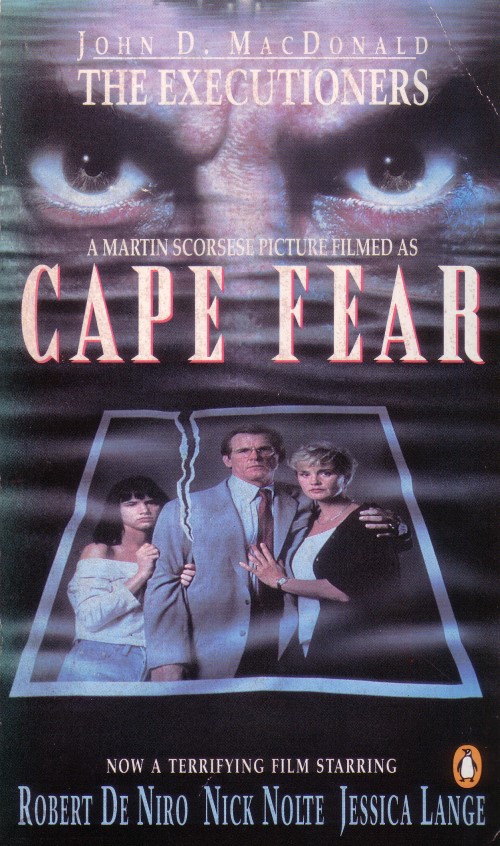
CAPE FEAR – The book of the films

Written in 1957 by John D. MacDonald, The Executioners has the distinction of being filmed twice – in 1962 and 1991. MacDonald died in 1986 so didn’t get to see the Scorsese remake. The title was changed to Cape Fear by Gregory Peck, who produced and starred in the first film. I have to agree with Peck, The Executioners is not really an appropriate title for the book and its theme. (The Executioner series featuring Mack Bolan by Don Pendleton didn’t appear until 1969).


It’s 1956 and Sam Bowden is a dedicated lawyer, a happily married man with a lovely wife, Carol, and three children, Jamie, Bucky and Nancy. Way back in 1943, Bowden was a First Lieutenant on the Judge Advocate General’s Department and became a prime witness in the trial and conviction of staff sergeant Max Cady for the assault on a young woman in an alley. Significant memory – ‘I hard a whimpering in an alley. I thought it was a puppy or a kitten. But it was a girl. She was fourteen.’

Cady got life, but was let out after thirteen years. And Cady began stalking Bowden.

There was no law of harassment in those days. The law seemed helpless, as did Bowden. ‘He swam out with furious energy, but he could not swim away from the sticky little tentacle of fear that had just fastened itself around his heart.’ MacDonald’s prose is littered with gems like this. Another: ‘He could have been a broker, insurance agent, advertising man – until he looked directly at you. Then you saw the cop eyes and the cop look – direct, sceptical and full of a hard and weary wisdom.’

All of the characters are deftly drawn, particularly Bowden’s wife. Although there’s a pall of incipient doom hovering in the absent guise of Cady, there’s humour too. ‘Carol was a good but emotional cook. She talked to the ingredients and the utensils. When something did not work out, it was not her fault. It was an act of deliberate rebellion. The darn beets decided to boil dry. The stupid chicken wouldn’t relax.’

Cady issues veiled threats, but never in anybody else’s hearing. Even when the Bowdens’ dog Marilyn is poisoned, there’s no evidence that it was Cady. In order to protect his family – ‘his four incredibly precious hostages to fortune’, Bowden arrives at the unpalatable conclusion that he must go outside the law to deal with Cady.

‘There are black things loose in the world. Cady is one of them. A patch of ice on a curve can be one of them. A germ can be one of them.’

Near the denouement, MacDonald returns to that significant memory. ‘… heard a faint mewling sound, a hopeless sound of fright and pain and heartbreak so like the unforgettable sound he heard long ago in an alley…’

The book begins and ends with the family on their boat, but unlike the movies the vessel doesn’t play any notable or dramatic part in the story. The beginning is a slow fuse, not recommended in modern thrillers. But it works because MacDonald paints a happy family, creating characters you’re going to care for and worry about. The ending, while realistic, is quite tame by modern standards and much of the action occurs off-screen, which adds to the psychological concern but diminishes the graphic assault on the senses. The ending lingers and perhaps shouldn’t – the screenwriter’s axiom is ‘enter late, leave early’ – and yet it’s a satisfying ending, the calm after the storm. Both Mitchum and De Niro bring suitable menace to a villain who doesn’t have to be in every scene to yet dominate the entire film. As Max Cady does in the book.