Search This Blog

Tuesday, 28 February 2023

ORGAN SYMPHONY - Book excerpts


ORGAN SYMPHONY published by Rough Edges Press

Some crime subjects don’t go away. Organ harvesting is one of them. It crops up in the news from time to time. It’s also the inciting incident that starts this Leon Cazador novel.

Occasionally, I like to book-end a tale – with a quote or image at the beginning and end of the book; for this one, I chose the word ‘heartless’:

August, 2016 - Lazzaretto Piccolo, Laguna Veneto, Italy

Gho Jun chuckled beneath his surgical mask and in his high-pitched voice joked, “Soon our rich client will be heartless, no?”

It doesn’t give anything away to reveal the book’s last line, here:

Carlota nodded. “Truly, Leon, those who ban people from listening to music are heartless.”

By no means exclusively, but in my books (and even some short stories) I attempt to feature places I’ve visited. Here, we go to Venice, Charleston, South Carolina, Cape Cod, Massachusetts, Stockbridge, Córdoba and Torrevieja in Spain and Tokyo. The story ranges from 2016 to 2022.

Nik Morton is really good at creating characters and describing action scenes.’ – a reader’s comment.

Amazon UK: https://tinyurl.com/szhr9s82

Amazon US: https://tinyurl.com/y2hdryym

Organ Symphony – a few excerpts:

By chance all three stayed together, and were trucked to South Carolina. Here, Rafael was taken away – it must have been about two weeks ago – and returned with a bandage wrapped round his body. One of the older kids showed his own operation scar, proudly displaying it as a badge of honor, and said, “They start on the bits we’ve got two of – like kidneys, eyes, lungs...” The rest was left unsaid. (p25)

***

Normally on weekdays they would exercise after waking. With Carlota sitting enticingly on his ankles, he would perform seventy sit-up crunches, alternate elbow to alternate knee, followed by seventy press-ups. Carlota did the same, though she was faster than him – but then again she was younger. After breaking a sweat, they would shower. At the weekend they would refrain and instead perform tai chi in a convenient park for a complete change.

But he’d vowed that on this mini-holiday they would give that form of physical exercise a miss. “Only that form of exercise?” she queried mischievously.

“Quite,” he answered straight-faced. (p97)

***

A mountainous landscape populated by dragons strode out of the swathes of hammam’s steam and approached Leon Cazador and Carlota.

Leon wasn’t surprised when Carlota stifled a gasp.

Hiroki Kuroda was tattooed over his entire torso and down to his wrists and calves. At a glance, he gave the impression that he was wearing long johns; instead, he was a walking exhibition of body art. Ray Bradbury’s Illustrated Man always sprang to mind when Leon saw him, but this was no fantasy. As a member of the Yakuza—a Japanese criminal organization similar to the Mafia, but much older—Hiroki as a much younger man had endured hundreds of hours of pain from a bamboo sliver simply to show that he could. He waved a greeting with his left hand. The little finger should have been missing at the first knuckle, but a shining substitute appeared grafted in place.

Sitting on the wooden slats of the bench, Leon wore light blue swimming shorts and Carlota, on his left, was skimpily covered by a dark green bikini she’d brought for use in the hotel pool but had yet had the opportunity to christen.

Hiroki adjusted the towel about his waist, acknowledged Carlota, and lowered his huge bulk on Leon’s right. (p109)

***

In the blink of an eye Leon raised the pistol and harshly whipped Okudara’s face with the silenced barrel.

The man backed against the shelving and rubbed his chin.

“Carlota,” Leon called over his shoulder, “shoot the other guy’s knees from under him if he so much as blinks!”

Leon aimed his automatic at Okudara’s left knee. “I can even things up,” he said. “You can limp with both legs.” (p167)

***

“We haven’t packed enough clothing to go gallivanting,” Carlota said. “We were only supposed to spend a couple of days in Córdoba.”

“We’re not gallivanting,” Leon corrected. “This isn’t recreation, my dear, it’s hunting.”

She kissed him. “I like it when you put on your serious face. Sends shivers down my spine.”

He hugged her and traced his fingers down her spine. “This isn’t getting the packing done, is it?”

“There’s time for that, don’t fret, my hunter.” And there was; time for everything. (p179)

***

Once they were back in their hotel room, Leon unwrapped the brown-paper parcel. Rose had managed to meet his specifications as to size, stopping power and weight. The Beretta Model 84 weighed a mere twenty-three ounces and was only six and a half inches long, suitable for concealing on Carlota’s person. Its magazine held thirteen rounds.

To fill his shoulder holster he’d opted for a Bernardelli P-018, its magazine holding fifteen 9mm parabellum cartridges. The slightly smaller and lighter Tanfoglio TA90 snugly fitted his ankle-holster; it too held fifteen 9mm parabellum cartridges. Rose had also supplied a spare clip of cartridges for each weapon. Between them they should have enough fire-power to deal with a crop of organ harvesters, he reckoned. (p199)

***

“You’re wet,” he observed. She wasn’t wearing a bra under her clinging white bandeau.

“I can see why you’re a private eye.” She grinned. “Don’t worry, I’m not going to catch my death. The sun and the warm breeze will soon dry me.”

“Hope not – catch death, I mean.” He revved the boat forward.

She stood and moved to his side. “We all die, eventually, darling.”

He hugged her with one arm while steering. “Let us not hasten the inevitable, eh?” (p213)

***

That, I hope, will provide a flavour at least...

Saturday, 25 February 2023

NO PRISONERS - book excerpts


NO PRISONERS

When Leon Cazador discovers the body of a fellow investigator who was working with the British National Crime Agency to infiltrate a pedophile group that uses the pursuit of golf as a cover for their organized abuses, he refuses to chalk it up to coincidence. Seeking justice for his fallen friend, Leon is presented with another missing person’s case. But this one is decidedly different. Diving deeper, Leon finds himself one step closer to uncovering the deadly pedophile ring that took down his comrade. Finding missing persons is all in a day’s work for Leon. But can he fight his ultimate nightmare in a race against time to save a group of innocent children and exact revenge on their abusers?

Amazon UK: https://tinyurl.com/3bmf9ukm

Amazon US: https://tinyurl.com/yz8b63fu

1.

“But you can’t tell me about it,’ Leon said. A statement, not a question.

“I’d like to – you know, unburden myself. The luxury of catharsis. But no, I’ll leave you out of it. Just breaking bread with you helps, even if I don’t divulge any details. I tell you what, though – I’ll never look at golf in the same way again!”

And with that cryptic remark he seemed to cheer up and they had finished the bottle of red.

If only he had quit the job, Leon reflected. Instead, the poor guy had quit this mortal coil. (p5)

2.

Carlota Diaz had high cheekbones which flushed at sight of him. She was twenty-four yet had a mature head on relatively young shoulders, which had served her well in the police – until she was shot in the leg by an escaping felon. Afterwards she’d been offered a desk job but she decided to resign instead. Leon made her a better offer.

She limped up to him, her warm and smooth hands clasping his. “I waited in for you.”

“Thank you. There was no need.” He gently released her hold and shut the door. He was pleased to see her. She was always full of life, a beacon of hope in the gray world he tended to inhabit.

They had a good relationship, despite the difference in their ages; God, it didn’t bear thinking about: he was thirty years older! His heart held a special place for her, but they had not taken it further than the occasional kiss. That age difference inhibited him. (p10)

3.

Wanda stood up at the head of the table and explained: “You all may not appreciate that this is a fairly radical venture. For too long paedophiles have been shunned by society. You’re probably aware that in the bad old days homosexuals were ostracized, hated and hounded, and yet, nowadays, they are widely regarded as ordinary, healthy people, no more ‘ill’ than people who are left-handed. It really is time that paedophilia should perhaps gain similar acceptance.”

“I can’t see that happening any time soon,” moaned Curtis. “I’m no youngster and I fear it won’t happen in my lifetime.”

“Oh, don’t be so pessimistic,” countered Nige. “What PG is doing is quite exciting! The fervent following of a popular sport – what could be more innocuous and acceptable, eh?” (p93) 

4.

From the office safe he took out his Astra A-100 automatic snug in its black leather shoulder holster, and dumped it on his desk.

Then he opened the closet in the corner. He removed his shirt, bunched it in a roll and gave his underarms a swift wipe with it then dropped it in the wastebasket. From the closet he took a black silk long-sleeved shirt and put it on , kicked off his shoes, unbelted his pants and replaced them with a black pair of cargo pants.

Carlota was unfazed. The first time he’d needed to change in a hurry, he’d asked her to go into her office. She’d complied but halfway through changing she’d entered with an urgent phone-call. “Don’t worry,” she’d said, “nudity is no big deal.” So this wasn’t the first time he’d undressed in front of her. Nor would it be the last, he suspected.

He selected a pair of black rock hopper neoprene shoes and fastened them.

She delved into a filing cabinet and handed him two magazines for the gun.

He distributed them in the various pants pockets so they wouldn’t make a noise knocking against each other. Finally, he pocketed two pairs of latex gloves and a set of wire-cutters.

“I guess you’re ready to go?” she said, stroking his cheek. (p111)

5.

Victims don’t stop being victims once they’re dead, Leon thought, facing the sick individual. “I’m not going to shoot you,” he said.

Andrés let out a sigh of relief and hastily crossed himself. Hypocrite.

Instead, Leon kicked Andrés between the legs, putting as much power and anger he could muster into the movement. The contact was immensely satisfying.

Andrés yelped and bent forward, wobbling with his pants round his ankles, trying to retain his balance while intent on clutching his damaged manhood. Next instant, Leon deployed the ninja Fudo-ken, the clenched fist slamming full into the bastard’s nose, shattering the bone structure. While the bone and cartilage probably wouldn’t penetrate this sick person’s brain, the blow would undoubtedly cause subdural hematoma which was bound to deny the brain adequate blood flow. As a result, a biochemical cascade was in all likelihood happening right now as Leon dispassionately watched. Brain cell death was imminent. No great loss to humanity. (p121)

6.

Myriad stars and a full moon shone in the deep blue night sky and reflected in the waters of Marsaskala Bay. Other reflections, from the odd occupied moored boat and buildings, bars and restaurants, diminished the magical effect. Dressed in their gray-and-black wetsuits and wearing their buoyancy compensators, an air tank each, and neoprene gloves and footwear, Leon and Carlota carried the rest of their scuba gear down to the rocky shore. Here, in the light of the moon they did their pre-dive checks on each other – air switched on, all quick-releases and straps secure, visible and within reach, and contents gauges showed “full”. Then they put on their fins and face-masks and swam a short distance into the wide bay and then submerged. (p184)


7.

The far door opened and a man walked in carrying a full bottle of vodka. Replenishment time. He saw them immediately. He was right-handed and the bottle was in his right hand. He fumbled. Instead of dropping the bottle – which would have smashed on the tile floor – he grabbed it with his left hand, clutching it to his chest, then reached for the revolver in his shoulder-holster.

Leon fired once. His bullet went through the vodka bottle, shattering it, soaking the man, and penetrated his chest, the vodka doubtless anaesthetizing the wound in the process. Not that it would do any good. He collapsed noisily to the floor amidst the shards of glass and liquor, dead.

“No prisoners,” Carlota whispered behind him. (p189)


Tuesday, 21 February 2023

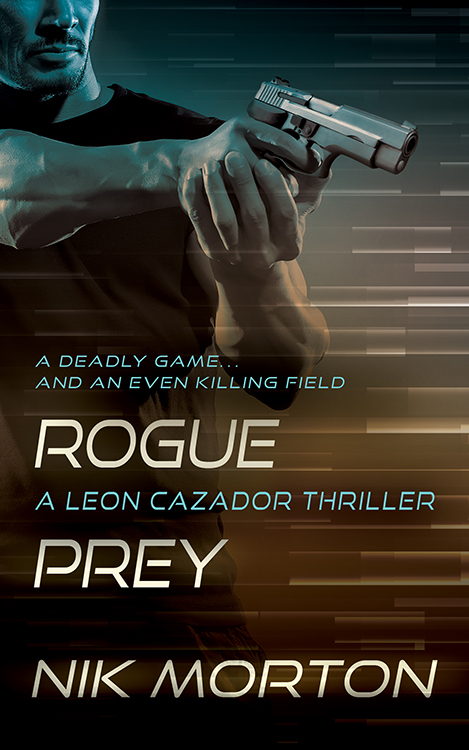
ROGUE PREY - Book excerpts


ROGUE PREY – Published by Rough Edges Press


Kindle currently £0.99/$0.99 - https://tinyurl.com/4s4cbjbt


Each hunter has the same equipment—a sniper rifle, five bullets and a machete. An even killing field.


A corrupt organization in Spain is selling the ultimate thrill. They cater to rich amateur game-hunters who hunger for the privilege of stalking and killing human prey. Their targets are non-persons. In effect, the vile process gets rid of illegal immigrants. Enter Leon Cazador—a half-English, half-Spanish private investigator who occasionally assists the authorities. Eager to take down this immoral organization, he’s tasked with going full cloak-and-dagger. But when his cover is blown and he’s forced to join nine other captives, will he become the hunters’ ultimate prey?

Here are a few excerpts:

‘Oh, I’ve made a kill or two,’ Leon said.

‘Which wildlife have you potted?’ Rudolf asked.

‘Plenty of wild animals.’ Mostly men.

‘Do you collect trophies?’ Harley pressed.

‘No. I just kill.’ Never for pleasure. (p24)

***

‘You’ve been in the wars, I see.’ Mateo indicated the scars on Leon’s torso and arms.

Knife and bullet wounds. But you should see the other guys – in the cemetery.

Mateo said, ‘Lost your tongue, eh?’

Leon recalled a Spanish proverb: Don’t mention the noose in the house of the hanged man. By now, his bruised stomach was advising him not to say the wrong thing anymore. He compromised and shrugged.

Mateo said, ‘No matter. We aren’t here to chat.’

Then the so-called ‘softening-up’ process began. (p40)

***

‘Your silly quips, they hide your insecurity, your fear, I know,’ she said.

‘I hope you don’t charge by the hour,’ Leon said. ‘Your psychoanalysis is sadly very wrong.’

‘You would say that, wouldn’t you?’ She came closer and touched his bare torso, running a hand over a couple of ancient scars. The tip of her tongue wetted her lips. ‘For a man of your age, you have kept yourself fit. A lesser man, taking such a beating…’ She lifted a shoulder fatalistically.

‘I’ll live.’

‘Not for much longer, though.’

‘We all must die sometime. Even you.’ (p49)

***

Baeza addressed Leon and the rest of the so-called targets: ‘I will signal the end of your thirty minutes with a single shot.’ He tapped his holster. ‘That will tell you that our hunters will begin tracking you down.’ He beamed sincerely. ‘And when they find you – which they will – they will not hesitate to eliminate you. All of you. Without exemption. This is an equal opportunity hunt!’

He unholstered his revolver – it looked like a Smith & Wesson Model 500 – and gestured with the barrel. ‘Get ready!’ he bellowed.

He consulted his fob watch and then fired the gun in the air. ‘Go! Run for your miserable lives!’ (p85)

Wednesday, 15 February 2023

TOKYO STATION - Book review


Martin Cruz Smith’s standalone thriller Tokyo Station was published in 2002. I’ve read several of his books and haven’t found a bad one yet. This one is very impressive indeed.

The book spans three time periods: 1922 in Tokyo when the main character Harry Niles is a young boy; 1937 in Nanking, mainly a flashback of Harry’s that reveals the many atrocities committed by the Japanese against the Chinese; and 1941 in Tokyo, some days before the Japanese attacks on Pearl Harbour.

The amount of detail seems prodigious but never swamps the narrative.

Harry was the son of an American missionary couple Roger and Harriet who were absent and busy proselytising most of his formative years. He gets involved with a gang of Japanese kids and quickly learns the language and the tricks of pickpocketing and generally conning people. A chance encounter with a local artist Kato ends up with him running errands and fraternising with his models, among them the beautiful Oharu. ‘To Americans a whore was a whore unless she was willing to be rescued; to the Japanese, a girl sold by her family to a brothel was a model daughter’ (p262).

Harry’s close friend Gen undertakes one of Harry’s errands as a favour and becomes involved with one of Kato’s clients, the enigmatic samurai Ishigami. Years later, Harry is responsible for Ishigami losing face in Nanking and thereafter he is hunted by the samurai. And neither he nor his friends and lovers are safe from the samurai sword…

The switches between the timelines are not labelled, but in most instances it’s obvious when that shift occurs.

Harry’s parents didn’t have much success in converting the citizenry: ‘The Japanese would smile, bow and say anything to move the gaijin along. Or would accept Jesus as a mere backup to Buddha’ (p101).

Harry owns and runs The Happy Paris nightclub. His jukebox operator is Michiko, who possesses a fiery temper and shares his bed. To complicate matters Harry lusts after Alice, the wife of the British ambassador, Beechum: ‘She did crossword puzzles in four languages. Most of the day, she was a brainless thing who spent her life at the Ginza’s shops and smart cafes, but every morning she spent in the code room of the British embassy’ (p168).

The imminent war with the United States is like an oppressive shroud over the Tokyo of 1941.  ‘A cart with metal-rimmed wheels went by, the nocturnal visit of the night-soil man visiting homes without plumbing, gathering what kept the rice fields fertile, the cycle of life at its most basic. The cart moved aside to let pass a van with the crossed poles and looped wires of a radio direction finder on the roof. The van sifted the air for illegal transmissions the way a boat night-rolled for squid. Or, Harry speculated, if the van was from the Thought Police, perhaps they were trying to sift dangerous ideas out of the air’ (p54).

Unusually, there is an instance of a single paragraph running to almost six pages (pp241-247), but Smith can be forgiven as it’s a painful reminiscence of his time in Nanking and his encounter with Ishigami – powerfully done.

Harry’s sexual awakening is finely judged and well told without being prurient. It’s almost poetic: ‘Followed by a profound sleep with Harry folded around  Oharu as if they were riding with their eyes closed slowly through the rain, the heart’s rhythm like a black horse. A faint electric haze lay in all directions. They rode through high grass soughing in the wind’ (p257).

A willow house was an establishment where geishas entertained, and there were plenty of them about. ‘A willow suggested something yielding and feminine, the sort of tree that knelt by water to admire its own reflection’ (p266).

There are suspenseful moments, some others quite grisly, and several finely tuned wisecracks pepper the tale. The characters are fallible, complex and believable. Throughout, Smith captures the time and the place convincingly. Recommended.

Saturday, 11 February 2023

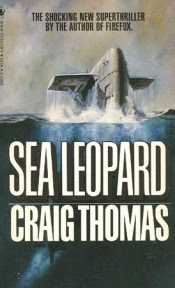
SEA LEOPARD - Book review


Craig Thomas is on top form with his seventh novel, the thriller
Sea Leopard published in 1981.

This adventure again features Kenneth Aubrey, Deputy Director of British Intelligence, and Patrick Hyde, one of his field agents.

The book begins with a map of the North Sea, UK, Scandinavia and Russia and the Barents Sea. This is followed by documents from Plessey, the weapons manufacturer, the SIS, Ministry of Defence and the US Navy Defence Department, all relating to the installation of a new anti-sonar system for submarines, ‘Leopard’.

The nuclear submarine HMS Proteus has the system installed and is running trials at sea when a distress call is detected.

At about this time a search was underway for Leopard’s inventor, Quinn, who has gone missing. Hyde is attempting to track down Quinn. Soviet agents are attempting to abduct Quinn’s daughter, Tricia, in the hope that she will lead them to Quinn’s whereabouts.

The distress call is a trap and the captain of Proteus, Commander Lloyd falls for it.

The tension mounts as a number of Soviet surface ships and submarines play cat-and-mouse with the Proteus – for their sonar is incapable of detecting the British submarine, thanks to ‘Leopard’.

Ingenious methods are deployed by Russian Valery Ardenyev, office in charge of the Soviet Underwater Special Ops Unit to incapacitate the submarine and take the crew captive and then learn everything about the Leopard system.

A rescue mission is then mounted by Aubrey, using USN special agent Ethan Clark.

The suspense mounts, switching from Hyde’s search in England, Ardenyev’s bold assault in inclement weather, Aubrey’s altercations with Ministers and the Navy’s hierarchy, Commander Lloyd’s concern for the safety of his vessel and crew, and Clark’s near-impossible mission on the edge of the Arctic Circle.

 A gripping thriller that time has not spoiled in the slightest. 

Wednesday, 8 February 2023

BEN RETALLICK - Book review


The first of E.V. Thompson’s nine book historical saga, Ben Retallick, was published in 1980. It begins in Cornwall in March 1818. The title character is fifteen and has just survived the flooding of the tin mine where he worked. His father Pearson, 37, also a miner, is suffering from years of working underground mining tin: ‘I’ve spent too many years following tin lodes, Ben. I carry a part of every one of them inside me now.’ In short, he’s finished; the tin in his blood and lungs.  Ben makes the acquaintance of Jesse Henna, a young girl and neighbour. There appears to be a mystery involving Jesse’s mother Maude and the local landowner Sir John Vincent. We will learn the answer in good time. However, when Sir John’s Colman inherits the manor house and land, he casts out the Hennas and encourages his game-keeper Reuben Holyoak to wed Jesse. Colman is not a pleasant man.

Holyoak is unaware of the attraction Ben and Jesse share. ‘In the darkness of the night, with only the stars to bear witness, Ben and Jesse had consummated their love, and Jesse had crossed the threshold of womanhood’ (p100).

Times were hard in those days, and people suffered real grinding poverty, and Thompson reflects this well. All the ingredients are here: suicide, press gang abductions, still-born birth, mob anger, fishermen and tin miners at odds, the imposition of cruel law, death on the gallows, drunken domestic violence, blighted love, poignant deaths, kind-hearted neighbours and social commentary that never dominates the story and characters.

The second volume is Chase the Wind (which surprisingly was published in 1977!).   

Friday, 20 January 2023

FOLLY - Book review

Alan Titchmarsh’s 2008 novel is a romantic story set across generations with a couple of twists.

He’s done this time-jumping before; it’s always a risk: maybe the reader will get confused or even lost. Here, it works well enough. The story begins in 2007 and concerns two long-established businesses in Bath – the Ballantynes and the Kings – both involved in the sale of artwork.

We fleetingly meet Jamie Ballantyne during an auction of some famous paintings, and Artemis (‘Missy’) King. He’s selling, she’s buying. They’d been friends for a long time and then she went off to the US and stayed for five years.

Then we step back into Oxford in 1949. There are four art students who go around together: the rich Honourable Leo Bedlington; John (‘Mac’) Macready, a Glaswegian; Harry Ballantyne; Richard King; and Eleanor Faraday. Both Harry and Richard desired her but neither did anything about it.

Jamie mulled about Missy and her appreciation of the painter Munnings. ‘Where dogs craved affection and cats demanded respect, horses inspired admiration and awe, and any artist who could catch their spirit seemed to her to be peerless. (p76).

In 2007 Missy’s grandfather is Richard and Jamie’s is Harry. Neither knows why, but their grandparents have been at loggerheads for almost sixty years! Nobody talks about it. Jamie’s mother has a streak of common sense to her: the feud’s ‘origins are lost in the mists of time and I think everyone would be better diverting their energies into today, rather than yesterday’ (p271). If only the ‘woke’ who want to rewrite history would listen!

Jamie and Missy reawaken their previous attraction and indeed fall in love. Yet the family feud threatens to confound them.

Skipping back and forth through time, we see how chances are lost, love is not reciprocated, and indeed the reader becomes irritated at the folly of these people who are incapable of revealing their true feelings. Except for Mac; he did just that, with disastrous results!

The descriptions of the period, the art world and the countryside sometimes verge on the poetic and at other times Titchmarsh delivers humour: ‘It seemed as if his inquisitor was in danger, at any moment, of bursting out of his clothes and sending buttons flying to the four corners of the book-lined room. All three chins wobbled as he made his point, and his cheeks were the colour and shade of Worcestor Pearmain apples… (p219).

The final twist was a mite too convenient but clearly Titchmarsh wanted to avoid an unhappy ending! An enjoyable novel, nevertheless.

I blame the editor:

When there only two characters in a scene, there is little need to constantly repeat their names to show who is speaking. In most cases, it will be obvious by what is being said. Also, ‘he said’ and ‘she said’ is adequate. There are a few instances of this issue; and one can be found on page 175.


Monday, 16 January 2023

DEEP DOWN IT MAKES SENSE

Looking back, it seems that although I never actually served in a submarine, my life has been connected to the Silent Service for quite a number of years, in the Senior Service and also civilian life. 

Leaving my parental home in Whitley Bay, I joined the Royal Navy on 18 October, 1965, after taking a long train journey (about 14 hours) from Newcastle upon Tyne mainline station via London to Torpoint, Cornwall. I was reading the science fiction novel Childhood’s End by Arthur C Clarke). I was inducted in HMS Raleigh, one of several RN training establishments, where I learned to march, tie knots, tackle obstacle courses, pass the swimming test wearing overalls, and many other nautical things that comprised Part I Training. From here the ratings were dispersed to a variety of establishments for specialist training, depending on their allocated branch. My branch was Supply and Secretariat (S&S): I was a Writer, which seemed appropriate since I’d written a novel when I was sixteen.

After specialist training in Chatham (Part II Training) I was drafted to the brick ship HMS St Vincent, Gosport, Hants, working in the Captain’s office. [This establishment has since been converted into a school]. My Service Certificate attests that I volunteered for the Submarine Service – though there were not many billets for writers; the branch only served on the larger submarines, not the conventional diesel vessels.

My first seagoing ship was the tribal-class frigate HMS Zulu (F124) which I joined on 27 April 1967 at Rosyth. Our office comprised a staff of two writers and a petty officer writer. Unfortunately in May, while the ship was exercising off Scotland, I developed a resistant cough which alarmed the Sick Berth medic so I had to be landed at HMS Neptune, Faslane – the Clyde Submarine Base. I was diagnosed with urti (upper respiratory tract infection). The shore-based sick bay was my first encounter with submariners.

I was fortunate to have a room to myself – the coughing was quite horrendous and disturbing to anyone else in the vicinity; for me, it was just painful. On the left-hand side of the bed was a bookcase crammed with books. Hitherto, my reading material at the time was spy novels and thrillers, science fiction, Edgar Rice Burroughs, Conan Doyle and Wilbur Smith adventures. In the bookcase, however, I found a good number of books by Agatha Christie, Raymond Chandler, and Georges Simenon, which I read voraciously.

A couple of hospitalised old salts popped in to see me – they’d heard my coughing, no doubt, since it was quite alarming and pronounced – and introduced themselves and asked me if I was on a boat. I said, ‘Yes. HMS Zulu.’

‘That’s not a boat,’ I was told most firmly, ‘it’s a ship. A boat is a submarine.’

‘Oh.’ Well, you live and learn.

When I finished my first seagoing deployment on Zulu – flying from Singapore to UK – I was drafted to the brick ship HMS Dolphin on the staff of Flag Officer Submarines (FOSM) in Gosport on 1 December 1969. Dolphin was the base for the First SM Squadron, comprising conventional submarines and here also was sited the distinctive Tower for training submariners, the SETT – Submarine Escape Training Tank. The SETT was commissioned in 1954 and continued pressurised submarine escape training until 2009.

I worked in the Drafting Office for submariners, an office above Alecto Colonnade. The whole office was transferred to a new building, HMS Centurion, Gosport in May 1970; other drafting office personnel (responsible for surface ship postings) – Commodore Naval Drafting – joined us from Haslemere, Lythe Hill, Surrey. Centurion was ‘commissioned’ 16 October 1970 as the RN pay and records establishment; its computers then were ICL machines.

While there I drafted Supply & Secretariat and Medical personnel to Nuclear, Polaris and conventional submarines. At that time, the squadrons consisted of: First – conventional based at Dolphin; Second – conventional and also Valiant-class submarines based at Devonport; Third – conventional based at Faslane; Seventh – conventional, based at Singapore, though disbanded in 1971; Tenth – the Polaris ‘bombers’ also based at Faslane.

Better to appreciate the living conditions I was assigning the men to endure, I requested a trip on a submarine. Happily, I identified the conventional submarine HMS Artemis which was scheduled for exercise off the Bay of Biscay followed by a brief visit to Newcastle upon Tyne. I joined Artemis alongside at Dolphin and sailed with her for a week or so. As it was a conventional boat, space was limited, the crew hot-bunking – one man on duty, the off-duty man in his bunk, and then vice versa. My bunk was different; it was in the fore-ends, among the torpedoes, with a polythene sheet stretched above me to catch the odd drip from the pipes that snaked along the deck-head. Lying there, I could hear the water rushing against the boat’s hull. For a brief watch period I steered the craft, used the periscope, and later climbed up into the conning tower, where the fresh air was most welcome; while up there, I participated in the excitement of ‘dive, dive, dive’, shutting the hatch on the way down. Needless to say, the rough seas of Biscay did not bother us. At the end of the exercise I thanked the crew and disembarked when the boat moored at the Tyne quayside; and I went home to Whitley Bay to see my parents for the weekend! Then I rejoined the office, greatly appreciative of the confined conditions the submariners lived and worked in.

Out of this experience I wrote my first short story sale, ‘Hover-Jack’ for the weekly magazine, Parade published in 1971: a spy story featuring a Soviet submarine and the Isle of Wight hovercraft!

The Navy News published two of my articles on the mechanics of drafting to submarines: ‘Giving deep thought to submarines’ and ‘How they filled Cornucopia’.  I created the fictional HMS Cornucopia for illustration purposes. At the time – I cannot speak for the present – there were never enough volunteers for submarines. Naturally, drafting officers would accept those who volunteered – providing they passed what was termed Part III Training, which entailed classes in the Submarine School in Dolphin, which included safety procedures and undergoing the Escape Training in the SETT. To fill the SM quota, certain personnel would be drafted into submarines who had not volunteered; their initial draft was for five years, after which they would be returned to the surface fleet. However, when the five years were due to expire the vast majority of those non-volunteers elected to remain in boats – around 90% –  partly due to the additional pay but also by then they were well-versed in the ethos of the Silent Service, which was essentially a small navy within the Royal Navy.

Every RN rating completed a drafting preference card (DPC), asking for a preferred base – in those days there were a lot more bases than nowadays. Every individual’s personal card showing current draft and previous billets, together with his DPC and was held in a whirligig (see photo below; I'm at the end of the office, with beard).


The idea was to balance sea-time with a certain amount of shore-time; this would vary depending on the particular branch. Submarine squadrons also had a ‘spare crew’, men drafted here who still might have more sea-time to clock up before being sent for a longer stay in a shore base. This spare crew was available at short notice to plug gaps due to illnesses and other absences; it was popular for some who preferred going to sea, but not for everyone, as they found it unsettling.

Several of the FOSM staff visited Barrow-in-Furness to give talks about the process of determining who to draft. While there we descended into the dry dock of HMS Conqueror. The words iceberg and surface sprang to mind; the screws were huge, gleaming, almost like gold, like something out of science fiction.

My time with submarine drafting ended in 1974 when I was drafted to RNH Mtarfa, a RN hospital in Malta near Rabat three months after marriage. On return in 1975 I underwent the Leadership Course at HMS Royal Arthur, Wiltshire, and then joined HMS Mermaid (F76) in March 1976, a few days after our daughter was born.  

In June 1977 I was reacquainted with submariners, being drafted to HMS Neptune, the Clyde Submarine Base; it was the day before my birthday, great timing! This was the home of four Resolution-class Ballistic missile Polaris submarines – below is a photo of one in the 1970s.


I was in charge of the Central Records Office, staff comprising seven naval personnel (male and female) and I also had the responsibility for several civilians, such as messengers, the typing pool, and the print room. The Head Messenger was a mine of information, since he’d been there a long time; he was due to retire and join his family in Canada so was not averse to apprising me of certain civil service goings-on.

For example: Every civilian was entitled to a certain number of days per year sick leave without the requirement of a doctor’s note; they made sure they took their ‘sickies’ – effectively looking on them as additional leave entitlement.

Before my time there, during a mail strike, two Glaswegian messengers were tasked with taking the RN van into the nearby town of Helensburgh and picking up the mail – and regularly popping into the local hostelry for a couple of bevvies before returning to the base with the mail sacks. No problem. However, after the strike ended, they continued doing this for well over a year.

Thus apprised, I pointed out to the pair that there was no longer any need for them to make the journey and taxpayers’ money was being wasted. They objected and brought in their union representative. The Commodore was not best pleased as this business was about to be blown out of all proportion, with a strike being threatened. I was told to sort it out, and arranged for a meeting with the union representative and the two messengers. That weekend at home I didn’t sleep too well. Fortunately, on the Monday, after I put my reasoned argument, the union man admitted that the two guys in question had enjoyed a good run but it must come to an end; we agreed on a compromise, giving them until the end of the month to desist.    

I left Neptune 9 October 1979, and returned to HMS Centurion until my draft to the Leander-class frigate HMS Diomede (F16) and had no further involvement with submarines whilst serving in the RN.

During our fifteen years living in Spain, Jen and I visited Cartagena a few times and saw the submarine Peral on display in the harbour. The craft was the first successful full electric battery-powered submarine. It was built by the Spanish engineer Isaac Peral for the Spanish Navy and launched in 1888. She was armed with two torpedoes. Yet, after two years of successful tests, the project was terminated.

Near our home in Spain is the town of Torrevieja. Here, in the harbour, is a submarine tourist attraction – S61 Delfín – Spanish for Dolphin.

Returning from our family’s lengthy sojourn in Spain, we moved to Blyth, Northumberland, which had been a submarine training base over many years.  During the First World War Blyth was the base for the depot ship Titania and submarines of the Eleventh Flotilla that were to support the Grand Fleet. Apparently, at the battle of Jutland, a Blyth-based submarine took part in the engagement and was credited with sinking a German warship.

At the time of the Second World War the Blyth base was named HMS Elfin and became a training base for about 200 officers. There is now a blue plaque signifying the position of the submarine base (see photo below); near the Blyth Boathouse and Caboose restaurant.


The S-class submarine HMS Seahorse was a member of the 2nd Submarine Flotilla whose wartime base was Dundee. After a number of unsuccessful patrols in the north-sea, the boat would often stop at Blyth, as the base was nearer its patrol area. On the night of 25 December 1939, before Seahorse would depart for her sixth war patrol off Heligoland Bight, seven submariners visited the Astley Arms, Seaton Sluice. Tickets for a raffle were being sold for a bottle of Johnny Walker Whisky. By the time of the draw, the submarine was at sea. As luck would have it, the submariners had won the bottle, but it was not collected. Seahorse’s orders were to initially patrol off Heligoland and then move to the mouth of the Elbe on 30 December. She was expected to return to Blyth on 9 January 1940. It was assumed that she was struck by a mine but after examining German records at the end of hostilities it was considered possible that she could have been sunk by the German First Minesweeper Flotilla which reported carrying out a prolonged depth charge attack on an unknown submarine on 7 January. Another possibility is that she was rammed and sunk by the German Sperrbrecher IV/Oakland southeast of Heligoland on 29 December. Seahorse was the first British submarine lost to enemy action. The whisky bottle remained untouched at the Astley Arms for many years until it was eventually transferred for display at the RN Submarine Museum in Gosport, Hants.

On display in the Blyth Community Hospital is the name-plate of HMS Onslaught. (I used to draft personnel to this Oberon-class boat). On the boat’s visit to Blyth in 1979 the officers and crew were given the Freedom of the Borough of Blyth. Onslaught was decommissioned in 1990, having served for twenty-eight years, and eventually scrapped at Aliga, Turkey in 1991.

Not far from the hospital, outside St Mary’s Church alongside Blyth’s regenerated town square, is a memorial and an anchor. The anchor (seen below through the silhouette) belonged to the T-class submarine HMS Tiptoe. She was named by Winston Churchill, implying that the boat could approach the enemy silently as if on tiptoe. The Royal Navy naming committee was against the name, arguing that ‘it was derogatory to one of His Majesty's ships’, but the Prime Minister had his way. The vessel had links with the Royal Ballet and Moira Shearer; its crest features a ballet dancer.


So far, that seems to be my involvement with submarines and submariners. I think it is quite apt that I should settle in a town that honours the Silent Service.

***

Jargon:

Boat: Submarine

Branch: Specialisation, such as Seaman, Communications, Medical, S&S, and Weapons.

Draft: Soldiers and airmen are posted but naval personnel are drafted.

Deck-head: ceiling in a ship or submarine

Fore-ends: the front of a submarine

Target: any enemy surface vessel

Friday, 13 January 2023

MOUNTAIN KILLER - Book review


 Mountain Killer is the first in a series concerning the Tales of Tom Mix by Scott McCrea (2022).

This adventure takes place in 1911 when Mix was thirty-one and a marshal of Dewey. By this time he had already starred in films and was well known. ‘Sheriff Kohl liked the showman-Marshal well enough, but suspected there was more show than sand in Tom Mix’ (p1).

On his way to give a talk to some Texas Rangers, Tom’s passing through the small city of La Mort Sanglante in the Oklahoma mountains. The place twenty-five years back had been a tent city but now was quite prosperous, virtually owned in its entirety by Mr Pierre Cavanagh. The previous night Mrs Evelyn Cavanagh was savaged by a bear, probably the notorious Big Claw, in her mansion’s library. Sheriff Kohl invites Mix to help out in an unofficial capacity.

The blurb tells us so it isn’t giving anything away to reveal that Mix suspects that the woman’s death was not caused by a bear but by a man.

How he arrives at this conclusion and his relationship with the various townsfolk keep the reader guessing. What seems likely is that some incidents over two decades ago are now casting fatal shadows over the township. The threat is decidedly real: while escorting Cavanagh’s pretty daughter Hillary they are shot at – whether that’s by a disgruntled film critic, an old enemy from Mix’s past, or a particularly talented bear remains to be seen.

It is clear that Mix has an eye for the ladies – not least the plucky Hillary – which is not surprising, perhaps, since he was married five times. During these events he was married to his third wife, Olive and nothing improper occurred.

Indeed, there are enough fascinating and amusing characters to enliven the story, not least the alcoholic Doc Gamble, the reclusive governor Suchet and his giant of an Indian butler-cum-bodyguard, Morgan.

There are also some amusing asides and observations to balance the grim killings in this engaging tale.

McCrea has created a likeable hero who clearly has the potential for many adventures: this one is followed by Savage Mesa, Cowboy Justice, Deuces Wild and Hogg Wild in that order.