Search This Blog

Friday, 11 February 2022

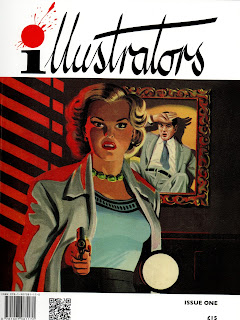
Illustrators Quarterly Magazine - #1


The ongoing series of quarterly perfect-bound full colour magazines began with this issue in 2012.

Anyone interested in illustrating art will cherish these magazines.

This issue features a lengthy article about Denis McLoughlin – 44 pages lavishly illustrated with his often gritty book covers. McLoughlin mainly concentrated on hard-boiled crime but also westerns, including the Buffalo Bill annuals I recall from my childhood. Indeed, McLoughlin, who hailed from Bolton, Lancashire, was so knowledgeable about the Old West that he produced The Encyclopedia of the Old West (original title Wild and Woolly) in 1975: a veritable mine of information!

There follows 22 pages of an interview with artist Ian Kennedy. Again, every page features samples of his comic illustrations and paintings, notably from the Commando comics that have been around since 1961. An outstanding artist, sadly missed (he died 5 February this year).

Next is a feature on the ‘Alluring Art of Angel Badia Camps’, one of a host of Spaniards who began plying their trade in Britain to good effect in the 1960s. We get fifteen pages of samples of his work from the covers of romantic fiction and women’s magazines; distinctive, atmospheric and colourful.

Two regular features are: The Gallery and The Studio. For the Gallery there are six pages of ‘the Fin de Siècle Erotica of Cheri Herouard’. He illustrated the covers of La Vie Parisienne, but also posters, postcards and menus. The Studio features Mick Brownfield’s iconic Christmas cover of the Radio Times in 2009 with Santa and a Dalek. The end pages consist of art-book reviews and contact details for art supplies, illustrators, museums and other related subjects.  

Copies of most back issues are still available, many at reduced prices.

It’s published by The Book Palace and can be obtained through their website www.illustratorsmag.com. Back issues can also be obtained from www.booksaboutart.co.uk.

The Book Palace also issues, from time to time, special issues on certain illustrators, and most of these are destined to become collectors’ pieces.

Tuesday, 8 February 2022

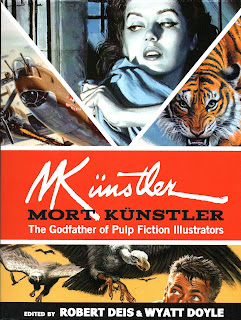
Mort Kunstler - The Godfather of Pulp Fiction Illustrators

Mort Künstler – The Godfather of Pulp Fiction Illustrators

Edited by Robert Deis & Wyatt Doyle


My daughter bought this for me for Christmas.

There are 110 pages; the first ten comprise illustrated text – reminiscences by Mort about how he got into the illustrating business. For many years he’d turn out three covers and two interior illos for men’s adventure magazines. He also worked for other publishers at the same time, ‘twelve-hour days, fifteen-hour days, sometimes seven days a week.’

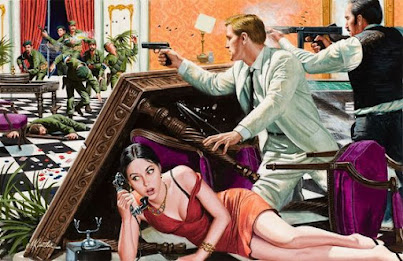
The remaining pages are full colour full page paintings full of action from magazines between 1952 and 1972. He also produced lots of film posters for adventure films such as The Poseidon Adventure and The Hindenburg, as well as advertising promotions and then broke into historical paintings for The National Geographic.

He relates that the word 'künstler' means ‘artist’ in German.


If you appreciate art, this book is an excellent addition to your collection.

Monday, 7 February 2022

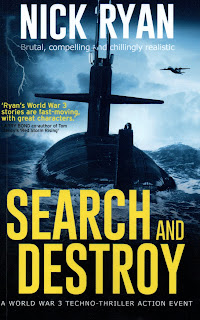
SEARCH AND DESTROY - Book review


Nick Ryan’s sixth book in his World War III techno-thriller series is gripping stuff. Where the earlier books relate to combat in Europe, this one concerns submarine warfare in the Pacific against China.

Commander Chris Coe is an old-school submariner and is abrasive with regard to his XO, Richard Wickham, so we have two types of conflict – personal and military.

The nuclear boat Oklahoma City is tasked with searching for a Chinese convoy and destroying it. The technical details seem authentic: the tension is raised as the vessels employ counter-measures, guile and gutsy experience.

Interestingly, Ryan’s website gives a blow-by-blow account of WWIII – without recourse to nuclear weapons! He must have been prescient, anticipating the January 2022 announcement from the five powers that they would not resort to nuclear weapons in any conflict!

The website is www.worldwar3timeline.com – and it makes fascinating reading. Gradually, he appears to be writing thrillers of similar length based on this timeline.

Let’s hope it all stays as fiction.

Editorial comment

Nothing that follows spoiled my enjoyment and appreciation of the book. However:

I bought the paperback so my comments relate to that; some of the comments won’t apply to the e-book version.

The cover is excellent. However, there’s no text on the spine. This mitigates buying/collecting any others in the series as they'll all be 'anonymous' on my bookshelves!

As this was published on Amazon, I must assume Mr Ryan is using Kindle Direct. Any book published in this system can have spine text if the page-count is in excess of 130. This book has 185 pages; so no excuse.

There are no page numbers! (I agree, this doesn’t matter for an e-book). The new KDP process requires creating an e-book first. But the text that is loaded can contain headers and footers, including page numbers; the second process is converting to a paperback where these features will show in the paperback. [Check out my book Mission: Khyber, a psychic spy novel in paperback and e-book, which shows how it can be done.]

Chapter headings are cramped and amateurish.

Typos listed below aren’t traceable by page number – see above!

‘dressed in hiv-viz colored vests’ should be ‘hi-viz’.

It may be different in the US Navy, but certainly in the Royal Navy, when referring to the 24-hour clock, only the number is used: 2300 – not ‘2300 hours’. The British army and air force use the suffix ‘hours’ however.

‘loosen the reigns’ – should be ‘reins’ [occurs more than once, I think]

‘computer-like monitor’ – surely it should simply be ‘monitor’?

‘carried a compliment of largely outdated torpedoes’ – should be ‘complement’ [this occurs twice]

‘sober expressions on his officer’s faces’ – this should be ‘expressions on his officers’ faces’ – there’s more than one officer so the apostrophe follows the ‘es’.

‘men poured over the imagery’ – should be ‘pored’.

‘Code strode into the wardroom’ – should be ‘Coe’.

‘tone was edge with frantic desperation’ – should be ‘edged’.

‘taut and nerve-wracking minutes’ – should be ‘nerve-racking’ (as if the nerves are on a rack; wrack is seaweed)


Friday, 7 January 2022

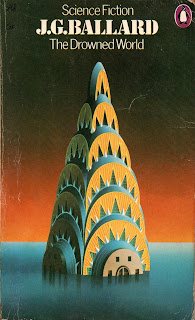
THE DROWNED WORLD - Book review


Although J.G. Ballard had many short stories published, it was his second novel, The Drowned World, published in 1962 that established him as a writer of note, infusing his work with the emotional significance of ravaged landscapes and destroyed technology.

Dr Kerans was among a group of scientists studying the effects of the Earth’s transformation. Some six decades earlier severe solar storms stripped away much of the ionosphere and left the planet prey to increased solar radiation, which resulted in the polar ice melting and the oceans rising. Now, he and the team – comprising Dr Bodkin, Lieutenant Harman, Colonel Riggs, Beatrice Dahl and several troopers – dwelled on a waterborne testing station in a sunken London which more and more resembled the Triassic age. ‘Like an immense putrescent sore, the jungle lay exposed below the open hatchway of the helicopter.  Giant groves of gymnosperms stretched in dense clumps along the roof-tops of the submerged buildings…’ (p53). There were islands of silt, where exotic plant-life thrived and alligators roamed as their primordial ancestors had aeons ago. ‘A thick cloacal stench exuded from the silt flat, a corona of a million insects pulsing and humming hungrily above it…’ (p61) Enclaves of the surviving population existed in the northern pole area.

Confusing disorientating dreams invaded the group’s consciousness, while waking and sleeping. Kerans believes humankind is regressing mentally to a prehistoric age, doubtless affected by the heat of the sun, minds entering ‘time jungles’ of uterine dreams, submerging into their amniotic past, experiencing archaic memories: ‘However selective the conscious mind may be, most biological memories are unpleasant ones, echoes of danger and terror. Nothing endures for so long as fear.’ (p43)

What set Ballard apart from a lot of his contemporary sci-fi writers was his mastery of the metaphor and his ability to describe in effective detail the cataclysmic worlds he envisaged. Such as: ‘like the heady vapours of some spectral grail.’ (p46). Or: ‘Overhead the sky  was vivid and marbled, the black bowl of the lagoon, by contrast, infinitely deep and motionless, like an immense well of amber.’ (p47) And: ‘Now and then, in the glass curtain-walling of the surrounding buildings, they see countless reflection s of the sun move across the surface in huge sheets of fire, like the blazing faceted eyes of gigantic insects.’ (p40)

Not a great deal happens, perhaps echoed here: ‘… a white monitor lizard sat and regarded him with its stony eyes, waiting for something to happen.’ The heat, the humidity, the pressure on the brain, all combined to wear them all down: when it came time for Riggs to move the team north, there was considerable reluctance to go: the ennui of lotus eaters corrupted their reality. However, escape, conflict and encounters with renegade groups liven things up.

Like many of his tales, this book depicts the gradual disintegration, both physically and mentally, of a man. Significantly, Ballard uses the phrase ‘Day of Judgement’ twice.

Interestingly, when Ballard writes ‘Staring out over the immense loneliness of this dead terminal beach, he soon fell into an exhausted sleep’ (p168), he is using the title of a short story published in New Worlds in 1964: ‘Terminal Beach’, which later became the title of a collection of his stories.

Editorial comments:

Two main protagonists are Kerans and Riggs – both names ending with an ‘es’. There’s nothing wrong with this, but some writers tend to avoid adopting such names, primarily because of the possessive apostrophe – Kerans’s or Kerans’, for example – which can appear clumsy.

‘… a warning shell from his flare pistol.’ (p31) ‘Warning’ seems incongruous since flares invariably were used to signal distress, not a warning.

Good to see he uses the phrase ‘he murmured to himself’ (p34) instead of the ludicrous but ever popular phrase among many published writers, ‘he thought to himself’.

 ‘He was talking to Beatrice and I when it happened…’ – should be ‘Beatrice and me’.

‘His bare feet sank into the soft carpeting…’ (p149), This would be disastrous for his bare feet, as the place had been seriously vandalised with broken glass everywhere!

Monday, 27 December 2021

Jack Higgins - Review of two early thrillers


HELL IS TOO CROWDED

This is an early Jack Higgins novel, originally published under his real name Harry Patterson in 1962, reprinted by Fawcett in 1976 and reissued here in 1977 with the name-change and the strap-line ‘by the author of The Eagle Has Landed’.

It’s a pot-boiler and reveals that Higgins was learning his trade.

Matt Brady was inebriated when he met the woman; he was ‘caught between the shadow lines of sleep and waking when strange things fill the mind’ (p5). One wonders if Higgins was alluding to the Joseph Conrad book The Shadow Line (1917) which depicts the threshold of a young man entering adulthood at sea. The woman was wearing a trench-coat and a scarf ‘peasant-fashion’.

‘A ship moved down the Pool of London sounding its foghorn like the last of the dinosaurs lumbering aimlessly through a primeval swamp, alone in a world that was already alien.’ (p5) Here, Higgins might be referencing Ray Bradbury’s classic short story ‘The Foghorn’ (1951).

Once in the woman’s apartment, he accepts a drink and abruptly passes out. When he comes to, the police are in the room and the woman is dead – her face brutally damaged… Brady is sent to prison for life. He must escape, however, to prove his innocence, which he does manage with some inside help. The trail leads him to several individuals, one of whom is Das who is a proud owner of a Ming vase among other items. In his desperation to get answers, Brady threatens to destroy the valuable vase. (This will be echoed in The Dark Side of the Island when the doctor Van Horn is threatened by the Nazi’s in a similar way).

Brady is befriended by Anne, a young woman, the daughter of a friend who has died. She believes in his innocence. The story behind the woman he was accused of murdering is revealed about three-quarters through the book; after which it’s a case of tracking down the real murderer.

There are several deaths before the denouement is reached.

The book was originally published in the US, I assume, since there were references to ‘color’, ‘hood’ of a car instead of ‘bonnet’, and ‘sidewalk’. Higgins may have been attempting an American point-of-view since Brady was from the States; however, there were other instances of the spelling ‘colour’. These were the days when publishers actually employed people to change the trans-Atlantic vocabulary as appropriate; now, they tend not to bother. None of this spoils the story-telling, which is page-turning.


THE DARK SIDE OF THE ISLAND

This is another early Jack Higgins novel, originally published under his real name Harry Patterson in 1963 and reissued here in 1989.

It’s a pot-boiler and reveals he was still learning his trade.

Seventeen years after fighting in the Second World War Hugh Lomax returns to the Greek island of Kyros. The last time he was here he’d been on a secret mission to destroy a vital Nazi radio station. Betrayal and capture followed and he barely escaped with his life. Now, he was back to find out the truth.

The Greek islanders haven’t forgotten him and indeed blame him for talking under Nazi interrogation and costing many innocent lives…

The book is split into three parts: 1) Lomax’s return and being confronted by antagonistic islanders; 2) Flashback to the actual landing on the island and the sabotage and escape and capture; 3) Lomax’s life threatened by the islanders while he seeks the truth.

There’s Katina, a local girl, who wears a scarf ‘peasant-fashion’. She’d been a teenager when they’d met in the war; now she was a mature woman who believes in Lomax’s innocence. Resident ex-pat Van Horn is a successful author and doctor; he’d been useful doctoring during the war. Van Horn was also an archaeologist and had a valuable collection, some of which was broken by the Nazi Steiner. Then there are the few Greek men who survived the Nazi depredations: Alexias, Dimitri, Nikoli, among a few others – any one of whom might have been the traitor…

The story is fast-paced, workmanlike, but the denouement is no great surprise.

Definitely, one for the Jack Higgins completists.

Editorial comments:

Some of Jack Higgins’s favourite words and phrases that are often repeated: ‘somehow’, ‘somewhere’, ‘moment’, ‘a frown on his face’. And: ‘heavy’ – ‘He pushed open the heavy glass door, crossed the heavy carpet soundlessly…’ (TDSOTI, p112).

These were early novels and his apprenticeship eventually paid off with his thirty-sixth novel, The Eagle Has Landed in 1975. The lesson here is blatantly clear: keep writing and improving.