Search This Blog

Showing posts with label Travis McGee. Show all posts

Sunday, 6 August 2017

Book review - The Redemption of Charm


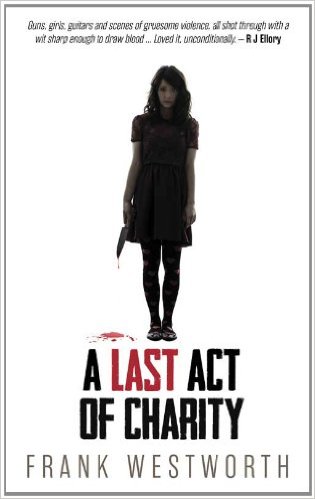
Frank Westworth’s The Redemption of Charm is the third in the Killing Sisters trilogy, following on from A Last Act of Charity and The Corruption of Chastity, all featuring hard-man  John-Jacques Stoner, known by most as JJ. The three killing sisters are Charity, Chastity and Charm.


You don’t need to have read the first two books, though there are inevitably back-references to incidents and characters. At the beginning of this book, JJ is in the United States, possibly in hiding, slowly recovering both mentally and physically from the trauma of betrayal, corruption and extreme violence in the previous book.

‘… his mind was healing as his body hardened. That as the fracturing inside his head knitted itself, so the flab of a civilised lifestyle was leaving his muscles, which were tightening and lightening, becoming tougher and stronger. Both his body and his brain were preparing for a fight. Flight was over; the time to fight was still over the horizon, but its presence was inescapable, looming insistent, and oddly welcome.’ (p42)

JJ does violence very well, too, as a few stroppy mugging bikers discover in a neatly choreographed example of aggression (pp33-36).

Chastity is an interesting character, who hungered for bookstores and cities rather than the big open air spaces. She hated driving in the city: ‘She could have been the original sufferer from road rage, and found intolerable the stupid behaviour of fools who should in her view never have been granted a birth certificate, never mind a driver’s licence. City streets were filled with potential accidental murderers at the wheels of heavy weapons.’ (p125)

The novel is peppered with similar philosophical asides, which reminded me slightly of the late great John D. MacDonald’s Travis McGee. One of JJ’s Stateside pals is an FBI agent, Travis, though of a different complexion!

Another enjoyable aspect is the wit and word-play: ‘(JJ) simply appeared to lack both curiosity  – which was famously fatal to felines – and appeared also to be wondrously capable of detaching himself from everything unimportant to him.’ (p127)  When another of JJ’s pals remarks, ‘I am a believer’ JJ responds, ‘Great song, wasted on monkeys.’ Yes, he is corrected: ‘Monkees, like trainee monks…’ (p221)  And the word-play seems inexhaustible; indeed, as Stoner is an ex-soldier, an assassin, which is also referred to as a stone killer. (p268)  There are plenty more instances, but I’ll confine myself to only one more. JJ is wearing a pair of camo-pattern biker pants with reinforced knees. Chastity suggests, ‘Useful for aggressive praying.’ (p362)

And we know where sympathies lie. ‘… politics is a much dirtier game than contract killing.’ (p203)

Ultimately, JJ is on a quest to silence whoever has most recently wrecked his life, or die in the attempt. He now trusts very few people, understandably. Can he trust Chastity and Charm? And what about the murderous Irish femme fatale Blesses?

Gritty, often raw in language, and brutal at times, with graphic sex, this convoluted plot is not for the easily offended. It is however a fascinating excursion into the psyche of JJ himself, a character who leaps off the page, whether he’s riding his Harley or playing his guitar or chilling out with cool torch singers, or delivering his own form of justice. Just don’t let grandmother read it – unless she was a gangster’s moll in a former life…


Tuesday, 7 April 2015

Travis McGee - Book Chronology

If you've read this blog

http://nik-writealot.blogspot.com.es/2015/03/ffb-cinnamon-skin.html

or have an interest in John D. MacDonald's Travis McGee crime series, then you should enjoy this illuminating article which involves quite a bit of detective work too:


Below are the first 8 covers from my collection of 19 books in the series. I like the uniform approach (though the man shooting is a bit naff, perhaps, and was dropped by #8). The spines also reflected the colour of the title up to and including #6.


Thursday, 12 March 2015

FFB - Cinnamon Skin

The penultimate Travis McGee novel by John MacDonald was published in 1982. I read the first in the series, The Deep Blue Goodbye (1964), in 1968 and was hooked. He wrote twenty-one McGee books. For the last few years I’ve been holding back from reading the final few; now, only one more to go – The Lonely Silver Rain (1985).

As can be guessed by the above, all the McGee titles feature a colour – pink, purple, orange, brown, gold, red etc – and the colours are juxtaposed with an unusual noun or adjective: Nightmare in Pink (1964), A Purple Place for Dying (1964), A Tan and Sandy Silence (1971), The Scarlet Ruse (1973) and Darker than Amber (1966), for example. The latter was made into a film starring Rod Taylor as McGee; The Deep Blue Goodbye is scheduled to star Christian Bale and Rosamund Pike.

Cover photo by Tony McGee!
 
McGee is a ‘salvage consultant’ – he finds things and people for his clients, often at great personal risk. He takes a percentage of the retrieved booty, usually.  McGee lives on a houseboat, The Busted Flush, in Florida, and his best pal is economist Meyer, who lives on the John Maynard Keynes – well, that’s where Meyer used to live until in this novel the boat is blown to smithereens, together with Mayer’s niece Norma and her new husband Evan.

A chance photograph alerts McGee to some dastardly chicanery and together with the grieving Meyer he starts digging. It isn’t giving too much away (since the blurb does this anyway), but it seems that Evan ‘had a lot of names in a lot of places, a lot of financial windfalls after a lot of deaths,  and a lot of dead wives…’

At the end of their last caper (The Green Ripper, 1981), Meyer was totally demoralised and was only gradually recovering when this latest tragedy occurred. Slowly, Meyer began to return to his old self, and after one brief moment of revelation, McGee says, ‘I’ve missed your impromptu lectures.’ To which Meyer responds, ‘Be careful what you say, I may try to make up for the lost year.’

‘I haven’t missed them that much,’ McGee ends (p152). Here and elsewhere, MacDonald injects humour, because life is like that. It isn’t all dark, or all light for that matter.

This begins as a slow burn story, until the explosion occurs, then the suspense and tension mount as the pair start asking questions.

Somebody once wrote that MacDonald needn’t attempt to write the American Dream novel, as each of his McGee books did that, an episode at a time, exposing the socio-political scene, not only in Florida, but the US as a whole.

MacDonald commits the cardinal sin of having his characters speak for very long paragraphs, which is unrealistic, but we forgive him because his characters always have something interesting to say, whether you agree with the viewpoint or not. And sometimes there are special insights. Here’s a snippet from p63: ‘The future managers have run on past us into the thickets of M-Basic, Fortran, Z-80, Apples and Worms. Soon the bosses of the microcomputer revolution will sell us pre-programmed units for each household which will provide entertainment, print out news, purvey mail-order goods, pay bills, balance accounts… But by then the future managers will be over on the far side of the thickets, dealing with bubble memories, machines that design machines, projects so esoteric our pedestrian minds cannot comprehend them. It will be the biggest revolution of all, bigger than the wheel, bigger than Franklin’s kit, bigger than paper towels.’ That’s quite a jump to now from 1982. And he couldn’t resist the humour of ‘paper towels’, either.
 
McGee is a moral man but on occasion he has to be dishonest when obtaining information. He doesn’t like it, but it’s necessary: ‘No matter how many times you do it, how many times you pretend to be someone you aren’t, and you get the good-hearted cooperation of some trusting person, you feel a little bit soiled. There is no smart-ass pleasure to be gained from misleading the innocent.’
 
Though not religious, McGee believes in evil. ‘I start with the assumption that there is such a thing as evil which can exist without causation. The black heart which takes joy in being black… the rogue.’ (pp132/133).
 
MacDonald died in 1986, aged 70.

Friday, 13 July 2012

FFB – Free Fall in Crimson by John D. MacDonald

Published in 1981 – some five years before MacDonald’s death, aged 70. This was the 19th Travis McGee adventure. Besides each novel title featuring a colour, they also contained delectable female companions, nasty villains, exotic locals such as Florida, Mexico and the Caribbean. McGee’s sidekick, friend and sounding-board is Meyer, an economist and Ph.D. McGee lives on his 52-foot (16 m) houseboat, the Busted Flush, named for the poker hand that started the run of luck in which he won her, and introduced in the first novel, The Deep Blue Goodbye. She is docked at Slip F-18, Bahia Mar marina, Fort Lauderdale, Florida.

This time around, McGee is tasked with finding out who murdered the millionaire cancer-riddled Ellis Esterland. His enquiries take him into the macho world of outlaw bikers, the crazy lives of film producers and actresses, and the dangerous pursuit of hot-air ballooning. This time around, his female companion is the luscious Anne Renzetti, ex-secretary of the murdered tycoon. Sometimes, his prose is hard-nosed and at other times, it’s lyrical, viz: ‘… moving in that sweet silence across the scents, the folds, the textures of the soft green April country’ when describing McGee’s first air-balloon journey.

MacDonald’s McGee crime books are hardboiled. Along the way, his first person narrative reveals the flawed American Dream.

Surprisingly, times haven’t changed – some 31 years later. As one character says, ‘But lots of terrible things are happening everywhere, I guess. Why is everybody getting so angry?’

Today, lack of driving standards is bemoaned. Nothing new there, then: ‘growling traffic, the trucks tailgating, the cowboys whipping around from lane to lane, and the Midwest geriatrics chugging slowly down the fast lanes, deaf to all honkings.’

Craftily, MacDonald uses Meyer to write about things that irk him, such as declining literacy. The Meyer speech is too long to reproduce here, but this is a taster: ‘In a nation floundering in functional literacy, sinking into the pre-chewed pulp of television, it heartens me to know that here and there are little groups of younguns who know what an original idea tastes like, who know that the written word is the only possible vehicle for transmitting a complex concept from mind to mind, who constantly flex the muscles of their heds and make them stronger… Nor will these children be victimized by the blurry nonsense of the so-called social sciences. The muscular mind is a cutting tool, and contemporary education seeks to take the edge off it.’

Yes, he breaks the rule about characters spouting long swathes of speech, but he seems to get away with it. Because he’s good, very good. I'd recommend any Travis McGee to anyone who has never tried one. This, like the others, is well crafted, with believable characters.