Search This Blog

Showing posts with label Geordie. Show all posts

Wednesday, 30 June 2021

Hannah Robson - book review

Brenda McBryde’s novel was published in 1991.


Set in the 1680s in Northumberland, Hannah Robson evokes the period well from the traumatic beginning where twelve-year-old Hannah witnesses the painful and bloody birth of her baby brother, to the satisfying end several years later.

Witnessing that birthing event, Hannah swore she would never marry or have children. She was a hard worker on the family’s bleak hill farm and suffered more than her fair share of lashings from her father’s belt. She is protective of her younger sister Joan who was born with a deformity: ‘It was unfair of God to disable thee when the rest of us are all well-made,’ Hannah says. Apparently, hers was a difficult birth and the father would not spare the fee of a midwife. ‘It is not God I blame,’ says Joan (p71).  Hannah has an older brother, Tom who leaves home to be apprenticed to a local potter. Her mother Mary offers little comfort or kindness, more noticeable when Hannah briefly stays with the potter’s family where the matriarch Emma is warm and sensitive: ‘It was a cold welcome back. No smile. No embrace. Not the smallest hint of affection. That part of Hannah which had flowered in the warmth of Emma’s kindness curled up close like a bud caught by the frost.’ (p69)

Hannah is bright and was a good student and learned to read and write; so she is taken on by the local lord’s wife to work in the laundry. In no time at all she progresses from that drudgery to assist in the kitchen and thence as a lady’s maid to Ursula, the lord’s daughter. The unlikely pair are soon firm friends, and it seems Hannah’s on her way up in society. Then tragedy strikes and Hannah is cast out and decides she will not be a servant again so instead takes on the role of a fisher-woman. Yet Hannah is indomitable and will rise above all setbacks, of which there are plenty: the affairs of the heart press strongly but she resists; and there is danger and attempted rape.

Throughout, resilient Hannah is true to herself. The privations of the period are leavened with poignant moments and the generosity of spirit of many characters, both male and female.

The Geordie vernacular is used on occasion but is almost always comprehensible; there’s also a glossary on p351.

The author wrote a sequel, Hannah’s Daughter, but I have not read that yet. Her writing style is excellent and she has a deft way with describing nature as well as individuals.

Interestingly, the author hailed from Whitley Bay, my home town in Northumberland (now Tyne & Wear). That fact drew me, as did the title character, Hannah, which happens to be the name of our daughter; additionally, the character’s surname belongs to a lifelong friend: Robson is quite common in the region. There is mention of many places familiar to me – Beamish, Druridge Bay, Newcastle, and Tynemouth.

 If you enjoy stories with strong female characters, then this is right for you. Recommended.

Saturday, 20 February 2021

A Safe Harbour - Book review


Benita Brown (1937-2014) published almost two dozen novels. A Safe Harbour was her thirteenth novel, a saga set in the Northeast of England. 

This well-written saga is set mainly in Cullercoats, in 1895. Eighteen-year-old Kate Lawson has striking Titian hair and is known to be bright and a worthy catch for any local man, but she has chosen Jos, a fisherman. Unfortunately, shortly before their wedding, Jos dies at sea due to a foolish accident. When her drunken father discovers she is pregnant, she is banished from the family home. Kate has to rely on the kindness of her aunt.

Richard Adamson, the handsome owner of a fleet of steam trawlers, is not popular among the fishermen as his new boats are more efficient and claim bigger catches. Despite her family’s enmity towards Adamson, she falls in love with him. Yet she cannot reveal her shame to him or anyone else in the community. The best she can hope for is to move abroad, heartbroken, to be confined with a relative in North America…

Brown was a north-easterner and it shows in her characterisation and depiction of the area and period. Many of the places named are familiar to me, not least Cullercoats, Tynemouth, Whitley, Jesmond, Newcastle, and Monkseaton. There is a smidgen of Geordie jargon, but nothing that is too incomprehensible. A family doctor figures, too, by the name of Phillips; which reminded me of our Whitley Bay family physicians, Doctors Phillips and Vardy, both of whom sported bow-ties!

Adamson is made from the broadcloth of Victorian heroes, and Kate is his equal in her strength of character.

Highly recommended.

Saturday, 19 October 2013

Years before, the mast! - how I became a Writer

Today, October 19, marks forty-eight years to the day since I joined the Royal Navy. I served for twenty-four years. Before signing on, I’d written two (unpublished) novels and felt I needed to see the world – nowadays, you’re more likely to see the sea rather than much of the world, since the navy has shrunk and its commitments haven’t.

My parents waved goodbye to me at Newcastle upon Tyne’s railway station, tears in Mum’s eyes. I was sharing a carriage with two other fellow Geordie* lads, Tom and Mick, who were also travelling to Plymouth to join the Andrew. It was a long and tedious journey in those days, changing trains en route; it lasted about fourteen hours. Intermittently, I read a novel – Arthur C. Clarke’s Childhood’s End.
The final part of our journey entailed crossing the river Tamar on a chain-link ferry. I joined at HMS Raleigh, Torpoint, Cornwall where we went through a six week course of basic training – learning to march, fire weapons, tie knots, wash and iron our kit, use polishing machines (!) and generally adapt to teamwork.
First section of my Service Certificate

From there we split up to go to our various specialist establishments – HMS Collingwood for electrical training, for example. I joined HMS Pembroke, Chatham, Kent to learn the trade of Writer – handling ship’s correspondence, personnel records and pay.[Chatham barracks closed in 1984.]

Me - at Plymouth
 
Christmas occurred in the middle of this training, so I went on leave, carrying my enormous heavy kitbag, travelling in uniform. My proud parents welcomed me home for a too brief sojourn.
After about four months, I passed out as a Junior Writer and was drafted to HMS St Vincent, Gosport, Hants as ship’s company. St Vincent was a boys’ naval training establishment; it closed in 1968. Initially, I worked in the Captain’s Office, handling correspondence; later, I’d move into the Cash Office to deal with the trainees’ and ship’s company’s pay. Then, payment was almost entirely in cash, fortnightly, dispensed in a small brown packet at pay parade. The recipient marched to the pay table, removed his cap, and the pay packet was put into the hat. In retrospect, a lot of time was wasted on the pay routine.

While in training, I was not permitted to go ashore (termed such even when serving in a brick ship, a training establishment) in civilian clothing, only uniform. One Saturday, I travelled on the train from Chatham to London in uniform to see two movies – The Spy Who Came in from the Cold and then Thunderball. While walking from one cinema to the other, I was accosted by a posh gent in his swish car; I declined his offer of a lift and went on to watch James Bond’s fourth escapade. I still managed to catch the return train to get back to base in time.
Now, as ship’s company, I could wear civvies when not working. Problem – I had none; they were posted home when we joined Raleigh. With my post office savings in my pocket, I caught the bus into Gosport and bought an entire wardrobe of jacket, trousers, shoes, shirts, socks and tie; that was quite a good feeling.

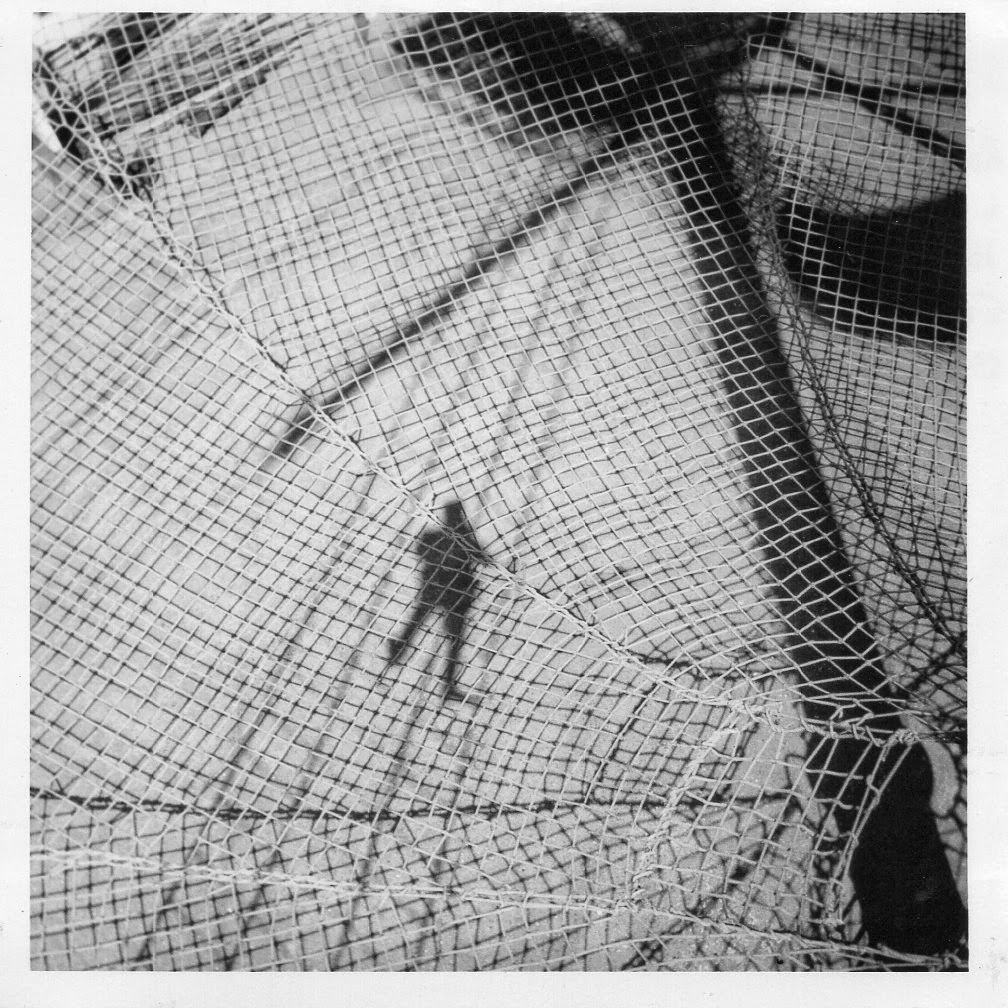
One Sunday afternoon, I approached the Officer of the Day of St Vincent and got permission to climb the mast at St Vincent to take photographs. I don’t know if anyone in civvies had ever done this before; he couldn’t see any regulations against it, so I started to climb the mast. Unlike the much younger recruits, who joined at HMS Ganges, Ipswich, I had never manned a mast. This was my first time. Close up, the ropes are quite thick. And, thankfully, firm, with only a slight bounce. I clung on and took my photos; I could only afford black and white film in those days.

My feet up the mast
 
Eventually, I climbed up to the crow’s nest. I wasn’t going to attempt the acme, the button, no, thanks. I did wonder if the net below would save me or make chips out of me...
In civvies up the mast
 
While there, I noticed a trainee in uniform climbing up. We got chatting; he couldn't understand why I'd willingly climb up, since I didn't have to. He was practising as he would soon have to man the mast with his mates. As it happened, he was a fellow Geordie. Small world.
Fellow Geordie up the mast
This is not the only occasion when I’ve met a Geordie in an unusual place – but that’s another tale.
-*-
*Geordie is someone who hails from the northeast of England, though purists might say Newcastle. In the wide world, northeast seems just fine to me!