Search This Blog

Sunday, 12 June 2022

THE LAST ONE LEFT - book review


It’s a long time since I read a John D. MacDonald novel. This one was first published in 1967; my edition is the 2014 Random House copy, recently purchased. Amusingly, MacDonald dedicated the novel ‘to Travis McGee who lent invaluable support and encouragement’.

It begins and also ends with the boating couple Howard and June Prowt off the Gold Coast off Florida. Anyone who has read MacDonald will be familiar with his knowledge of sailing craft, which shows in his description of both the vessel and the state of the sea. They thought they saw a boat adrift but were unable to go alongside and then it was gone.

Staniker has survived an explosion at sea; he’d been hired to captain the boat for the Kayd family. He’s the last one left, the rest of the passengers have perished. He is being nursed back to health.

Sam Boylston, a Texas lawyer, is mourning the death of his sister Leila – she was one of the passengers on the Kayd vessel.  Leila’s husband Jonathan was convinced she was alive and planned a hair-brained search for her in the vast ocean.

Chrissie Harkinson is pleased to bed the young boat boy Oliver for she has a use for him. She also knows Staniker so naturally she visits him, just to see how he’s doing…

And so begins a convoluted but easy to follow plot that is pure MacDonald. His descriptions of characters, minor and major, and the locales are spot on, as ever. Oh, yes, indeed, there’s certainly something not right. There’s the question of a considerable amount of cash involved which might be missing… There’s also a beautiful Cuban maid with an interesting back-story, and she is involved with Raoul Kelly, an investigative reporter.

The characters are set up, the plot is unfolding and it all falls into place. And as you’d expect with one of John D.’s mystery thrillers there are murders and betrayals.

Loved it. Good to reacquaint myself with you, John D. You might have died in 1986, aged seventy, but you still excite your readers three decades later.

Friday, 10 June 2022

SYMPATHY FOR THE DEVIL - Book review


The University: Book One by Terrence McCauley is like it says on the cover, a fast-paced thriller. Highly original too.

Way back in the early 1970s there was a sci-fi detective series called Probe starring Hugh O’Brian as agent Hugh Lockwood. The series concerns the so-called World Securities Corporation, a high-tech international private investigation company that employs field operatives—the elite of whom are aided by implanted audio receivers and who carry Scanners, tiny video camera/telemetry units which can be attached to tie clips or other jewellery. The most common method is to wear the Scanner on a ring, enabling it to be discreetly aimed. Two other agents Tony Franciosa and Doug McClure. They’re in constant contact with the probe technical staff. At the time I thought this was great stuff.

Now move to the present and we have an agency that is ten or even a hundred times better than depicted in Probe. The University is a non-government intelligence network. OMNI – the Optimized Mechanical and Network Integration protocol – was now far-reaching, thanks to advances in artificial intelligence and satellite assets.

Heading The University is the Dean.

One of the Office Heads is James Hicks; he’s ex-special services and knows how to handle himself. He has worked for the Dean for almost two years but had never met him.

Hicks has access to the OMNI satellite feeds, able to spy on and listen to suspects and enemies alike. And of course OMNI can perform instant translation of languages overheard. Omniscient, indeed.

Hicks also has access to all kinds of useful people, one of whom is Roger, who is a master at interrogation. Quite a chilling creation, is our Roger.

For this latest mission Hicks is thrown by the fact that an asset has seemingly been turned against the University. Many of the assets he recruited were unsavoury men and women, but they all had something in common: they could be useful when called upon for certain tasks required by The University. In fact, as Hicks observed, ‘They’d all done things that had opened themselves to University pressure and blackmail. Any dirt he had on them was their own fault. He’d sooner have sympathy for the devil himself than for any of his potential recruits’ (p8)

There is plenty of non-stop action throughout so that the 323 pages sped by. This could become an addictive series.

Although this is a contained story, it leaves the reader wanting more – and happily there is more. Book Two is A Murder of Crows. Two other books follow... so far.

Wednesday, 4 May 2022

Dead Burying the Dead Under a Quaking Aspen - book review


Screenwriting guides advocate “leave plenty of white space on the page”; effectively, “less is more”; or “give the reader/viewer space to visualize”. David Cranmer accomplishes that with this slim yet thoughtful and often poignant book of 29 poems. Indeed, his words “create fuel for the soul” – “The Need”. Herein you will find a “carefully crafted house of words” – “Daughter”.

The range of subject matter is considerable. From Haiti to Texas; from New York to the intergalactic void of space.

“The Inconsiderate” puts you into a grim gory scene laid out by the dreaded Tonton Macoute, for example.

Cranmer has the neat knack of sometimes deliberately forcing a space – a pause – in a line, mainly to make it more telling. Of course poetry is best appreciated when read – the listener gets the cadences, soaks up the emotion through the tone.

“reaching out to take my hand

asking to be   familiar again.” – “Cri de Coeur

Many of the poems feature death in all its guises. He quotes Martin Amis pointing out that “poetry alone… can face death on anything like equal terms.”

As Cranmer says in “Blue”:

“capturing the poetry of a slow death.”

There’s the unresolved murder of Hugh Chaffin, a man who loved gardening and was bound, gagged and bludgeoned to death; there’s the internationally abhorred murder and dismemberment of Jamal Khashoggi, journalist and a resident of Virginia.

So, yes, there’s anger here, too.

And there’s the poignant “On the Border” where the narrator is visiting his Mom in a hospice and is reminiscing about those times when they’d watched westerns on TV together. “Except in these rooms, Alzheimer’s is the ruthless gunslinger.” He swats a mosquito and feels like a “much-needed paladin” – a fine reference to Have Gun Will Travel.

Perhaps pride of place must go to “Under the Quaking Aspen” where a few moments spent with his daughter Ava prove almost ineffably tender. His wife Denise is not forgotten: for their daughter is “cut from a priceless diamond”.

A fine production that will bear re-reading.

Friday, 11 February 2022

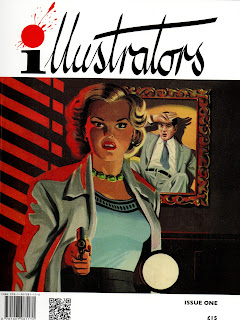
Illustrators Quarterly Magazine - #1


The ongoing series of quarterly perfect-bound full colour magazines began with this issue in 2012.

Anyone interested in illustrating art will cherish these magazines.

This issue features a lengthy article about Denis McLoughlin – 44 pages lavishly illustrated with his often gritty book covers. McLoughlin mainly concentrated on hard-boiled crime but also westerns, including the Buffalo Bill annuals I recall from my childhood. Indeed, McLoughlin, who hailed from Bolton, Lancashire, was so knowledgeable about the Old West that he produced The Encyclopedia of the Old West (original title Wild and Woolly) in 1975: a veritable mine of information!

There follows 22 pages of an interview with artist Ian Kennedy. Again, every page features samples of his comic illustrations and paintings, notably from the Commando comics that have been around since 1961. An outstanding artist, sadly missed (he died 5 February this year).

Next is a feature on the ‘Alluring Art of Angel Badia Camps’, one of a host of Spaniards who began plying their trade in Britain to good effect in the 1960s. We get fifteen pages of samples of his work from the covers of romantic fiction and women’s magazines; distinctive, atmospheric and colourful.

Two regular features are: The Gallery and The Studio. For the Gallery there are six pages of ‘the Fin de Siècle Erotica of Cheri Herouard’. He illustrated the covers of La Vie Parisienne, but also posters, postcards and menus. The Studio features Mick Brownfield’s iconic Christmas cover of the Radio Times in 2009 with Santa and a Dalek. The end pages consist of art-book reviews and contact details for art supplies, illustrators, museums and other related subjects.  

Copies of most back issues are still available, many at reduced prices.

It’s published by The Book Palace and can be obtained through their website www.illustratorsmag.com. Back issues can also be obtained from www.booksaboutart.co.uk.

The Book Palace also issues, from time to time, special issues on certain illustrators, and most of these are destined to become collectors’ pieces.

Tuesday, 8 February 2022

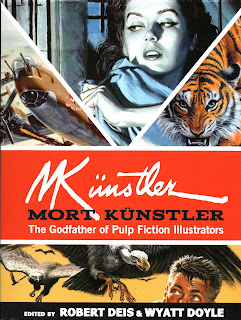
Mort Kunstler - The Godfather of Pulp Fiction Illustrators

Mort Künstler – The Godfather of Pulp Fiction Illustrators

Edited by Robert Deis & Wyatt Doyle


My daughter bought this for me for Christmas.

There are 110 pages; the first ten comprise illustrated text – reminiscences by Mort about how he got into the illustrating business. For many years he’d turn out three covers and two interior illos for men’s adventure magazines. He also worked for other publishers at the same time, ‘twelve-hour days, fifteen-hour days, sometimes seven days a week.’

The remaining pages are full colour full page paintings full of action from magazines between 1952 and 1972. He also produced lots of film posters for adventure films such as The Poseidon Adventure and The Hindenburg, as well as advertising promotions and then broke into historical paintings for The National Geographic.

He relates that the word 'künstler' means ‘artist’ in German.


If you appreciate art, this book is an excellent addition to your collection.

Monday, 7 February 2022

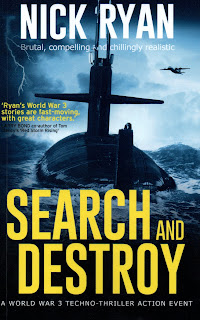
SEARCH AND DESTROY - Book review


Nick Ryan’s sixth book in his World War III techno-thriller series is gripping stuff. Where the earlier books relate to combat in Europe, this one concerns submarine warfare in the Pacific against China.

Commander Chris Coe is an old-school submariner and is abrasive with regard to his XO, Richard Wickham, so we have two types of conflict – personal and military.

The nuclear boat Oklahoma City is tasked with searching for a Chinese convoy and destroying it. The technical details seem authentic: the tension is raised as the vessels employ counter-measures, guile and gutsy experience.

Interestingly, Ryan’s website gives a blow-by-blow account of WWIII – without recourse to nuclear weapons! He must have been prescient, anticipating the January 2022 announcement from the five powers that they would not resort to nuclear weapons in any conflict!

The website is www.worldwar3timeline.com – and it makes fascinating reading. Gradually, he appears to be writing thrillers of similar length based on this timeline.

Let’s hope it all stays as fiction.

Editorial comment

Nothing that follows spoiled my enjoyment and appreciation of the book. However:

I bought the paperback so my comments relate to that; some of the comments won’t apply to the e-book version.

The cover is excellent. However, there’s no text on the spine. This mitigates buying/collecting any others in the series as they'll all be 'anonymous' on my bookshelves!

As this was published on Amazon, I must assume Mr Ryan is using Kindle Direct. Any book published in this system can have spine text if the page-count is in excess of 130. This book has 185 pages; so no excuse.

There are no page numbers! (I agree, this doesn’t matter for an e-book). The new KDP process requires creating an e-book first. But the text that is loaded can contain headers and footers, including page numbers; the second process is converting to a paperback where these features will show in the paperback. [Check out my book Mission: Khyber, a psychic spy novel in paperback and e-book, which shows how it can be done.]

Chapter headings are cramped and amateurish.

Typos listed below aren’t traceable by page number – see above!

‘dressed in hiv-viz colored vests’ should be ‘hi-viz’.

It may be different in the US Navy, but certainly in the Royal Navy, when referring to the 24-hour clock, only the number is used: 2300 – not ‘2300 hours’. The British army and air force use the suffix ‘hours’ however.

‘loosen the reigns’ – should be ‘reins’ [occurs more than once, I think]

‘computer-like monitor’ – surely it should simply be ‘monitor’?

‘carried a compliment of largely outdated torpedoes’ – should be ‘complement’ [this occurs twice]

‘sober expressions on his officer’s faces’ – this should be ‘expressions on his officers’ faces’ – there’s more than one officer so the apostrophe follows the ‘es’.

‘men poured over the imagery’ – should be ‘pored’.

‘Code strode into the wardroom’ – should be ‘Coe’.

‘tone was edge with frantic desperation’ – should be ‘edged’.

‘taut and nerve-wracking minutes’ – should be ‘nerve-racking’ (as if the nerves are on a rack; wrack is seaweed)